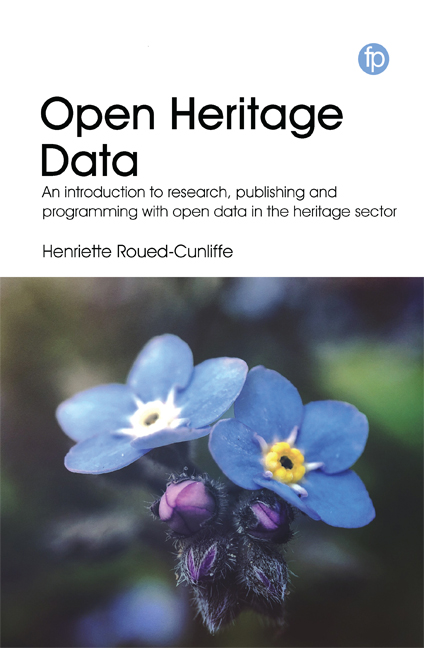
 Open Heritage Data
 An Introduction to Research, Publishing and Programming with Open Data in the Heritage Sector
Book contents
- Frontmatter
- Dedication
- Contents
- List of Case Studies, Figures and Tables
- List of Abbreviations
- Acknowledgements
- Preface
- Introduction
- 1 Openness in Heritage
- 2 Sharing Legally
- 3 Publishing Open Data
- 4 Using and Reusing Open Data
- 5 Visualising Open Data
- 6 Combining Open Data
- 7 Open Data for Research
- Appendix A Examples Used in the Book
- Appendix B Introduction to Coding
- References
- Index
4 - Using and Reusing Open Data
Published online by Cambridge University Press: 23 July 2020

Book contents
- Frontmatter
- Dedication
- Contents
- List of Case Studies, Figures and Tables
- List of Abbreviations
- Acknowledgements
- Preface
- Introduction
- 1 Openness in Heritage
- 2 Sharing Legally
- 3 Publishing Open Data
- 4 Using and Reusing Open Data
- 5 Visualising Open Data
- 6 Combining Open Data
- 7 Open Data for Research
- Appendix A Examples Used in the Book
- Appendix B Introduction to Coding
- References
- Index
Summary
Heritage is not static. It is continually developing and redeveloping, combining and splitting, alongside or together with current cultural trends. In essence this means that we are all using heritage and heritage material in our lives, whether through a modern Ikea table inspired by century-old designs or a family heirloom that we have painstakingly restored. We introduce our children to our own favourite childhood characters. We interpret current politics based on what we know and understand about the history of the world around us. Our heritage is with us in our daily lives and in our interactions with other people. It is all around us and can be tangible or intangible, or a combination of both. Heritage that is tangible is what we can see and touch. It is the type that is often displayed in museums or accessed in archives. Intangible heritage comes to light in songs, performances, oral stories, and is much more difficult to quantify. It is also present in datasets through transcriptions, recordings or videos, as well as maps and more. Intangible heritage can be recorded with technology and published as datasets that can be shared alongside tangible heritage datasets.
Nonetheless, we are not able to use heritage that we do not know about: heritage that is forgotten, or lost, or even just hidden in archives and in dusty lofts. The first requirement for heritage to be used and reused is for it to be available. The previous chapters have focused on making heritage available. This chapter will look at what is possible and what can happen when heritage and heritage material are made available in an open manner.
Readers can use this chapter as an inspirational catalogue that showcases different examples of use and reuse of heritage and heritage data.
Use and users
One of the first issues to tackle with heritage data use and reuse is that of the users themselves. Before any online publication of a heritage collection, it is vital to examine who the users could be and what uses they might have for the data. Terras (2015b) has examined the various ways that reuse of digitised heritage content has been studied through both qualitative and quantitative measures, and acknowledges the difficulty in doing so.
Information
- Type
- Chapter
- Information
- Open Heritage DataAn Introduction to Research, Publishing and Programming with Open Data in the Heritage Sector, pp. 57 - 74Publisher: FacetPrint publication year: 2019
Accessibility standard: Unknown
Why this information is here
This section outlines the accessibility features of this content - including support for screen readers, full keyboard navigation and high-contrast display options. This may not be relevant for you.Accessibility Information
Accessibility compliance for the PDF of this chapter is currently unknown
and may be updated in the future.
- 1
- Cited by