Meteorite researchers include astronomers, physicists, astrophysicists, planetary scientists, organic and inorganic chemists, materials scientists, metallurgists, and even some industrious collectors and dealers, but the largest cohort comprises geoscientists of various stripes (mainly petrologists, mineralogists, crystallographers, and geochemists). Nevertheless, most geoscientists are practical folk, working in the mining, petroleum, geological engineering, agricultural, meteorological, and environmental industries. According to the online recruitment services provider Zippia, only 6% work in education. And among university-level geo-educators, most have little experience with meteorites. The website of the geology department at the University of Illinois at Urbana-Champaign (where I took an introductory geology course) provides a list of faculty research areas: Earth Materials (Mineral Science), Sedimentary and Earth Surface Processes, Geobiology, Hydrogeology, Seismology, Geochemistry/Petrology, Geophysical Fluid Dynamics, Paleoclimate, and Tectonics/Structural Geology. Absent are any stated interests in meteoritics, cosmochemistry, or planetary science.
If they snag an interview, meteorite researchers applying for a job at such an institution may be asked about the relevance of their field. In such moments, there is no need for apprehension or reticence. As far back as 1858, the German chemist Karl Reichenbach noted that meteorites are simultaneously “cosmological, astronomical, physical, geological, chemical, mineralogical, and meteorological” objects (Burke, Reference Burke1986). Pejovic (Reference Pejovic1982) pointed out that meteorites are of special interest to chemists, metallurgists, nuclear physicists, biologists, and aerodynamicists.
And more than a century ago, Farrington (Reference Farrington1915) presented three cogent reasons that meteorites should be a topic of particular interest:
1. They are our only tangible sources of knowledge regarding the universe beyond us.
2. They are portions of extraterrestrial bodies.
3. They are a part of the economy of Nature.
These points are valid today, but with the advent of sample-return space missions, meteorites are no longer the sole source of tangible extraterrestrial material. Farrington’s list can be augmented. Here are 25 succinct modern reasons (cosmochemical, astrophysical, geological, anthropological, and sociological) why meteorite research is important and relevant:
1. Meteorites are our most abundant source of extraterrestrial material.
2. Meteorites formed under a wide range of redox conditions and contain many minerals not found on Earth.
3. The study of meteorites extends the range of known petrological and geochemical processes.
4. Meteorites serve as concrete examples of shock metamorphism of natural materials.
5. Many meteorites contain the most ancient examples of aqueous alteration of minerals that can be studied in the lab.
6. Meteorites are the building blocks of the planets.
7. The O-isotopic composition of the upper layers of Earth’s atmosphere can be measured by analyzing cosmic spherules.
8. CI carbonaceous chondrites provide the cosmic abundances of most elements (excluding noble gases and a few other elements).
9. Meteorites derive mainly from meter-to-decameter-sized bodies that were bombarded by cosmic rays in interplanetary space and thus can provide information about the interactions of cosmic rays with solid materials.
10. Meteorites likely delivered raw materials (e.g., water and organics from carbonaceous chondrites; phosphorus from irons) to the Early Earth, possibly helping to facilitate the origin of life.
11. Carbonaceous chondrites provide the most ancient organic compounds (including hundreds of amino acids) that can be studied in the lab.
12. Collisions of asteroids with the Earth changed the course of biological evolution.
13. Impact-crater formation by asteroidal collisions is the predominant geomorphological process in the Solar System.
14. The existence of iron meteorites supported the idea that the Earth has an iron core.
15. Iron meteorites provide otherwise inaccessible samples of planetesimal cores.
16. Meteorites provide clues to the geological history of asteroids.
17. Lunar meteorites come from the entire lunar globe, enhancing our understanding of the geology of the Moon.
18. Martian meteorites allow us to study the geological history of Mars.
19. Ancient refractory inclusions in chondritic meteorites yield the age of the Solar System.
20. Chondrules, which occur only in chondritic meteorites, were the most abundant discrete objects in the Solar System during the epoch when planetesimals accreted.
21. The relative numerical abundances of different varieties of meteorites reflect the relative sizes of parent bodies and source regions and the durability of meteoroids/meteorites in interplanetary space and the terrestrial environment.
22. Presolar grains in chondritic meteorites permit the in situ examination of materials from stars that existed long before the birth of the Solar System.
23. Meteorites were occasionally worshipped by ancient peoples.
24. For some technologically primitive peoples, iron meteorites served as the sole source of metallic iron for making tools.
25. Meteorite collecting and meteorite museums promote public appreciation of planetary science.
The components of primitive chondrites reveal vital information about the early Solar System. Unequilibrated, type-3 ordinary chondrites contain about 70–75 vol.% chondrules – the most abundant igneous objects formed in the solar nebula. The fine-grained matrix of these (and other) chondrites contains presolar grains, small particles that condensed in the atmospheres of dying stars. Also present in these meteorites are rare calcium-aluminum inclusions – the oldest objects formed in the Solar System. The differences among the H, L, and LL groups in metal abundance and metal composition provide evidence for chemical fractionations in the nebula.
A panoply of complex parent-body processes can be studied in the ordinary chondrites, including thermal metamorphism, shock metamorphism, and aqueous alteration. These processes may have operated in tandem (Lewis et al., Reference Lewis, Jones and Brearley2022) and caused fluid-assisted metamorphism, hydrothermal alteration, metasomatism during thermal metamorphism, shock-induced annealing, and shock heating of ice and mobilization of liquid water. Such processes could also have operated sequentially: for example, multiple shock events, post-shock annealing, post-shock alteration, and finally post-alteration annealing.
Some iron meteorites were formed from carbonaceous-chondrite-like parent asteroids, others from noncarbonaceous asteroids (e.g., Kruijer et al., Reference Kruijer, Burkhardt, Budde and Kleine2017a, Reference Kruijer, Kleine, Burkhardt and Budde2017b, Reference Kruijer, Burkhardt, Budde and Kleine2017c; Poole et al., Reference Poole, Rehkämper, Coles and Goldberg2017). But the only chondrite clan that can be tied specifically to iron meteorites is that of ordinary chondrites: IIE irons may be a fourth ordinary-chondrite group, more reduced than H (e.g., Bild and Wasson, Reference Bild and Wasson1977; Rubin, Reference Rubin2022a); IVA irons are related to L or LL chondrites (Clayton et al., Reference Clayton, Mayeda, Olsen and Prinz1983); and the Guin ungrouped iron is related to LL chondrites (Rubin et al., Reference Rubin, Jerde and Zong1986).
Ordinary chondrites have been bombarding the Earth throughout geological time. After the L-chondrite parent asteroid was disrupted by a massive collision ~470 Ma ago (Korochantseva et al., Reference Korochantseva, Trieloff and Lorenz2007), L-asteroid fragments were dispersed throughout the Inner Solar System (Schmitz et al., Reference Schmitz, Tassinari and Peucker-Ehrenbrink2001). Numerous L-chondrite samples from this event were recovered as fossil meteorites in a quarry of Ordovician limestone in Sweden (e.g., Thorslund and Wickman, Reference Thorslund and Wickman1981). The Lockne-Målingen doublet crater (7.5 km, 0.7 km) in Central Sweden formed 458 Ma ago; it may have been produced by a small L-chondrite asteroidal fragment derived from the L parent-body breakup.
Ordinary chondrites are still falling. In the five-year inclusive period of 2019–2023, 56 meteorite falls were recovered, analyzed, and approved (so far); as of this writing, an additional H-chondrite fall from France (on September 9, 2023) is going through the classification and approval process. Including this French fall, 46/57 (81%) are ordinary chondrites (22 H, 20 L, 1 L/LL, 3 LL). The other falls include six carbonaceous chondrites, one enstatite chondrite, two HEDs, and two aubrites.
Most terrestrial impact craters with accompanying meteorites are associated with irons.Footnote 1
The most famous example is Meteor Crater, Arizona and the Canyon Diablo IAB iron. Three craters have yielded intact ordinary-chondrite fragments: (1) A 25-cm, ~750-g, LL6 chondrite breccia (Morokweng) was found within the 145-Ma-old, ~70-km-wide Morokweng crater in South Africa (Maier et al., Reference Maier, Andreoli and McDonald2006). (2) A 900-kg H5 chondrite (Kunya-Urgench) was recovered from a 6-m-wide, 4-m-deep crater (or impact pit) after a large mass crashed in Turkmenistan at 5:25 PM local time on June 20, 1998 (Alexeev et al., Reference Alexeev, Gorin, Ivliev, Kashkarov and Ustinova2001). An additional 100–200 kg of material was later retrieved. (3) A 342-g H4-5 chondrite (Carancas) was recovered from the ~14-m-wide Carancas crater in Peru (Kenkmann et al., Reference Kenkmann, Artemieva and Wünnemann2009). The collision that produced this crater occurred at 11:45 AM local time on September 15, 2007. Carancas is the youngest known impact crater on Earth. (There is a younger and far smaller circular depression [7 cm wide, 3 cm deep] dubbed a “crater” – with the requisite quotation marks – by Bartoschewitz et al. [Reference Bartoschewitz, Appel and Barrat2017]. It occurs within a pebble-concrete step in front of a house in Braunschweig-Melverode, Germany. The crater, which has an ejecta blanket and prominent rays, formed at 2:07 AM local time on April 23, 2013. Straddling the crater is the 214-g main mass of the Braunschweig L6 chondrite. The meteorite shattered into hundreds of pieces upon impact; a total mass of 1.3 kg was recovered.)
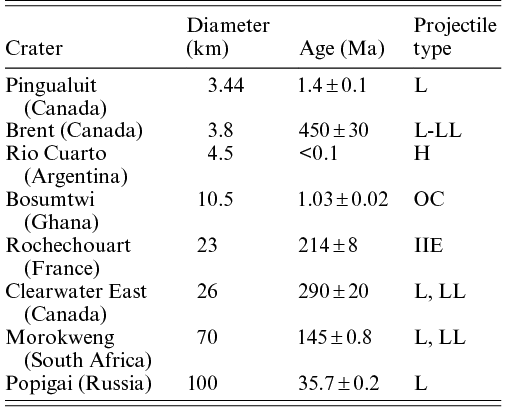
Toward the other end of the size scale is the ~100-km-diameter Popigai impact crater in Northern Siberia. Analysis of Pt-group elements in samples of impact melt from the crater indicate a meteoritic contaminant of ~0.2 wt.% (Tagle and Claeys, Reference Tagle and Claeys2005). The Ru/Rh, Pt/Pd and Pd/Ir ratios of the impact melt show the contaminant to be an ordinary chondrite, probably L. This finding is in accord with ordinary chondrites’ having made up a large fraction of the impactors that created >1.5-km-diameter craters since the beginning of the Cambrian Period 538.8 Ma ago (McDonald et al., Reference McDonald, Andreoli, Hart and Tredoux2001; McDonald, Reference McDonald2002) (Table I.1). These bodies would likely be S-type asteroids in Earth-crossing orbits.
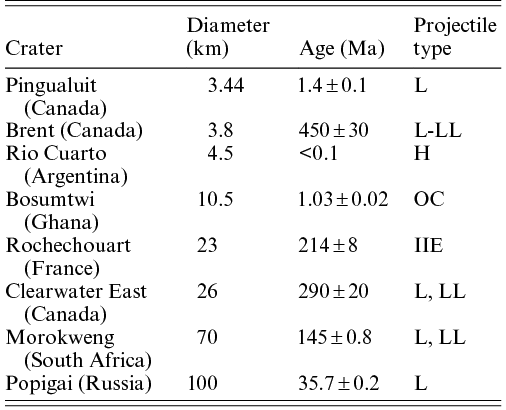
Pingualuit is from the Inuit word for “pimple.” This impact structure was previously called Chubb Crater and New Quebec Crater.
In his 1923 collection of New Hampshire poems, Robert Frost included “A Star in a Stoneboat” (the “star” being a meteorite and the stoneboat being a handcart used for hauling stones). The first stanza reads:
Although Frost lacked firsthand knowledge, he appeared certain that farmers must have encountered meteorites as they cleared their fields and stacked the meteorites along with terrestrial rocks to build stone walls at the borders of their property. An approximation of this scenario came to pass with an ordinary chondrite in 1996, when a farmer found the 22-kg main mass (plus 11 smaller pieces) of Korra Korrabes (H3) in a dry riverbed in Namaland, Namibia. Eventually 120–140 kg of the meteorite were collected with the aid of metal detectors. The main mass was placed in a garden wall. Other ordinary chondrites have been identified in rock gardens – Clifford (L6), 11.36 kg; and Kramer Creek (L4), 2.30 kg (as enthusiastically reported by Schmidt, Reference Schmidt1973). An ordinary chondrite that may have been retrieved from a rock garden is Roosevelt County 075 (H3.10; 258 g), one of the least equilibrated H chondrites known. It was found on the concrete driveway of a home near Portales, New Mexico after a rock fight the night before (McCoy et al., Reference McCoy, Keil and Ash1993).
The first meteorite discovered by the indefatigable Harvey Nininger in a region not previously known to harbor meteorites was an ordinary chondrite. On the evening of May 17, 1944, Nininger had stopped for lunch along U.S. Highway 85 in Socorro County, New Mexico when he spotted a small, dark, 7.673-g pebble. Closer inspection revealed it to be a meteorite – the Puente-Ladron L6 chondrite (Nininger, Reference Nininger1944). The only other previously unknown meteorite discovered by Nininger himself is also an ordinary chondrite: in 1955 he spied the 800-g cucumber-shaped Cottonwood H5 chondrite residing in a rock-strewn field in Yavapai County, Arizona (Nininger, Reference Nininger1972). Through his meteorite hunting, trading, and extensive public outreach, Nininger had assembled one of the largest meteorite collections in the world by 1946. It contained an unprecedented proportion of finds and included many ordinary chondrites.
Ordinary chondrites span the Earth: from north to south – Greenland (L6 Ella Island; L5 Ryder Gletcher) and Norway (e.g., H3-6 Oslo; L/LL6 Trysil) to Antarctica (e.g., L5 Adelie Land; LL6 Yamato 003259); from east to west – Japan (e.g., L5 Fukutomi; H4/5 Yonozu) to Alaska (LL6 Hope Creek); from A to Z – Afghanistan (L6 Kandahar) to Zimbabwe (e.g., H3-5 Magombedze; L6 Nkayi); from large countries to small ones – Russia (e.g., LL5 Chelyabinsk; H3.8 Raguli) to Mauritius (LL5-6 Mauritius); and from urban areas to rural ones – cities (e.g., H6 Peekskill; H5 New Orleans) to the Australian outback (e.g., L4 Biduna Blowhole 001; H5 Murrili). There is even one ordinary chondrite from the United States in my very small personal collection (L4 Gold Basin).
Although they commonly elude mention in geology or astronomy textbooks, more than 65,000 ordinary chondrites have currently been classified. Thousands more have been recovered and await classification. Despite their relative abundance, ordinary chondrites are extraordinary objects.
Let’s learn about them.