Book contents
- Frontmatter
- Contents
- Preface
- Chronological Outline
- 1 Introduction
- 2 Beginnings in Cambridge
- 3 Newton states his claim: 1685
- 4 Leibniz encounters Newton: 1672–1676
- 5 The emergence of the calculus: 1677–1699
- 6 The outbreak: 1693–1700
- 7 Open warfare: 1700–1710
- 8 The philosophical debate
- 9 Thrust and parry: 1710–1713
- 10 The dogs of war: 1713–1715
- 11 War beyond death: 1715–1722
- Appendix: Newton's “Account of the Book entituled Commercium Epistolicum”
- Notes
- Index
Book contents
- Frontmatter
- Contents
- Preface
- Chronological Outline
- 1 Introduction
- 2 Beginnings in Cambridge
- 3 Newton states his claim: 1685
- 4 Leibniz encounters Newton: 1672–1676
- 5 The emergence of the calculus: 1677–1699
- 6 The outbreak: 1693–1700
- 7 Open warfare: 1700–1710
- 8 The philosophical debate
- 9 Thrust and parry: 1710–1713
- 10 The dogs of war: 1713–1715
- 11 War beyond death: 1715–1722
- Appendix: Newton's “Account of the Book entituled Commercium Epistolicum”
- Notes
- Index
Summary
I became interested in the theme of this book while editing Newton's correspondence during the years of his controversy with Leibniz and Leibniz's supporters. Although the outline of its story has often been told, the great richness of materials bearing upon it that has appeared during recent years made a more detailed study seem worthwhile, and more than one scholar has asked that it should be made. Moreover, a historian of today can approach the calculus dispute with a more detached perspective than his Victorian predecessors could do. He will not be shocked to discover that even Leibniz and Newton could display human faults. Again, the historian who (like myself) has no intention of investigating in technical detail the origins, development, and applications of calculus methods in mathematics can safely rely on modern work devoted to precisely these questions. Although he will not overlook his debt to the pioneers, notably C. I. Gerhardt, he must be particularly grateful for the interpretations and especially the documentation provided by J. E. Hofmann, H. W. Turnbull, and D. T. Whiteside, not to mention other equally reliable scholars who have examined the lesser mathematicians contemporary with Leibniz, James Gregory, and Newton.
Information
- Type
- Chapter
- Information
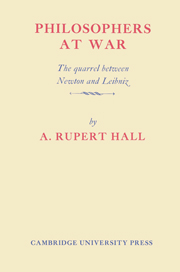
- Philosophers at WarThe Quarrel between Newton and Leibniz, pp. 1 - 9Publisher: Cambridge University PressPrint publication year: 1980
Accessibility standard: Unknown
Why this information is here
This section outlines the accessibility features of this content - including support for screen readers, full keyboard navigation and high-contrast display options. This may not be relevant for you.Accessibility Information
Accessibility compliance for the PDF of this book is currently unknown
and may be updated in the future.