Book contents
- Frontmatter
- Contents
- Acknowledgments
- Prologue
- Part I Pattern recognition
- Introduction
- 1 The centric representation
- 2 The fundamental theorem and its applications
- 3 Hierarchical control in phyllotaxis
- 4 Allometry–type model in phyllotaxis
- 5 Practical pattern recognition
- Epilogue
- Part II Pattern generation: a key to the puzzles
- Part III Origins of phyllotactic patterns
- Part IV Complements
- Appendixes
- Bibliography
- Author index
- Subject index
1 - The centric representation
Published online by Cambridge University Press: 27 April 2010

Book contents
- Frontmatter
- Contents
- Acknowledgments
- Prologue
- Part I Pattern recognition
- Introduction
- 1 The centric representation
- 2 The fundamental theorem and its applications
- 3 Hierarchical control in phyllotaxis
- 4 Allometry–type model in phyllotaxis
- 5 Practical pattern recognition
- Epilogue
- Part II Pattern generation: a key to the puzzles
- Part III Origins of phyllotactic patterns
- Part IV Complements
- Appendixes
- Bibliography
- Author index
- Subject index
Summary
Parastichy pairs (m, n)
Patterns in plants
Pattern formation in organisms is one of the commonest phenomena observed in nature. Virtually all animals and plants possess symmetries that result in pattern formation. Most animals seem to be bilaterally symmetrical; others show radial symmetry. For a whole plant, radial symmetry is more common, while such plant organs as leaves usually exhibit bilateral symmetry. Such symmetrical morphologies are perceived as patterns and are usually regarded as being attractive or beautiful. These patterns appear in many ways in plants: in the arrangements of leaves or branches on the stem, in the venation of leaves, and particularly in flowers with their patterns of shapes and colors. Of course humans are not the only ones to appreciate such patterns; pollinating insects are also attracted to flowers by this means.
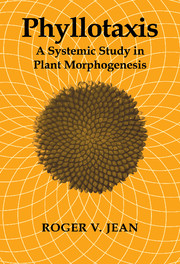
In spite of the overwhelming diversity of plant architecture, there are common patterns that link a wide range of species. These patterns can be seen macroscopically, as when viewing shoot tips or adult plants from above, and microscopically (using scanning electron micrographs), at an early stage of development, in sectioned or in dissected shoot apices. An outstanding example of such patterns is the spiral arrangement of florets in the capituli of sunflowers and daisies.
This book is not concerned with all types of patterns.
Information
- Type
- Chapter
- Information
- PhyllotaxisA Systemic Study in Plant Morphogenesis, pp. 11 - 30Publisher: Cambridge University PressPrint publication year: 1994
Accessibility standard: Unknown
Why this information is here
This section outlines the accessibility features of this content - including support for screen readers, full keyboard navigation and high-contrast display options. This may not be relevant for you.Accessibility Information
Accessibility compliance for the PDF of this chapter is currently unknown
and may be updated in the future.