Book contents
- Frontmatter
- Contents
- Acknowledgments
- Prologue
- Part I Pattern recognition
- Introduction
- 1 The centric representation
- 2 The fundamental theorem and its applications
- 3 Hierarchical control in phyllotaxis
- 4 Allometry–type model in phyllotaxis
- 5 Practical pattern recognition
- Epilogue
- Part II Pattern generation: a key to the puzzles
- Part III Origins of phyllotactic patterns
- Part IV Complements
- Appendixes
- Bibliography
- Author index
- Subject index
Introduction
Published online by Cambridge University Press: 27 April 2010

Book contents
- Frontmatter
- Contents
- Acknowledgments
- Prologue
- Part I Pattern recognition
- Introduction
- 1 The centric representation
- 2 The fundamental theorem and its applications
- 3 Hierarchical control in phyllotaxis
- 4 Allometry–type model in phyllotaxis
- 5 Practical pattern recognition
- Epilogue
- Part II Pattern generation: a key to the puzzles
- Part III Origins of phyllotactic patterns
- Part IV Complements
- Appendixes
- Bibliography
- Author index
- Subject index
Summary
Behind the untold diversity of plant architecture we can find mathematical constants – many great minds such as Goethe and Leonardo da Vinci were aware of that. It was however only in the first half of the nineteenth century that naturalists developed coherent accounts of phyllotaxis. In the 1830s the brothers L. and A. Bravais presented the first mathematical treatment of the phenomenon, which is known today as the cylindrical representation of phyllotaxis (introduced in Chapter 2). The centric representation of phyllotaxis used later by Church and Richards, also known as the spiral lattice, is dealt with in Chapters 1 and 2.
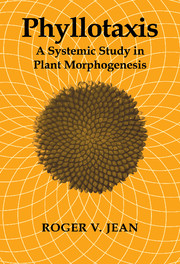
Chapter 1 gives an elementary description of phyllotaxis. The reader will learn to recognize phyllotactic patterns; he will be introduced to the terminology, parameters, and concepts used for their description. Among the concepts we find the divergence angle d, the parastichy pair (m,n), and the plastochrone ratio R. This chapter gives a geometrical description of the spiral pattern of florets or seeds in the sunflower head and of the cross section of terminal buds under the microscope. The theorem of Chapter 2, which is called here the fundamental theorem of phyllotaxis, relating d and (m,n), will be given particular formulations and many applications. Among the applications we find the interpretation of a type of puzzling pattern known as spiromonostichy observed in Costus (Chapter 2) and the study of proteins (Chapter 10). This theorem gives an interesting insight into the historical development of phyllotaxis (Chapter 2).
Information
- Type
- Chapter
- Information
- PhyllotaxisA Systemic Study in Plant Morphogenesis, pp. 9 - 10Publisher: Cambridge University PressPrint publication year: 1994
Accessibility standard: Unknown
Why this information is here
This section outlines the accessibility features of this content - including support for screen readers, full keyboard navigation and high-contrast display options. This may not be relevant for you.Accessibility Information
Accessibility compliance for the PDF of this chapter is currently unknown
and may be updated in the future.