


2 Interrogative intimations: On a possible social economics of interrogatives
2.1 Introduction
One of the deep puzzles of human evolution concerns the very special course of events that would have allowed the evolution of cooperation, with unparalleled altruism in the natural world. One of the arenas in which we see such altruism repetitively displayed is in everyday interaction, in which information appears freely exchanged, people help each other with directions, make room for each other, go to efforts to greet and part amicably and so forth – all deeply puzzling to the evolutionarily informed observer (Sperber et al. Reference Sperber, Clément, Heintz, Mascaro, Mercier, Origgi and Wilson2010). Much pragmatic theory has been built on the predictions that can be derived from a presumption of cooperation in conversation (Grice Reference Grice, Cole and Morgan1975, Levinson Reference Levinson2000). Similarly, Goffman noted that many small exchanges of information and petty services are seen as “free goods” to be freely requested and exchanged, whether it is a request for a cigarette, a route direction or help with berthing a heavy bag in public transport.
Close observers of human interaction see something different. They notice that beneath the surface of genial interaction there is a micropolitics of constant subtle adjustments of relative position to other participants (Labov and Fanshel Reference Labov and Fanshel1977), claims to expertise (Heritage and Raymond Reference Heritage and Raymond2005), stance and evaluation of events and so forth. Under the rubric of “epistemics”, conversational analysts have noted that the source of information, the degree of expertise about the relevant domain, and so forth is carefully tracked (Heritage 2012) – facts independently evident from the proliferation of grammatical markers of evidentiality and merativity (Aikhenvald Reference Aikhenvald2004).
These observations challenge the view that conversation falls wholly under the “free goods” rubric, exhibiting boundless altruism in the exchange of information. Instead they raise the question whether there might not be a highly structured economy of information within which careful accounting records are maintained. It has long been noted (Sacks Reference Sacks and Jefferson1992) that we do in fact keep careful mental records of to whom we have told what to – essential not only to avoid being cast as the party bore repeating the same jokes, but also so that, for example, after a death or other misfortune exactly the right people are told in the right order.
In this chapter, I explore the possible ramifications of such an accounting system in the domain of questions. The ideas being explored suggest a kind of primitive economy of information – “primitive” because, as long noted in the anthropology of exchange systems, “primitive” money has both an economic and social evaluation. For example, the shell money system of Rossel Island has both purchase power and the prestige and appeasement value associated with honours: when you buy a wife, or pay off a social delict, you compensate the sellers not only with cash but with medals and insignia, as it were. More later.
Like all economic speculation, the ideas here come with a government warning: they may be a bubble, and they may yield little or no return. But let us entertain them and see. First, however, some relevant properties of interrogatives and questions will be reviewed in sections 2.2 and 2.3, in preparation for the economic model to be developed in later sections.
2.2 Some typological properties of interrogatives
There is a long tradition in philosophy and linguistics of treating interrogative sentences as encoding a “mood”, contrasting with declarative and imperative marking. The old view is that the mood marks desire to know; the “speech acts” view (after Austin and Searle) is that the special morphosyntax of interrogatives is an “Illocutionary Force Indicating Device” (or IFID), indicating special satisfaction conditions in contrast to truth-conditions. The problem with the IFID view is that it is predicated on a close relation between form and function, but as work on “indirect speech acts” already made clear in the 1970s there is no 1:1 or even 1:few relation between form and function (see Levinson Reference Levinson1983 for a review). Interrogatives turn out to be workhorses in the functional arena: they are routinely used to do introductions (“How do you do?”), repair (“He said what?”), suggestions (“Why don’t we get a coffee?”), requests (“Would you mind taking this?”), statements (“Well, what damn fool would trust a bank with their money?”), reprimands (“Who do you think you are?”), etc. A reasonable response to these difficulties has been to revert to the pre-speech acts idea, that moods have some semantically general semantics, and their deployment for speech acts belongs to a separate pragmatic realm where their semantics will be exploited for multiple purposes at hand (Bierwisch Reference Bierwisch, Searle, Kiefer and Bierwisch1980). There are problems with that position too, namely that there are many details of morphosyntax and lexicon that get deployed to mark function much more exactly, so that the relations between form and function – viewed in a broader construction grammar perspective – are too close to the core of language structure to be relegated entirely to a theory of language usage.
Remaining agnostic on these issues for the moment, let us just review what is known about interrogative marking cross-linguistically. First, there appears to be a strong conditional universal in this domain: For all languages that have clear interrogative markers, they mark yes-no questions (or polar questions) differently from Wh-questions (or content questions). Note this does not rule out having a form of marking that is shared across both polar and content questions (e.g. Hai//om marks both types by deleting the declarative marker, although it goes on to distinguish different kinds of Wh-word; Hoymann Reference Hoymann2010).
Turning first to polar questions, about a fifth of the world’s languages have no distinctive morphosyntactic marking that singles these out as distinct from declaratives (Dryer Reference Dryer, Haspelmat, Dryer, Gil and Comrie2008). Grammars mostly say that in these cases questions are marked intonationally with rising intonation. However, every corpus study ever done on such languages, or on languages like English that use declaratives as polar questions most of the time, has falsified this. The interpretative procedures are actually likely to be pragmatic (see below). The rest (c. 80%) of the world’s languages mark their polar questions either on the verb (c. 20%) or by a particle (c. 60%) (Dryer Reference Dryer, Haspelmat, Dryer, Gil and Comrie2008). The particle type allows a large range of variants, each with subtly differing degrees of questionhood on a cline from assertion to full information question. Incidentally, note that polar questions are often called yes-no questions, on the assumption that all languages preferentially use particles of this sort as answers – however, it is well known that some languages (e.g., Tzeltal) prefer a repetition strategy (see Brown Reference Brown2010).
Content (or Wh-) questions would, one might think, have to be unambiguously marked by a Wh-word. However, this is not necessarily the case: many languages (number not known, but this is a common South-east Asian type) use indefinite quantifiers (‘someone’, ‘something’, etc.) as Wh-words (see, e.g., Enfield Reference Enfield2010 on Lao). This seems quite natural: if I say to you “Someone came?”, it is clear that I would like to know who. More abstractly, both Wh-questions and indefinite quantifiers have a variable that might usefully be filled. For languages with clear Wh-words, a number of cross-linguistic predictions have been made. First, there is at least a tendency for languages to follow an implicational hierarchy of the following kind where “pro-X” is a special Wh-proform:
pro-verb > pro-numeral > pro-adjective > pro-adverb > pro-noun
(see Konstanz Universals Archive, Universal 1699). Here within a single language the existence of an item on the left implies that all items to its right also exist in the language. So if a language has a ‘which’ it has a ‘when’ or ‘why’ (or other adverb) and a ‘what’. Second, Wh-words for ‘who’, ‘what’, and ‘which’ are much more likely to be underived than ‘why’, ‘how’, ‘where’, ‘when’, etc., which can be expressed as ‘for which reason’, etc. (see Cysouw Reference Cysouw2004, Mackenzie Reference Mackenzie2009). Note that it is perfectly possible for a language to have just one (Zeshan 2003) or two Wh-forms (Cysouw Reference Cysouw2007, Mackenzie Reference Mackenzie2009).
The movement of Wh-words to initial position as in English was inspirational to a generation of generative grammarians, who saw there a parallel to quantifier binding in logical representations and found that much other movement could then be explicated. It is instructive therefore to bear in mind that only a third of languages actually move their Wh-words to initial position, most leaving them in situ much as in English echo questions like “John did what?” (see Dryer Reference Dryer, Haspelmat, Dryer, Gil and Comrie2008). The only generalization easy to make is that languages rarely move their Wh-words to final position, although at least one sign language is known to do so (Indo-Pakistani sign; Zeshan Reference Zeshan2003).
This brief typological excursus will suffice for current purposes. The main lessons to take away are that not all languages make a sharp formal distinction between declaratives and interrogatives: languages may lack polar question morphosyntax, they may offer degrees of interrogativity between declarative and interrogative, and they may formally assimilate Wh-interrogatives to indefinite quantificational structures that are declarative in form.
2.3 Questionhood
We turn now to the functional side, and enquire what makes a question? The standard speech act line (Searle Reference Searle1969) defines a question in terms of the conditions that would collectively make an utterance succeed in questioning:
(1) Felicity conditions on questioning
1. Essential condition: the utterance counts as an attempt to elicit the information specified in the propositional content.
2. Preparatory conditions:
a. the speaker does not know the information requested
b. it is not obvious that the addressee will provide the information spontaneously.
3. Sincerity condition: the speaker wants the information requested. (after Searle Reference Searle1969)
It is well known that there are cases where each of these conditions fails. If I ask an errant kid “Why did you throw a baseball through my window?”, I am not trying to elicit information (cf. 1. above). Similarly, if I wonder aloud “What was that noise?”, my main intent may be to draw attention to the noise. And there are numerous conditions under which the speaker does not want to know the answer (3. above), either because he is simply checking that the addressee knows it (exam questions, contrary to 2a.), or because he is going through the polite motions (“How are you?”).
More generally, the conditions are too strong for the most common uses of questions. Corpus studies show that one of the main uses of interrogatives is to initiate repair of the prior utterance (“What?”, “He did what?”), thus requesting a re-enactment or a rephrasing of the prior utterance. A second highly frequent use is to request confirmation, where the speaker is pretty sure that he knows the information, or even knows it full well but wants it repeated for a third party. A comparative study of ten languages shows that on average some 13% of interrogatives and/or questions function as repair initiators, and some 30% are confirmation requests or checks on understanding, which, together with many other uses such as requests, suggestions and the like, leaves only 35% being serious information requests (data extracted from the usage studies in Enfield et al. Reference Enfield2010).
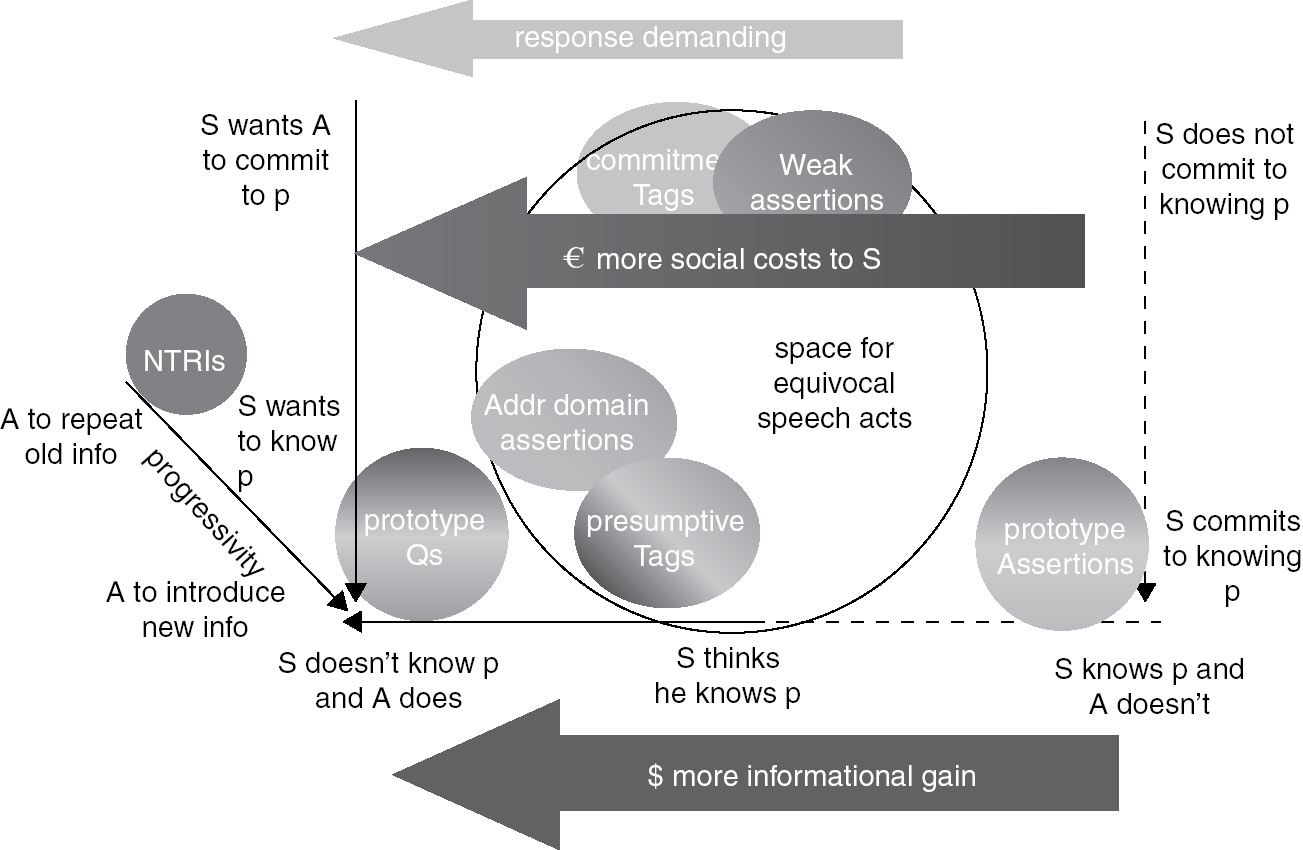
So what is a question? There are empirical reasons to think that some aspects of the Searlian account are correct. Gordon and Lakoff (Reference Gordon and Lakoff1971) were the first to note that the “felicity conditions” in (1) form one basis for “indirect speech acts”: stating or questioning one of these conditions can, under the right circumstances, instantiate a question (e.g., “I don’t know whether John is coming”, or “I’d like to know if John is coming” or “Do you know if John is coming?”). On the other hand, the corpus statistics just mentioned suggest something more like a prototype category, with possible degrees of questionhood in different dimensions. One way to capture both observations is to imagine a question function “space” which has as two of its axes the crucial felicity conditions, namely 2b. and 3. in (1) above). A third axis seems required to separate the repair and confirmation functions, which can be thought of as an axis concerned with the checking on previously introduced material vs. the introduction of new material (which a full-blooded information question is after). That yields something like Figure 2.1. Notice that the familiar felicity conditions now lie at only one end of variable axes, for example the degree to which the speaker thinks the addressee knows the information vs. the degree to which the speaker already knows it (preparatory condition parameter), and the degree to which the speaker actually wants the information vs. the degree to which he merely wants the addressee to commit to believing it. Quite likely, the space is more multidimensional than this, but this gives us a useful first approximation, separating out different functions of questions as sketched in the figure.
A further useful observation can be incorporated with a slight extension of the space. Consider Bolinger’s Reference Bolinger1977 observation that there exists a “squish” or cline from questions through to assertions, as in (2):1
(2) Bolinger’s question-to-assertion cline
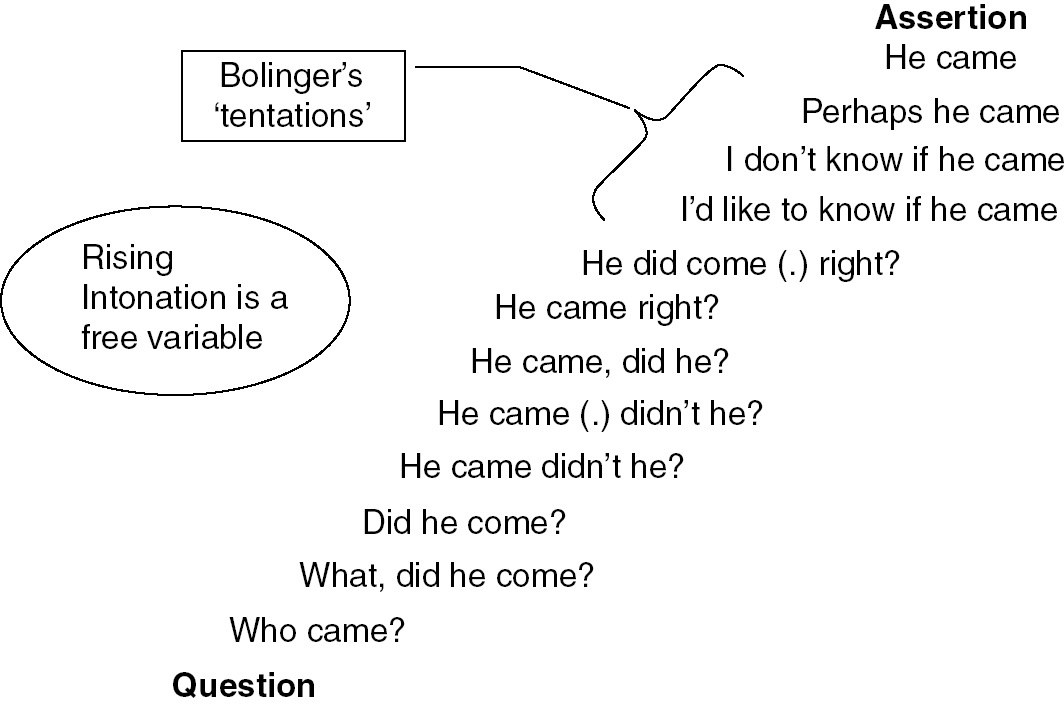
Note that a range of lexical, grammatical and prosodic resources (modal adverbs, tags of different kinds, intonation) allow a speaker to locate an utterance at different points on this cline. If this is correct, then we should elaborate the question space more along the lines in Figure 2.1, which incorporates a cline towards assertionhood. Here an utterance like “He went, did he” may (depending a bit on prosody) lie midway between question and assertion, while a weak assertion like “Maybe he went” lies close to “He went, right?”. I will assume that some such picture is roughly right, although exactly how the parameters of the space should be thought about clearly needs elaboration.

Figure 2.1 The question function space.
One of the most prominent differences between questions and assertions is the obligation to respond. In the case of questions the obligation is strong enough that failure to respond is likely to be understood as a negative answer by the questioner:
(3)
| Caller: So I was wondering would you be in your office on Monday (.) by any chance? (1.0 second silence) probably not. (from Levinson Reference Levinson1983) |
This response obligation, not unique to questions but nevertheless a prime characteristic of them, has been characterized in terms of “adjacency pairs” (Schegloff Reference Schegloff2007), wherein there is a strong expectation that a typed first part will be met by its matching second part (as also in greetings, offers and the like). The coerciveness may also be understood as lying on a cline as sketched in Figure 2.2 (see Stivers and Rossano 2010 for further observations), although this suggestion has proved controversial. Regardless of that, the coercion is likely to come at a cost, as noted for example with requests (Brown and Levinson Reference Brown and Levinson1987), because it puts the addressee on the spot – he or she has to respond; further, asking a question is a confession of ignorance, as every student knows.

Figure 2.2 The question- and assertion-function space.
Finally, something should be said about the syntactic and semantic “glue” across question-answer pairs. First, questions focalize specific linguistic categories (“Who came?” makes the NP slot focal), and for this reason the analysis of information structure in text has often employed an implicit question paradigm (for a recent version see, e.g., Beaver and Clark Reference Beaver and Clark2008). This then predicts prosodic highlighting and ellipsis (“Herb” or “Hérb came” will be fine answers). In languages with case structure, ellipsis is especially interesting, as in German where the elliptical phrase carries the case marking that it would have had in the full sentence:
Second, the syntactic structure of questions often “primes” the structure of the answers, so that one finds the structure of the question mirrored in the answer (Levelt and Kelter Reference Levelt and Kelter1982):
(5)
| A: When do you close? | A: At what time do you close? |
| B: 5.00 o’clock. | B: At 5.00 o’clock. |
The semantics of questions has puzzled theorists for generations. Do they, contrary to Austin, have a truth-conditional valuation, and if not, how is the propositional content to be characterized? The formal solution has been to think of the semantics of an interrogative in terms of the set of its possible answers – the intension of an interrogative would then be the set of propositions that might answer it (Hamblin Reference Hamblin1958). It follows from this that a Wh-question like “Who came?” entails a yes-no question like “Did Herb come?” (providing Herb is in the domain of discourse), because the Wh-question ranges over a superset of possible answers that includes the set of possible answers to the yes-no question (Groenendijk and Stokhof Reference Groenendijk, Stokhof, van Benthem and ter Meulen1997). This result is intuitive: in some sense to ask a Wh-question is to ask more (or presuppose less), because it does not narrow the range of questionables in the same way that a yes-no question does – an intuition we will make use of below.
Semantic theory moved into a distinctively new turn around 1980 with the introduction of dynamic models of information flow (as in, e.g., Hamblin Reference Hamblin1971, Stalnaker Reference Stalnaker and Cole1978, Kamp Reference Kamp, Groenendijk, Janssen and Stokhof1981). Most of these models assumed a pool of shared information or “common ground” and asked how specific linguistic structures encoded instructions about how to update this common ground (see van Eijck and Visser Reference van Eijck, Visser and Zalta2010). Meaning then can be equated with contextual change. An assertion, for example, might encode presuppositions that should already be in the common ground, while having new asserted content that should be added to it. Questions partition information states and their answers eliminate some of these partitions (Groenendijk Reference Groenendijk, Hulstijn and Nijholt1998), so updating common ground. One of the problems these models share is that no account of disagreement or disbelief is allowed for, and this will prove critical for what follows, where we will abandon such simple models for an alternative where individual commitments are publicly registered or audited as it were.
We now have in place the background to an exploration of the economy of question asking.
2.4 On the primitive economy of information in conversation
Have you ever hesitated to ask a question? Perhaps you feared it might be foolish. Or it might be too near the bone, too probing. Perhaps it might cause offence. Or it might open up a can of worms: things one would rather not hear. Or it might distract us from the business at hand and lead to other things. Or it might open you up to the reciprocal question, which you would not want to answer. Introspection suggests a plethora of reasons for suppressing questions that might arise in one’s mind. Then there is the curious phenomenon of going to the doctor, the mechanic, the friend’s home, the interview, intending to ask such and such, and finding oneself coming away with that damn question unasked. Perhaps there is no general phenomenon here, just a collection of distinct reasons for frustrated interrogative ambitions. But then, again, there just might be something systematic, some kind of social or economic inhibition: perhaps just like one cannot afford all the shoes one might like, so perhaps one cannot ask all the questions one might entertain.
An economic model of social information transfer is not going to look like a modern market economy. It might perhaps have some passing resemblance to the “primitive” economics of pre-industrial societies, with multiple measures for specific goods (bushels and grosses, cords and cubits), and multiple barter and exchange systems. Take the so-called shell money system of Rossel Island (Liep Reference Liep2009), which consists of twenty-odd denominations of shells, with no exact equivalences of value and a delimited arena in which they can be used – it offers only the faintest semblance of a market economy (the shells are usable, e.g., for bride price, the purchase of pigs, houses and canoes, but not for food or manual labour). Shells are stores not only of economic but of social value, and top shells have names, like the Koh-i-noor diamond. Gaining possession of an individually named shell is like being temporary owner of a Picasso: it is an individual, not a mass of multiple undifferentiated tokens, and it reflects glory on its owner. Large injustices and delicts can be atoned for by the assuaging properties of such shells, even if only on loan for a fortnight. Shells go in one direction in exchange for goods, services and immaterial benefits (like forgiveness) in the other; but because there is constant flow in both directions, and shells are borrowed from all and sundry with intended eventual repayment, the market is about as murky as subprime derivatives. Such a system, with a multitude of special factors, frictions and exuberant irrationalities, offers us a better picture of the economics of everyday social life than textbook market economics.
We begin by laying out a model of a conversational economy of information, and later come back to explaining its motivation. We need two kinds of currency. The one measures the value of the information exchanged – let us denominate this in terms of Carnaps (for which the symbol will be $). Carnaps measure semantic information (Bar-Hillel and Carnap Reference Bar-Hillel and Carnap1953). Holding other things constant, the more information one gives, the more Carnaps one accrues. There is a general expectation that if I am free with information, you should be also, but no immediate return can be expected. However, there is an immediate return, but this is in another currency.
The other kind of currency is a social measure, a measure of social IOUs or social “feel good” factors or “brownie points”, which we can imagine measured in Goffman units (for which the symbol will be € – although unfortunately we have no such actual measure; see Goffman Reference Goffman1967, Brown and Levinson Reference Brown and Levinson1987). Consider the situation where I ask you a question: There are social costs, which we may enumerate as in (6):
(6) Potential social costs of asking a question – by asking, the speaker confesses:
1. He does not know the information requested, while the addressee presumably does. (Potential danger: face loss due to ignorance)
2. He wants the information, and cares about the matter questioned. (Potential danger: clues to speaker’s current interests and concerns)
3. He thinks he has a right to know the information, and the addressee the rights to give it. (Potential danger: speaker can be mistaken, with loss of face all round)
4. He judges that the addressee will give him at least some truthful information. (Potential danger: speaker may need to act as if he believes the information provided)
5. He will owe the addressee something for the information, to whom it can be attributed. (Potential danger: the addressee may want parallel information from the speaker)
These social costs help to explain the reluctance to ask questions – students may hesitate for reason 1., private eyes or spies may hesitate for reason 2., friends of a couple heading for divorce may hesitate to ask about it for reason 3., a lost traveller may hesitate to ask a down and out for directions for reason 4., and for reason 5. I may hesitate to ask a colleague about her new partner in case she asks about mine. In general, asking a question expresses an epistemic imbalance, the recognition of which has social consequences; given which, questions are not socially free. In the other direction, every academic is familiar with the apparently innocent but devastating question, and every legal witness with the consequences of carelessly phrased answers.
What then about Goffman’s “free goods”, the right, for example, to ask one’s way when lost? Well, notice that the question is normally phrased politely, with apologies for stopping the anonymous party, and thanks offered freely for the help. This despite the fact that asking for directions is, perhaps in most cultures, clearly in the category of “free goods”. Other cultures may include other domains, like the startling question one may receive at a first meeting in India about the exact amount of one’s income. Esther Goody (Reference Goody1987) has pointed out that questions are a double-edged weapon: on the one hand they can indicate subordination as in the guru–disciple relationship or the press conference, on the other hand they can indicate power and authority as in interrogation or the classroom. Empirical studies of question-answer sequences in these different settings show how the exact phrasings of question and answer adjust to, and contribute to these imbalances (see, e.g., Atkinson and Drew Reference Atkinson and Drew1979, Clayman and Heritage Reference Clayman and Heritage2002). A peculiarity of questions is that questioners have the floor returned to them after the answer, facilitating chains of questions and giving the questioner “control of the conversation” (Sacks 1995: 54), part of the reason for the association of questioning with asymmetries of power. The default conversational model, built on the assumption of equal rights to turns, presumes some functional equality between participants, and the corresponding economic model is a free-market one, not a commercial economy, in which information is positively valued and exchanged for some immaterial benefit.
For those still sceptical about the social evaluation of information, reference should be made to the recent conversation analytic literature on “epistemic authority”. In conversation, rights to speak about specific topics and domains are carefully guarded and mostly respected, so that participants carefully distinguish between primary and secondary knowledge, between matters properly one’s own vs. those to which we have equal access, and between expert and lay opinions (Heritage and Raymond Reference Heritage and Raymond2005). Consequently, a value judgement or assessment (like “James is a little terror isn’t he?”) is potentially a site for conflicting claims of priority access or knowledge, as when James is the addressee’s grandson (Raymond and Heritage Reference Raymond and Heritage2006). Throughout interaction tremendous sensitivity is found about the primary ownership or rights over information. In addition, this work has shown that, as mentioned in the introduction, information is tagged with its source and every speaker carries a running inventory of what has been told to whom. This has a direct bearing on the very ability to detect a question, as we shall see below (Heritage Reference Heritage2012).
So far we have provided some prima facie basis for thinking that questions involve two kinds of evaluation: one in terms of information requested and exchanged, and another in terms of the social implications of that exchange. If we put this together with the Dynamic Semantics models of successively incremented common ground (van Eijck and Visser Reference van Eijck, Visser and Zalta2010), we might represent the model so far, using (tongue in cheek) a hydraulic analogy, as in Figure 2.3: in asking a question, A causes B’s greater knowledge to flow into the common reservoir or common ground. A incurs costs in social Goffmans (shown here as flowing to B, but perhaps they remain with A as debts or debits), and gains materially in informational Carnaps.

Figure 2.3 Common-ground model of information flow: Carnaps (measured information in $) flows into the common ground from the answerer’s supply, while the social value in Goffmans (€) is owed by questioner to questionee.
This is simple-minded of course. And it will not do. For one thing, as mentioned above, it matters who provided the information, and some kind of reckoning is maintained. Otherwise we could not disagree. For example, when I say “Herb hasn’t written two books, he has written three,” I presumed that you have said he has written two, and that presumption is what I am negating in this metalinguistic negation of the upper-bounding conversational implicature (Levinson Reference Levinson2000: 253). The system is therefore built for disagreement as well as agreement. We could capture this by complicating the hydraulic model so that now it is more like a fountain formed of tiers of overflowing bowls as in Figure 2.4. Now we have separated out the individual accounts or “commitment slates” of the participants (to use the terminology of Hamblin Reference Hamblin1971), and only if A has no reason to doubt or disagree with B’s answer, does the answer flow into the common ground or sump of common presuppositions.

Figure 2.4 ‘Commitment slate’ model of information exchange.
On this model, individuals’ contributions are accountable, and the model has a number of desirable properties. First, the individual “commitment slates” make sense of a class of tag questions like “You’ll do it, right?”, where the speaker seeks a commitment from the addressee. Second, the partition of knowledge into A’s domain and B’s domain fits the observation made originally by Labov and Fanshel (Reference Labov and Fanshel1977) that A’s declarative about B’s domain will be understood as a question (“You’re hungry”), an observation recently extended and developed by Heritage (Reference Heritage2012). Third, it predicts that, if information has already been offered, Carnaps will have been reaped – so repair questions do not incur further Goffmans qua requests for information (one may apologize for initiating repair, as in “pardon?”, but the apology is not in proportion to the information missing).
The model, simple though it is, makes a number of predictions. Questioners should be economical with their questions, and languages will adapt by providing a range of interrogative types, varying in informational strength. Thus every language may be presumed to have conventional ways of doing Wh-questions, polar questions and more equivocal, half-assetoric speech acts. Beyond that, and more specifically, the predictions are as follows:
1. Questioners will never ask a Wh-question where a polar question would do. Why? Because (a) the more information requested, the greater the cost; (b) since Wh-questions entail the corresponding polar questions and not vice versa, Wh-questions request more information.
2. More generally, speakers should ask for the smallest informational increment they think they need. So given an informational scale like the following:
Wh-Qs > polar Qs > presumptive tag Qs
speakers will escalate to the left only when required. For languages with polar question particles, there is often a range of particles across the spectrum from strong informational interrogatives to dubitative declaratives, and again the same strategy should obtain, namely “minimize the informational increment requested”.
3. If speakers can ask a question without being on record as doing so, they will do so. The prediction is that across languages speakers will exploit question-equivocal forms, like the Labov and Fanshel queclarative, the question in declarative form.
4. Given these strategic tendencies, the frequency of questions in corpora should vary inversely with their informational strength: amongst the most frequent forms should be queclaratives (questions in declarative clothing), then polar interrogatives, then Wh-questions.
These are far-reaching predictions. Are they borne out? The answer is mostly, though not invariably, judging from the ten-language study of questions in use reported in Enfield, Stivers and Levinson (Reference Enfield, Stivers and Levinson2010). For example, with respect to prediction (1) above, nine of the ten languages have more, and roughly twice as many, polar questions as Wh-questions (Hoymann Reference Hoymann2010: 2728). Similar proportions can be found in the London Lund corpus of English (Geluykens Reference Geluykens1988). The odd man out is Akhoe-Hai//om, a language used by a speech community that favours an interactive style in which interlocutors’ desires need not be met. Consequently even though more Wh-questions than polar questions were asked, questions in general were more frequently unaddressed and left unanswered (like “outlouds” as it were), and responses were slower than in most other languages; moreover a greater proportion of Wh-questions were here repair initiators than in other languages (Hoymann Reference Hoymann2010: 2734): without the same coercion to respond, the economic costs in Goffmans of asking questions are much lower.2
With regards to prediction (2), the proportion of polar interrogatives that are tag interrogatives is hard to measure across all the ten languages, because of structural differences that make tags different things in different languages – still, averaging, one finds that tags are frequent, constituting about a third of all polar questions. Further work would need to distinguish polar questions of various types which differ in the way they bias preferences for answers. Prediction (3) is clearly confirmed: The proportion of declarative questions is high in most of the ten languages studied. English and Dutch show the expected tendency for c. 60% or more of polar questions to be declarative in form, while in languages with sentence-final question particles, these are omitted in at least 40% of cases (Lao; Enfield Reference Enfield, Stivers and Levinson2010) and up to 70% of cases (Korean; Yoon Reference Enfield, Stivers and Levinson2010).3 Italian and Yélî Dnye have capitalized on this tendency to use queclaratives, to the extent that they have no morphosyntactic coding of polar interrogatives available; Italian uses rising intonation in less than a third of these, and Yélî Dnye uses none (Rossano 2010, Levinson Reference Levinson, Enfield, Stivers and Levinson2010). Prediction (4) is indeed overall confirmed in the ten-language study. The findings then show that speakers prefer to use polar over Wh-questions, i.e., the more specific question type over the more general one, and thus ask for as little as will do, and further they most often “disguise” this polar question in declarative form. Why on earth would language users disguise such a core function of language?4 How could such a system evolve? This suggests that there is some inhibitive factor at work, along the lines suggested by a model of social costs.
If we now return to the idea of a question-to-assertion function space, we can see that the social costs seem to increase leftwards as we move towards greater questionhood and greater pressure to respond, as sketched in Figure 2.5. Note that generally informational gain runs parallel to social debt, although they may diverge somewhat at the top of the figure, where the pressure to respond parts company with the informational gain.
As stated at the outset of this section, there is no certainty that there is a systematic field of enquiry here – everything could just be a matter of special factors, different kinds of questions in different contexts. Yet if that were so, would we expect the regularities we find across ten languages, each with their special inventory of contexts? It is certainly worth a moment’s thought. Such speculations on an economy of information would need to be further grounded of course, and as a first step I apply the ideas to the distribution of questions and interrogatives in a Pacific island society, about as distant culturally and geographically from the homeland of English as could be found. The point of this application of the ideas to another language and culture is not merely to show that they might apply equally well there – rather, each language and cultural pattern of language use has wrinkles of its own that can throw further light on investigations into language usage.
2.5 Questions and their uses on Rossel Island, Papua New Guinea
The 4–5,000 inhabitants of Rossel Island (which lies about 450 km east from mainland Papua New Guinea) speak a language, Yélî Dnye, not known to be related to any other. The language is well known for its complexities, which include multi-articulated segments among its ninety phonemes, morphological and syntactic ergativity, widespread lexical suppletion and massive paradigms of verbal affixes or clitics (Levinson, Reference Levinsonin preparation). It is still the primary language of the inhabitants and used in all speech genres.
Yélî Dnye has an unusually full inventory of Wh-forms, with at least eighteen monomorphemic question words and an indefinite number of compound forms (the details are provided in Levinson Reference Levinson, Enfield, Stivers and Levinson2010: 2746ff.). A study of their usage shows that most Wh-forms are not fronted, and about 40% of all Wh-forms function as repair initiators. Wh-questions form only 37% of all functional questions – polar questions far outnumber them. If we subtract the Wh-questions used in repair, we find that Wh-interrogatives doing serious information-seeking comprise little over 20% of all questions (Levinson Reference Levinson, Enfield, Stivers and Levinson2010: 2749), in line with the social inhibition model.
Polar questions in Yélî Dnye cannot be delivered in interrogative form because there is no such form (there are tags, which have special uses, about which we will say more later). Thus all polar questions, except for tag questions, are delivered in declarative form. How on earth are these recognized? Well, as mentioned above, the grammatical absence of polar interrogative marking is, at about 20%, reasonably common in the languages of the world, but grammars usually suggest that these queclaratives are distinctively marked by rising intonation. However, wherever corpus studies are done, this is repeatedly shown not to be the case (see, e.g., Rossano 2010 on Italian). That leaves open of course the possibility that some other prosodic contour or contours are distinctive. Yélî Dnye however seems to rule this out, because the prosody of questions and answers is closely matched. Consider Figure 2.6, where the pitch trace falls in both question and answer. All question-answer pairs examined show a similar matching, and a pitch contour not distinctive of polar questions.

Figure 2.6 Matching falling intonation in polar declarative question and answer. The blue (bottom) trace shows the pitch contour, the yellow (top) trace the intensity.
Recognition of these declaratives as polar questions is almost certainly reliant on Labov and Fanshel’s (Reference Labov and Fanshel1977) heuristic of the B-event: a statement by A about a domain on which B is the authority should be understood as a question. In the example in Figure 2.6, B but not A observed the events described, so A’s declarative should be interpreted as a question. Once again, the question arises: why would any language abstain from any coding of such a basic function as the polar question? Some explanation seems required, and the social theory of questioning costs may offer us the answer.
As mentioned, Yélî Dnye has tags. These seem on various grounds rather different than English tag questions, although they do in the same way request uptake. Unlike English tags, they are stand-alone morphemes or phrases, they are not integrated into the syntax, they may or may not be integrated into the prosodic envelope of the utterance but often they follow the utterance after a pause. Seven distinct forms are listed in Levinson Reference Levinson, Enfield, Stivers and Levinson2010: 2744, and most of these are reduced whole clauses of the kind “Do you see?”, “Do you understand”, “You say it!”, or phrases like “In your knowledge?” (the question marks are, of course, not coded). It is then perhaps not surprising that these fail the Sadock and Zwicky (Reference Sadock, Zwicky and Shopen1985) test for sentence types which requires illocutionary force indicators (IFIDs) to be contrastive and in complementary distribution. Consider for example (7), where an imperative is followed by a tag within a falling intonation contour:
(7)
| A: | wu | kópu | wunté | ye | dpî | vyi | ngi, | cha |
| These | words | thus | to.them | 2sIMP | tell | 2sIMP | 2sContPres | |
| w:ee | ||||||||
| understand | ||||||||
| Tell them this, see? (lit. are you understanding) | ||||||||
| B: | ((nods)) | ||||
| yipi | ’ne | dumu n:aa | ngmê | kuwo | |
| 2s IMP. to 3PL | grass.skirt | CLASS | NegImp | leave | |
| tell them – do not leave any of the grass skirts behind! | |||||
The functions these tags perform seem to share one basic feature: they are demands for acknowledgement and commitment. Unlike the example in (7), they are mostly appended to declarative sentences basically performing assertions (and not uncoded questions). In the following example, for instance, A states a bit of A-privileged knowledge, but still asks for recognition of what he has said (the tag is incorporated in the falling intonation contour):
(8)
| A: | y:i | wa | a | nya | nê, | lama |
| There | FutCI | 3PL | get.person | 1sObj | your. knowledge | |
| They’ll pick me up you know | ||||||
| B: | ((nods)) |
In (9), A presumes they have agreement and closure on some arrangements, but checks with a tag (also within the general falling contour):
(9)
| B: | machedê |
| Finished | |
| We’re done |
In (10)), A tells B that A and C would have headed to his village tomorrow if he had not come here today; A then turns to C with a tag, asking for independent confirmation from a third party.
(10)
| A → B: | wo | choo | keewo | awêde. | ||
| CounterFCndl | 2s | come.up | today | |||
| If you hadn’t come up here today, | ||||||
| mââ | ye | nyichi | dê | pêchi | n:aa | |
| tomorrow | there | 1dual | 2sFut | CounterFCndl | motion | |
| ny:ee | dê. | |||||
| meet | 3ObjDual | |||||
| you would have met us two down there (at your place), | ||||||
| A → C: | apii |
| Right? |
In (11), a speaker uses an indefinite expression (‘one of those things’) to introduce an entity, and later adds ‘a basket, you know’: he has clearly failed initially to be clear about the reference, and ‘a basket’ probably means ‘a basket of something’, and is thus still inadequate. The tag asks the addressee to acknowledge that he knows what is intended, which the recipient signals with an eyebrow-flash, here a recognition token. The tag here explicitly checks that despite the inexplicitness the addressee knows what to add to the speaker’s ‘commitment slate’.
(11)
| A: | mu | tpile | ye | mu | ngmê | n:uu | y:ângo, |
| That | thing | to.them | deict | indef.Abs | 1sPastMotion | give.to.3, | |
| kpéni | lama | ||||||
| basket | 2.knowledge | ||||||
| I went and gave them one of those things, a basket you know | |||||||
| B: | ((eyebrow flash)) |
What these examples should make amply clear is that merely expressing assertions (or producing other speech acts) does not necessarily put them in the common ground, at least not in this speech community. To guarantee that, more may be required, namely an overt recognition from the addressee that the speaker has committed himself, or if relevant that the addressee has committed himself, to the matter in hand, and that is what these tags seem to seek. That is why the standard Dynamic Semantics model in Figure 2.3 is wholly inadequate: speakers commit to their version of the world (as in the improved ‘commitment slate’ model in Figure 2.4), and sometimes they demand overt recognition of this, as with Yélî Dnye tags. Notice that, as (10) makes clear, each participant has his own commitment slate: A is stating to B that A and C would have come, and wants C to make his own commitment to the same proposition.
Since these tags are not requests for information, merely requests for confirmation of receipt, they incur low costs in Goffmans, which is why the responses are almost invariably minimal, nods (as in (7) and (8)) or eyebrow flashes (as in (11)) or minimal elliptical expressions as in (9) (see further below).
Despite the considerable differences from the resources offered by English sentence types and patterns of usage, the Yélî Dnye question-to-assertion function space does not seem fundamentally different, as sketched in Figure 2.7.

Figure 2.7 The question-to-assertion function space in Yélî Dnye.
There are a couple of wrinkles in the pattern of usage in Yélî Dnye that seem to support an economic model of the kind I am purveying. First, there is one rather telling pattern of self-repair by questioners, in which an initial Wh-question is immediately followed, and thus effectively replaced, by a polar question. Some examples are given in (12).
(12)
| (a) | A: | ló y:i | nmyi | scale | kalê ngópu (.) | mu nmyi scale kalê ngópu |
| where did you weigh it? you have weighed it? | ||||||
| (b) | A: | ló | n:ii | (.) | Kulu |
| which | one? | The Kulu song? | |||
| (c) | A: | awêde | yémî, | awêde | twenty two |
| today is | how many, | today’s | the twenty second (of August)? | ||
| (d) | A: | ló yimê, | kî yimê mu m:ii |
| which rat (species), | the rat that wanders? | ||
In all, about 10% of Wh-questions have this form, and none have the reverse, i.e., a polar question followed by a Wh-one. What could motivate this pattern? Presumably the speaker judges, immediately after producing the Wh-question, that he could have produced the more specific polar question. Secondly, since polar questions are unmarked, there is even a potential ambiguity of the repaired part of the utterance: is it a question or a candidate answer? A motivation for this pattern would be that the speaker thus reduces what he would owe in Goffmans, either midway to a polar question value or completely by answering the question himself – while at the same time getting out the Wh-question that he actually wants answered.
A second little wrinkle, partially broached above, is that there is a clear sense in which “little questions” get “little answers”. A “little question” here is one that is low in Goffmans or social costs. That could be because it is low on the progressivity scale (the third depth dimension in Figure 2.7, measuring the extent to which the query introduces new topical material into the conversation) – that is, it is a repair initiator, or an understanding check, or a confirmation request. Or it could be because it lies midway towards the assertion end of the function space, as with the tag questions. Consider the following examples. In (13) A warns B that C is in pursuit of tobacco. B laconically points to a woman and indicates elliptically and kinesically that he has given his stock to her. A then checks he has understood – of course, he is not asking for any news, for the indication of the information has already been elliptically made. Note how this query is responded to wordlessly, with an eyebrow flash, a signal fully conventionalized in this culture, indicating that the speaker agrees with the proposition expressed (see Brown and Levinson, Reference Brown, Levinson, Brown and Levinsonin preparation).
(13)
| A: | ((tells B that C is asking for tobacco)) |
| B: | (points) | Dolopw:e | ka | ← elliptical |
| woman’s.name | Dative | |||
| (I’ve given mine) to Dolopw: e | ||||
| A: | u kwo | ngmê | chi y:oo |
| to.3s | indef.Abs | 2sImmPast give.to3 |
| You gave her some? | ← small Q (understanding check) | |
| B: | ((eyebrow flash)) | ← small A |
| (you’re right) |
That question was low on the progressivity scale. The following is midway in the question-to-assertion function space. A produces an assertion, and then after a brief pause follows it up with a tag requesting confirmation. Once again, the query gets a purely non-verbal response, in this case an eyebrow flash combined with an artificial blink (yet another conventional signal of assent or at least participancy).
(14)
| A: | ((shakes head)) | nê, | daa | nmî | kópu, | daa | a | kópu |
| I said, | not | our3 | words, | not | my | words | ||
| I said they are not our words, not my words | ||||||||
| (0.5) | ||
| chi | ny:oo | |
| 2sPres | hearing | |
| did you hear? | ||
| B: | ((Blink + eyebrow flash)) | |
I have argued elsewhere that non-verbal signals count as more minimal than verbal ones – a fact that is shown by systematic patterns of upgrade in repair (Levinson Reference Levinson2005: 445, Reference Levinson, Enfield and Stivers2007). Anthropological observers have also long noted that, in the case of taboos on speaking recourse is made to non-verbal signals, so this is a general cross-cultural pattern. Here then we have minimal questions being answered by minimal means – again a matching that suggests economic principles at work.
A third little wrinkle special to the Rossel Island case but supportive of the overall picture is the following. Yélî Dnye belongs to the class of languages that has an answering system distinctively different from English. Compare the following patterns of response (in gloss for Yélî Dnye, for perspicacity).
(15)
| English | Yélî Dnye | |||||
| (a) | A: | ‘Did he come?’ | A: | ‘Did he come?’ | ||
| B: | ‘Yes, he did’ or ‘No, he didn’t’ | B: | ‘Yes, he did’ | or | ‘No, he didn’t’ | |
| Eyebrow-flash | Head-shake | |||||
| (b) | A: | ‘Didn’t he come?’ | A: | ‘Didn’t he come?’ | ||
| B: | ‘No, he didn’t’ or ‘Yes, he did’ | B: | ‘Yes, he didn’t’ | or | ‘No, he did’ | |
| Eyebrow-flash | Head-shake | |||||
What is clear is that the responses to positive questions (as in (a) above) are just like in English, but the responses to negative ones (as in (b)) are opposite: ‘Yes’ in Yélî Dnye indicates agreement with the negative proposition expressed, while ‘No’ indicates disagreement. Let us call the English system the “polarity agreement answering system” and the Yélî Dnye version “the propositional agreement system”. The latter appears to be typologically reasonably common (it holds, e.g., in Japanese, or in Welsh (Jones Reference Jones1999)), but I know of no wide typological study.
Notice that in Yélî Dnye the non-verbal signals pattern just like the verbal ones: an eyebrow flash indicates agreement with both a positive and negative proposition in polar questions. All this makes perfect sense if we think about the negative question more as a negative assertion: ‘I bet he didn’t come’ is responded to as ‘Yes you’re right, he didn’t come’. Now recollect that in Yélî Dnye there is no marking of polar questions (apart from the rather special tags) – they come in declarative form with falling intonation, and thus are equivocal as far as their placement on the question-to-assertion function cline is concerned. So the system makes perfect internal sense. Given the absence of systematic cross-linguistic data it is unclear whether this explanation for the propositional answering system generalizes. But it is a hypothesis worth looking into, whether languages with this kind of answering system tend to offer such a cline of assertion-to-questionhood.
2.6 Conclusions
We have seen that there is a great range of pertinent cross-linguistic facts that might yield to a general account of the social economy of information transfer. Why, for example, do we find the kind of constructional cline between questions and assertions exhibited in Bolinger’s list of English constructions or the sentence-final particles of South-East Asian languages? How are we to explain the statistical tendencies for polar questions to outnumber Wh-questions two-to-one across languages? Why do all languages apparently prefer to disguise their polar questions as declaratives? This paper has developed a model of social information transfer that just might offer us a glimpse of an explanation. The model needs to presume a more complex picture of informational increment than the common-ground models of Dynamic Semantics, one in which informational additions remain attributable and accountable to individual parties (the idea of individual “commitment slates”). It needs to presume a more or less continuous question-to-assertion function space, with an additional dimension for variable progressivity of contributions. And it seems to require some notion of costs incurred for information received in order to predict the cross-linguistic tendencies.
If we take such a model and apply it to some language other than the familiar ones, like Yélî Dnye, we seem to find, beyond the same statistical tendencies, additional snippets of evidence for something like it. Yélî Dnye does not even bother to have morphosyntactic coding for polar questions, nor distinctive prosody: after all, if there is a use for equivocality, why not make them all equivocal? Not surprisingly, then, we found just the same kind of question-to-assertion function space that we found in English. We found too that Yélî Dnye tags seem to be all about individual commitment slates. And self-repairs always seem to replace the socially expensive Wh-question with the cheaper polar one, not the other way around. Non-progressive queries low on progressivity, and thus low on cost, are dealt with in a backgrounded peremptory way, with answers mostly reduced to the non-verbal. And the Yélî Dnye question-answering system, although a fairly widespread feature, seems very well to fit a system that treats polar questions like assertions.
None of this is decisive evidence for a loose model of the kind here advanced. But it is suggestive that there may be a systematic field of enquiry here.5
1 See also Givon, 1984; the location of Queclarative He came? is equivocal – a point developed below.
2 Moreover, a greater proportion of Wh-questions in Akhoe-Hai//om were repair initiators than in other languages – thus swelling the numbers of Wh-questions.
3 Tags in languages with other means of polar masking are a special case – see below, section 5.0; see also Brown, Enfield, and de Ruiter, this volume.
4 For an empirical study of one motivation for disguised questions, see Pomerantz Reference Pomerantz1980.
5 I am very grateful to Penelope Brown, Kobin Kendrick and the editor, Jan Peter de Ruiter, for searching questions, comments and suggestions on this chapter.


