Introduction
Published online by Cambridge University Press: 24 February 2010

Summary
The question of religious self-definition and that of interreligious understanding continue to intrigue contemporary historians of religions. The first seeks to determine how particular religious traditions have defined themselves at various periods in their histories. The second inquires about ways in which one tradition perceives, or has perceived, another. Self-reflective concerns cede prominence to external investigations. The lines cross, of course, at those points where one tradition attempts to distinguish itself from another. In such instances interreligious understanding, by a kind of via negativa, becomes self-definition.
The focus of the present study will be this question of interreligious understanding as undertaken within a Muslim context. In particular, the Islamic understanding of Christians will be probed. As the youngest of the three “Abrahamic” faiths, Islam from its inception developed in both confrontation and conversation with Jews and Christians. The gradual clarification of differences among these traditions generated a vast polemical literature on all three fronts. This literature, in turn, bases itself upon and draws its lines of argument from a rich scriptural heritage.
The primary source for the Muslim understanding of Christianity is the revelation vouchsafed to Muḥammad, the Qurʾān. While the still-vigorously debated questions of the Qurʾān's compilation and early exegesis will be discussed later, it is important at the outset to clarify that conception of the Qurʾān which undergirds this study. For the committed Muslim, the Qurʾān represents the word of God as revealed, or ‘sent down’, to His prophet, Muḥammad. It is not, then, for Muslims, a book like other books, or a mere part – even if an obviously important part – of their religious literature.
Information
- Type
- Chapter
- Information
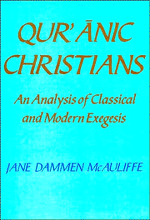
- Qur'anic ChristiansAn Analysis of Classical and Modern Exegesis, pp. 1 - 10Publisher: Cambridge University PressPrint publication year: 1991
Accessibility standard: Unknown
Why this information is here
This section outlines the accessibility features of this content - including support for screen readers, full keyboard navigation and high-contrast display options. This may not be relevant for you.Accessibility Information
Accessibility compliance for the PDF of this book is currently unknown
and may be updated in the future.