Book contents
- Frontmatter
- Dedication
- Contents
- List of figures, boxes, case studies and appendices
- Foreword
- Contributors
- Introduction
- 1 Supporting every child to read
- 2 Listening to their voices: what research tells us about readers
- 3 Becoming a reluctant reader
- 4 Reading Club: a case study from Finland
- 5 Trained reading helpers: Beanstalk's magic ingredient
- 6 Let all children experience the joy of reading: promoting children's reading in Korea
- 7 Reflecting readers: ensuring that no one is excluded
- 8 Pulling in reluctant readers: strategies for school librarians
- 9 Not just for the avid reader: inclusive Carnegie and Kate Greenaway shadowing
- 10 Listen up! How audiobooks support literacy
- 11 Reading the future
- Index
Introduction
Published online by Cambridge University Press: 08 June 2018

Book contents
- Frontmatter
- Dedication
- Contents
- List of figures, boxes, case studies and appendices
- Foreword
- Contributors
- Introduction
- 1 Supporting every child to read
- 2 Listening to their voices: what research tells us about readers
- 3 Becoming a reluctant reader
- 4 Reading Club: a case study from Finland
- 5 Trained reading helpers: Beanstalk's magic ingredient
- 6 Let all children experience the joy of reading: promoting children's reading in Korea
- 7 Reflecting readers: ensuring that no one is excluded
- 8 Pulling in reluctant readers: strategies for school librarians
- 9 Not just for the avid reader: inclusive Carnegie and Kate Greenaway shadowing
- 10 Listen up! How audiobooks support literacy
- 11 Reading the future
- Index
Summary
‘There's not much you can do if you can't read well, is there?’
This piece of wisdom from a 7-year-old boy in the North East of England is quoted in the 2015 Kids and Family Reading Report from Scholastic (2015). It encapsulates the purpose behind this book, which is to explore how we can, as library and education professionals, ensure that no child is left behind. Because reading is so fundamental to an individual's life and universal literacy is of such benefit to society as a whole it is hereby defined as a right.
But of course literacy has actually been recognised as a human right for over 50 years in several international declarations and initiatives. Since its creation, UNESCO has promoted literacy as a right: in the 1975 Persepolis Declaration, the 1997 Hamburg Declaration and the 2006–2015 Literacy Initiative for Empowerment (LIFE). In March 2016 ELINET (the European Literacy Policy Network) published A Declaration of European Citizens’ Right to Literacy (Valtin et al., 2016). ‘Everyone in Europe has the right to acquire literacy. European Union Member, candidate and associate States should ensure that people of all ages, regardless of social class, religion, ethnicity and gender, are provided with the necessary resources and opportunities to develop sufficient and sustainable literacy skills and knowledge.’ This was published just three months before the UK voted to leave the EU. One can only hope that, whatever form the exit from Europe eventually takes, the UK government will in any case recognise its ongoing responsibility to develop literate citizens.
Every child has a right to read and we have a social responsibility, as parents, teachers, librarians, publishers, booksellers, campaigners and policy makers to ensure that they are able to exercise that right. Sadly, it is not quite so simple to achieve that outcome as to state it! This introduction will examine the current state of reading in the UK and internationally and what the latest research tells us about children who are failing to read. Inevitably it will also examine the context in which schools and libraries are struggling to provide the support that potential readers need.
Information
- Type
- Chapter
- Information
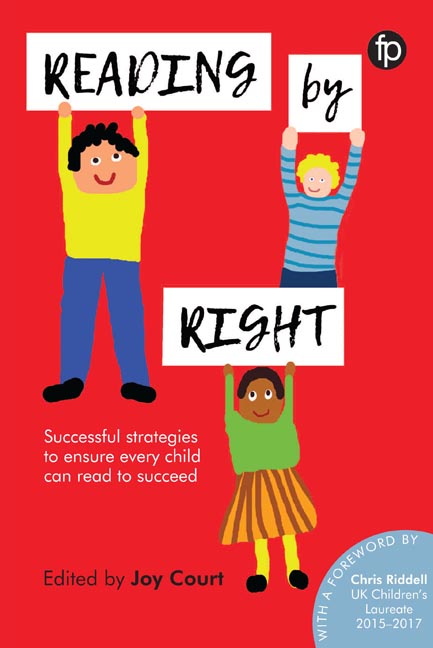
- Reading by RightSuccessful strategies to ensure every child can read to succeed, pp. xix - xxxviiiPublisher: FacetPrint publication year: 2017
Accessibility standard: Unknown
Why this information is here
This section outlines the accessibility features of this content - including support for screen readers, full keyboard navigation and high-contrast display options. This may not be relevant for you.Accessibility Information
Accessibility compliance for the PDF of this chapter is currently unknown
and may be updated in the future.