


Chapter 1 explains how examples used in this chapter were chosen.
Chapter 2 synthesizes key challenges related to conceptualization and introduces the CIRCle Framework of regulatory functions to address cumulative environmental problems.
Chapter 3 sketches the landscape of laws that may respond to cumulative environmental problems, including those that focus on a matter of concern (the conceptualization of which is the core of this chapter).
Chapter 5 (“Information”) discusses rules for collecting and analyzing data and information that link with conceptualization.
Chapter 6 (“Regulatory intervention”) discusses how rules can influence behavior to ensure that cumulative harm to the matter of concern stays within acceptable limits.
Chapter 7 (“Coordination”) covers coordinating between and among agencies and levels of government, nongovernment, and quasi-government entities, including to inform conceptualization.
Each case study (Chapters 8–10) focuses on specific CIRCle Framework functions. Chapter 8 examines conceptualization in detail using the context of groundwater management and environmental justice in California, and explains how conceptualization links to the CIRCle Framework functions of information, regulatory intervention, and coordination.
4.1 Conceptualization as a Regulatory Function
At the heart of a regulatory regime to address a cumulative environmental problemFootnote 1 is the thing that matters, and that is threatened by cumulative impacts, such as water quality, or biodiversity, or a sacred site. This is the “matter of concern,” the subject matter for protection or restoration. The first function of rules for addressing a cumulative environmental problem is articulating in law what matters, or providing a process for doing so. I use the term “matter of concern” for brevity and because it is intentionally neutral: This book does not suggest that environment-related laws should adopt any particular matter of concern. Indeed, matters of concern may vary widely, corresponding to the wide range of laws that are capable of regulating cumulative impacts – from environmental impact assessment (“EIA”) law, to natural resources laws dealing with fisheries, water allocation, and forestry, to land use planning and endangered species and beyond.Footnote 2 A matter of concern may be a part of the nonhuman environment described without an express link to humans (e.g., water quality, a national park, or a species); or a part of the nonhuman environment expressed in a way that directly links either with humans in general (e.g., ecosystem services, or cultural landscapes) or with a specific human community that is affected by changes in the environment (e.g., children, Indigenous Peoples, or disadvantaged communities).
The main argument of this chapter is that while matters of concern vary, legal mechanisms can better address cumulative harm to them if they conceptualize the matter of concern in a way that addresses challenges inherent in cumulative environmental problems,Footnote 3 using rules that have specific features. This involves more than simply stating a goal or writing a definition into a rule – it is a challenging, multidimensional task that engages with questions of values – hence “conceptualization.” As discussed earlier in this book, the multiple dimensions that need to be clarified to respond to cumulative harm, the subjective, value-rich nature of decisions about these dimensions, and the demonstrable risks of incoherent decisions about these matters are all notable challenges. They point to the need for rules to provide structure, transparency, and some degree of stability for conceptualization.
Conceptualization is part of a broader framework of interlinking functions that form the “CIRCle Framework” – conceptualization, information, regulatory intervention, coordination – for formal rules, broadly defined,Footnote 4 to respond to cumulative environmental problems. Formal rules are the focus of the CIRCle Framework and of this book, while also acknowledging that informal practices and nonlegal factors (e.g., courage of leaders) have an important role to play that rules cannot replace.
A foundational premise of this chapter is that it is important for rules to distinguish deciding the thing that matters and thresholds at which its conditions would become unacceptable (conceptualization), from understanding the current conditions of the matter of concern and what threatens it (which relates to information), from deciding what do about those threats (a decision about intervention), from coordinating among government and nongovernment entities to do these things. These are interlinked and potentially contested – but, importantly, separate – functions in the CIRCle Framework.
Conceptualization has links to well-established constructs and principles. Emphasizing conceptualization aligns with the scientific focus on clearly defined “valued environmental components” in cumulative impact analysisFootnote 5 – though the intention here is to address broader legal contexts beyond EIA.Footnote 6 By contrast, “problem framing” in the policy analysis literature refers to unpacking what actors do to persuade decision-makers and others about a problem and its importance, drawing simultaneously on values, narratives about cause and effect, the difference between observed and desired conditions, and preferred solutions.Footnote 7 However, the purpose of the CIRCle Framework differs from the goals of scientific cumulative impact analysis and policy analysis: Here, the goal is to design rules to guide decision-making. The function of conceptualization, then, takes that part of “problem framing” that defines what is important to protect or restore, and what protection or restoration means. Conceptualization relates more closely to policy aims, objectives, and targets in policy design,Footnote 8 but is here elaborated in a way that is specific to cumulative environmental problems and formal rules.
After setting out the place of conceptualization in the CIRCle Framework, Section 4.2 explores how variation in the matter of concern can affect how difficult it is to clearly conceptualize it. This alerts rule designers to issues that deserve special attention in their context. Using the findings of Chapter 2 as a foundation,Footnote 9 and drawing on illustrative legal examples from around the world, Section 4.3 advances four categories of design features that help conceptualize a matter of concern fully, clearly, and transparently, by specifying, or providing a process for specifying its key dimensions: key environmental and human elements of the matter of concern (“what matters” and “who matters”); the spatial boundaries of the matter of concern; the limit of conditions to it that are acceptable, and their relationship to time, or the conditions that are sought, in the case of something that needs restoring; and adapting each of these things when required. Chapter 8 then provides deeper insights about conceptualization in a case study of concerns about groundwater and environmental justice in California’s Central Valley.
4.1.1 What Is Conceptualization?
As used in this book, conceptualization refers to how legal mechanisms define what and who matter for protection from cumulative threats, noting that processes for resolving conflicts about conceptualization among governments and with stakeholders are discussed separately, through the function of coordination.Footnote 10 Mechanically, legal mechanisms may undertake conceptualization through statutes or regulations or indirectly through policies or processes for which they provide. This should be distinguished from deciding what matters on a case-by-case basis, as developments arise that might affect something that matters. That approach does not provide for stability or certainty, and invites shifting baselines.Footnote 11
As suggested by the cross-disciplinary insights in Chapter 2, legal mechanisms can support conceptualizing a matter of concern by providing clarity and transparency about its important dimensions: its environmental and, if relevant, social dimensions (“what” and “who” matters); its spatial boundaries; important thresholds that describe the limits of acceptable conditions, which may have a temporal element; and providing for adapting these things (Figure 4.1). Section 4.3 takes up these dimensions as design features for conceptualization, providing illustrative examples of legal approaches to specifying them.
Clearly and transparently conceptualizing a matter of concern to facilitate responding to cumulative environmental harm requires identifying its key elements and the spatial boundaries and cumulative threshold conditions that correspond to those elements in a way that facilitates adaptation over time

Figure 4.1 Long description
The illustration describes the matter of concern as a wide variety of things that we care about and on which the law focuses, for example, an endangered species, a landscape, environmental justice, the ambient concentration of an air pollutant et cetera. The three dimensions mentioned in the illustration are the Matter of Concern which includes what and who matters and the links between them, the Spatial Boundaries about what and who matters, and the Cumulative Threshold Conditions of what matters and who matters, beyond which conditions are unacceptable, which may have a temporal element. These dimensions need to be refined or adapted over time, influencing other dimensions.
A conceptualization that is clear in these ways reduces ambiguity and uncertainty about what matters. Without clarity about elements that matter and thresholds, it is difficult to know what to monitor to understand the extent of cumulative change and when to intervene to control cumulative change. Clarity about a matter of concern allows policymakers, public servants, and others to consider the ways in which different rules might be unaligned and make it difficult for the law to achieve its objects. For example, interventions might be directed at subtly different things. The California groundwater case study in Chapter 8 illustrates this, showing how different laws aimed at protecting groundwater actually take different views of what and who matter.
While the need for clarity may seem self-evident, in practice, a failure to clearly identify important dimensions of a matter of concern “sometimes obscures policy debate and the capacity for evaluation [and] contributes to poor practice … at both the level of particular impacts and across landscapes or jurisdictions.”Footnote 12 Consider the ambiguity and contestation surrounding well-established (and still ambiguous) terms such as “resilience” or conceptualizations of elements of the environment as legal persons, which has garnered popular support but may lack clarity in relation to rights and duties and spatial delimitation.Footnote 13 Regulatory clarity about what matters and important thresholds also helps head off key difficulties in dealing with cumulative environmental problems, such as baseline shift and policy drift.Footnote 14
Transparency requires articulating the values underlying why something matters. This can influence the dimensions of conceptualization (such as thresholds or spatial boundaries) and other CIRCle Framework functions, like publicly justifying plans for a future intervention even if it is not immediately possible; or clarifying whether a specific type of intervention is appropriate. For example, if an area of natural heritage is protected because it is unique, this would probably rule out a regulatory strategy that allows offsetting harm to the unique thing by creating a benefit somewhere else.Footnote 15 Transparency also helps identify parties relevant to coordination (e.g., involving a bird protection association where an area is conserved as habitat for birds). Formal rules can be useful for transparency because they are often accompanied by publicly available elaborations of what is intended by a rule, for example, through committee debates, explanatory memoranda, and management plans or policies.
As noted in Chapter 2, having rules that clearly and transparently conceptualize a matter of concern does not imply that this conceptualization should be set in stone. It may need to change with time, for example, with significant changes in social values. Contemporary environmental law seeks to protect many things that were not protected even fifty years ago.Footnote 16 Environmental stressors like climate change may require triage or “directed adaptation.”Footnote 17 Therefore, legal mechanisms to support conceptualization should also include processes for transparently modifying how a matter of concern is conceptualized.
4.1.2 Conceptualization as an Integrated Regulatory Function in the CIRCle Framework
Conceptualization of the matter of concern is the basis for functions related to information, regulatory intervention, and coordination. This section explains how these functions work together to contain cumulative change to the matter of concern within acceptable limits (Figure 4.2, buliding on Figure 2.1, which depicts basic links between regulatory functions).
Integration of legal mechanisms for conceptualization with other CIRCle Framework functions, each necessary for regulating cumulative environmental problems

Figure 4.2 Long description
The interactions are as follows. 1. Conceptualization drives, directs and influences approaches to information. 2. Information allows for refining and adapting conceptualization. 3. Conceptualization drives, directs and influences approaches to regulatory intervention. 4. Regulatory intervention addresses unacceptable changes to clearly specified dimensions of conceptualization. 5. Conceptualization reveals government and non-government parties needed for coordination. 6. Coordination allows for coherence and joint refinement of conceptualization.
Clearly and transparently conceptualizing a matter of concern drives efforts to collect information about its conditions and to prevent unacceptable change to it by intervening. The way a matter of concern is conceptualized will indirectly influence and may even rule out some approaches to gathering information and intervening. A “reductionist” natural capital accounting approach to information or intervention, for example, would seem poorly aligned with a conceptualization that rests on holistic concepts of ecological integrity.Footnote 18 What is perceived as a threat – and therefore a candidate for intervention – will vary based on how the matter of concern is conceptualized.Footnote 19 If pesticide concentrations in irrigation water is a matter of concern but nitrates are not, regulatory intervention would consider farmers that use excess pesticides but not those who produce excess nitrates.
Clear conceptualizations also facilitate identifying regulatory actors with responsibility for the matter of concern for the purpose of coordinating approaches. This includes, for example, actors whose responsibilities are determined by the spatial boundaries of a matter of concern (e.g., within the territory of a province or city) or its legal designation (e.g., the listing of a species as endangered).Footnote 20
A key variable for conceptualization is the degree to which it includes people.Footnote 21 This has flow-on effects for approaches to coordination. In settler jurisdictions, for example, some matters of concern will inherently require the central involvement of Indigenous Peoples – not just as an exercise in respecting and including Indigenous knowledges as information (though that is also important)Footnote 22 but to help legal articulations of what matters reflect Indigenous views in a way that is inseparable from the involvement of Indigenous Peoples and their local contexts.Footnote 23 An environmental justice lens that highlights cumulative impacts on disadvantaged communities also points to involving those communities in responding to impacts as a matter of procedural justice.Footnote 24 The implication of this relationship between conceptualization and coordination is not merely expanding the circle of nongovernment actors involved in conceptualization: Enabling their meaningful involvement may require dedicated resources.Footnote 25 Clearly conceptualizing a matter of concern is also necessary (but not sufficientFootnote 26) to address risks of different regulatory actors adopting different and incoherent conceptualizations of what and who matter. Coordination makes it possible to act, taking a coherent, or at least not mutually undermining, view of what matters.
Conversely, other regulatory functions in the CIRCle Framework influence how a matter of concern is conceptualized. Legal mechanisms for information may lead to adapting a conceptualization by producing information about the current conditions of the matter of concern or current or likely impacts to it. For example, better understanding how a species or ecosystem responds to stressors – say, a coral species being more sensitive to high marine temperatures than previously known – may lead to a desire to protect or promote different, more heat-tolerant coral species.Footnote 27 Understanding that water wells used by a groundwater-reliant disadvantaged community are going dry because others are overpumping the aquifer may prompt incorporating groundwater sustainability issues into conceptualizations of environmental justice, or vice versa.Footnote 28 Equally, by facilitating new interactions between agencies, levels of government, or nongovernment actors, legal mechanisms for coordination may lead to refining how a matter of concern is conceptualized.
4.2 Different Approaches to What and Who Matter
A matter of concern can take many forms. This is unsurprising: Different nations, cultures, and communities value different things. Even taking a single thing that we care about, there are multiple ways to conceptualize it as a matter of concern, each of which expresses different values and none of which is universally or objectively “correct.” “Clean water,” for example, might be expressed as a river that is swimmable, a municipal water supply that meets detailed drinking water standards, or lake water that is so clear that it attracts tourists for its aesthetic value. Some matters of concern have characteristics that make it more challenging (but no less important) to articulate the dimensions of a conceptualization that help deal with cumulative impacts (Figure 4.1). Other matters of concern inherently adopt a cumulative impacts mindset.
This part explores two ways in which a matter of concern can vary and present challenges: the degree to which the matter of concern is reductionist or multidimensional and the degree to which it includes human communities (summarized in quadrants in Table 4.1). Multidimensional and human-linked matters of concern are entirely legitimate but can pose special challenges because they are prone to ambiguity and specifying thresholds may be difficult – issues to which regulatory designers ought to be especially attuned. Ultimately, no quadrant is universally “right.” Rather, it is clarity and transparency that are important so that rules can protect what matters. Exploring the diversity of matters of concern also supports the earlier argument that a wider range of laws is relevant for controlling cumulative effects than is typically conceived to be so.Footnote 29
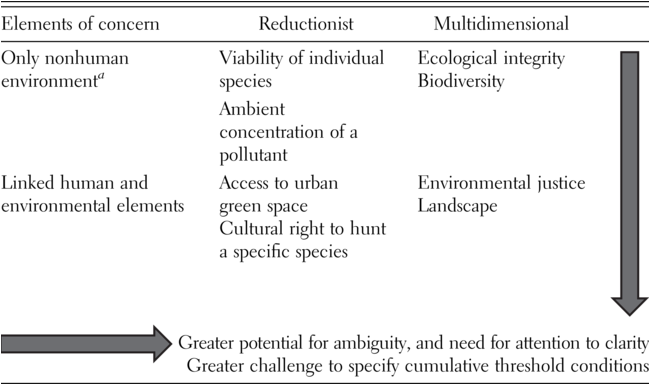
a Note that a focus on the nonhuman environment may be motivated by human needs, e.g., sensitivity to air pollutants.
4.2.1 From Reductionist to Multidimensional Matters of Concern
Environment-related laws traditionally break up pieces of the nonhuman environment into smaller parts, say, individual species or pollutants – an approach termed atomism or reductionism.Footnote 30 Some contemporary environmental legal scholars criticize a reductionist approach to environmental protection or praise a more holistic or integrated view of what we ought to care about through law. They point to broader matters of concern like the connectedness between people and places, or planetary boundaries, as better reflecting ecological reality or spotlighting unaddressed harms.Footnote 31
The distinction between reductionist and multidimensional matters of concern highlights risks that make clarity especially critical for regulatory designers. Multidimensional matters of concern may increase ambiguity and therefore the potential for interpreting the matter of concern in different ways, as well as increasing the difficulty of specifying an acceptable threshold of change. This, in turn, risks producing information-gathering measures, interventions, and coordination that undermine or do not support each other. The meaning of fine particulate (PM2.5) air pollution (which causes illness with both short- and long-term exposure)Footnote 32 is clear. By contrast, a law may seek to protect “air quality,” without more detail and without a process for elaborating which components matter. This gives decision-makers significant discretion to decide precisely what matters in a way that may depart from what was intended, privilege “loud voices,” or lead to different interpretations in different places or through time, failing to guard against inadvertent cumulative harm.
Lack of clarity is a pronounced problem for cumulative impact analysis under project-level EIA laws. These laws tend to be vague about what matters (e.g., “resources, ecosystems and human communities” in the United StatesFootnote 33). This, in turn, means that different analysts may interpret what matters differently, either inadvertently or strategically, making it difficult to gain a clear view of cumulative impacts on something affected by multiple projects.Footnote 34 To reduce the potential for ambiguity and incoherence in regulating cumulative harms, broadly specified matters of concern benefit from more detailed definitions, policies, and regulatory processes for understanding what and who matters in a local context.Footnote 35
Whether a matter of concern has a reductionist or multidimensional nature also has important implications for other regulatory functions in the CIRCle Framework. A reductionist matter of concern produces a narrower scope of activities that can be understood as contributing to cumulative environmental harm. If the ambient concentration of PM2.5 is the matter of concern, only activities that increase PM2.5 – such as power plants, vehicles, and wood stoves – are potential contributors to cumulative harm. If “air quality” is what matters, without further detail, then additional activities, say, activities that contribute to ozone, contribute to cumulative harm. This has flow-on effects for collecting information about potentially threatening activities, designing diverse interventions required to deal with more diverse threats, and considering the actors relevant to coordination.
4.2.2 From Separation to Links between Human and Environmental Elements
Diverse legal concepts link humans and their environment. Traditionally, Western law conceives of humans as separate from the other-than-human environment (for brevity, “environment”).Footnote 36 Western law has tended to link the two through constructs like property and narrowly specified rights, like water rights or a right to access a beach. Conversely, some Indigenous laws emphasize interconnectedness and “consider[] reductionist worldviews to be fundamentally flawed.”Footnote 37 There is much in between. Legal concepts of landscape and heritage recognize and value the way humans shape an environment, from outstanding landscapes to those that are ordinary or ecologically degraded.Footnote 38 Some recent concepts recognize the value of the environment to humans in a utilitarian way. In this category, we see ecosystem services, environmental accounting, and natural capital conceived at different scales, from individual parcels of land to the whole globe.Footnote 39
Other legal concepts focus on the way that damaging the environment hurts people, or their rights. Environmental justice may be interpreted as ensuring that no subpopulation experiences disproportionate environmental burden.Footnote 40 “Solastalgia” captures the emotional pain felt by human individuals experiencing environmental loss.Footnote 41 Environmental rights focus on human dependence on the environment. This occurs through some rights of nature approachesFootnote 42 and rights to a healthy environment.Footnote 43 Similarly, the human-centered principle of intergenerational equity may be interpreted as requiring “assessment of the cumulative impacts of proposed activities on the environment.”Footnote 44 Impact assessment also increasingly addresses how changes to the nonhuman biophysical environment affect humans through visual, cultural, health, human rights, and socioeconomic impacts.Footnote 45
Like multidimensional matters of concern, human–environment “linked” matters of concern can be ambiguous and increase the potential for different interpretations of what the matter of concern actually is. This risk requires special attention. A central and difficult question is: Which humans matter, and form part of the matter of concern? There is often no objective definition of a “community.”Footnote 46 In the context of environmental justice, for example, foundational questions remain about the identity of the “community of justice”: at the extremes, international and intergenerational, or local and intragenerational.Footnote 47 Chapter 8 demonstrates how choices about which communities matter can influence acceptable thresholds of harm (conceptualization) and feasible mitigation measures (intervention). Sometimes including human communities even introduces fundamental ambiguity about whether an effect is positive or negative. A cultural practice, say, Alpine grazing, may itself be what matters, or it might adversely affect a nonhuman part of the environment that matters, like forests that would expand in the absence of grazing (as discussed in Chapter 10).
Thresholds can also be more difficult to specify for human–environment linked matters. Take distributional environmental justice: It is difficult to quantify a threshold total environmental burden that is “too much,” and legal approaches tend to express the threshold in a relative sense, as a “disproportionate” burden. The difficult question remains, though: disproportionate compared to the burden experienced by whom and where? Some kinds of harm to people involve a degree of subjectivity that also involves ambiguity, such as noise pollution or negative impacts on the aesthetic quality of an environment. The potential for greater ambiguity in human–environment linked matters suggests the need for even more attention to specifying the matter of concern in a detailed way, (or a process for specifying it) to avoid manipulation or inadvertently allowing unacceptable cumulative effects.
A matter of concern that links human and environmental elements has important implications for other regulatory functions in the CIRCle Framework. Effects on coordination have already been mentioned.Footnote 48 Human links may influence the type of effects and activities that are considered harmful and are candidates for intervention. On the face of it, recognizing a human dimension to a matter of concern expands the types of impacts that are cognizable as harm if humans rely on something that most or all nonhuman biota do not (e.g., deep groundwater).
While these concepts highlight some risks for well-chosen regulatory features to mitigate, some matters of concern, advantageously, have an inherently cumulative character. Environmental accounting and natural capital are inherently about aggregation.Footnote 49 Distributive environmental justice considers the cumulative burden of a range of different sources of pollution or other environmental harm on communities, often those that also suffer demographic disadvantage or social vulnerability or difference.Footnote 50 These burdens may be specified in some detail, as demonstrated by government efforts to quantify and map environmental (in)justice.Footnote 51 This inherently cumulative character provides a useful structure for appreciating and keeping track of the slow accumulation of individually minor harms.
4.3 Crosscutting Design Features
Despite the great variation in conceptualizing matters of concern discussed above, Chapter 2 identified common challenges. This section now turns to regulatory design features that cut across different approaches to conceptualization, drawing illustrative regulatory examples from across the world.
4.3.1 Specifying What and Who Matter
To regulate cumulative adverse effects, we need to understand what constitutes harm to a matter of concern. This requires clarity about what the matter of concern is, or who they are, or both, including how human and environmental elements are linked.Footnote 52 Knowing this, we can determine whether a change from one state to another is harmful,Footnote 53 which informs other regulatory functions.
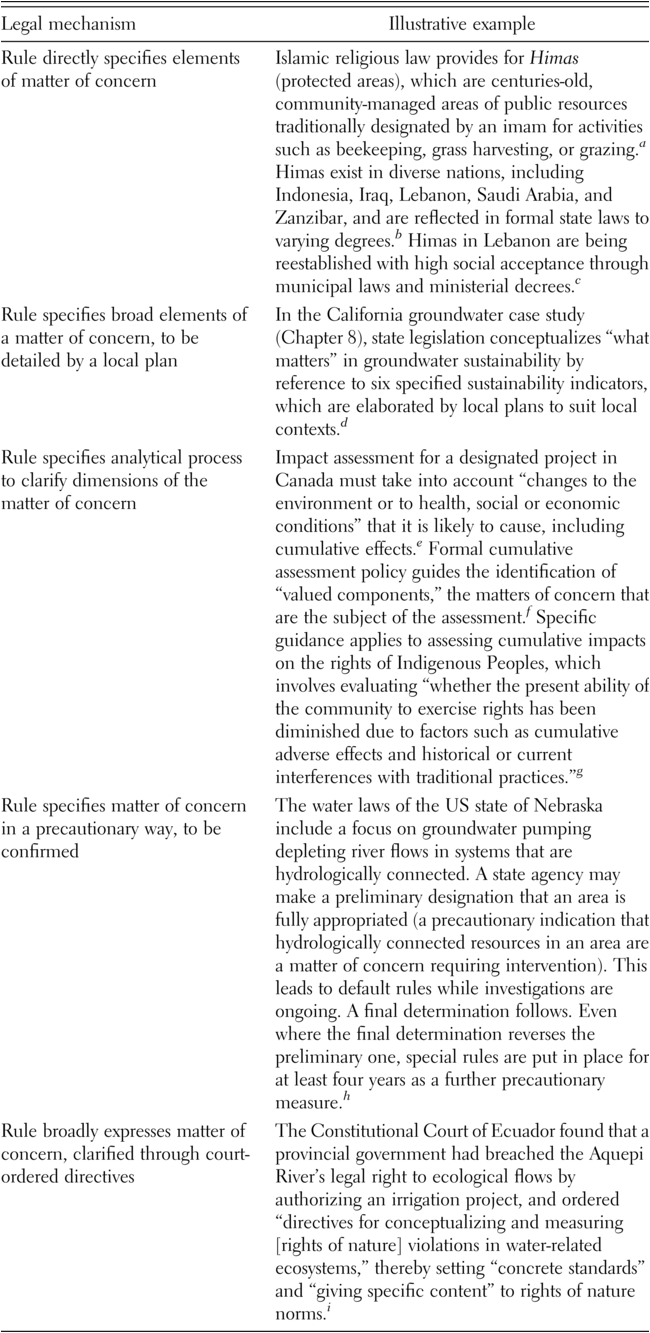
In practice, some rules specify a matter of concern broadly, perhaps for reasons of political compromise or to maximize administrative discretion, and rely on the courts to figure out or constrain what they mean.Footnote 54 This is slow, less democratic than available alternatives, inefficient (as bureaucracies guess at a meaning before a court clarifies things), and uncertain. Incoherence can emerge if different bureaucracies or courts come to different conclusions. It is far preferable for rules to clarify the matter of concern – or provide for a process to do this – so that other regulatory functions can support it. Clear rules do not necessarily need to be specified in highly technical scientific terms (see Table 4.2), they just require an absence of ambiguity from the perspective of those in the local context.
a See generally Hala Kilani, Assaad Serhal and Othman Llewlyn, Al-Hima: A Way of Life (IUCN 2007) 1–6.
b Rianne C. ten Veen, “Hima as a Protected Area – Opportunities and Challenges in the 21st Century” in Radhika Borde and others (eds), Religion and Nature Conservation: Global Case Studies (Routledge 2022) 215–224, 218–220.
c Kilani, Serhal and Llewlyn, Al-Hima, 9–11.
d See Section 8.4.2.4.
e Impact Assessment Act 2019 (Canada) art. 22(1)(a).
f Government of Canada, “Policy Framework for Assessing Cumulative Effects under the Impact Assessment Act” (Government of Canada, 2023) www.canada.ca/en/impact-assessment-agency/services/policy-guidance/practitioners-guide-impact-assessment-act/policy-framework-assessing-cumulative-effects-under-impact-assessment-act.html, archived at https://perma.cc/EUU2-44PM. Note that reforms to this guidance were anticipated at the time of writing.
g Government of Canada, “Policy Context: Assessment of Potential Impacts on the Rights of Indigenous Peoples” (Government of Canada, 2020) www.canada.ca/en/impact-assessment-agency/services/policy-guidance/practitioners-guide-impact-assessment-act/assessment-potential-impacts-rights-indigenous-peoples.html, archived at https://perma.cc/DC9Q-75G8. Note that reforms to this guidance were anticipated at the time of writing.
h Nebraska Revised Statutes § 46-714.
i Craig M. Kauffman and Pamela L. Martin, “How Ecuador’s Courts Are Giving Form and Force to Rights of Nature Norms” (2023) 12 Transnational Environmental Law 366–395, 383.
It may not always be possible or desirable for rule makers to specify the matter of concern in precise terms at the time a rule is drafted. Perhaps not enough is known about public values or scientific information, or perhaps specifying what matters requires negotiation between government and nongovernment entities. In such cases, rules can provide for processes, including coordination,Footnote 55 to clarify what and who matters. Table 4.2 sets out illustrative examples of approaches to regulatory design that facilitate clearly specifying the matter of concern even where further work is required.
4.3.2 Specifying Boundaries of Matters of Concern
Clearly specifying the spatial boundaries of the matter of concern is an important dimension of conceptualization to address cumulative impactsFootnote 56 (time is also important, and is most relevant to thresholds and adaptationFootnote 57). The boundaries of environmental resources often do not match jurisdictional or administrative boundaries,Footnote 58 and clarity about the boundaries of the matter of concern indicates which jurisdictions, regulators, and potentially traditional rights holdersFootnote 59 are relevant in regulating cumulative harm. Comparing the boundaries of the matter of concern and jurisdictional boundaries may also illuminate problematic spatial gaps in regulatory responsibility, where harms can accumulate free of formal rules.
Boundaries are also important because they can influence available approaches to intervention. For example, if the concept of “favorable conservation status” of a species under the EU Habitats Directive refers to species present in a nation, rather than in Europe as a whole (i.e., same species, but different boundaries for the matter of concern), a nation may not be permitted to undertake positive action elsewhere to excuse harm in its own territory.Footnote 60
Setting boundaries may be controversial and require extensive processes for information gathering, coordination, and trust-building among government and nongovernment bodies.Footnote 61 For human-linked matters of concern, it is not immediately clear, for example, which boundaries correspond to concerns about environmental justice and more complex ideas of spatiality may be needed.Footnote 62 For some environmental matters of concern, the relevant space is complex, being both lateral and vertical, as for groundwater, airspace, and oceans.
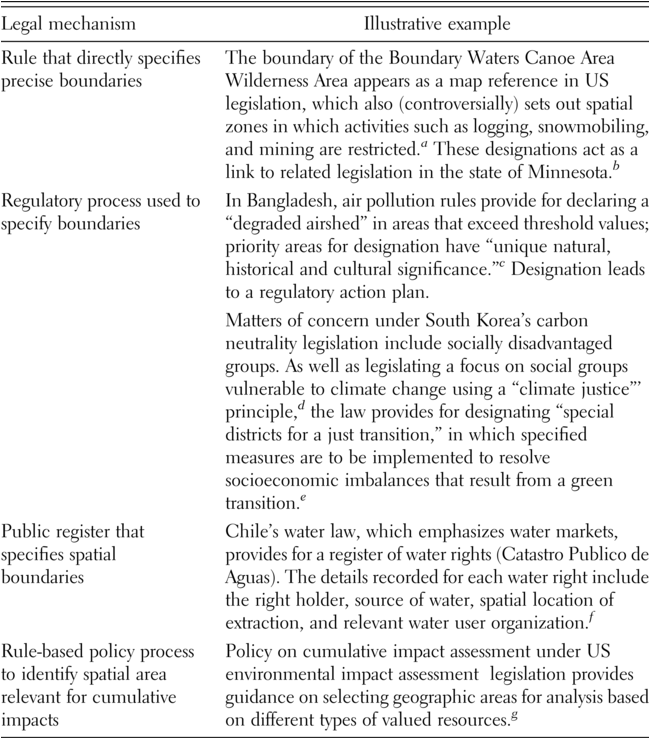
Concerns about the cost and other burdens of delineating legal boundaries arise in diverse contexts, from registers of communal land in the PhilippinesFootnote 63 to groundwater protection zones in France.Footnote 64 In such cases, laws may usefully set out a process for delineation, rather than doing it directly. The Great Barrier Reef Marine Park, discussed in the case study in Chapter 9, was formally proclaimed in 1983 under a 1975 lawFootnote 65 that initially only referred to a roughly described “Great Barrier Reef Region.”Footnote 66 A statutory body then arranged surveying and studies to establish boundaries. Spatially defined zones under subsequent statutory plans provided for conceptualizing different matters of concern across the Reef.Footnote 67 The legislation also intentionally made it more difficult to de-establish marine park areas by requiring each House of the national Parliament to pass a resolution to do so.Footnote 68 This raises the issue of adaptability, which is addressed further later on.Footnote 69 Table 4.3 illustrates diverse approaches to specifying spatial boundaries in conceptualizing a matter of concern.
a Boundary Waters Canoe Area Wilderness Act, Pub. L. No. 95-495, 92 Stat. 1649 (1978) ss 3, 4, 10.
b See generally John Helland, “Chronology of Historical Actions for Boundary Waters Canoe Area Wilderness within Minnesota’s Superior National Forest” (Minnesota House of Representatives Research Department, 2004) www.house.mn.gov/hrd/pubs/bwcawild.pdf, archived at https://perma.cc/RC53-NGAA.
c Mohammad Mostafa Hosain and Mohammad Ershadul Karim, “Bangladesh” (2022) 33 Yearbook of International Environmental Law 184–190, 187.
d Framework Act on Carbon Neutrality and Green Growth for Coping with Climate Crisis (기후위기 대응을 위한 탄소중립ㆍ녹색성장 기본법) (Republic of Korea), Act No. 18469, September 24 2021, amended by Act No. 20514, October 22 2024, art. 2(12) (definition of climate justice), 3(4) (principle of climate justice), 4(6) (obligations re climate justice).
e Footnote Ibid art. 48.
f Código de Aguas [Water Code], Decreto con Fuerza de Ley [Decree with the Force of Law] No. 1122, 1981, as amended (Chile) Title VIII art. 119.
g Council on Environmental Quality (U.S.), Considering Cumulative Effects, 12–16.
4.3.3 Specifying Cumulative Threshold Conditions of Matters of Concern
It is not enough to be clear about what we want to protect from cumulative harm. We also need to know what protection means: the state or conditions of the matter of concern, beyond which additional impacts would be unacceptable, in relation to the elements that matter.Footnote 70 I term this set of conditions at the limit of acceptability “cumulative threshold conditions.” “Threshold” indicates that one side is acceptable, while the other side is not. This is distinct from an ecological threshold, as discussed later on. Transparency about how thresholds are selected is also important to expose the role of valuesFootnote 71 (and whose values) and to guide any subsequent consideration of adapting a threshold by exposing the rationale for the threshold conditions as originally set.
4.3.3.1 Cumulative Thresholds versus Intervention and Information
The CIRCle Framework helps distinguish between conceptualizing the matter of concern, and intervention, being the decision about what to do to prevent the matter of concern being unacceptably affected. Logically, and tautologically, the only way to prevent an unacceptable change to the conditions of something that we care about is to be clear about the limits of conditions that are acceptable (conceptualization). Clarifying limits must come before, and is distinct from, ensuring that we act on an impact that would cause aggregate conditions to become unacceptable (intervention).Footnote 72 It is also related to, but distinct from, scientific ecological thresholds that describe the point at which there is a sudden shift in conditions in response to impacts (information). A water quality example of cumulative harm illustrates this: A cumulative threshold condition might quantify and transparently justify a desired level of water clarity in a lake threatened by nutrients and sediment in catchment runoff (conceptualization).Footnote 73 That is separate from predicting the impacts, such as the contribution of nutrients, climatic conditions, and so on, that would cause loss of water clarity to different degrees (information).
Scholars have long worried about thresholds, especially in impact assessment lawsFootnote 74 that provide for assessing whether a proposed action would have a “significant impact” and laws that require “no net loss” of biodiversity, without clarifying “no net loss compared to what?”Footnote 75 “Significant impact” or “net loss” to a matter of concern triggers intervention, like not approving or requiring changes to a project. Commentators have characterized determinations of significance as value-dependent, imprecise, and context-dependent.Footnote 76
Significance determinations also have another problem: They can conflate the functions of conceptualization and intervention. Conceptualization focuses on what and who matter and defines overall aggregate conditions of the matter of concern that are unacceptable, without being distracted by any particular proposed project. If actual or predicted conditions exceed cumulative threshold conditions – however this occurs, whether by 1 project or 1,000 projects or a cyclone or a heat wave – then, by definition, conditions are unacceptable and intervention is needed. The kind of intervention that should follow, its strictness, the burdens it entails, who must undertake it and when – these are different questions, discussed later in detail.Footnote 77 The important thing here is that the rules clearly define what constitutes unacceptable conditions, raising the question of what to do if they are predicted, rather than sweeping unacceptable conditions under the regulatory rug by providing a path for saying that a predicted impact is not “significant.” This just invites shifting baselines and masks unacceptable cumulative impacts. Rules should clearly identify what we want to protect, provide for a threshold, and safeguard it from being warped by the influence of considering any particular proposed activity. In the EIA context, this could mean better linking EIA laws with other types of laws that are better suited to determining thresholds for matters of concern, or processes under EIA laws for triggering or informing strategic assessments to determine thresholds.Footnote 78
Some ways of specifying thresholds exacerbate the risk of shifting baselines and unplanned cumulative harm. It is risky to describe cumulative threshold conditions using current authorizations or levels of development. For example, a law might provide for assessing a project’s significance by comparing predicted impacts to pre-project “baseline” conditions.Footnote 79 This comparison relates to a trigger for intervention – it does not clearly conceptualize the environmental elements that matter. A baseline of preexisting conditions is irrelevant if that does not reflect what society wants in terms of improving conditions (in the case of a restoration goal), or if the matter of concern could undergo significant cumulative change from baseline conditions and still be acceptable.
In addition, current conditions or current authorizations do not accurately indicate the impacts that current activities will cause to a matter of concern, so taking these approaches to thresholds risks overlooking unacceptable harms. Authorizations may have been granted but not activated fully or at all (e.g., years between infrastructure approvals and construction and impacts commencing). Further time lags can separate activities starting and impacts manifesting (e.g., pumping from groundwater wells reducing groundwater levels at distant locations over decades or longerFootnote 80).
Other laws might set a “regulatory limit” based on an assumed “ecological threshold,” which predicts the impacts of disturbance. Such a threshold seeks to identify when an ecosystem, for example, would enter an entirely different state.Footnote 81 Again, a regulatory limit speaks to intervention, not necessarily conceptualization that expresses a threshold of acceptable conditions; and ecological thresholds are information, not conceptualization: “no matter how precise and accurate, [ecological thresholds] represent information, not objectives….”Footnote 82
The discussion thus far has generally framed cumulative threshold conditions in the context of linked interventions to limit harm – ensuring that conditions do not fall below an acceptable level – but cumulative threshold conditions are also important in the context of restoration goals. A restoration threshold says that current conditions are not acceptable and need to improve to meet the threshold. This requires interventions both to improve conditions and limit further harm. If current conditions are unacceptable, any further harm requires intervention – indeed, further harm negates others’ investments in restoration. Along these lines, Möckel argues that if a conservation objective under the EU Habitats Directive is to restore favorable conservation status, and a proposed development would cause an adverse effect and thus “substantial delays to this process … this then has a significant adverse impact on the conservation objective.”Footnote 83
Cumulative threshold conditions that express restoration goals would address cumulative impact problems noted around the world. Controls on project-level cumulative impacts on reindeer herded by Indigenous Sámi in northern Sweden are criticized for “never deliver[ing] anything better than what existed before an industrial project was proposed… There are no planning processes in place that would allow for proactive improvements in reindeer pastures or other ways to develop reindeer herding according to their own aspirations.”Footnote 84 A clear restoration threshold would do these things. In Canada, Murray and others point to the “scorched earth” justification of project proponents who argue that a project would have an insignificant impact where pre-project conditions are already below acceptable conditions.Footnote 85 By contrast, case law in California has noted that “the greater the existing environmental problems are, the lower the threshold should be for treating a project’s contribution to cumulative impacts as significant.”Footnote 86 A clear, rule-based restoration threshold – the threshold above which conditions will become acceptable – would help avoid this.
4.3.3.2 Specifying Thresholds
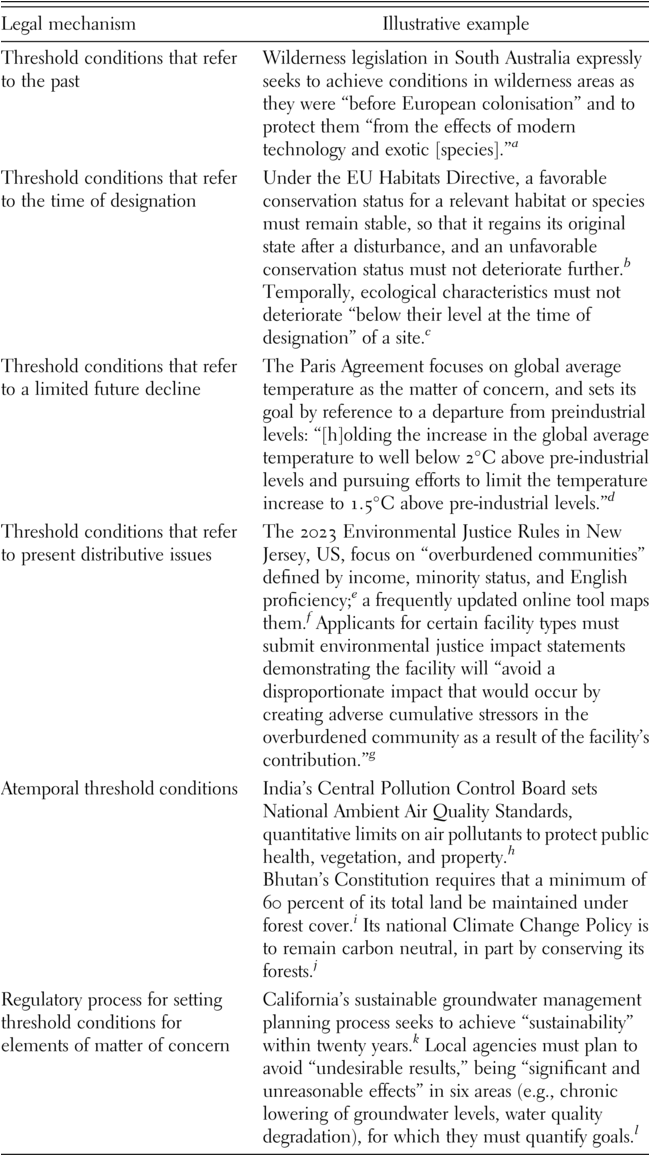
Clearer cumulative threshold conditions are not impossible, and in fact appear in legal contexts outside EIA in diverse ways using different terms and underlying ideas (Table 4.4). Some reflect visions of the past,Footnote 87 the present, or even a future in which there has been some limited degradation. Some seek to preserve a “pristine” set of conditions because those conditions are inherently valued, such as “wilderness” conditions or a “heritage” landscape. At the other end of the spectrum, some laws adopt restoration objectives, which inherently seek to reverse cumulative damage and “challenge the scourge of shifting baselines.”Footnote 88 Time can also feature in thresholds in a different way, as the achievement of conditions by a particular point in time.Footnote 89 An alternative, atemporal approach is to describe threshold conditions by reference to specific utilitarian environmental benefits that the law seeks to secure.
a Wilderness Protection Act 1992 (South Australia) ss 7(1)(d), 12(2)(b).
b Möckel, “The Assessment of Significant Effects on the Integrity of ‘Natura 2000’,” 61.
c European Commission and Directorate-General for Environment, Managing Natura 2000 Sites – The Provisions of Article 6 of the “Habitats” Directive 92/43/EEC (Publications Office 2019) 29.
d Paris Agreement under the United Nations Framework Convention on Climate Change, December 12, 2015, in force November 4, 2016, 3156 U.N.T.S. 79, art. 2(1)(a).
e New Jersey Administrative Code § 7:1C-1.5 “overburdened community”.
f New Jersey Department of Environmental Protection, “Environmental Justice Rules Frequently Asked Questions” (2023) 10 https://dep.nj.gov/wp-content/uploads/ej/docs/ej-rule-frequently-asked-questions.pdf, archived at https://perma.cc/S5DJ-223Z; New Jersey Department of Environmental Protection, “Environmental Justice Law” (n.d.) https://dep.nj.gov/ej/law/, last accessed March 18, 2025, archived at https://perma.cc/V3WJ-5YE3.
g New Jersey Admin. Code § 7:1C-3.2(a)(9).
h Air (Prevention and Control of Pollution) Act 1981, as amended (India) s 16(2)(h); Central Pollution Control Board (India), National Ambient Air Quality Status and Trends 2019 (2020) 3, annex 2.
i Constitution of The Kingdom of Bhutan 2008, art. 5(3).
j National Environment Commission (Bhutan), Climate Change Policy of the Kingdom of Bhutan (2020) 5–6 www.nec.gov.bt/publications/climate-change, archived at https://perma.cc/KZ9K-JEVP.
k California Water Code § 10727.2(b)(1).
l 23 California Code Regs. §§ 354.22–354.30. See also Chapter 8 case study.
However they are expressed, detailed cumulative threshold conditions make it easier for different decision-makers to approach protection coherently, reducing the potential for inadvertent cumulative impacts. In some cases, quantified thresholds will be appropriate, and can relate to diverse matters of concern, for example, maximum air pollutant concentrationsFootnote 90 or place-based cultural health indices developed by and for Indigenous Peoples from Aotearoa/New Zealand to the Marshall Islands and Nepal.Footnote 91 Quantification can helpfully reduce the discretion that can make decision-makers vulnerable to inappropriate influence from powerful interest groups associated with proposed projects.Footnote 92 But for emerging matters of concern and those that are considered indivisible, quantification may not be possible or desirable.Footnote 93
Cumulative environmental problems inherently involve numerous and diverse contributors to harm, and multiple regulatory actors, so setting cumulative threshold conditions benefits from participatory, collective, and collaborative coordination.Footnote 94 Who is involved may affect both what and how threshold conditions are specified. Consensus may not always be possible, but, as discussed later in this book, rules for coordination can create conditions for fruitful interchange and dispute resolution in often politicized debates.Footnote 95 Under past Canadian EIA legislation, setting thresholds appears rarely to have been collaborative or reflected the values of affected communities,Footnote 96 but EIA policy now requires considering Indigenous community–defined thresholds in assessing whether impacts of a designated project are acceptable.Footnote 97
4.3.4 Adapting Conceptualizations
Finally, and for completeness, the ways that rules conceptualize what matters for the purpose of regulating cumulative environmental harm may need to change with time, especially in the context of climate change. This need for adaptation is not unique to regulating cumulative environmental problems; extensive scholarship deals with the issue,Footnote 98 which is covered only briefly here by reference to issues already raised.
In encouraging adaptive conceptualization, rule designers may consider rules that positively facilitate adaptation by including change processes and ways to frame rules to avoid creating barriers to important change. As with conceptualization generally, the less desirable alternative is to rely on courts to change how rules are interpreted to catch up (slowly) with changing times. At the same time, the cumulative context cautions against making a matter of concern too easy to reconceptualize, lest this invite frequent changes that would only serve to disguise shifting baselines.
All the dimensions of a conceptualization (Figure 4.1) might theoretically need to adapt over time. What matters and who matters might change in response to changed community values, changing populations or environments or simply better information about what already exists. The twentieth century saw water laws of many jurisdictions adapt to recognize water rights for environmental uses, as well as traditional consumptive uses like irrigation.Footnote 99 Climate change may make certain environments newly desirable as objects of legal protection as they become more ecologically valuable (e.g., aquatic refugia in environments predicted to become more arid) or more threatened (e.g., grasslands in regions predicted to become more valuable for farming and more subject to agricultural pressure). In relation to boundaries, rule designers should consider avoiding permanent static boundary delineations if a matter of concern might move, whether a species distribution or a natural feature like a river’s course.Footnote 100 Rule designers should be alert to criticism that cumulative thresholds in biodiversity-related laws, such as species protection and protected area laws, focus excessively on historical preservation and restoration, reducing their power to “counter biodiversity loss in a changing climate.”Footnote 101 This may occur, for example, where climate change would make it impossible to return to historical conditions. An alternative approach would be to focus laws on sustaining biodiversity in the context of a changing climate, for example, delineating the boundaries of protected areas to allow species movement through “corridors” of connected areas.Footnote 102
4.4 Conclusion
Rules for regulating cumulative harm depend on knowing: harm to what and whom? Rules can help to conceptualize what and who matter (“the matter of concern”) for restoration or protection from cumulative harm as the basis for regulatory functions related to information, intervention, and coordination. These other functions, each the subject of a chapter that follows, interlink to the function of conceptualization to help contain cumulative change to the matter of concern to acceptable levels. In particular, since articulating what matters is fundamentally a question of values, it benefits from coordination – interactions among government and nongovernment bodies – that allows values to be contested in resolving a conceptualization.Footnote 103
Matters of concern can vary widely, from a sacred place to the ambient concentration of a micropollutant. This chapter has suggested that rules for conceptualizing what matters should set out, or provide a process for setting out, the key dimensions of what and who matter, their spatial boundaries, and thresholds of acceptable conditions, each in a way that is clear and transparent as to underlying values. Clarity will usually require detail. That said, there is no universally “correct” way to specify elements, boundaries, and thresholds, or rules for doing so. This chapter has presented examples from around the world to illustrate some diverse possibilities. Rule designers should also be alert to the greater potential for ambiguity in matters of concern that are multidimensional and that link people and the environment (e.g., landscape, environmental justice, sustainability), which counsels even more attention to clarity. The case study on California groundwater (Chapter 8) analyzes these issues in more detail in a local context, with a focus on environmental justice as a challenging multidimensional matter of concern.


 Open access