Book contents
- Frontmatter
- Acknowledgements
- Contents
- Analytical table of contents
- Preface
- Introduction: Rationality
- Part A Representing
- Part B Intervening
- 9 Experiment
- 10 Observation
- 11 Microscopes
- 12 Speculation, calculation, models, approximations
- 13 The creation of phenomena
- 14 Measurement
- 15 Baconian topics
- 16 Experimentation and scientific realism
- Further reading
- Index
Book contents
- Frontmatter
- Acknowledgements
- Contents
- Analytical table of contents
- Preface
- Introduction: Rationality
- Part A Representing
- Part B Intervening
- 9 Experiment
- 10 Observation
- 11 Microscopes
- 12 Speculation, calculation, models, approximations
- 13 The creation of phenomena
- 14 Measurement
- 15 Baconian topics
- 16 Experimentation and scientific realism
- Further reading
- Index
Summary
One fact about medium-size theoretical entities is so compelling an argument for medium-size scientific realism that philosophers blush to discuss it: Microscopes. First we guess there is such and such a gene, say, and then we develop instruments to let us see it. Should not even the positivist accept this evidence? Not so: the positivist says that only theory makes us suppose that what the lens teaches rings true. The reality in which we believe is only a photograph of what came out of the microscope, not any credible real tiny thing.
Such realism/anti-realism confrontations pale beside the metaphysics of serious research workers. One of my teachers, chiefly a technician trying to make better microscopes, could casually remark: ‘X-ray diffraction microscopy is now the main interface between atomic structure and the human mind.’ Philosophers of science who discuss realism and anti-realism have to know a little about the microscopes that inspire such eloquence. Even the light microscope is a marvel of marvels. It does not work in the way that most untutored people suppose. But why should a philosopher care how it works? Because it is one way to find out about the real world. The question is: How does it do it? The microscopist has far more amazing tricks than the most imaginative of armchair students of the philosophy of perception. We ought to have some understanding of those astounding physical systems ‘by whose augmenting power we now see more/than all the world has ever done before’.
Information
- Type
- Chapter
- Information
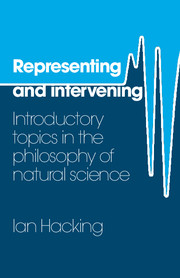
- Representing and InterveningIntroductory Topics in the Philosophy of Natural Science, pp. 186 - 209Publisher: Cambridge University PressPrint publication year: 1983
Accessibility standard: Unknown
Why this information is here
This section outlines the accessibility features of this content - including support for screen readers, full keyboard navigation and high-contrast display options. This may not be relevant for you.Accessibility Information
Accessibility compliance for the PDF of this book is currently unknown
and may be updated in the future.
- 3
- Cited by