Book contents
- Frontmatter
- Contents
- List of Tables
- Preface
- CHAPTER 1 A Watershed Election?
- CHAPTER 2 A Distinctive Scottish Voice? Identities, Values and Attitudes
- CHAPTER 3 What has Devolution Achieved? The Public's View
- CHAPTER 4 Governing Scotland: The People's Preferences?
- CHAPTER 5 Lost Labour Votes? Records, Personalities and Issues
- CHAPTER 6 How the SNP Won
- CHAPTER 7 Do Voters Care about Parties Any More?
- CHAPTER 8 A Personal Vote? How Voters Used the STV Ballot
- CHAPTER 9 Conclusion
- Technical Appendix
- Index
CHAPTER 1 - A Watershed Election?
Published online by Cambridge University Press: 12 September 2012

Book contents
- Frontmatter
- Contents
- List of Tables
- Preface
- CHAPTER 1 A Watershed Election?
- CHAPTER 2 A Distinctive Scottish Voice? Identities, Values and Attitudes
- CHAPTER 3 What has Devolution Achieved? The Public's View
- CHAPTER 4 Governing Scotland: The People's Preferences?
- CHAPTER 5 Lost Labour Votes? Records, Personalities and Issues
- CHAPTER 6 How the SNP Won
- CHAPTER 7 Do Voters Care about Parties Any More?
- CHAPTER 8 A Personal Vote? How Voters Used the STV Ballot
- CHAPTER 9 Conclusion
- Technical Appendix
- Index
Summary
Two battles were being fought when Scotland went to the polls on 1 May 2007. The first contest was for the 129 seats in the devolved Scottish Parliament, the third such election to be held since the parliament was established in 1999. The second tussle was for 1,222 seats on all of the country's 32 local councils.
Both events appeared to represent a watershed, or even a revolutionary change in the nature of Scottish politics. In the parliamentary election the Scottish National Party (SNP), whose principal objective is that Scotland should leave the United Kingdom and become an independent state, emerged with most votes and most seats. It was the first time that the party, formed as long ago as 1934, had succeeded in coming ahead of all of its rivals in a nationwide contest. Apparently the warnings of those who argued that devolution would put Scotland on a ‘slippery slope’ to independence were proving all too prescient (Dalyell, 1977).
The local elections, meanwhile, were fought using a new more proportional electoral system. Instead of using the single-member plurality (or first-past-the-post) system that had been in place ever since the reorganisation of Scottish local government in the 1970s, councillors were elected using the single transferable vote in three- or four-member wards. This new system allowed voters both to express support for more than one party and to choose between candidates of the same party. As a result it supposedly shifted the emphasis of the elections away from being contests between parties and towards being races between individual candidates.
Information
- Type
- Chapter
- Information
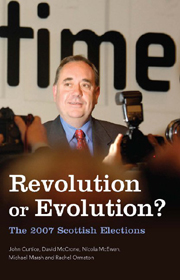
- Revolution or Evolution?The 2007 Scottish Elections, pp. 1 - 16Publisher: Edinburgh University PressPrint publication year: 2009
Accessibility standard: Unknown
Why this information is here
This section outlines the accessibility features of this content - including support for screen readers, full keyboard navigation and high-contrast display options. This may not be relevant for you.Accessibility Information
Accessibility compliance for the PDF of this book is currently unknown
and may be updated in the future.