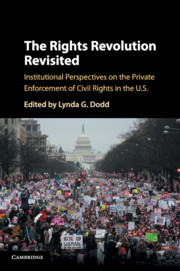

The rights revolution in the United States consisted of both sweeping changes in constitutional doctrines and landmark legislative reform, followed by decades of innovative implementation in every branch of the federal government - Congress, agencies, and the courts. In recent years, a growing number of political scientists have sought to integrate studies of the rights revolution into accounts of the contemporary American state. In The Rights Revolution Revisited, a distinguished group of political scientists and legal scholars explore the institutional dynamics, scope, and durability of the rights revolution. By offering an inter-branch analysis of the development of civil rights laws and policies that features the role of private enforcement, this volume enriches our understanding of the rise of the 'civil rights state' and its fate in the current era.
Loading metrics...
* Views captured on Cambridge Core between #date#. This data will be updated every 24 hours.
Usage data cannot currently be displayed.
This section outlines the accessibility features of this content - including support for screen readers, full keyboard navigation and high-contrast display options. This may not be relevant for you.
Accessibility compliance for the PDF of this book is currently unknown and may be updated in the future.
