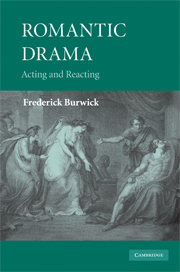
Book contents
- Frontmatter
- Contents
- List of illustrations
- Acknowledgments
- Introduction
- 1 Periscopes into the theatre
- 2 Nationalism and national character
- 3 Genre: the realism of fantasy, the fantasy of realism
- 4 Acting: histrionics, and dissimulation
- 5 Transvestites, lovers, monsters: character and sexuality
- 6 Setting: where and elsewhere
- 7 Gothic and anti-Gothic: comedy and horror
- 8 Blue-Beard's castle: mischief and misogyny
- 9 Vampires in kilts
- Notes
- Bibliography
- Index
Introduction
Published online by Cambridge University Press: 04 August 2010

Book contents
- Frontmatter
- Contents
- List of illustrations
- Acknowledgments
- Introduction
- 1 Periscopes into the theatre
- 2 Nationalism and national character
- 3 Genre: the realism of fantasy, the fantasy of realism
- 4 Acting: histrionics, and dissimulation
- 5 Transvestites, lovers, monsters: character and sexuality
- 6 Setting: where and elsewhere
- 7 Gothic and anti-Gothic: comedy and horror
- 8 Blue-Beard's castle: mischief and misogyny
- 9 Vampires in kilts
- Notes
- Bibliography
- Index
Summary
The poet, John Keats insisted in his letter to Richard Woodhouse (October 27, 1818), has no self, no character, no identity, but is ever ready to assume identity and enter into a role:
As to the poetical Character … it has no self – it is everything and nothing – It has no character – it enjoys light and shade; it lives in gusto, be it foul or fair, high or low, mean or elevated. It has as much delight in conceiving an Iago as an Imogen. What shocks the virtuous philosopher, delights the camelion Poet. It does no harm from its relish of the dark side of things any more than its taste for the bright one; because they both end in speculation. A Poet is the most unpoetical of anything in existence because he has no Identity; he is continually in for and filling some other Body.
To describe how the poetic imagination moves from nonentity to identity, Keats introduces contrasting Shakespearean characters: the innocent Imogen, the evil Iago. Whatever their moral difference, both have equal affective value because “both end in speculation.” The poet is always ready for such role-playing, “continually in for and filling some other Body.” Keats's theatrical metaphor for entering into character might seem to apply broadly to the assumptions about acting in the period. The successful performer, a Sarah Siddons or a John Philip Kemble, is presumably one who can enter convincingly into role and become that character for the duration of the play.
Information
- Type
- Chapter
- Information
- Romantic DramaActing and Reacting, pp. 1 - 13Publisher: Cambridge University PressPrint publication year: 2009
Accessibility standard: Unknown
Why this information is here
This section outlines the accessibility features of this content - including support for screen readers, full keyboard navigation and high-contrast display options. This may not be relevant for you.Accessibility Information
Accessibility compliance for the PDF of this book is currently unknown
and may be updated in the future.