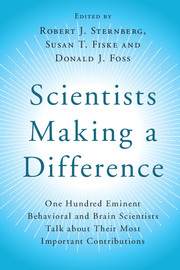
 Scientists Making a Difference
 One Hundred Eminent Behavioral and Brain Scientists Talk about Their Most Important Contributions
Book contents
- Frontmatter
- Contents
- List of Contributors
- Foreword: Making a Creative Difference = Person × Environment
- Preface
- Part I Introduction
- Part II Biological Bases of Psychology: Genes, Brain, and Beyond
- Part III Cognition: Getting Information from the World and Dealing with It
- Part IV Development: How We Change Over Time
- Part V Motivation and Emotion: How We Feel and What We Do
- Part VI Social and Personality Processes: Who We Are and How We Interact
- Part VII Clinical and Health Psychology: Making Lives Better
- Part VIII Conclusion
- Afterword: Doing Psychology 24×7 and Why It Matters
- Index
- References
28 - Memory Matters
from Section B - Learning and Memory
Published online by Cambridge University Press: 05 August 2016

Book contents
- Frontmatter
- Contents
- List of Contributors
- Foreword: Making a Creative Difference = Person × Environment
- Preface
- Part I Introduction
- Part II Biological Bases of Psychology: Genes, Brain, and Beyond
- Part III Cognition: Getting Information from the World and Dealing with It
- Part IV Development: How We Change Over Time
- Part V Motivation and Emotion: How We Feel and What We Do
- Part VI Social and Personality Processes: Who We Are and How We Interact
- Part VII Clinical and Health Psychology: Making Lives Better
- Part VIII Conclusion
- Afterword: Doing Psychology 24×7 and Why It Matters
- Index
- References
Summary
In December 2004, the New York Times reported on that year's winners of the Grawemeyer Awards. The Grawemeyer Awards are given in Psychology and also several other fields (e.g., education, religion, improving world order). That year they were accompanied by a $200,000 prize – amongst the largest for an award in a field that does not have a Nobel Prize. It was with enormous pride that I learned that I had won the award in Psychology. Another news outlet reported that I was the most controversial researcher ever to win the prize, and the most controversial winner since former Soviet President Mikhail Gorbachev won the 1994 prize for improving world order. The award is for a big, important idea in Psychology. So what was my big, important idea?
A staff member sent me an email about that time, letting me know what the external awards committee had said when summarizing my “idea.” Their summary practically made me weep. The committee said that I had “changed the way that both scientists and lay citizens think about the nature of human memory,” and had “made it clear that human memory is not a literal and faithful recorder of experience.” Of course, we've known for some time that memory is fallible, and just how easy it is for us to forget things. But what my work has shown is that we can also falsely remember things differently from the way they happened, and can remember entire events that never happened.
This work teaches us about the malleable nature of memory. Information suggested to an individual about an event can be integrated with the memory for the event itself, so that what actually occurred, and what was discussed later about what may have occurred, become inextricably interwoven, allowing distortion, elaboration, and even total fabrication from suggestions.
People often ask me how I came up with this idea, and to answer I have to take us back to the 1970s. Back then I was interested in what happened when witnesses were questioned about events they had experienced, important events such as crimes or accidents. I did several studies in which I showed that leading questions could bias what people claimed to have seen.
Information
- Type
- Chapter
- Information
- Scientists Making a DifferenceOne Hundred Eminent Behavioral and Brain Scientists Talk about Their Most Important Contributions, pp. 136 - 139Publisher: Cambridge University PressPrint publication year: 2016
References
(2007). Elizabeth F. Loftus (Autobiography). In & (eds.). History of psychology in autobiography (vol. IX, pp. 198–227). Washington, D.C.: American Psychological Association Press.
, & (1974). Reconstruction of automobile destruction: An example of the inter-action between language and memory. Journal of Verbal Learning and Verbal Behavior, 13, 585–589.Google Scholar
Accessibility standard: Unknown
Why this information is here
This section outlines the accessibility features of this content - including support for screen readers, full keyboard navigation and high-contrast display options. This may not be relevant for you.Accessibility Information
Accessibility compliance for the PDF of this chapter is currently unknown
and may be updated in the future.