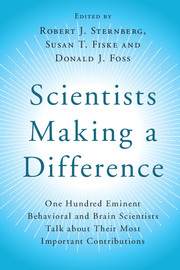
 Scientists Making a Difference
 One Hundred Eminent Behavioral and Brain Scientists Talk about Their Most Important Contributions
Book contents
- Frontmatter
- Contents
- List of Contributors
- Foreword: Making a Creative Difference = Person × Environment
- Preface
- Part I Introduction
- Part II Biological Bases of Psychology: Genes, Brain, and Beyond
- Part III Cognition: Getting Information from the World and Dealing with It
- Part IV Development: How We Change Over Time
- Part V Motivation and Emotion: How We Feel and What We Do
- Part VI Social and Personality Processes: Who We Are and How We Interact
- Part VII Clinical and Health Psychology: Making Lives Better
- Part VIII Conclusion
- Afterword: Doing Psychology 24×7 and Why It Matters
- Index
- References
91 - Understanding Clinical Depression
from Section B - Understanding Mental Disorders
Published online by Cambridge University Press: 05 August 2016
By

Book contents
- Frontmatter
- Contents
- List of Contributors
- Foreword: Making a Creative Difference = Person × Environment
- Preface
- Part I Introduction
- Part II Biological Bases of Psychology: Genes, Brain, and Beyond
- Part III Cognition: Getting Information from the World and Dealing with It
- Part IV Development: How We Change Over Time
- Part V Motivation and Emotion: How We Feel and What We Do
- Part VI Social and Personality Processes: Who We Are and How We Interact
- Part VII Clinical and Health Psychology: Making Lives Better
- Part VIII Conclusion
- Afterword: Doing Psychology 24×7 and Why It Matters
- Index
- References
Summary
Have you ever been depressed? Not just sad or despondent for a few days – I mean really depressed, where you can't get out of bed, don't want to see people, feel like you'll never recover from feeling as badly as you do. Like everyone else, I've had times when I've been down, but for me such times have passed quickly. But I've known many strong, effective people who have been tortured for weeks or months by a sadness and hopelessness that seemed difficult to fathom. I wanted to understand why some people snap out of these feelings while others succumb to the debilitating condition we call clinical depression. In this chapter, therefore, I briefly describe my involvement in what I believe are two significant scientific contributions: adapting experimental cognitive paradigms to assess cognitive functioning in depression, and integrating psychological and biological assessments to elucidate mechanisms underlying the intergenerational transmission of risk for depression.
Information-Processing Approaches to Understanding Cognitive Functioning in Depression
At the time I became interested in trying to understand the causes and consequences of depression, in the mid-1970s and early 1980s, most psychologists were using self-report measures to characterize the functioning of depressed adults. Aaron Beck had just formulated his cognitive theory of depression, positing that depressed individuals have a negative view of themselves, their world, and the future. And indeed, when filling out self-report questionnaires assessing cognitions, depressed participants indicated that they had negative thoughts, apparently confirming Beck's theory. But it seemed to me that that this conclusion might be based on something known as “common method variance”; that is, people who were reporting negative behaviors and affect in an interview that got them diagnosed as depressed were also reporting negative cognitions on a questionnaire (“I feel bad and I'll tell you that on every measure you give me”).
Starting with a collaboration with Doug McCann (now a professor at York University), and continuing more recently with Jutta Joormann (now a professor at Yale University), I began to adapt tasks and paradigms developed by experimental cognitive psychologists to circumvent the problems inherent in the use of self-report questionnaires to assess cognitive content and processes.
Information
- Type
- Chapter
- Information
- Scientists Making a DifferenceOne Hundred Eminent Behavioral and Brain Scientists Talk about Their Most Important Contributions, pp. 435 - 439Publisher: Cambridge University PressPrint publication year: 2016
References
, , & (2014). Understanding familial risk for depression: A 25-year perspective. Perspectives on Psychological Science, 9, 94–108. doi:10.1177/1745691613513469.Google Scholar
, , & (2012). Cognitive aspects of depression. Wiley Interdisciplinary Reviews: Cognitive Science, 3, 301–313. doi:10.1002/wcs.1177.Google Scholar
, & (2014) The neuroscience of depression: Implications for assessment and intervention. Behaviour Research and Therapy, 62, 60–73.Google Scholar
Accessibility standard: Unknown
Why this information is here
This section outlines the accessibility features of this content - including support for screen readers, full keyboard navigation and high-contrast display options. This may not be relevant for you.Accessibility Information
Accessibility compliance for the PDF of this chapter is currently unknown
and may be updated in the future.