Book contents
- Frontmatter
- Contents
- Preface
- Acknowledgements
- Introduction
- 1 Debating the Secular beyond the West
- 2 Gandhi’s Ashram and Political Thought: A Counter-narrative of Secularity
- 3 Gandhi’s Associationalism: A Non-state Alternative to Liberal Secularism?
- 4 Was Nehru Nehruvian? Religion, Secularity and Nehruism
- 5 Nehru and the Politics of Liberalism of Fear
- Conclusion
- Bibliography
- Index
Preface
Published online by Cambridge University Press: 27 September 2022

Book contents
- Frontmatter
- Contents
- Preface
- Acknowledgements
- Introduction
- 1 Debating the Secular beyond the West
- 2 Gandhi’s Ashram and Political Thought: A Counter-narrative of Secularity
- 3 Gandhi’s Associationalism: A Non-state Alternative to Liberal Secularism?
- 4 Was Nehru Nehruvian? Religion, Secularity and Nehruism
- 5 Nehru and the Politics of Liberalism of Fear
- Conclusion
- Bibliography
- Index
Summary
December 2019 was a season of faith's perfection when India saw country-wide protests in response to an Act passed by the parliament which challenged the secular spirit of the Indian constitution. Many of these peaceful protests were accompanied by ritualised reading of the preamble of the Indian constitution, and with this simple act, ‘We, the people of India’ sought to reaffirm the idea of India as a secular democratic republic. The post-colonial state in India today shows alarming impunity towards individual and minority rights, accompanied by a disregard for and dismissal of norms and values on which the ‘idea of India’ stands. One such value that has increasingly become marginal and seemingly only of symbolic importance to the state in contemporary India, most visibly after the demolition of the Babri Masjid in 1992, is secularism. This political ideal, which found expression in the ‘Gandhi–Nehru tradition’ through popular slogans like ‘unity in diversity’ and sarva dharma samabhava during the Indian national movement and in Nehruvian secularism after independence, from being dominant and indeed one of the defining features of Indian nationhood, stands at the margins today. One may even go as far as to argue that today India is a ‘secular republic’ only nominally. Right-wing politics today does not simply reject secularism.
It has re-defined the secular ideal; it is homogeneous and majoritarian. The Gandhi–Nehru tradition, by contrast, is based on ideals of pluralism and equality. The unfolding crisis in India's post-colonial history makes it urgent for us to revisit the inclusive ideas and ideals that marked the beginning of this nation. By examining Gandhi and Nehru's thought and politics on the question of the religion–state–society relationship, this book revisits the Gandhi–Nehru tradition in order to gain moral and political insights that may guide contemporary India's imperilled secular imaginary. Both the intellectual and political decline of the Gandhi–Nehru tradition of secularity, from a dominant one in the twentieth century to a marginal one in the twenty-first century, are tinged with irony when seen through the lens of intellectual history. On the one hand, late-twentieth-century writings on Gandhi and Nehru are replete with hagiographical accounts.
Information
- Type
- Chapter
- Information
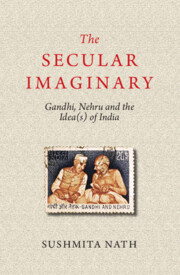
- The Secular ImaginaryGandhi, Nehru and the Idea(s) of India, pp. vii - viiiPublisher: Cambridge University PressPrint publication year: 2022
Accessibility standard: Unknown
Why this information is here
This section outlines the accessibility features of this content - including support for screen readers, full keyboard navigation and high-contrast display options. This may not be relevant for you.Accessibility Information
Accessibility compliance for the PDF of this chapter is currently unknown
and may be updated in the future.