

English noun-noun compounds (teabag, oil drum, sunflower, bedframe, copy machine, engagement ring) consist of two concatenated nouns, henceforth N1 and N2, that together form a noun.Footnote 1
(1) [N N1 N2]
Compounding is recursive, often productively, as in (2), and may include some quasi-syntactic elaboration, as in (3). However, with the exception of the conjunctions in (3), the branching seems to be exclusively binary.Footnote 2
(2) [ice cream] cone
[screen door] [key hole]
[[[health management] cost] containment] services
[[[Volume Feeding] Management] [Success Formula]] Award (from Gleitman and Gleitman Reference Gleitman and Gleitman1970)
[[[childhood [lead poisoning]] prevention] program] [[property transfer][[lead paint] notification] package] (title of a legal document involved in buying a house)
(3) [health and welfare] fund
[[stress relief] and [aroma therapy]] product
[[[Fresh Pond] Parkway] [[sewer separation] and [surface enhancement]]] project
[smoked [pork shoulder]][boiled dinner]
[[Arts and Sciences] chairs] [[short term][planning committee]]
The issue to be addressed in this chapter is how the meaning of a compound is built from the meanings of N1 and N2. The conclusion will be that the rich range of possibilities can be characterized in terms of a generative system that is localized in semantic structure, and that this rich semantics is expressed through the very limited morphosyntax of (1).
2.1 Some basic issues
One fairly reliable constraint on English noun-noun compounds is that N2 is normally the semantic head of the compound: the compound denotes a particular subtype of the type denoted by N2. Beef stew is a kind of stew, but stew beef is a kind of beef. I’ll call this the Head Principle; it will be stated more formally in section 2.4.
Three sorts of exceptions to the Head Principle are well known. One sort (dvandva compounds) equates the two components (4a). Another sort, exocentric (or bahuvrihi) compounds, have a tacit semantic head (4b), and sometimes N2 is metaphoric (4c). A third sort, relatively rare left-headed compounds of various patterns (4d), are not noun-noun compounds, so I will set them aside here.
- (4)
a. tractor-trailer = ‘something that consists of both a tractor and a trailer’
b. blockhead = ‘someone with a head like a block’ ≠ ‘a head like a block’
c. seahorse = ‘something that resembles a horse and lives in the sea’ ≠ ‘a kind of horse’
d. attorney general, mother-in-law, blowup, pickpocket
Section 2.7 will show how exocentric compounds fall under a suitably generalized form of the Head Principle.
Beyond these basic points, the interpretation of compounds is hugely varied. Consider the variety of meaning relations between N1 and N2 in (5).
- (5)
a. chocolate cake = ‘a cake made with chocolate in it’
b. birthday cake = ‘a cake to be eaten as part of celebrating a birthday’
c. coffee cake = ‘a cake to be eaten along with coffee and the like’
d. marble cake = ‘a cake that resembles marble’
e. layer cake = ‘a cake formed in multiple layers’
f. cupcake = ‘a little cake made in a cup’
g. urinal cake = ‘a (nonedible) cake to be placed in a urinal’
This range of semantic relations is not confined to conventionalized compounds: Wisniewski and Gentner (Reference Wisniewski, Gentner and Simpson1991) show that a similarly wide range is found in people’s judgments of novel compounds.
To be sure, speakers store thousands of lexicalized compounds with semi-idiosyncratic meanings. But compounds cannot all be stored in the lexicon. Many of the examples in (2)–(3) are understood on the fly. Downing (Reference Downing1977) stresses the frequent coining of compounds in particular discourse situations, citing for instance bike girl being used for a girl who left her bike in the vestibule, and apple juice seat for a seat at which apple juice was set on the table. Some years ago, my daughter left something for our cats, accompanied by the note “Maggie and Peanut’s heat wave present”. Gleitman and Gleitman (Reference Gleitman and Gleitman1970), Brekle (Reference Brekle1986), and Sadock (Reference Sadock, Lapointe, Brentari and Farrell1998) make similar observations. Such creativity is not confined to adults: Clark, Gelman, and Lane (Reference Clark, Gelman and Lane1985) observe that children begin understanding novel compounds – and coining their own – between about 2½ and 3½ years of age (see Berman Reference Berman, Lieber and Štekauer2009 for cross-linguistic documentation). For instance, a more recent coinage of my daughter’s, understood immediately by her two-year-old twins, was rainbow car for a car painted in multicolour stripes.
There is no principled line between listed and generated compounds. For example, soccer ball is listed in my lexicon: I can connect it to particular physical objects. However, although I may not have ever heard bocce ball before, I can guess on the fly that it is a ball for playing bocce – without knowing what one looks like. But it certainly is listed in the lexicons of bocce players, so speakers may differ in whether they list or “generate” particular compounds.
However, the creativity of recursive compounding along the lines of (2) is rather fragile by the usual standards of productive grammar. Students in Introductory Linguistics enjoy building up a compound like (6a) piece by piece, in such a way that everyone understands it at the end. But if it were presented as a whole to a naive class, few would get it (cf. Gleitman and Gleitman Reference Gleitman and Gleitman1970). By contrast, the syntactic paraphrase (6b), while unwieldy, is nevertheless easier to comprehend, presumably because the addition of function words makes the semantic relations more explicit.
- (6)
a. an inflectional morphology instruction manual software programming course
b. a course in programming the software that accompanies manuals that teach inflectional morphology
Similarly, (7a), from a restaurant menu, is hard to understand, because the preference for balanced prosody encourages one to parse it pairwise, like (7b). The prosody for the proper parsing (7c) is highly marked.
- (7)
a. braised beef tongue toast
b. [[braised beef] [tongue toast]]Footnote 3
c. [[braised [beef tongue]] toast],
i.e. ‘toast with [braised [tongue of beef]]’
The upshot is that the fragility of recursive compounding also has to be part of the account: semantic interpretation is highly dependent on the pragmatics of the words being combined and on the contextual specifics of use. The language user must home in on the intended meaning of a novel compound by making use of (a) the semantic details of the constituent words and (b) the discourse and extralinguistic context. Syntax does not give much support.
Such a conclusion should not be seen as too radical. After all, the semantic relations that link individual sentences into discourse are not marked syntactically either. Rather, hearers use the meanings of the sentences plus understanding of the context – including social context – to create the semantic linkages from sentence to sentence, whether spoken by the same or different speakers. Compounding is just the same sort of phenomenon writ small. (We return to this parallel in section 2.8.)
2.2 Compositionality and its limits
The analysis here is carried out in the framework of Conceptual Semantics (CS; Jackendoff Reference Jackendoff1983, Reference Jackendoff1990, Reference Jackendoff2002, Reference Jackendoff2010), which is concerned both with details of word meaning and with how these interact with the composition of phrase meanings. CS incorporates a great deal of what is usually called pragmatics: aspects of meaning that are not encoded in word meanings or in relations conveyed directly by syntactic structure. Given the rudimentary syntax of compounds, pragmatics plays a much larger role here than in canonical syntactic constructions.
The basic intuition, as in other approaches, is that the meaning of a compound is a function of the meanings of its constituents. Thus the problem is: given two nouns N1 and N2 that mean X1 and Y2 respectively, what is the function F(X1, Y2) that yields the meaning of the compound [N1 N2]?
Of course, it is important to recognize the limits of compositionality in compounds. For novel compounds (say, backgammon ball), compositionality should be all that is available. But lexicalized compounds usually also incorporate idiosyncratic information. No linguistic principle predicts that stereotypical soup bowls and fish bowls differ in shape, or that a boxcar is a kind of railroad car but a kiddy car is a kind of toy. And general principles cannot account for cranberry morphemes (underlined parts of (8a)) or what I like to call “strawberry” morphemes – real words within compounds that play no role in the compound’s meaning; for example, the underlined parts of (8b).
- (8)
a. cranberry, basset horn, bogeyman, pratfall, fascia board, iceberg, fig newton, nightmare
b. strawberry, cottage cheese, polka dot, bobby pin, dogwood, horseradish, monkey wrench, honey moon
So sometimes lexicalized meaning has to ignore the semantics of one noun or the other, just as it ignores bucket in the idiom kick the bucket. Still, on the whole there is significant compositionality, and an analysis of compounds should recognize it, to the extent it exists.
One technique for analysing compounds is to establish a phrasal paraphrase and to attribute the meaning of the paraphrase to the compound. However, as Lees (Reference Lees1960) observes, it is sometimes impossible to establish a single best paraphrase for a compound:
[I]t is not even obvious which interpretation [of pontoon bridge] is the most commonly used, but the following ones might occur to us:
[9]
bridge supported by pontoons (like steamboat) bridge floating on pontoons (like seaplane) bridge made of pontoons (like blockhouse) pontoons in the form of a bridge (like cell block)
Gleitman and Gleitman (Reference Gleitman and Gleitman1970: 95) make similar remarks: “We suspect that the person who says lion-house would consider it rather odd if someone asked him: ‘Did you mean a house for a lion, a house suitable for lions, or a house lions can live in?’ Obviously the speaker meant any of these indifferently.” Levi (Reference Levi1978) also discusses this problem at length.
The solution involves three different cases. First, the paraphrases may be pure semantic variants, as in Gleitman and Gleitman’s ‘house for a lion’ and ‘house suitable for a lion’, or felafel ball = ‘ball made of/created from felafel’. Here, a proper semantic analysis should abstract F(X1, Y2) away from the particular way it happens to be expressed in the paraphrase.
Slightly more complex multiple paraphrases arise in cases like (10).
(10) ticket window = ‘window at which tickets are bought/at which tickets are sold’
toll booth = ‘booth at which tolls are paid/at which tolls are collected’
movie theater = ‘theater where movies are seen/at which movies are shown’
Here the multiplicity arises from different ways of orienting the same connection between N1 and N2. Following Langacker (Reference Langacker1987) and Fillmore and Atkins (Reference Fillmore, Atkins, Lehrer and Feder Kittay1992), the two paraphrases express the same conceptualized “event schema”, changing only the perspective. Buy places the initiative with the recipient of goods, and sell with the original owner; while in a real transaction both must play an active role. Similarly with the payment and collection of tolls, and with the seeing and showing of movies. The solution, then, is that F(X1, Y2) likely consists of the simple event schema, bereft of perspective or focus. The paraphrases, however, create alternative perspectives, because the overt use of a verb forces us to choose a particular frame of thematic roles.
The following examples, like pontoon bridge, present a third situation.
(11) boxcar = ‘car that carries boxes/that resembles a box/that serves as a box’
elevator shaft = ‘shaft that an elevator travels in/that is part of an elevator’
file folder = ‘folder in which one places a file/that forms part of a file’
Unlike (10), these cases are not lexical or perspectival variants of the same relation. Resembling a box and serving as a box are quite distinct relations.
Lees, Levi, and the Gleitmans suggest that there is no fact of the matter about which paraphrase is correct. Someone learning these words is typically given no evidence (e.g. “This is called a box car because it looks like a box”): the relation is normally taken to be self-evident and without need of explanation (“That thing is called a boxcar”). Boxcar is not ambiguous: it picks out the same objects no matter which reading we take to be the “correct” one. It is not like football the game vs. football the ball. Nor is boxcar vague: it does not leave open a continuous range of possibilities on a scale, the way, say, cold does.
I propose that there is another way that boxcar can have multiple meanings besides being ambiguous or vague: it can have all the meanings in (11) simultaneously, in cooperation rather than in competition. We might call such a word promiscuous (by contrast with ambiguous). The claim, then, is that pontoon bridge and boxcar are promiscuous. A learner attempts all plausible strategies for combining N1 and N2 (presumably in parallel), and since there are multiple satisfactory strategies that do not conflict, any or all such semantic combinations may be encoded in memory as part of the meaning of the compound. (Of course, if asked to define the compound, speakers will likely give only one of the combinations and be satisfied with that.)
If such a solution seems like giving up, one must remember that a word meaning is an entity in a brain, not in a logical system, and the brain likes redundancy. A linguist seeking to analyse these compounds faces the same problem as the learner. The insistence on a single best solution is only a prejudice, which, I acknowledge, is well grounded in scientific and common-sense practice. But in dealing with brain processes, I believe it is sometimes counterproductive, and should be judiciously abandoned when inappropriate.
2.3 Aspects of compound meaning that come from the semantics of nominals
The semantics of compounding involves a number of distinct components. This section sketches three components implicated in the semantics of nouns in general; the next four sections add components that are specifically involved in compounding.
2.3.1 Profiling
The first general component is profiling (following the usage of Langacker Reference Langacker1987; Brekle Reference Brekle1975 calls it topicalization): picking out a character in an event and designating this character as the one being referred to. For instance, the action of driving involves an agent directing the motion of a vehicle, and the nominal driver profiles the agent. A standard notation for this is lambda-abstraction, which binds an argument within an expression to a variable outside (12b). I adopt the slightly different (and more expressive) notation (12c). Here the head of the expression is PERSON and the expression after the semicolon is a modifier. The modifier contains a variable α which is bound by the superscript on PERSON. Profiling a particular argument of a function, then, consists in binding it to something outside the function; this is the semantic counterpart of a relative clause in syntax.
- (12)
a. DRIVE (A, B) = ‘A drives B’
b. λx[DRIVE (x, INDEF)] = ‘individual who drives something’
c. [PERSONα; [DRIVE (α, INDEF)]] = ‘a person α such that α drives something’
Any argument can be profiled; for instance (13a, b) show the distinction between employer and employee.
- (13)
a. employer: [PERSONα; [EMPLOY (α, INDEF)]]
b. employee: [PERSONα; [EMPLOY (INDEF, α)]]
The distinction between “process” and “result” nominals is that the latter profiles the theme argument, as in (14).
- (14)
a. John’s composition of the song (process nominal):
[Event COMPOSE (JOHN, SONG)]
b. John’s new composition (result nominal):
[MUSICα; NEW; COMPOSE (JOHN, α)]
Conceptual Semantics notates the relation between syntactic and semantic constituency through coindexing. Thus (12a) and (12c) can be notated more precisely as (15a, b) respectively, and the productive use of the -er suffix can be encoded as the schemas (16a, b), where F is an unspecified function of some unspecified number of variables. The “=” symbol now stands for the interface relation between syntax and semantics.Footnote 4
- (15)
a. A1 drives2 B3 = [DRIVE2 (A1, B3)]
b. drive1-er2 = [PERSON2α; [DRIVE1 (α, INDEF)]]
(16)
a. V1-er2 = [PERSON2α; [F1 (α, …)]] (agentive -er) b. V1-er2 = [OBJECT2α; [F1 (INDEF, …); WITH α)]] (instrumental -er)
The semantic structure of (16a) also appears in morphologically different nominals such as (17a), as well as in compounds such as (17b). The differences among them show up in the coindexation between the morphosyntax and the semantic structure.
- (17)
a. violin1-ist2 = [PERSON2α; [PLAY (α, VIOLIN1)]]
b. violin1 play2-er3 = [PERSON3α; [PLAY2 (α, VIOLIN1)]]
2.3.2 Action modality
Busa (Reference Busa1997) develops an analysis of agentive nominals – nouns that denote characters individuated by their actions. She points out, for example, that although violinist denotes someone who plays the violin, it is actually ambiguous between an occupation (18a), a habitual activity (18b), or an ability (18c). It can even be used when playing the violin is a specific activity on a specific occasion (i.e. a stage-level predicate). For instance, (18d) might be used if all the players in the orchestra have switched instruments as a joke (a situation I actually experienced once). All this is unchanged, of course, if we substitute the compound violin player.
- (18)
a. She’s a violinist in the Philharmonic but hasn’t played since they went on strike.
b. She’s an occasional violinist.
c. She’s a good violinist, but hasn’t played since she sold her violin ten years ago.
d. My god! None of the violinists can play the violin!
I’ll call these variant interpretations the action modalities under which a nominal can be understood.
Example (18) might suggest that the choice of action modality is just a matter of pragmatics. But there are action nominals for which action modality is an essential part of their lexical meaning. For instance, pedestrian is a stage-level predicate: someone on foot on a particular occasion. I do not remain a pedestrian when I am driving my car. Similarly, passengers are individuated by their trips: when one counts passengers carried by American Airlines, the same person counts as a different passenger on each trip. By contrast, someone who only happens to discuss economics on a particular occasion is unlikely to be called an economist (except perhaps sarcastically); being an economist is an occupation. A customer may be either current (stage-level) or habitual; for the occupation, the term is buyer. And the difference between a whore and a slut is whether the action in question is taken to be an occupation or a habit.
Among compounds, some (e.g. milkman, garbage man, mailman) lexically denote occupations; others (fisherman, bartender, violin player) are more open in their action modality. Novel coinages in particular may be understood as stage-level or “current”, with specific function and specific action. For instance, Downing’s (Reference Downing1977) bike girl, ‘girl who left her bike in the hallway on this particular occasion’, is of this sort, parallel to pedestrian. In the context of a recipe, starch bowl, ‘bowl currently containing starch’, also has the action modality “current”.
An important action modality is Ruth Millikan’s (Reference Millikan1984) notion of proper function. Roughly, “[h]aving a proper function is a matter of having been ‘designed to’ or of being ‘supposed to’ (impersonal) perform a certain function” (Millikan Reference Millikan1984: 17). Crucially, an object need not actually ever perform its proper function. Millikan’s parade example is a sperm: only one of millions ever performs its proper function of fertilizing an egg.
Three major classes of things can have proper functions. The first class is artefacts: concrete objects constructed by peopleFootnote 5 who have some function in mind for them, or who benefit from their functioning. The second class is parts. Parts of artefacts, such as the back of a chair, serve part of the proper function of the artefact. Parts of organisms also have proper functions: the heart is to pump blood, the leaves of a plant are to perform photosynthesis, and so on. A third class is objects that are “destined” to become something: the proper function of a seed is to become a plant, of an egg to become an animal, and of a fiancée to become a wife – whether or not these situations actually come to pass.
I formalize action modality as an operator on an action. So, for instance, the occupation reading of violinist can be notated as (19a), and the “current” reading of starch bowl as (19b). For a noun that denotes an artefact such as book, the proper function is part of its lexical entry, as in (19c).
- (19)
a. violin1ist2 = [PERSON2α; [OCC (PLAY (α, VIOLIN1))]]
b. starch1 bowl2 = [BOWL2α; [CURRENT (CONTAIN (α, STARCH1))]]
c. book1 = [BOOKα; [PF (READ (PERSON, α))]]1
It is an interesting empirical question what the full repertoire of action modalities is.
2.3.3 Cocomposition
An important way in which natural language semantic composition goes beyond simple Fregean compositionality is cocomposition, first explored extensively by Pustejovsky (Reference Pustejovsky1995). For instance, the complement of verbs such as enjoy must denote an activity, as in we enjoyed singing. However, the syntactic complements in we enjoyed the book/the beer do not denote activities. Nevertheless, their interpretations do incorporate an activity, ‘reading the book’ and ‘drinking the beer’ (with other possibilities depending on context). The default activity depends on the choice of noun. The obvious source for this extra piece of meaning is the internal structure of the noun’s meaning, in particular its proper function.
Let me formalize just enough of this for our purposes here. Example (20a) is what would result from composing enjoy and book in simple Fregean fashion; it is ill-formed because a book is not a kind of activity. Example (20b) is a slightly more complex but well-formed expression; the unspecified function F serves as a sort of “adapter plug” “coerced” into the interpretation, so that all selectional restrictions can be met (Jackendoff Reference Jackendoff1997: ch. 3). The first argument of F, the actor, is bound to BILL by the αs, so that it is Bill who is performing the action F.
- (20)
a. Bill1 enjoyed2 the book3 = *[ENJOY2 (BILL1, [Activity BOOK3])]
b. Bill1 enjoyed2 the book3 = [ENJOY2 (BILL1α, [Activity F (α, BOOK3)])]
‘Bill enjoyed doing something (F-ing) with/to the book’
The content of the underspecified function F is filled out by incorporating material from the proper function of book, as in (19c), repeated in (21a). We can think of this expression as being “reprofiled” into an activity: if there is a book that is read, there is an act of reading (21b). It is now possible to fill out F by unifying it with this reprofiled expression, as in (21c), where the cocomposed function is in italics.
- (21)
a. book = [BOOKβ; [PF (READ (PERSON, β))]]
b. reprofiled: [READ (PERSON, BOOK)]
c. Bill1 enjoyed2 the book3 =
[ENJOY2 (BILL1α, [Activity READ (α, BOOK3)])]
However this is formalized,Footnote 6 the general idea is clear. First, when pieces of meaning that are expressed syntactically cannot link up semantically, it is sometimes possible to add unspoken functions in order to create well-formed semantic connections (coercion). Second, it is possible to fill out these functions by reprofiling events from inside the meanings of nouns (cocomposition).
2.4 Semantic structure of (relatively) simple compounds
2.4.1 The Head Principle and the Argument Schema
We now return to compounds. Determining the conceptual structure of a compound N1N2 involves two factors: designating a head, and establishing the semantic relation between N1 and N2. The fact that N2 must be head of a compound (in English) can be formalized as (22).
Example (22) assigns no role to N1. There are two ways N1 can receive a role: it may be an argument of N2 (this subsection) or something else (the rest of this chapter). When it is an argument, this produces so-called synthetic compounds such as union member, ‘member of a union’. The general schema appears in (23), where X and Y are the meanings of N1 and N2 respectively.
Example (23) includes two configurations. In the first, N2 expresses a function with an inherent semantic argument, and N1 satisfies this argument: a member is a member of something, a colour is a colour of something, and so on.
(24) [Y2 (X1)]:
wardrobe colour, food surplus, sea level, union member, wavelength
Example (23) also characterizes the vast class of compounds in which N2 is morphologically composed of V+er – for instance, bus driver and screwdriver – or is a zero derivative of a verb – like supply or attack. As seen above, the meaning of V+er nominals (and some zero nominals) is precisely ‘someone/something that V’s’; that is, the noun is a profiled agent or instrumental argument of the predicate. N1 is then the patient of the predicate. The exact morphology of N2 is irrelevant; for instance, screwdriver and paperclip are semantically parallel in all relevant respects.
- (25)
a. [N1 [N V3-er]2] = [PERSON2α; [Y3 (α, X1)]], ‘someone who V3’s N1’:
woodcarver, junk dealer, hairdresser, dogcatcher, gravedigger, bus driver
b. [N1 [N V3]2] = [PERSON2α; [Y3 (α, X1)]], ‘someone who V3’s N1’:
life guard, talk-show host
c. [N1 [N V3-er]2] = [OBJECT2α; [Y3 (INDEF, X1, WITH α)]],
‘something that someone V3’s N1 with’:
hair dryer, windbreaker, aircraft carrier, snowblower, flycatcher
d. [N1 [N V3]2] = [OBJECT2α; [Y3 (INDEF, X1, WITH α)]],
‘something that someone V3’s N1 with’:
power supply, wine press, hair dye, noise filter, bookmark, stomach pump
2.4.2 The Modifier Schema
The second way N1 and N2 can be related is by their both being arguments of another function F, as in (26a). However, in order to be compatible with the Head Principle, this expression has to profile Y2, the meaning of N2. This is the Modifier Schema, (26b).
- (26)
a. [F (…, X1, …, Y2, …)]
-
[N1 N2] = [Y2α; [F (…, X1, …, α, …)]]
‘an N2 such that F is true of N1 and N2’
What is the range of possibilities for F? The examples in (5), the different kinds of cake, offer a sample. Many accounts in the literature, for instance Downing (Reference Downing1977), Selkirk (Reference Selkirk1982), Ryder (Reference Ryder1994), and Lieber (Reference Lieber2004), have despaired at finding a systematic account of the possibilities. Jespersen (Reference Jespersen1942, 137–138) says: “The analysis of the possible sense-relations can never be exhaustive.” Other accounts such as Lees (Reference Lees1960) and Levi (Reference Levi1978), noting that F is not entirely arbitrary, have attempted to enumerate a set of functions that accounts for all compounds, either in semantic or syntactic terms (e.g. for Levi, in terms of a set of recoverably deletable predicates in the underlying forms of compounds).
I propose that there is a generative system that creates an unlimited set of possibilities for F. This generative system includes:
a family of basic functions or relations, many of which can be profiled on either variable;
the set of action modalities, which are applied to the function F to provide further possibilities;
cocomposition of aspects of noun meaning with the function F;
combinations of the above that create structurally more complex realizations of F.
Section 2.3.2 described action modalities. Section 2.5 enumerates the basic functions; section 2.6 deals with cocomposition; section 2.7 with larger combinations.
First I must discuss the reversibility of the basic functions, which has not to my knowledge received much notice in the literature.Footnote 7 Consider again beef stew and stew beef. In both, the stew is made of beef. The difference lies in profiling and action modality: beef stew is telling us the makeup of this kind of stew, and stew beef is telling us the proper function of this kind of beef. Example (27) illustrates that both meanings are instances of the Modifier schema (26b), and both have the same modifier, just profiled differently. Many of the basic functions display this behavior.
- (27)
a. beef1 stew2 = [STEW2α; [MADE-FROM (α, BEEF1)]]
b. stew1 beef2 = [BEEF2α; [PF (MADE-FROM (STEW1, α))]]
2.5 Thirteen basic functions
Here is a list of the (most prominent) basic functions that can fill out F in English noun-noun compounds.
2.5.1 CLASSIFY (X, Y)
Here, the meaning of N1 plays only a classificatory role.
(28) [Y2α; [CLASSIFY (X1, (α))]], ‘N1 classifies N2’:
beta cell, X-ray, Leyden jar, Molotov cocktail
2.5.2 BE (Y, X), ‘Y is (also) an X’
This yields dvandva compounds (29a). Olsen (Reference Olsen2001) points out that this function has two variants. One denotes objects that are some sort of mixture, lying on the boundary between the two categories (29b); another variant denotes an object composed of both N1 and N2 (29c).
- (29)
a. [Y2α; [BE (α, X1)]], ‘N2 that is an N1’:
boy king, politician-tycoon, maiden aunt, compound noun, torah scroll, killer bee
b. witch doctor, pantyhose, prose poem, sweater vest, apeman
c. tractor-trailer, Alsace-Lorraine
2.5.3 SIMILAR (X, Y
(30) [Y2α; [SAME/SIMILAR (α, X1)]], ‘an N2 similar to N1’:
piggy bank, string bean, sunflower, kidney bean, I beam, hairpin bend, marble cake
2.5.4 KIND (X,Y)
This is a relation among kinds. It is reversible.
- (31)
a. [Y2α; [KIND (X1, α)]], ‘an N2 of kind N1’:
puppy dog, ferryboat, pine tree, gemstone, limestone, girl child
b. [Y2α; [KIND (α, X1)]], ‘an N2 that is a kind of N1’:
seal pup, bear cub
Note the distinction between (29) and (31). A witch doctor is both a witch and a doctor, and a puppy is both a puppy and a dog. But a puppy is, more specifically, a kind of dog, whereas a witch is not a kind of doctor.
2.5.5 BE (X, AT/IN/ON Y)
This is the locative function. It is reversible (32a, b). A special case is temporal location, ‘while’ or ‘during’ (32c).
- (32)
a. [Y2α; [BE (α, AT/IN/ON X1)]], ‘N2 that is located at/in/on N1’:
sunspot, window seat, lake dwelling, tree house, background music, nose hair
b. [Y2α; [BE (X1, AT/IN/ON α)]], ‘N2 with N1 at/in/on it’:
raincloud, garlic bread, inkpad, stairwell, icewater, water bed, beanbag
c. [Y2α; [BEtemp (α, AT X1)]], ‘N2 that takes place at time N1’:
spring rain, morning swim, 3 a.m. blues
The cases in (32b) verge closely on ‘X with Y as a part’, below. It is not clear to me whether they are distinct.
This class of compounds also includes many in which location is involved in the proper function of the object (33), some in which the location is characteristic rather than a proper function (34), and some in which the thing being located is information (35).
- (33)
a. [Y2α; PF ([BE (α, AT/IN/ON X1)])], ‘N2 whose proper function is to be at/in/on N1’:
door mat, street light, kitchen sink, hair ribbon, bathroom scale, urinal cake
b. [Y2α; PF ([BE (X1, AT/IN/ON α)])], ‘N2 whose proper function is to have N1 at/in/on it’:
steam room, boiler room, oyster shell, hot-air balloon, lamp post, insane asylum
- (34)
a. [Y2α; CHAR ([BE (α, AT/IN/ON X1)])], ‘N2 characteristically at/in/on N1’:
seashell, house plant, housefly, seabird, water buffalo, bedbug, caveman
b. [Y2α; CHAR ([BE (X1, AT/IN/ON α)])], ‘N2 with N1 characteristically at/in/on it’:
bear country, duck pond, Indian territory
(35) [Y2α; PF ([BE (X1, AT/IN/ON α)])], ‘N2 whose proper function is to have N1 in/on it’:
address book, notebook, notepad, graph paper, order blank, index card
2.5.6 COMP (X,Y), ‘X is composed of Y’
This function is reversible.
- (36)
a. [Y2α; [COMP (α, X1)]], ‘N2 composed of N1’:
felafel ball, rubber band, rag doll, tinfoil, brass instrument, jellybean, inkblot
b. [Y2α; [COMP (X1, α)]], ‘N2 that N1 is composed of’:
wallboard, brick cheese, sheet metal, plate glass
The compounds in (36a) have characteristic compound stress on N1. Another class with the same meaning relation has stress on N2; for instance, cardboard box, tin can, fur coat, leather jacket, glass jar. It is not clear whether these are compounds morphosyntactically. However, semantically they are indistinguishable.
2.5.7 MADE (X, FROM Y), ‘X is made out of Y’
This function differs from COMP (X, Y) in that here the object or substance Y is no longer in evidence. For instance, one can still find the onions in an onion roll (COMP), but one can no longer find the olives in olive oil (MADE FROM). The distinction is, however, slippery. This function too is reversible.
- (37)
a. [Y2α; [MADE (α, FROM X1)]], ‘N2 made from N1’:
apple juice, olive oil, grain alcohol, cane sugar, cornstarch, tomato paste
b. [Y2α; [MAKE (X1, FROM α)]], ‘N2 that N1 is made from’:
sugar beet, rubber tree
2.5.8 PART (X,Y), ‘X is a part of Y’
This too is reversible, with two variant paraphrases (38b, c), depending on whether the part is count or mass.
- (38)
a. [Y2α; [PART (α, X1)]], ‘N2 that is part of N1’:
whalebone, cigarette butt, suit coat, oar handle, apple core, doorknob, stew beef
b. [Y2α; [PART (X1, α)]], ‘N2 that has N1 (count) as a part’:
snare drum, lungfish, string instrument, wheelchair, rattlesnake, fur seal
c. [Y2α; [PART (X1, α)]], ‘N2 that is composed in part of N1 (mass)’:
gingerbread, cinnamon bun, cheesecake, noodle soup, dill pickle, jelly roll
The difference between COMP and PART can be illustrated by the ambiguity of clarinet quartet. On the COMP reading it means ‘quartet of four clarinets’; on the PART reading it means ‘quartet of which a clarinet is a distinctive member’; for example, a clarinet and three strings.
2.5.9 CAUSE (X,Y), ‘X causes Y’
(39) [Y2α; [CAUSE (X1, α)]], ‘N2 that is caused by N1’:
sunburn, diaper rash, knife wound, surface drag
2.5.10 MAKE (X,Y), ‘X makes Y’
This function is reversible.
- (40)
a. [Y2α; [MAKE (X1, α)]], ‘N2 made by N1’:
moonbeam, anthill, fingerprint, horse shit, gopher hole, snake poison
b. [Y2α; [MAKE (α, X1)]], ‘N2 that makes N1’:
honeybee, lightbulb, musk deer, textile mill, lighthouse, silkworm, songbird
It is sometimes hard to distinguish MAKE from CAUSE. Perhaps MAKE (X,Y) decomposes as CAUSE (X, (COME INTO EXISTENCE (Y)).
2.5.11 ‘X serves as Y’
The next function might be paraphrased as ‘X serves as Y’. This can be reduced to a more basic analysis: ‘the function of X is as a Y’ or ‘the function of X is to perform the proper function of Y’.
(41) [Y2α; [BE (PF (α), PF(X1))]], ‘N2 whose (proper) function is to function in the proper function of an N1’:
handlebar, feature film, extension cord, farmland, retainer fee, buffer state, guard dog
2.5.12 HAVE (X,Y), ‘X has Y’
This might be further separated into the many senses of ‘have’ in English, some of which are found in (42). I have not attempted a full semantic analysis, which would doubtless benefit from cross-linguistic comparison.
- (42)
a. [Y2α; [HAVE (α, X1)]], ‘N2 that has (an) N1’
AIDS baby, career/glamour girl
b. [Y2α; [HAVE (X1, α)]], ‘N2 that N1 has’:
writer’s cramp, shepherd’s dog, gangster money
2.5.13 PROTECT (X, Y, FROM Z), ‘X protects Y from Z’
The final function is the only one that does not seem especially “basic”. It creates two families of compounds, depending on whether N1 realizes the thing being protected (43a) or the thing being protected from (43b).Footnote 8
- (43)
a. [Y2α; [PROTECT (α, X1, FROM Z)]], ‘N2 protects N1 from
something’:
chastity belt, lifeboat, safety pin, safety lock
b. [Y2α; [PROTECT (α, Z, FROM X1)]], ‘N2 protects something from N1’:
mothball, flea collar, cough drop, mosquito net, sun hat, speed bump, mud flap
This list of functions is not far off others that have been proposed in the literature. With the exception of PROTECT, they seem rather plausible as functions that are readily available pragmatically. Moreover, the meanings of the compound construction overlap to an extent with those of N of NP.
(44)
a. ant heap = heap of ants (COMP) b. donut hole = hole of a donut (PART) c. heart beat = beat of the heart (Argument) d. shoemaker = maker of shoes (Agentive argument) e. love song = song of love (Information located in)
This suggests that we are dealing with a common stock of rather primitive semantic relations that can be expressed through various (morpho)syntactic frames, compounding among them.
An important question is how many of these functions are available for compounding cross-linguistically, and what other functions might appear in other languages’ compounds (this question is addressed explicitly and implicitly in many of the articles in Lieber and Štekauer Reference Štekauer, Lieber and Štekauer2009).
2.6 Using material from the meanings of N1 and N2
If this were all there were to filling out the interpretation of compounds, the number of possible relations in compounds would be thirteen, or, allowing for all the variants and reversibility, somewhere in the twenties or thirties – clearly not enough. However, two other strategies come into play that create a larger range of relations: incorporating material from the internal semantic structure of the two nouns, and composing functions to enable more distant relations between N1 and N2. We take these up in turn.
Consider first the locative relations illustrated in (33)–(35). They appear to include only locations paraphrasable by at, in, or on – perhaps the least marked spatial relations. Yet the meanings of compounds can include other spatial relations.
Usually, the spatial relation in question comes from the proper function of one or the other of the nouns, usually N2. For instance, the proper function of a fountain is for liquid to flow out of it (45a). We can “reprofile” this, as we did with enjoy the book in section 2.3.3, yielding (45b). We can then use the reprofiled function as F in the Modifier Schema, and plug WATER into the LIQUID argument, yielding the structure of water fountain, as shown in (45c). (Again the cocomposed function is notated in italics.)Footnote 9
- (45)
a. fountain = [FOUNTAINα; [PF (FLOW (LIQUID, OUT-OF α))]]
b. reprofiled: [FLOW (LIQUID, OUT-OF (FOUNTAIN))]
c. water1 fountain2 = [FOUNTAIN2α; [PF (FLOW (WATER1, OUT-OF α))]]
‘a fountain that water flows out of’
Similar cases are coal mine (‘dug out of’), gas pipe (‘flows through’), Charles River bridge (‘crosses over’), and Downing’s (Reference Downing1977) toe-web (‘extends between’). In all these cases, N2 has a proper function that includes a spatial relation, and N1 is an argument of the reprofiled function.
This approach accounts for large families of compounds such (46).
- (46)
a. N2 is a container:
coffee1 cup2 = [CUP2α; [PF (HOLD (COFFEE1, IN α))]]
also photo album, carbarn, soapdish, fishtank
b. N2 is a vehicle:
cattle1 car2 = [CAR2α; [PF (CARRY (CATTLE1, IN α))]]
also baby carriage, garbage/icecream/oil truck
c. N2 is an article of clothing:
pinky1 ring2 = [RING2α; [PF (WEAR (INDEFβ, α, ON [PINKY(β)]1))]]
also face mask, necktie, ankle bracelet, skullcap, earring, backpack, wristwatch
d. N2 is itself a location:
liquor1 store2 = [STORE2α; [PF (BUY/SELL (INDEF, LIQUOR1; IN α))]]
also fruit market, movie theater (SHOW/SEE), law school (LEARN/TEACH)
e. N2 is an incipient stage of something else:
rose1bud2 = [BUD2α; [PF (BECOME (α, ROSE1))]]
also chick embryo, grass seed, dinosaur egg
This strategy also accounts for cases in which N2 is agent or instrument of an action but is not derived from a verb. (The agentive and instrumental cases in (25b, d) thus also fall redundantly under this schema.)
- (47)
a. N2 is an agent or causer:
silk1 merchant2 = [MERCHANT2α; [OCC (SELL (α, SILK1))]]
also eye doctor, pork butcher, sanitation engineer, locksmith, brick mason, car thief
b. N2 is an artifact:
glue1 gun2 = [Y2α; [PF (SHOOT (INDEF, GLUE1, FROM α))]
also fishnet, ant bait, bread knife, handsoap, snow shovel
When N2 denotes an information-bearing item such as a song, N1 can describe the topic of the information (what the information is about).
(48) love1 song2 = [SONG2α; [BE (INFORMATION (α), ABOUT LOVE1)]]
also Passion play, research paper, success story, fairy tale, horror film, newsletter
It is also possible to cocompose F with material from N1. Consider cannonball, ‘ball whose proper function is to be shot from a cannon’ (49a). Reprofiled as (49b), it can be cocomposed with F to form (49c).
- (49)
a. cannon = [CANNONβ; PF (SHOOT (INDEF, BALL, FROM β))]
b. reprofiled: SHOOT (INDEF, BALL, FROM CANNON)
c. cannon1ball2 = [BALL2α; [PF (SHOOT (INDEF, α, FROM CANNON1))]]
‘a ball whose proper function is for people to shoot it from a cannon’
2.7 Generative schemata for F
So far we have seen cases in which N1 is an argument of N2 (union member, hair dryer, etc.), cases in which N1 and N2 are co-arguments of a basic function (gemstone, sunspot, etc.), cases in which N1 is an argument of a modifier within the lexical meaning of N2 (coffee cup, silk merchant, etc.), and cases in which the proper function of N1 serves as a modifier of N2 (cannonball). Suppose none of these possible relations makes sense. Then further combinatorial options have to come into play to create a more complex relation.
First, two of the basic functions can compose. A swordfish is a fish with a part that is like a sword, so it involves both the PART and the SIMILAR functions.
(50) sword1fish2 = [FISH2α; [PART ([Zβ; SIMILAR (β, SWORD1)], α)]]
also alphabet soup
For a second case, a street singer is not someone who sings streets (like a ballad singer), but someone whose singing is in the street. Here F comes from the occupation or characteristic activity of singing, and the basic locative relation is used to construct a modifier to F:
(51) street1 sing3-er2 =
[PERSON2α; [OCC/CHAR (SING3β(α); [BE (β, IN STREET1)])]]
‘a person who occupationally or characteristically sings, and the singing is in the street’
also skywriter, water skier (ON instead of IN), grasshopper (INSECT instead of PERSON)
Another such configuration is found in (52), steamboat. Here F is filled in from the lexical semantics of boat, ‘something whose proper function is to move in water’, and ‘move’ is modified by the basic function CAUSE, encoding the means by which the boat moves.
(52) steam1boat2 = [BOAT2α; [PF(MOVEβ (α); [CAUSE (STEAM1, β)])]]
‘a boat that moves by steam causing its movement’
Next consider barbershop. Like store and market in (46d), a shop is a place whose proper function is for goods and services to be bought and sold in it (53a). However, a barber shop does not sell barbers (like a cheese shop), it sells what barbers do, namely cutting hair. In other words, the thing being sold is found in the proper function of barber, (53b). In order to compose (53b) with (53a), it has to be reprofiled as an activity, (53c). It can then form an argument of the proper function of shop, yielding the desired meaning, (53d).
- (53)
a. shop = [SHOPα; [PF (BUY/SELL (INDEF, INDEF; IN α))]]
b. barber = [PERSONα; [OCC (CUT (α, HAIR))]]
c. reprofiled: [CUT (PERSON, HAIR)]
d. barber1 shop2 =
[SHOP2α; [PF (BUY/SELL (INDEF, [CUT (PERSON1, HAIR)]; IN α))]]
‘a shop in which one buys the action of someone cutting hair’
also toll booth, ‘a booth at which one pays tolls’
Hence the function linking N1 and N2 uses material from the meanings of both nouns.
A still more complex case is piano bench, ‘bench on which one sits while playing the piano’. Sitting comes from the proper function of bench, and playing comes from the proper function of piano. These two functions are connected by the basic function of temporal location, ‘while’. Thus there are three independent components involved in linking N1 and N2, two of which come from the proper functions of pianos and benches, and one from a basic function.
(54) piano1 bench2 =
[BENCH2α; [PF (SITβ (PERSONγ, ON α); [BEtemp (β, AT
[PLAY (γ, PIANO1)])])]]
‘a bench on which one sits, such sitting being while one plays a piano’
also bass stool, bike helmet, lobster bib, dessert wine, coffee cake
A final case is exocentric compounds such as blockhead, which violate the Head Principle. These result from using a schema, not restricted to compounds, that allows one to refer to an object by using the name of something that resembles it. This schema is invoked in swordfish (50) to characterize the part of the fish that is like a sword.
But now consider what happens if this schema is the outermost material in linking X and Y together. In this case, the semantic head of the compound corresponds to Z, that is, it is unexpressed, in violation of the Head Principle. Aside from that, the meanings of N1 and N2 are incorporated just as in ordinary compounds, interweaving basic functions and cocomposition. Here are five examples, each slightly different in how the constituent nouns are incorporated. Since these are exocentric compounds, the head has to be lexically stipulated.
- (56)
a. pig1tail2 = [HAIRα; [SIMILAR (α, [TAIL2 (PIG1)])]]
‘hair that is similar to the tail of a pig’
b. canvas1back2 = [DUCKα; [SIMILAR ([BACK2 (α)], CANVAS1)]]
‘duck whose back resembles canvas’
c. bird1brain2 = [PERSONα; [SIMILAR ([BRAIN2 (α)], [BRAIN (BIRD1)])]]
‘person whose brain is similar to that of a bird’
d. sea1 horse2 = [ANIMATEα; [SIMILAR (α, HORSE2)]; [CHAR (BE (α, IN SEA1))]]
‘animate entity similar to a horse that is characteristically in the sea’
e. coat1tail2 = [Zα; [SIMILAR (α, TAIL2)]; [PART (α, COAT1)]]
‘something that is similar to a tail and that is part of a coat’
2.8 Closing remarks
By the time we get to the semantic structures in the last section, a large proportion of the meaning is connective tissue: unexpressed basic functions, bound variables, and cocomposed functions. Nevertheless, the overall result should be clear. The semantic relation between N1 and N2 arises by coercing extra functions into the structure, either in argument or in modifier positions, and by filling these functions out either with basic functions or with internal semantic structure from N1 and N2. The generative system for compound meanings can be summed up as follows:
-
[N1 N2] = [Y2α; [F (…, X1, …, α, …)]]
‘an N2 such that F is true of N1 and N2’
(57) Auxiliary principles
Cocomposition of F or an argument or modifier of F in (26b) with
This is fairly straightforward when there is only one function F undergoing cocomposition, as in sections 2.4 and 2.5, but complexity increases quickly with multiple loci of cocomposition, as in sections 2.6 and 2.7. The resulting number of options for the semantic relation between N1 and N2 also increases quickly, which seems consistent with the literature’s limited success at enumerating them. In the present approach, the repertoire of possible relations is created by a generative system which, aside from the rudimentary linking of N1 and N2 into the structure, is entirely within the semantics. So in a sense Jespersen is correct in saying “The analysis of the possible sense-relations can never be exhaustive” – and yet it is systematic.
As mentioned earlier, another important system in language has properties similar to compounding: discourse. The semantic connections among sentences in discourse are by definition not expressed in syntax, which is confined to the structure of individual sentences. As is well known, the semantic connections among sentences are highly dependent on world knowledge:
- (58)
a. Max fell. Bill pushed him. (S2 causes/explains S1)
b. Max fell. Bill helped him up. (S2 follows S1)
- (59)
a. The car collided with the building. The headlights broke.
(S2 is result of S1)
b. The car collided with the building. The clutch broke.
(S2 causes/explains S1)
Asher and Lascarides (Reference Asher and Lascarides2003) (from which (59) is taken) work out a formal logic of discourse connection that depends on about ten basic relations, which can link up sentences or groups of sentences in the discourse – and not always sequentially, but rather in a plethora of possible ways. (See also Clark Reference Clark1996 for the hierarchical complexity of connections among sentences in conversation.) Some of the relations posited by Asher and Lascarides parallel basic relations in compounding. For instance, cause/result appears in both systems, and their Elaboration function, where S2 specifies details of S1, can be construed as parallel to PART in the compound system: the event denoted by S2 is a part of the event denoted by S1. The system proposed here for compounding has parallel properties, but it relates nouns inside a compound instead of sentences in a discourse.
Consideration of discourse, then, makes it clear that only part of language understanding can be controlled by the orderly composition of lexical meanings, guided by syntactic structure. Discourse requires much freer “seat-of-the-pants” composition, guided only by semantics and pragmatics. This provides a point of comparison for the analysis of compounds, especially cases like those in sections 2.6 and 2.7, where a great deal of unexpressed semantic material is needed in order to connect the nouns.
The questions raised by this account are the same ones that have persisted in the literature, but they can perhaps now be couched more precisely. Here are five; other researchers will surely have more.
What is the full set of basic functions, and how uniform are they cross-linguistically?
To what extent are these functions generally available for pragmatics (including discourse) and non-linguistic conceptualization?
To what extent are these functions special to language – or to English?
How extensive can coerced and cocomposed functions be in compounds, and to what extent does the answer differ between lexicalized and novel compounds?
What other basic morphosyntactic patterns must be added to the simple N1N2 structure in (22), (23), and (26b) in order to account for the quasi-syntactic elaborations in (3) (e.g. health and welfare fund), and what is their status vis-à-vis morphology and syntax?
The first and third of these questions may be answered in part by the typological descriptions such as those in Lieber and Štekauer (Reference Štekauer, Lieber and Štekauer2009); the fifth may be addressable in the framework of Construction Morphology (Booij Reference Booij2010a). Other traditional questions have been answered by the present account; for example, why the possible relations between N1 and N2 are so varied yet not altogether wild, and precisely how the meanings of the two nouns contribute to the meaning of the compound. Above all, because the framework of Conceptual Semantics liberates the generative capacity of semantics from that of syntax, it has been possible to give a semantically based account of compounds that is sufficiently formal to see what is going on, while keeping the syntax as absolutely simple as it looks.
Compounding is a subject that has received extensive attention in morphological literature in recent years, with volumes like Lieber and Štekauer (Reference Lieber and Štekauer2009) and Scalise and Vogel (Reference Scalise and Vogel2010) giving prominent overviews. Both structural and semantic properties of compounding have been explored in many different frameworks, but disagreement still exists on the best way of modeling the interpretation of various kinds of compounds. This chapter will provide a general introduction to the treatment of compounds within the lexical semantic framework developed in Lieber (Reference Lieber2004, Reference Lieber2006, Reference Lieber, Lieber and Štekauer2009, Reference Lieber, Scalise and Vogel2010, forthcoming). Extensive development and justification of the framework and more detailed analyses of individual compound types can be found there. The following is meant as a kind of distillation of those works. The chapter is structured as follows. Section 3.1 contains a brief introduction to the framework. Section 3.2 gives an overview of the classification of compounds developed in Scalise and Bisetto (Reference Scalise, Bisetto, Lieber and Štekauer2009). Section 3.3 looks at various types of endocentric compounds in English, that is, compounds which are hyponyms of their heads. In section 3.4, I will take up the question of exocentricity.
3.1 The framework
The framework of Lieber (Reference Lieber2004) is designed to represent the lexical semantics of both simple and complex words. It decomposes the meanings of words into two basic parts: the semantic skeleton which contains those aspects of lexical and affixal meaning that are syntactically relevant, and a semantic body which contains all aspects of meaning that are encyclopedic in nature. The skeleton is a hierarchically organized structure of functions and their arguments (1), where functions consist of combinations of features, the most important of which for our purposes are listed in (2).
-
(1)
a. [F1 ([argument])] b. [F2 ([argument], [F1 ([argument])])]
(2) Semantic featuresFootnote 1
[+/−material]: the presence of this feature defines the conceptual category of substances/things/essences, the notional correspondent of the syntactic category Noun. The positive value denotes the presence of materiality, characterizing concrete nouns. Correspondingly, the negative value denotes the absence of materiality; it defines abstract nouns.
[+/−dynamic]: the presence of this feature signals an eventive or situational meaning, and by itself signals the conceptual category of situations. The positive value corresponds to an event or Process, the negative value to a state.
[+/−IEPS]: this feature stands for ‘Inferable Eventual Position or State’. Informally, we might say that the addition of [IEPS] to a skeleton signals the addition of a path. The positive value implies a directed path, and the negative value a random or undirected path.Footnote 2
[+/−Loc]: lexical items that bear the feature [Loc] for ‘Location’ are those for which position or place in time or space is relevant. For those items which lack the feature [Loc], the notion of position or place is irrelevant. Further, those which bear the feature [+Loc] will pertain to position or place. [–Loc] items will be those for which the explicit lack of position or place is asserted.
[+/−B]: this feature stands for ‘Bounded’. It signals the relevance of intrinsic spatial or temporal boundaries in a situation or substance/thing/essence. If the feature [B] is absent, the item may be ontologically bounded or not, but its boundaries are conceptually and/or linguistically irrelevant. If the item bears the feature [+B], it is limited spatially or temporally. If it is [–B], it is without intrinsic limits in time or space.
[+/−CI]: this feature stands for ‘Composed of Individuals’. The feature [CI] signals the relevance of spatial or temporal units implied in the meaning of a lexical item. If an item is [+CI], it is conceived of as being composed of separable similar internal units. If an item is [–CI], then it denotes something which is spatially or temporally homogeneous or internally undifferentiated.
[+/−Scalar]: this feature signals the relevance of a range of values to a conceptual category. With respect to [–dynamic] situations it signals the relevance of gradability. Those situations for which a scale is conceptually possible will have the feature [+scalar]. Those situations for which a scale is impossible will be [–scalar]. With respect to substance/thing/essences, the feature [scalar] will signal the relevance of size or evaluation. This will be the feature which characterizes augmentative/diminutive morphology in those languages which display such morphology.
Example (1a) illustrates a skeleton that has a single feature as its function, say [+material] and a single argument; for example, the simple noun dog ([+material ([ ])]. Example (1b) is a more complex skeleton in which one set of features and arguments is embedded under another. We will see examples of such skeletons in some detail below.
It is assumed in this framework that the features in (2) are ones that are useful for characterizing English, but that they might not be either necessary or sufficient for other languages. In Lieber (Reference Lieber, Lieber and Štekauer2009), I propose that there might be a universal inventory of features from which individual languages choose to compose their skeletons, with the remaining features being relegated to the semantic body. The semantic body, then, would be composed partly of the universal but syntactically inactive features in any given language and partly of random bits of encyclopedic information that are likely to differ from one language to the next and, indeed, from one speaker to the next. For example, the simplex word cat is illustrated in (3), where the features in angle brackets are the syntactically inactive features and the items without brackets are meant to represent the flotsam and jetsam that constitute the remainder of the body.
(3) cat
[+material ([ ])]
<+animate>
<−human>
has fur
four legs
tail
meows
domesticated pet
uses litter box
kills mice
coughs up hair balls
Note that the framework of Lieber (Reference Lieber2004) follows Higginbotham (Reference Higginbotham1985) in assuming that nouns have arguments just as verbs do, the typical argument being what is referred to as the “R” or referential argument.
In the lexical semantic framework, bound morphemes may have skeletons just as free morphemes do, although they may have little or no content to their bodies. I illustrate affixal skeletons with the skeleton for the suffix -er in English, which forms agent nouns like writer, instruments like printer, and a variety of other sorts of non-event nominals.
(4) Skeleton for -er
[+material, dynamic ([ ], <base>)]
Affixal skeletons must be referentially integrated with their bases, a process which is effected by the Principle of Coindexation (Lieber Reference Lieber, Lieber and Štekauer2009).
(5) Principle of Coindexation:
In a configuration in which semantic skeletons are composed, coindex the highest non-head argument with the highest (preferably unindexed) head argument. Indexing must be consistent with semantic conditions on the head argument, if any.
The composed skeleton for the complex word writer is given in (6).
-
(6) [+material, dynamic ([i], [+dynamic ([i], [ ])])]
-er write
The suffix -er has no semantic restrictions on its R argument, so the Principle of Coindexation coindexes this argument with the highest argument of the verb write. Indexation is what accounts for the tendency of words derived in -er to express the thematic role of the subject of their base verb (but see Lieber Reference Lieber2004 for a detailed analysis of the polysemy of -er in this framework).
There is obviously a great deal more to be said about the details of this framework, but this brief overview will be enough to allow us to look at compounding. The interested reader is referred to Lieber (Reference Lieber2004, Reference Lieber2006, Reference Lieber, Lieber and Štekauer2009, Reference Lieber, Scalise and Vogel2010, forthcoming) for further details.
3.2 Kinds of compounds
Scalise and Bisetto (Reference Scalise, Bisetto, Lieber and Štekauer2009) give us a useful classification with which to organize our discussion of English compounds in section 3.3. They divide compounds into three main categories – subordinate, coordinate, and attributive – each of which can in turn be divided between endocentric and exocentric types. Subordinate compounds are those in which one element of the compound bears an argumental relation to the other, as we find in English synthetic compounds like truck driver, cost containment, or city employee, or in Romance compounds like Italian lavapiatti (lit. ‘wash dishes’, i.e. dish washer). The English examples are endocentric subordinates, the Romance variety exocentric, since the compound as a whole is not a hyponym of either of its elements. Coordinate compounds are those in which the two compounded elements bear a relationship like ‘and’, ‘or’, or ‘between’ to each other, as we find, for example, in scholar-athlete, pass-fail, or parent-child (in parent-child relationship). Of these, the last is arguably exocentric, as parent-child denotes neither a kind of parent nor a kind of child. The final category of compounds is attributive, which Lieber (Reference Lieber, Lieber and Štekauer2009) concludes is a default category. In attributives, one member of the compound bears a relationship of loose modification to the other. So-called root or primary compounds in English are attributives in this classification, with compounds like dog bed or file cabinet being endocentric exemplars and compounds like air head or hard hat (when it denotes a construction worker) being exocentric.
3.3 The analysis of compounding in the lexical semantic framework
Whereas affixation in the lexical semantic framework involves the subordination of a base skeleton to an affixal skeleton, compounding involves the composition of bases (which can themselves be either simple or complex) without subordination of skeletons. Depending on the characteristics of the two skeletons, subordinate, coordinate, or attributive interpretations can emerge. What we will see is that subordinate compounds are those that involve indexation between one element of the compound and an argument of the base verb from which the other element is derived. Coordinate interpretations arise when the lexical semantic representations of head and non-head are very similar in terms of both skeleton and body. Attributive compounds then are a sort of default, where the modification relationship arises as a way of resolving the semantic incommensurability of the two bases.
3.3.1 Subordinate compounds
In a sense, subordinates are the most straightforward type of compounds to account for, as most of their interpretation arises from the effect of indexing on the base skeletons. I will illustrate their properties first with synthetic compounds in English, and then go on to discuss a second type of subordinate compound in English, which I have called non-affixal (de)verbal compounds or NDVCs for short (Lieber Reference Lieber, Scalise and Vogel2010).
3.3.1.1 Synthetic compounds
In English synthetic compounds, the first element of the compound is interpreted as an argument of the verbal base of the second element. It should be noted that the first element is not invariably interpreted as a complement or an adjunct of that verbal base, as is typically claimed (e.g. truck driver, hand washed), but has a wider range of interpretations available, including a subject interpretation, as will be shown below.
I begin with the subordinate compounds truck driver and city employee in English. Assuming that the complex word driver has the skeleton in (7a) and truck the skeleton in (7b), the Principle of Coindexation would give us the composed skeleton in (7c).
-
(7)
a. driver [+material, dynamic ([i], [+dynamic ([i], [ ])])] -er drive b. truck [+material ([ ])] truck c. truck driver [+material ([j])] [+material, dynamic ([i], [+dynamic ([i], [j])])] truck -er drive
Because the suffix -er has already indexed the highest argument of drive, the R argument of truck is then preferentially coindexed with the second argument of drive, and truck therefore comes to be interpreted as a complement of drive.
However, given a deverbal noun that has a different indexation pattern, the first element of a compound can sometimes be given a subject interpretation, rather than a complement interpretation. Consider, for example, the suffix -ee, which requires its R argument to be coindexed with a verbal argument that is sentient but non-volitional. When a deverbal noun like employee is compounded, the only argument available to be coindexed by the first element of the compound is the highest argument of the verb.
(8) city employee
[+material ([j])] [+material, dynamic ([sentient, non-volitional-i], [+dynamic ([j],[i])])]
city -ee employ
The resulting interpretation is that city receives the subject/agent interpretation.
The properties of compounds like truck driver and city employee have been covered extensively in the literature on synthetic compounds. Less well understood are the properties of synthetics based on event/result nominal; for example, birthday celebration or family celebration. These pose special challenges because with eventive deverbal nouns in the head position of the compound, the first element can receive the interpretation either of subject or complement, depending on context.Footnote 3 That this is indeed the case, contrary to claims in the literature (e.g. Roeper and Siegel Reference Roeper and Siegel1978; Selkirk Reference Selkirk1982; Lieber Reference Lieber1983), can be shown with examples extracted from the Corpus of Contemporary American English (COCA) like those in (9) (see Lieber, forthcoming for further examples).
-
(9)
a. CBS_Morning 2001: It’s a 50th birthday celebration by The Nature Conservancy, which commissioned 12 great photographers, to choose a favorite spot from among the many The Conservancy protects and then photograph it each in his or her own way.
b. Associated Press 2000: One of them, Philipsburg Manor in Sleepy Hollow, NY, begins the season with a Dutch-style family celebration of St. Nicholas Day, Dec. 5 and 12.
In other words, it has long been believed that subject interpretations of compounds based on nominalizations in -ation or -ing are not possible; this belief has been codified in early literature on generative morphology as the First Sister Principle (Roeper and Siegel Reference Roeper and Siegel1978) and the First Order Projection Principle (Selkirk Reference Selkirk1982) and similar theoretical proposals. But examples such as those in (9b) suggest that synthetic compounds in which the first element is interpreted as subject are indeed possible.
To account for this pattern of facts, I propose that event/result nominalizations formed with affixes like -ation, -ing, -ment, etc. can have the two related skeletons in (10), as argued in Lieber (forthcoming).
(10)
a. event reading skeleton (as in, the doctor’s examination of the patient) [–material, dynamic (<base>)] b. result reading skeleton (as in, the examination was unopened on the table) [±material, dynamic ([non-sentient], <base>)]
The former skeleton is meant to capture the generalization that event nominalizations are abstract nouns that refer to events. The critical point is that the event skeleton lacks the usual “R” argument that characterizes the skeleton of nouns; in other words, in their event readings nominalizations are not referential in the manner that is typical of nouns. Result readings of nominalizations, on the other hand, are referential, and may be abstract or concrete depending on the base verb and the meaning with which they have been lexicalized. In what follows I will refer to the skeleton in (10a) as the E skeleton and the one in (10b) as the R skeleton.
When the E skeleton is combined with a verbal base, there is no process of coindexation, as there is no affixal argument that needs to be integrated into the composite skeleton. On the other hand, when the R skeleton is combined with a base, the Principle of Coindexation has its usual effect. I illustrate this in (11).
-
(11)
a. event reading [–material, dynamic ([+dynamic [ ], [ ]])] -ation examine b. result reading [+material, dynamic ([non-sentient-i], [+dynamic [ ], [i]])] -ation examine
Assuming this analysis of event/result nominalizations (for full justification, see Lieber forthcoming), we can return to synthetic compounds with E/R nominalizations as their second elements. The composed skeletons for birthday celebration and family celebration are illustrated in (12).
-
(12)
a. celebration (event reading) [–material, dynamic ([+dynamic [ ], [ ]])] -ation celebrate b. family celebration [+material ([sentient-i])] [–material, dynamic ([+dynamic [sentient-i], [ ]])] family -ation celebrate c. birthday celebration [–material ([i])] [–material, dynamic ([+dynamic [ ], [i]])] birthday -ation celebrate
Assuming that the E reading of celebration has the skeleton in (12a), we can see that either the subject interpretation of the synthetic compound (12b) or the object interpretation (12c) is possible, depending on the semantic characteristics of the R argument of the first element of the compound. Since family denotes a sentient entity, it can be coindexed with the first argument of celebrate. The noun birthday is an abstract noun, however, so it is preferentially coindexed with the second argument of celebrate. Note that in either case there is one verbal argument that remains unindexed and that therefore may be realized syntactically as a prepositional phrase, as in a family celebration of Christmas or a birthday celebration by the Nature Conservancy.
3.3.1.2 Non-affixal (de)verbal compounds (NDVCs)
By non-affixal (de-)verbal compounds (NDVCs), I mean compounds like those in (13) in which one element is clearly a noun and the other either a noun derived by conversion from a verb or just a verb.
-
(13)
a. dog attack, bee sting, landslide, snowdrift, birth control, haircut, bloodshed, boat ride, moon walk, pub crawl
b. attack dog, slide rule, scrub woman, drawbridge, row boat, drawstring, bake house
In items like those in (13a), it is relatively clear that the second element is deverbal, that is, a noun formed by conversion, since the compounds are themselves nouns, but for those in (13b), it is less clear whether the first element is a verb or a noun derived from a verb. Little hinges on the choice for the purposes of this analysis, though, so I will simply assume without further discussion that words like attack, sting, slide, etc. are deverbal conversion nouns whether they occur as the first or second element of the compound.Footnote 4
Such compounds have at least been noted by Jespersen (Reference Jespersen1942), Marchand (Reference Marchand1969), Bauer and Renouf (Reference Bauer and Renouf2001), Huddleston and Pullum (Reference Huddleston and Pullum2005), and Jackendoff (Reference Jackendoff, Lieber and Stekauer2009), but the most thorough analysis, to my knowledge, is that given in Lieber (Reference Lieber, Scalise and Vogel2010). However, the analysis provided here differs in details from that of Lieber (Reference Lieber, Scalise and Vogel2010) in that NDVCs will be treated in the same way that I analysed synthetics based on E/R nominalizations above. In Lieber (Reference Lieber, Scalise and Vogel2010) I assumed that NDVCs are more prone to the subject interpretation than synthetic compounds are, and that they therefore needed different treatment. Lieber (Reference Lieber, Scalise and Vogel2010) treats deverbal conversion nouns as having a mismatch between skeleton and syntactic category. That is, conversion nouns are given the skeletal representation of verbs but the syntactic category of noun. However, subsequent corpus work has shown that there is no real difference between the two types of compounds in terms of the likelihood of subject interpretation (see Bauer et al. Reference Bauer, Lieber and Plag2013), so I have revised my analysis accordingly.
What is significant for our purposes is that NDVCs are like synthetic compounds in that one element is always interpreted as an argument of the other, and as with synthetic compounds based on E/R nominalizations, either a subject or object interpretation of the non-(de)verbal element of the compound is possible.
-
(14)
a. subject interpretation: dog attack, attack dog b. object interpretation: clam bake, push cart
I will assume that the deverbal nouns in NDVCs have an eventive reading rather than a result reading and therefore that their skeletons should be like those of nominalizations with overt affixes like -ation or -ing.
(15)
attack, bake [–material, dynamic ([+dynamic ([ ],[ ])])]
That is, these conversion nouns will lack an R argument just as the nominalizations in -ation and -ing will. When they are compounded with different nouns, then coindexation will proceed such that semantic characteristics of arguments are optimally matched, and the appropriate reading will emerge. The complete representations of the compounds dog attack and push cart are given in (16).
-
(16)
a. dog attack [+material ([sentient-i])] [–material, dynamic ([+dynamic ([sentient-i],[ ])])] dog attack b. push cart [–material, dynamic ([+dynamic ([sentient],[i])]) [+material ([non-sentient-i])]] push cart
Given the semantic characteristics of the nouns dog and cart, the compounds can receive different indexings, giving rise to the subject interpretation in (16a) and the object interpretation in (16b).
3.3.2 Coordinate compounds
Coordinate compounds are those in which the two elements have some sort of equivalence relationship. In English coordinates, we can find interpretations such as the ones illustrated in (17).
(17) Coordinate compound interpretations
a. simultaneity scholar-athlete b. opposition pass-fail (as in pass-fail test) c. mixture blue-green d. ‘between’ parent-child (as in a parent-child argument)
For these compounds, as with the attributive compounds discussed in the next section, we cannot rely merely on the skeletons of the compounded elements to explain the range of possible interpretations. Here, we must look at the full semantic representations of the compounded elements to see how a coordinate interpretation can arise.
I have argued in Lieber (Reference Lieber, Lieber and Štekauer2009) that coordinate compounds involve the usual concatenation of lexical semantic representations with coindexation, but that the range of coordinate interpretations arises when both the skeletons and the bodies of the concatenated elements are nearly identical. I begin with the compounds scholar-athlete and blue-green, represented in (18) and (19).
(18) scholar-athlete
[+material, dynamic ([sentient-i])] [+material, dynamic ([sentient-i])] scholar athlete <+animate> <+animate> <+human> <+human> goes to school plays sports etc. etc.
(19) blue-greenFootnote 5
[–dynamic, +scalar ([i])] [–dynamic, +scalar ([i])] blue green <color> <color> like the sky like grass wavelength xyz wavelength abc etc. etc.
What we see in (18) and (19) is that the skeletons of the two elements comprising the compound are identical, as are the features that make up the more formal aspects of the body. It is only when we get to encyclopedic information that they begin to differ. Given the parallelism of the two elements, the only interpretive possibilities are ones that allow for equivalence. Whether the reading is a ‘simultaneous’ one or a ‘mixture’ one is a matter of pragmatic inference. As long as the two elements are given equal status, the interpretation is coordinate. Note that although the ‘mixture’ interpretation is the prevalent one in English compounds like blue-green, there is nothing necessary about this interpretation. In other languages, coordinates made up of two colors can receive the ‘simultaneous’ reading, as is the case with the nicknames of Italian soccer teams such as the rossoneri ‘red-black.pl’ for the Milan team.
3.3.3 Attributive compounds
We come now to the last category of compounds, attributives. In the present framework, these are compounds that do not involve either argumental or equivalence interpretation. They comprise an ‘everything else’ category – in other words, attributive compounds are a sort of default in the lexical semantic framework. It is well known that the relationship between the first and second elements of attributive compounds can receive just about any pragmatically conceivable interpretation, as the compounds in (20) suggest (Bauer et al., Reference Bauer, Lieber and Plag2013: 475).
(20)
adult bed ‘for an adult’ air bed ‘filled with air’ alcove bed ‘located in an alcove’ army bed ‘(of the type) used by the army’ bamboo bed ‘made of bamboo’ birth bed ‘place where birth takes place’ bunk bed ‘with bunks’ custom bed ‘custom made’ day bed ‘for use during the day’ designer bed ‘made by a designer’ dream bed ‘that you dream about’ emergency bed ‘for use in an emergency’ fairy-tale bed ‘like something in a fairy-tale’ foldout bed ‘that folds out’ heirloom bed ‘that is an heirloom’ marshmallow bed ‘that is soft like a marshmallow’ observation bed ‘where one undergoes observation’ sex bed ‘in which one has sex’ Shaker bed ‘from a Shaker design, in the Shaker style’ tanning bed ‘designed to allow the tanning of the skin’ travel bed ‘intended to be used while traveling’
The compounds in (20) are all taken from COCA, and the gloss that I give reflects the reading that appeared in context; most of these could have other readings as well given different contexts.
It is easy to see that when we concatenate the lexical semantic representations for the pairs of nouns comprising compounds like adult bed, air bed, or day bed, they are different from either subordinate or coordinate compounds. Consider the representations in (21).
-
(21)
a. adult bed [+material ([i])][+material ([i])] adult bed <+animate> <+artifact> <gendered> <function> <human> <3-dimensional> over 18 <horizontal orientation> average size for sleeping size = n inches x m inches b. air bed [+material ([i])][+material ([i])] air bed <−artifact> <+artifact> <non-dimensional> <function> invisible <3-dimensional> breathable <horizontal orientation> contains oxygen for sleeping c. day bed [–material([i])][+material ([i])] day bed <temporal> <+artifact> 24 hour interval <3-dimensional> opposed to night <function> etc. for sleeping flat soft etc.
The representations of the body in the compounds in (21) are of course meant to be sketches of the sorts of information a speaker might have in their mental lexicon, but are not intended in any way to be comprehensive. In the representation in (21a), the skeletons match, but neither the featural parts of the body nor the encyclopedic parts are similar, except insofar as competent speakers probably have some idea that adults are larger than children and beds come in various sizes. This sort of encyclopedic knowledge suggests an interpretation in which the size of the bed and that of the adult must have something to do with each other (for lack of other obvious possibilities) and therefore that the bed is intended for use by an adult. In (21b) and (21c), even less matches. In neither case do the formal or encyclopedic parts of the body correspond in any straightforward way. Interpretation, then, is a matter of the speaker or hearer finding some contextually plausible relationship between the semantic representations of the first and second elements that have been compounded. In the case of (21b), that relationship depends on the encyclopedic knowledge that beds have mattresses and that mattresses can sometimes be filled with air. In the case of (21c), the encyclopedic knowledge involves such things as that beds can double as other types of furniture and that although people generally sleep at night, they sometimes take naps during the day. Interpretation is not determined by any morphological rule or principle per se. Indeed, the less the lexical semantic representations correspond, the more encyclopedic knowledge is necessary to build an interpretation.
The examples in (20) are all examples of noun-noun attributive compounds, but attributive compounds consisting of nouns and adjectives should, in principle, work the same way. Consider, for example, the compounds rock hard or American cheese, with the semantic representations suggested in (22) (again, these are just meant as sketches).Footnote 6
-
(22)
a. rock hard [+material ([i])][–dynamic, +scalar ([i])] rock hard <−animate> <consistency> <−artifact> strong made of minerals resists pressure solid involves effort etc. etc. b. American cheese [–dynamic, –scalar ([i])][+material ([i])] American cheese <locative> <−animate> country in Western <+artifact> hemisphere edible north of Mexico made of milk etc. etc.
As was the case with (21b) and (21c), the skeletons in (22) are completely different, as are the body features and encyclopedic material. However, in each case, the encyclopedic material can at least suggest a plausible relationship. Rocks are solid and resist pressure, so the relationship between the first and second elements in (22a) can be one of similarity. For (22b) artefacts must be made somewhere and American can have a spatial interpretation, so a plausible interpretation can be constructed that American cheese is a specific kind of cheese made in America.
3.4 Exocentricity
So far I have looked exclusively at types of compounds in English which receive endocentric interpretations. English, of course, also displays exocentric compounds, although as Bauer (Reference Bauer, Scalise and Vogel2010) argues, there are a number of different ways in which compounds can be exocentric; exocentricity is not a unitary phenomenon. Here I will look at three cases of exocentricity in English and discuss how the lexical semantic framework might handle them. My argument will be that nothing needs to be added to the framework as the core semantic interpretations of exocentrics can be represented within the theory just as they are in endocentrics, and the reasons for their exocentricity can be attributed to grammatical devices that are not specific to compounding.
Among the candidates for exocentric compounds in English are those in (23).
-
(23)
a. pickpocket, cutpurse b. doctor-patient (as in a doctor-patient disagreement) c. airhead, hardhat
Careful readers will note that the compounds in (23) include a subordinate type (23a), a coordinate type (23b) and an attributive type (23c). Bauer (Reference Bauer, Scalise and Vogel2010: 167) also lists items like black out or show off (as nouns) as possible candidates for exocentricity, but I will exclude them here as they seem likelier to me to be the result of conversion from verb plus particle combinations than types of compounding.
I will start with the compounds in (23c). It has been argued that compounds like airhead are metaphorical or metonymic, and therefore should be treated in exactly the same way that we treat any other semantic extension of this sort. In other words, the argument is that some analysis of metaphor and metonymy is necessary for simplex words as well as complex words and compounds, and that whatever the analysis is for simplex items can extend to compound examples as well. So, just as pig can be used metonymically to refer to a messy person or gun to the person who wields the gun (e.g. a hired gun), the compound airhead can be used to refer to a person whose head is empty. Indeed, hardhat can be either literal (‘a helmet used by a construction worker’) or metonymic (‘a construction worker’), so we would not want exocentrics of this sort to have a different sort of analysis than endocentrics.
As for the coordinate example in (23b), let us note first that we are dealing with the possibility of both syntactic and semantic exocentricity. I will deal with the syntactic question first. Whether we must analyse doctor-patient in (23b) as an adjective because we find it modifying a noun is a matter of syntactic analysis rather than semantics: if syntacticians allow for the possibility that nouns can modify nouns, such examples would not display syntactic exocentricity at all. But this is an issue that is largely orthogonal to the question of semantic analysis. As for the semantic analysis needed for doctor-patient, we can say, as with the attributives, that the lexical semantic framework does not treat these any differently from endocentric coordinate compounds; that is, that the lexical semantic framework simply makes available the representations of the two items – doctor and patient – as it does with the members of other coordinate compounds and that the relationship between the two members is inferred on the basis of both encyclopedic information and context. If the compound is predicated of another noun like disagreement, an endocentric interpretation is ruled out. But in another context, doctor-patient could potentially be interpreted exactly as I analysed scholar-athlete above, in other words, as denoting a single person who is both doctor and patient at once. Again, since the same item has the potential for either an endocentric or an exocentric interpretation, we would not want radically different lexical semantic analyses for the endocentric and exocentric readings.
Our last case is that of subordinate compounds like pickpocket and cutpurse. Since English items of this sort are rare and all quite lexicalized, it is not possible to find an example analogous to hardhat or doctor-patient, that is, where either an exocentric or an endocentric interpretation is possible for the same item. However, I would argue that these do not require any extension to the lexical semantic framework either. Note that compounds like pickpocket are structurally similar to NDVCs like scrub woman or row boat. The latter are clearly endocentric (a scrub woman is a kind of woman, a row boat is a kind of boat), but structurally they consist of a verb (or a deverbal noun) plus a noun in an argumental relationship. The same can be said for pickpocket and cutpurse. The latter two, however, might arguably be treated on analogy to airhead and hardhat in the sense that they can be seen as metaphorical or metonymic extensions. Again, whatever accounts for metaphoric or metonymic semantic extension in simplex items can be said to account for these as well.
3.5 Conclusion
In this chapter I have largely stayed away from comparisons between the lexical semantic treatment of compounds and other frameworks. In closing, I will just briefly touch on this subject. The most important point is that no good analysis of compounds can afford to ignore compound semantics in all its richness and complexity. This would seem to be an obvious point, but it is unfortunately a point that still needs to be made. As an example, frameworks like Distributed Morphology (Harley Reference Harley, Lieber and Štekauer2009) or Borer’s exocentric model (Borer Reference Borer2013) still try to account for compounding within purely syntactic frameworks. Significantly, they stick to a much narrower range of semantic generalizations than what even a single language like English tends to exhibit. Those semantic generalizations include the following that I have tried to account for here:
compounds include subordinate, coordinate, and attributive types;
any of these might have either endocentric or exocentric exemplars;
subordinate compounds allow for any argumental relation to be expressed between the head and non-head members of the compound and are not restricted to object or adjunct interpretations;
subordinate compounds (even in English) include types other than the canonical synthetic compounds that are found in English;
coordinate compounds also display a range of interpretations consistent with any conceivable relationship between compound members (simultaneity, mixture, opposite, etc.);
attributives are unrestricted in the relationships that can be expressed between compound members.
In this chapter I have tried to show that the lexical semantic framework of Lieber (Reference Lieber2004, Reference Lieber2006, Reference Lieber, Lieber and Štekauer2009, Reference Lieber, Scalise and Vogel2010, forthcoming) can capture all of these facts. The challenge for other frameworks is to do so as well.
This chapter is supposed to discuss compounding from an onomasiological point of view. This seems to be, however, a contradictory requirement, because the onomasiological approach as outlined and discussed mainly in Štekauer (Reference Štekauer1998, Reference Štekauer, Štekauer and Lieber2005b) does not recognize the term compounding in the same way, as there is no place for the traditional word formation terms like prefixation, suffixation, back-formation, blending, conversion, reduplication. The reason is simple and logical – the traditional terminology stems from the classical and deep-rooted semasiological approach to word formation which takes the form of complex words as its point of departure. Meaning in this mainstream approach has been, with a few exceptions, represented, for example, by Lieber (e.g. Reference Lieber2004, this volume) and Jackendoff (Reference Jackendoff2010, this volume), of secondary importance – if considered at all. In the onomasiological approach presented here, all these form-based processes are replaced with the so-called onomasiological types resting on the Morpheme-to-Seme-Assignment Principle, equally applicable to all new complex words as well as to free and bound morphemes of a language system.
Certainly, given the topic of this volume which lays emphasis on two terms, notably, compounding and semantics, this chapter aims to show how various types of compounds may be represented in an onomasiological, that means, cognitively founded, approach. First, a general theoretical background will be outlined to set the scene for an onomasiological account of the interrelation between semantics and what has traditionally been labelled as the process of compounding.
4.1 Theoretical framework
Semantics has not played an important role in Western linguistics since the Bloomfieldean period for the major part of the twentieth century. Different from this, Saussurean tradition and the tradition of the Prague School of Linguistics (e.g. Mathesius Reference Mathesius1961; Vachek Reference Vachek1976) teach us that form and meaning are inseparable and any linguistic analysis should take into account their interrelation. This view was given very strong support from Cognitive Linguistics. One of its founders, Langacker (Reference Langacker and Rudzka-Ostyn1988: 49) maintains that “a description of grammatical structure that makes no reference to meaning is no more revealing than a dictionary providing only a list of undefined forms”. Actually, Langacker repeats what was pointed out by Marchand as early as 1965 who, when criticizing Lees’ (Reference Lees1960) formalism, points out that “grammatical criteria alone are clearly insufficient to describe the semantic side of compounds” (Reference Marchand1965: 58) and concludes that a semantic description is indispensable.
As far as word formation is concerned, its first comprehensive and systematic description from an onomasiological perspective was provided by Dokulil in his ingenious (Reference Dokulil1962) work and in a series of follow-up articles. Dokulil, at least a decade before the emergence of generative word formation, laid theoretical foundations for a number of topics that came to play a central role in the mainstream, semasiologically oriented word formation, including productivity, derivational paradigms, the place of word formation in the system of linguistics, the differences between morphological and word formation analyses, word formation motivation, the internal form of a word, headedness, lexicalization, and the notion of word formation type. Dokulil influenced several generations of morphologists in the former Czechoslovakia as well as a number of significant morphologists in Central and Eastern Europe. The approach outlined here draws on some basic principles of Dokulilean onomasiological theory of word formation as elaborated into a theory of word formation by Štekauer (mainly Reference Štekauer1998 and Reference Štekauer, Štekauer and Lieber2005b).
The central claim of Štekauer’s approach concerns the triad of relations between the extralinguistic reality (object to be named),Footnote 1 the speech community (represented by a ‘coiner’ of a new complex word), and the word formation component (word formation rules), thus emphasizing the fact, ignored by the vast majority of mainstream word formation theories, that each new complex word results from a specific act of naming which responds to a very real and specific naming demand on the part of a member (members) of the speech community. This means that this approach lays emphasis on the active role of language users in the process of giving names to objects instead of presenting word formation as an impersonal system of rules detached from the objects named and from language users. Thus, the naming act is not a purely linguistic act. Complex words do not come into existence in isolation from factors, such as human knowledge, human cognitive abilities, experiences, habits, traditions, and a whole range of sociolinguistic factors, including age (Štekauer et al. Reference Štekauer, Chapman, Tomaščíková and Franko2005; Körtvélyessy Reference Körtvélyessy2010), gender (Säily Reference Säily2011), education (Gleitman and Gleitman Reference Gleitman and Gleitman1970; Ryder Reference Ryder1994), and language background (Keune Reference Keune2012; Klembárová Reference Klembárová2012; Körtvélyessy and Štekauer Reference Körtvélyessy, Štekauer, Lieber and Štekauer2014). These circumstances of word formation cannot but have significant influence upon some basic questions of word formation such as productivity as well as the examination of the preferences of language coiners in regard to forming semantically transparent vs. formally economical complex words.
The onomasiological model of word formation which underlies my considerations in this chapter has already been described in Štekauer (Reference Štekauer1998, Reference Štekauer, Štekauer and Lieber2005b). Therefore, I will concentrate on the core of this model, in particular the interrelation between the onomasiological structure and the onomatological structure, because it is this part of the model which is crucial for an onomasiological approach to ‘compounds’. The onomasiological structure results from conceptual analysis of the object to be named; the onomatological structure reflects the competition between two general tendencies in any language – the tendency toward semantic transparency and the tendency toward formal economy.
4.2 Basic principles of an onomasiological approach to word formation
In order to understand the basic difference between the traditional (structuralist as well as generativist) models, on the one hand, and the onomasiological model of word formation, on the other, it is useful to highlight the fundamental principles of the latter. An onomasiological model is a dynamic model which aims to account for the way new words come into existence. It takes a speaker’s cognitive abilities as a point of departure. Second, it does not take binary analysis into immediate constituents as a dogma. Instead, it introduces a ternary onomasiological structure as its prototypical structure for the cognitive category of substance. An onomasiological structure, arrived at by conceptualization of a class of objects to be labelled by a linguistic sign, is constituted by the relations between semantic categories like Agent, Patient, Instrument, Location, Time, and Manner. One constituent, the onomasiological base, stands for a class to which the object to be named belongs. The onomasiological mark (modifier in the mainstream approach), which specifies the base, consists of the determining constituent and the determined constituent. The determined constituent always stands for the cognitive category of action in one of its three modifications (Action proper, Process and State) and is, as it were, the crucial constituent in terms of interpretation/predictability of the meaning of novel complex words,Footnote 2 because it has the capacity to relate the other two constituents of the onomasiological structure. All in all, the onomasiological structure is a cognitive foundation for the act of naming.
For illustration, let us suppose that there is no name for a ‘person who writes novels (professionally)’. A conceptual analysis results in an onomasiological structure in which the semantic category of Action (writing) as a determined constituent of the mark relates the Agent (person who performs the Action of writing) and the Result of the Action (novel).
-
(1) Result – Action – Agent
At the onomatological (morphological) level, the onomasiological structure is morphologically represented in accordance with the Morpheme-to-Seme-Assignment Principle (MSAP): this principle ensures that the individual constituents (semantic categories) of the onomasiological structure are assigned morphemes whose semantic facet corresponds with the particular, cognitively founded, semantic category of the onomasiological structure. In other words, this operation is based on matching the meaning facet of a potentially assignable morpheme (stored in the Lexicon) with the respective semantic category of the onomasiological structure.
What is crucial is that the MSAP operates both syntagmatically and paradigmatically. Paradigmatically, it scans the Lexicon with regard to the lexical and affixal morphemes that can be retrieved from it in order to represent the semantic categories of the onomasiological structure. Syntagmatically, it reflects any and all restrictions (both semantic and formal) imposed on the combinability of the individual lexical and affixal morphemes. While there are a number of options for the morphological representation of a particular onomasiological structure (suffice to think of the number of affixes that can stand for the category of Agent in our example), general productivity of word formation rules (i.e. onomasiological types), fashionable trends, and individual preferences determined by age, gender, education, and language background narrow down the actual number of options from which a speaker can choose. In any case, the possibility to choose from several options indicates an active role of a coiner. From this it follows that no new complex word comes into existence from a blind, predetermined process. The opposite is true. This phenomenon is labelled as Creativity Within Productivity Constraints.
To get back to our example, the way of representing the onomasiological structure determines the nature of novel complex words. This brings us to the notion of onomasiological type – an onomasiological counterpart of the formally anchored Word Formation Rule. The onomasiological type is defined by the interrelation between two levels of word formation: the onomasiological level and the onomatological level. One option of how to represent the onomasiological structure of a ‘person who writes novels (professionally)’ is (2).
-
(2)
Result – Action – Agent novel – write – er
In this onomasiological type, all three constituents of a ternary onomasiological structure are represented by a corresponding morpheme. Let us label this type as Onomasiological Type 1 (OT1).
In Onomasiological Type 2 (OT2), the determining constituent is not represented at the onomatological level, as in (3).
-
(3)
Result – Action – Agent 0 write – er
In Onomasiological Type 3 (OT3), it is the determined constituent of the mark that is left unexpressed, as in (4).
-
(4)
Result – Action – Agent novel 0 ist
It should be noted that these three onomasiological types represent different naming strategies reflecting two universal contradictory tendencies, in particular, the tendency toward economy of expression and the tendency toward semantic transparency, which also manifest themselves at other levels of language (cf. assimilation, elision, reduction of weak words at the phonic level; elliptical constructions, one-element sentences, two-element verbless sentences at the level of syntax); in fact, the whole system of word formation is a paramount manifestation of the economy principle because it may be viewed as a shortcut representation of descriptive phrases.
OT1, illustrated in (2), features high semantic transparency thanks to which the predictability of the meaning of a new complex word is high owing to the presence – at the onomatological level – of an Actional semantic category which unambiguously relates the morphemes standing for the base and the determining constituent of the mark, that is, between -er and novel. The high degree of semantic transparency is obtained to the detriment of formal economy: the complex word is formally not economical because all three constituents are morphematically represented. By implication, this kind of complex word is listener/reader-friendly but speaker/writer-unfriendly.
OT3 is speaker/writer-friendly, because it is shorter, but it may cause serious interpretation problems, and the predictability of the meaning of a new complex word of this type is much lower: the relation between novel and -ist may in principle be interpreted in a number of ways; for example, ‘a person who writes novels’, ‘a person who sells novels’, ‘a person who proofreads novels’, ‘a person who publishes novels’, ‘a person who loves to read novels’, and dozens of other potential interpretations. Hence, this onomasiological type is not listener/reader-friendly.
OT2 is somewhere between the two extremes. It is economical, hence speaker/writer-friendly, and, at the same time, it is partly predictable thanks to the presence of the morpheme representing the Actional constituent of the mark, which makes this type seemingly acceptable to the listener/reader. However, the problem is that this type usually produces complex words that are too general, and therefore it does not identify the named object of extralinguistic reality sufficiently. Writer can write novels, poems, letters, articles, blogs, etc. The meaning predictability is thus much lower than in the case of OT1.
These three basic (ternary) onomasiological types clearly indicate a close interrelation between word formation and word interpretation. In this chapter, the original system of onomasiological types (Štekauer Reference Štekauer1998) is elaborated on in order to provide a more fine-grained system. It is represented in (5) where R indicates that a particular semantic category of the onomasiological structure is represented by a corresponding morpheme.
-
(5)
OT 1 DingM – DedM – Base R R R Example: Instrument – Action – Agent guitar play er OT 2 DingM – DedM – Base 0 R R Example: Instrument – Action – Agent 0 play er OT3 DingM – DedM – Base R 0 R Example: Instrument – Action – Agent guitar 0 ist
The new, more fine-grained proposal of onomasiological types presented here deviates from the original version, where Onomasiological Type 4 (OT4) represented all complex words with a binary onomasiological structure. These are words in which it is not possible to distinguish between the determining and the determined constituents, and the mark functions as a single whole. In the new system, it is labelled as OT7 because it is placed among binary structure types.
Similarly, the original OT5 represented all types of conceptual recategorization (conversion in the traditional terminology) without recognizing considerable structural differences between them. Here, it is split into two types: one of them is based on a ternary onomasiological structure (labelled here as OT4), the other one is based on a binary onomasiological structure (labelled here as OT8).
OT4 is of the type of action-to-substance recategorization. This type ranks among the most economical of all onomasiological types because a ternary structure is represented by a single morphematic unit. For example, cheat is ‘a person who cheats (someone)’. The base and the determined constituent of the mark are represented by a single morpheme, as in (6).
(6)


OT5 employs the same feature as OT4, that is, joint representation of the base and the action category. However, unlike OT4, the determining constituent of the onomasiological structure is represented by a morpheme. For illustration, this type is exemplified with a complex word for ‘a person who cheats tourists’ in (7).
(7)

OT6 is another extremely economical onomasiological type. Neither the base nor the determined mark are expressed, as is the case with exocentric compounds like redskin, that is, ‘a person who has red skin’. If viewed from the perspective of the Surface Structure, this type might raise suspicion as the internal structure of complex words has been (in various modifications) aptly accounted for by what Kastovsky (Reference Kastovsky1982) labels as an identification-specification scheme where the head (onomasiological base) is first identified as a class of objects to be named, and subsequently the modifier (onomasiological mark) restricts the scope of the class. This also applies to OT6. The base is an inherent part of the onomasiological structure (‘person’ in our example), and the mark restricts its scope to a person ‘who has red skin’). The absence of the base and the determined constituent of the mark at the onomatological level do not contradict this scheme. Their absence can only be explained by an effort of a coiner at maximum possible economy of expression. By implication, the meaning predictability of this onomasiological type is poor. Anything can have a red skin, as evidenced by another meaning of this word, that is, ‘potato which has a red skin’.
(8)
OT6 DingM – DedM – Base R 0 0 Example: Quality – State – Patient red skin 0 0
In OT7, the mark cannot be structured into the determining and the determined parts, which yields a binary onomasiological structure, including a mark and a base. Both base and mark are morphematically represented.Footnote 5
(9)
OT7 Mark – Base R R Example: Negation – Quality un happy
In OT8, the mark of a binary onomasiological structure is not expressed. This can be illustrated with an example of substance-to-action conversion such as ‘to bridge (something)’.
(10)
OT8 Mark – Base 0 R Examples: Object – Action 0 bridge Manner– Action 0 laze
Some of these onomasiological types are employed in an onomasiological description of the ‘compounding’ system in section 4.
4.3 An onomasiological analysis of compounds
4.3.1 Category of substance
With this framework in mind, let us have a look at how different types of English compounds are represented in the onomasiological model outlined above.
One of the basic classifications of English compounds is that into primary and synthetic compounds. Primary compounds, such as baby book, evidently belong to OT3, which predicts their very low degree of meaning predictability due to the absence of a morpheme standing for the crucial, Actional, constituent. And in fact, the number of potential meanings is high as illustrated in (11).
-
(11) A book for babies (fairy tales, rhymes, pictures, drawings)
A book about babies and how to take care of them
A book with photos of one’s baby(ies)/album
A book with records of a baby’s development
A very small book
A naive, babyish book
A book in the shape of a baby, etc.
No doubt, the economy of this onomasiological type does not contribute to the listener’s/reader’s semantic ‘happiness’.
A subtype of OT3 is constituted by attributive compounds in which the determining constituent of the mark expresses quality as in (12). Example (13) illustrates a case with the mark standing for the cognitive category of circumstance. In these cases, the meaning predictability appears to be much higher.
-
(12)
Quality – State – Patient strong 0 man
-
(13)
Location – State – Patient back 0 ground
OT3 also includes appositional compounds like girl friend and woman doctor which also appear to feature better meaning predictability, as in (14).
-
(14)
Stative – State – Patient girl 0 friend
Certainly, the meaning predictability of appositional compounds is far below compounds formed on the basis of OT1. So, for example, it is generally known that compounds like woman doctor and Greek scholar can have at least two basic meanings: ‘a female doctor’ vs. ‘gynecologist’ and ‘a scholar of Greek nationality’ vs. ‘a scholar dealing with Greece’.
Synthetic (verbal) compounds are complex words morphologically representing all three constituents of the onomasiological structure. We have already discussed an example of this type – novel writer. A slightly different representation is obtained for compounds like house-cleaning where there are two subtypes of the cognitive category of action: the Action proper and the Process (i.e. the process of cleaning a house).
-
(15)
Object – Action – Process house clean ing
What is important, however, is that verbal compounds and primary compounds belong to two different onomasiological types and represent two opposing naming strategies in terms of the opposition between the tendency toward economy of expression and the tendency toward semantic transparency.
A different onomasiological picture is provided by the classification into endocentric and exocentric compounds. While endocentric compounds are those which morphologically express the base (standing for a general class of objects), a much more interesting case is the group of exocentric compounds. It follows from the principles of the onomasiological theory that the claim that they are headless structures is unacceptable. The onomasiological theory postulates that – at the onomasiological level – the base is always present no matter whether or not it is represented at the onomatological level. Thus, for example, the compound redskin has the structure given in (16).
-
(16)
Stative – State – Patient redskin 0 0
Here, neither the base nor the determined constituent of the mark are morphematically represented. However, within the naming act, all three constituents are present, and the strategy applied in cases like this may be viewed as an extreme case of effort to economize the process of naming. The meaning prediction process is fairly difficult if we realize how different are the things this complex word denotes: ‘a Native American’ vs. ‘a potato with red skin’. Even more serious is that the number of different things which can be labelled by this word is high. By implication, what has traditionally been labelled as exocentric compounds establishes another onomasiological type (OT6), one in which it is only the determining element of the mark that is expressed at the onomatological level.
Not all exocentric compounds are of the same type. Thus, for example, pickpocket, killjoy, cutthroat represent a different onomasiological type (OT5) in which the base and the Action have a joint morphematic representation. Moreover, these complex words are characterized by a reversed order, that is, the base is on the left-hand side, illustrated in (17).
(17)

This type is more listener/reader-friendly than OT4 and appears to feature better meaning predictability.
A different situation occurs in the case of a word like drawbridge. A ternary onomasiological structure is ‘incompletely’ represented at the onomatological level with the missing constituent being typically the semantic category of Manner, although it may also be a different semantic category within the cognitive category of circumstance. This case, given in (18), is a variant of OT2.
-
(18)
Manner – Action – PatientFootnote 6 0 draw bridge
Another variant of OT2 can be illustrated with touchstone in (19).
-
(19)
Object – Action – Instrument 0 touch stone
Coordinative compounds such as actor-manager and fighter-bomber represent a special type combining two onomasiological bases,Footnote 7 as in (20).
-
(20)
Agent – Agent actor manager
Finally, phrasal compounds like floor of a birdcage taste, punch in the stomach effect, pipe and slipper husband, which fall within the class of attributive compounds in Scalise and Bisetto (Reference Scalise, Bisetto, Lieber and Štekauer2009), belong to OT7.
4.3.2 Category of action
One of the most challenging issues within the cognitive category of action is the phenomenon labelled differently as back-formation, compounding, zero-derivation, and paradigmatic word formation in different approaches. Štekauer (Reference Štekauer, Müller, Ohnheiser, Olsen and Rainer2015) proposes – in accordance with Hall Jr. (Reference Hall1956) and Kastovsky (Reference Kastovsky, Kastovsky and Szwedek1986) – to treat this currently productive process of word formation, illustrated with examples like to back-form, to hand-write, to proof-read, to dry-clean, to baby-sit, to tape-record, to vacuum clean, to sandblast, to stage-manage, as noun incorporation rather than back-formation. Since noun incorporation is a special case of compounding which, formally, combines two lexical morphemes, it should also be included in our discussion. Onomasiologically, then, these coinages belong to the category of action which is, prototypically, a binary one, indicating an action which is performed by an Agent, by means of an Instrument, using some Material, in a particular Manner, Direction or at a particular Location or Time. Thus, to proof-read and to dry-clean, for example, fall within a specific onomasiological type that is constituted by a base and an unstructured onomasiological mark (OT7), as illustrated in (21) and (22).
-
(21)
Object – Action proof read
-
(22)
Manner – Action dry clean
This onomasiological type also includes complex nouns like arms control, book review, property damage in which the base stands for action and the unstructured mark for its various aspects. The first two of our examples illustrate a Process aimed at an Object, the last one a State of a Patient. From these examples it follows that within the cognitive category of action, Action, Process and State stand for the base rather than for the determined mark (i.e. unlike complex words belonging to the cognitive category of substance). This results in a binary onomasiological structure with both semantic categories represented at the onomatological level.
Since State is a variant of the cognitive category of action, OT7 also includes compounds like ill-bred, well-read and well-known in which the base represents a State resulting from a former Action,Footnote 8 as in (23).
-
(23)
Manner – State ill bred
Furthermore, this onomasiological type includes words like blue-eyed, as in (24), which according to Scalise and Bisetto (Reference Scalise, Bisetto, Lieber and Štekauer2009: 53) have a parasynthetic status.
-
(24)
Quality – State blue-eye ed
Similarly, compounds like wide-awake in which the head constituent represents State and the modifier functions as a Pattern or indicates a Degree illustrate OT7.
-
(25)
Degree – State wide awake
And the same onomasiological type underlies compound words with the structure Cause – State as in (26).
-
(26)
Cause – State poverty stricken
4.3.3 Category of quality
This category includes mostly compound adjectives. They can combine two semantic categories of Quality and have, prototypically, a binary onomasiological structure, including a base and an unstructured mark. By implication, they feature the same onomasiological structure as compounds falling within the category of action and both the base and the unstructured mark are expressed by corresponding morphemes. In (27), the modifier further specifies the Quality.
-
(27)
Quality – Quality bitter sweet
Complex words like red-hot, ice-cold, pitch-dark, crystal-clear are examples of what Hoeksema (Reference Hoeksema and Oebel2012) calls elative compounds. They express a very high degree of a Quality represented by the onomasiological base, as illustrated in (28).
-
(28)
Degree – Quality red hot
4.3.4 Category of circumstance
This category expresses various ‘circumstances’ concomitant to the category of Action, State or Process such as Location of Action, Time of Action, Manner of Action, and Degree of Action. This category, too, has, prototypically, a binary structure, as illustrated in (29).Footnote 9
-
(29)
State – Degree wet through
4.4 Conclusions
This chapter aims to demonstrate the following.
1. An onomasiological method provides us with a completely different perspective of the process of coining new complex words. It does not replace the semasiological method. Both of these methods should be perceived as complementary in the description of the system of complex words of a particular language.
2. The onomasiological model enables us to view the formation of complex words as a very specific act of naming by a concrete language user who takes an active role in choosing one of several naming strategies represented by various onomasiological types.
3. Word formation is a competition between two contradictory tendencies, the tendency toward economy of expression and the tendency toward semantic transparency, the former of them being speaker/writer-friendly and the latter listener/reader-friendly. The above overview indicates that these tendencies are differently implemented by individual onomasiological types which specify different degrees of both semantic transparency and economy of expression. However, meaning predictability, which is significantly conditioned by the onomasiological type underlying a specific complex word, represents a continuum within each onomasiological type. It is in this sense that we can speak about the scalar nature of the transparency-economy continuum.Footnote 10
4. An inclination of a language user toward one of these two tendencies is influenced by the productivity of onomasiological types but also by sociolinguistic factors (age, education, profession, language background), the psycholinguistic factor of verbal vs. non-verbal type of personality, as well as fashionable trends in the field of word formation.
These observations can be represented by means of the onomasiological model of complex words in Figure 4.1 reflecting the interconnection between word formation and word interpretation with regard to naming strategies (represented by the selection of a particular onomasiological type); two basic tendencies in the formation of complex words; and the fundamental principles of forming new words from an onomasiological perspective. Finally, the model aims to show that a comprehensive theory of complex words must reflect the role of sociolinguistic and psycholinguistic factors without which it cannot be complete.
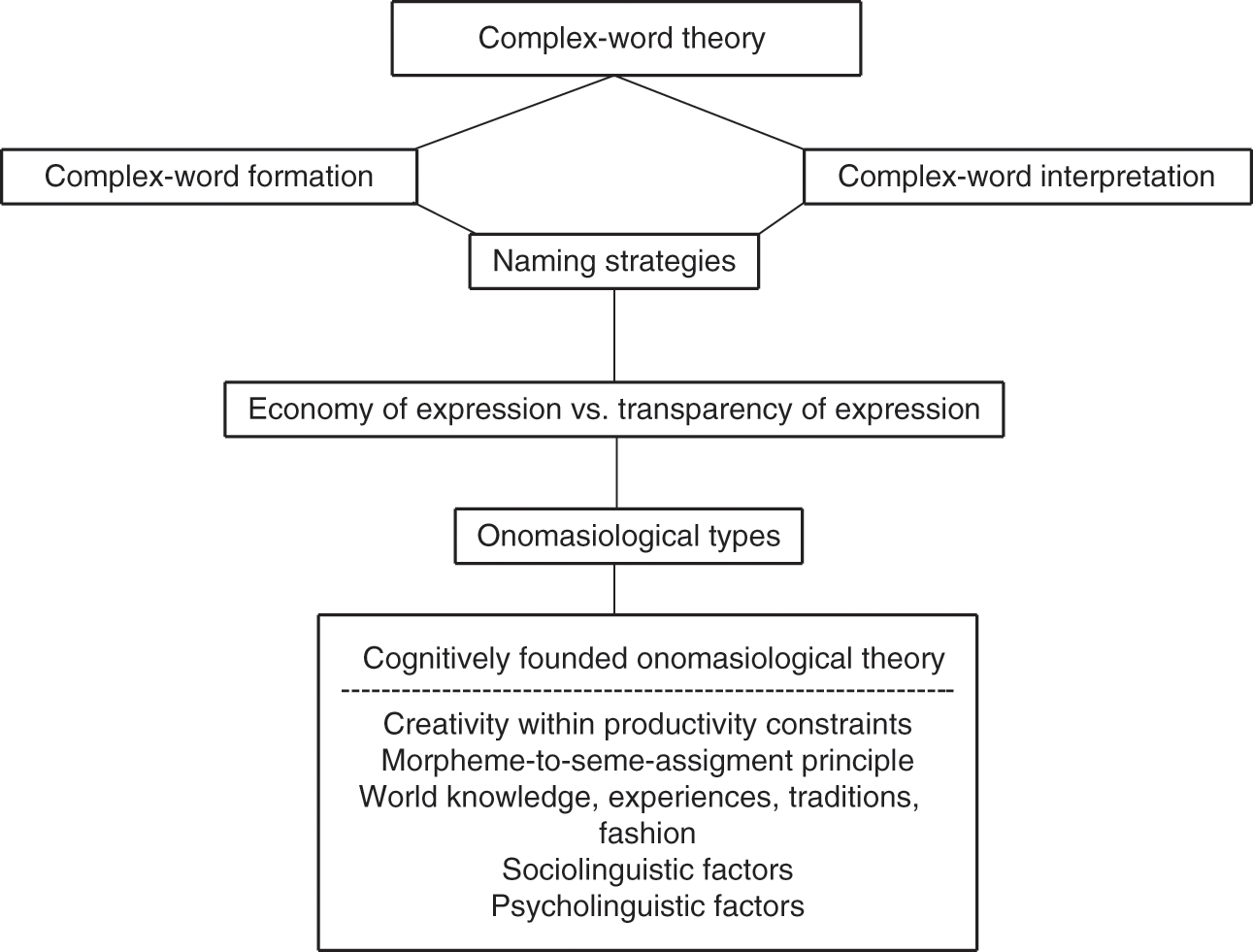
Figure 4.1 An onomasiological model of complex words

