Book contents
- Frontmatter
- Contents
- List of Figures and Tables
- Preface
- Abbreviations
- Series Editor's Preface
- Map
- Introduction: Diodorus' Work and Our Sources
- 1 Diodorus’ Sources
- 2 Ancient History: Assyrians, Chaldeans, and Medes
- 3 The Persians and the Greek Wars
- 4 Revolt and Sedition
- 5 Alexander the Great Defeats Darius III
- 6 From Persepolis to Babylon
- 7 The Period of the Diadochs: The Rift Opens
- 8 The Period of the Diadochs: The Rift Deepens
- 9 The Vicissitudes of the Diadoch Kingdoms: The Final Years of Diodorus' Persian Account
- 10 Semiramis' Legacy
- Conclusion
- Bibliography
- Index of Classical Sources
- Index of Modern Authors
- General Index
Conclusion
Published online by Cambridge University Press: 10 May 2017

Book contents
- Frontmatter
- Contents
- List of Figures and Tables
- Preface
- Abbreviations
- Series Editor's Preface
- Map
- Introduction: Diodorus' Work and Our Sources
- 1 Diodorus’ Sources
- 2 Ancient History: Assyrians, Chaldeans, and Medes
- 3 The Persians and the Greek Wars
- 4 Revolt and Sedition
- 5 Alexander the Great Defeats Darius III
- 6 From Persepolis to Babylon
- 7 The Period of the Diadochs: The Rift Opens
- 8 The Period of the Diadochs: The Rift Deepens
- 9 The Vicissitudes of the Diadoch Kingdoms: The Final Years of Diodorus' Persian Account
- 10 Semiramis' Legacy
- Conclusion
- Bibliography
- Index of Classical Sources
- Index of Modern Authors
- General Index
Summary
Some final remarks seem to be in place. Many people involved in ancient history and classical Greek and/or Latin literature apparently tend to forget that the ancient historians, perhaps with a few exceptions such as Thucydides, who stated that he wrote his work as a κτη̃μα ές άεὶ (‘a possession for all time’: Th.1.22), did not write for them but for their contemporaries and, maybe, the next generation at best. All efforts to try and categorise those authors, an activity that I myself occasionally also practise, are, therefore, ultimately not really very rewarding. Paraphrasing the words of Schwartz (Schwartz 1903a: cols. 663–4), referred to in the Introduction, I might state that only those writing many centuries after Diodorus were sufficiently arrogant to measure his work (and that of many of his contemporaries) by the standards they should have applied primarily to their own works.
I think that, essentially, it might well be more useful to try and find out what kind of sources our predecessors used, how they used them, and – if at all possible – why they used them as they did, and what their personal beliefs (in the widest sense) were. An additional challenge might well be to try and establish how their efforts were valued, by both their contemporaries and, perhaps, the subsequent generation(s), possibly even (though it certainly seems a long shot) what caused their work(s) to be preserved and that of many others not. Such research might, in the end, force us to take a more humble attitude towards those predecessors, on whose work we have to rely, after all, as one of the very sources for our own studies (along with, for example, archaeological, numismatic, papyrological, and epigraphical sources). Having stated this, I do not want to entice anyone to appreciate an author like Diodorus more than he deserves, though I sincerely believe he deserves (much) better than he got from Schwartz and the latter's followers.
Information
- Type
- Chapter
- Information
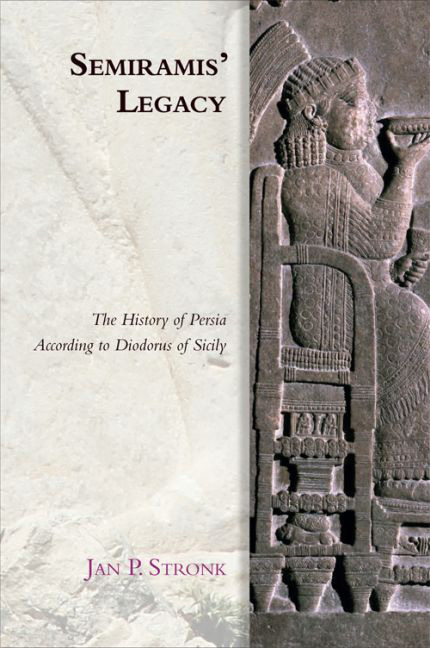
- Semiramis' LegacyThe History of Persia According to Diodorus of Sicily, pp. 543 - 545Publisher: Edinburgh University PressPrint publication year: 2017
Accessibility standard: Unknown
Why this information is here
This section outlines the accessibility features of this content - including support for screen readers, full keyboard navigation and high-contrast display options. This may not be relevant for you.Accessibility Information
Accessibility compliance for the PDF of this book is currently unknown
and may be updated in the future.