Book contents
- Frontmatter
- Contents
- List of contributors
- Editors' and Authors' Acknowledgements
- 1 Individuals and populations
- 2 The sheep of St Kilda
- 3 Population dynamics in Soay sheep
- 4 Vegetation and sheep population dynamics
- 5 Parasites and their impact
- 6 Mating patterns and male breeding success
- 7 Selection on phenotype
- 8 Molecular genetic variation and selection on genotype
- 9 Adaptive reproductive strategies
- 10 The causes and consequences of instability
- Appendix 1 The flora of St Kilda
- Appendix 2 Inheritance of coat colour and horn type in Hirta Soay sheep
- Appendix 3 How average life tables can mislead
- References
- Index
- Plate section
1 - Individuals and populations
Published online by Cambridge University Press: 07 December 2009

Book contents
- Frontmatter
- Contents
- List of contributors
- Editors' and Authors' Acknowledgements
- 1 Individuals and populations
- 2 The sheep of St Kilda
- 3 Population dynamics in Soay sheep
- 4 Vegetation and sheep population dynamics
- 5 Parasites and their impact
- 6 Mating patterns and male breeding success
- 7 Selection on phenotype
- 8 Molecular genetic variation and selection on genotype
- 9 Adaptive reproductive strategies
- 10 The causes and consequences of instability
- Appendix 1 The flora of St Kilda
- Appendix 2 Inheritance of coat colour and horn type in Hirta Soay sheep
- Appendix 3 How average life tables can mislead
- References
- Index
- Plate section
Summary
Sheep on St Kilda
Off the north-west coast of Scotland, beyond the protective chain of the Outer Hebrides, lie the islands of St Kilda (Fig. 1.1). The fragmented ring of a tertiary volcano, the four main islands are steep and craggy, their low ground green with lush grass (Fig. 1.2). The steep sea-cliffs of the islands are streaked with the droppings of seabirds for whom the islands are a major breeding base. Over many centuries, the birds have enriched the islands' soil and their eggs and young have attracted humans for more than four thousand years. The earliest hunters left few visible marks on the landscape, but the dry-stone walls built by the farmers that followed still bisect the low ground and the ruins of their cottages are scattered across the lower slopes of the hills.
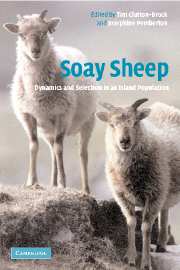
Through these ruins, Soay sheep wander (Fig. 1.3a, b). Small, horned and mostly brown or black, they are the survivors of the earliest domestic sheep that spread through Europe in the Bronze Age, reaching Britain's remotest islands between three and four thousand years ago. In the course of time, they were replaced by larger, more productive breeds, but a remnant population of original sheep was abandoned on Soay, a 99-ha island where their existence was protected by the difficulty of access (Fig. 1.4).
Information
- Type
- Chapter
- Information
- Soay SheepDynamics and Selection in an Island Population, pp. 1 - 16Publisher: Cambridge University PressPrint publication year: 2003
Accessibility standard: Unknown
Why this information is here
This section outlines the accessibility features of this content - including support for screen readers, full keyboard navigation and high-contrast display options. This may not be relevant for you.Accessibility Information
Accessibility compliance for the PDF of this book is currently unknown
and may be updated in the future.
- 2
- Cited by