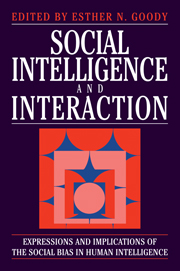
 Social Intelligence and Interaction
 Expressions and implications of the social bias in human intelligence
Book contents
- Frontmatter
- Contents
- List of contributors
- Conventions used in transcripts
- Preface
- Introduction: some implications of a social origin of intelligence
- Part I Primary processes
- Part II The interactive negotiation of meaning in conversation
- Part III Genres as tools that shape interation
- Part IV Expressions of a social bias in intelligence
- Consolidated bibliography
- Index
Preface
Published online by Cambridge University Press: 09 January 2010
Edited by

Book contents
- Frontmatter
- Contents
- List of contributors
- Conventions used in transcripts
- Preface
- Introduction: some implications of a social origin of intelligence
- Part I Primary processes
- Part II The interactive negotiation of meaning in conversation
- Part III Genres as tools that shape interation
- Part IV Expressions of a social bias in intelligence
- Consolidated bibliography
- Index
Summary
It is both a hazard and a delight of anthropological fieldwork that the more completely one becomes immersed in a society and culture totally different from one's own, the more similar people seem to kin and friends at home. Despite the manifest, subtle and profound differences there is a level on which people seem to feel and act in basically similar ways. The dynamics of this dialectic between socio-cultural uniqueness and common humanity lie in part at the intersection between cultural forms and inter-personal interaction. This is an area I first explored in papers on the links between greeting, giving and constraining (1972) and on questioning (1978a). However these two problems raised more general issues concerning the inferring of intentions in interaction, and thus the significance of social roles for making interaction more predictable (1978b). Ethologists are now suggesting that primate intelligence was directly linked to the challenges of social interdependence. This insight places the problems of greeting, questioning and inferring intentions in an even wider context. What can we learn about the nature of human society by taking seriously the possibility that human intelligence is in this fundamental sense social intelligence?
It is difficult to know where to begin with such a general problem, particularly if there is a commitment to a firm empirical base. The Working Papers were essays directed at particular aspects: the implications for primate social intelligence of an emerging spoken language; the new potentiality of language for meeting the challenges of social interdependence; language and the emergence of institutionalized gender roles; language and the emergence of rules.
Information
- Type
- Chapter
- Information
- Social Intelligence and InteractionExpressions and implications of the social bias in human intelligence, pp. xi - xivPublisher: Cambridge University PressPrint publication year: 1995
Accessibility standard: Unknown
Why this information is here
This section outlines the accessibility features of this content - including support for screen readers, full keyboard navigation and high-contrast display options. This may not be relevant for you.Accessibility Information
Accessibility compliance for the PDF of this chapter is currently unknown
and may be updated in the future.