
Skip to main content Accessibility help
×
  • Cited by 15
    • Show more authors
    • You may already have access via personal or institutional login
    • Select format
    • Publisher:
      Cambridge University Press
      Publication date:
      20 March 2021
      15 April 2021
      ISBN:
      9781108588249
      9781108706612
      Dimensions:
      Weight & Pages:
      Dimensions:
      (229 x 152 mm)
      Weight & Pages:
      0.12kg, 68 Pages
    You may already have access via personal or institutional login
  • Selected: Digital
    Add to cart View cart Buy from Cambridge.org

    Book description

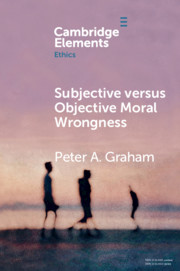
    There is presently a debate between Subjectivists and Objectivists about moral wrongness. Subjectivism is the view that the moral status of our actions, whether they are morally wrong or not, is grounded in our subjective circumstances – either our beliefs about, or our evidence concerning, the world around us. Objectivism, on the other hand, is the view that the moral status of our actions is grounded in our objective circumstances – all those facts other than those which comprise our subjective circumstances. A third view, Ecumenism, has it that the moral status of our actions is grounded both in our subjective and our objective circumstances. After outlining and evaluating the various arguments both against Subjectivism and against Objectivism, this Element offers a tentative defense of Objectivism about moral wrongness.

    References

    Berker, S. 2018. “The Unity of Grounding,” Mind, 127: 729–77.
    Bykvist, K. 2009. “Objective versus Subjective Moral Oughts,” Uppsala Philosophical Studies, 57: 3965.
    Cohen, Y. and Timmerman, T. 2016. “Moral Obligations: Actualist, Possibilist, or Hybridist?Australasian Journal of Philosophy, 94(4): 672–86.
    Davidson, D. 1963. “Actions, Reasons, and Causes,” The Journal of Philosophy, 60(23): 685700.
    Driver, J. 2012. “What the Objective Standard Is Good For,” Oxford Studies in Normative Ethics, 2: 2844.
    Feldman, F. 1986. Doing the Best We Can. Dordrecht: D. Reidel.
    Feldman, F. 2012. “True and Useful: On the Structure of a Two-Level Normative Theory,” Utilitas, 24(2): 151–71.
    Fine, K. 2012. “Guide to Ground,” in Correia, F. and Schnieder, B. (eds.), Metaphysical Grounding. Cambridge: Cambridge University Press, 3780.
    Fox, P. 2019. “Revisiting the Argument from Action Guidance,” Journal of Ethics and Social Philosophy, 15(3): 222–54.
    Frankfurt, H. 1969. “Alternate Possibilities and Moral Responsibility,” The Journal of Philosophy, 66(23): 829–39.
    Goble, L. 1993. “The Logic of Obligation, ‘Better’ and ‘Worse’,” Philosophical Studies, 70: 133–63.
    Goldman, H. S. 1976. “Dated Rightness and Moral Imperfection,” Philosophical Review, 85: 449–87.
    Goldman, H. S. 1978. “Doing the Best One Can,” in Goldman, A. I. and Kim, J. (eds.), Values and Morals. Dordrecht: D. Reidel, 185214.
    Gowans, C. W. (ed.). 1987. Moral Dilemmas. New York: Oxford University Press.
    Graham, P. A. 2010. “In Defense of Objectivism about Moral Obligation,” Ethics, 121(1): 88115.
    Graham, P. A. 2014. “A Sketch of a Theory of Moral Blameworthiness,” Philosophy and Phenomenological Research, 88(2): 388409.
    Graham, P. A. 2019. “An Argument for Objective Possibilism,” Ergo, 6(8): 217–47.
    Graham, P. A. in press. “Two Arguments for Objectivism about Moral Permissibility,” Australasian Journal of Philosophy.
    Greenspan, P. S. 1978. “Oughts and Determinism: A Response to Goldman,” Philosophical Review, 87: 7783.
    Hedden, B. 2012. “Options and the Subjective Ought,” Philosophical Studies, 158(2): 343–60.
    Howard-Snyder, F. 2005. “It’s the Thought That Counts,” Utilitas, 17(3): 265–81.
    Hurka, T. 2019. “More Seriously Wrong, More Importantly Right,” Journal of the American Philosophical Association, 5(1): 4158.
    Jackson, F. 1991. “Decision-Theoretic Consequentialism and the Nearest and Dearest Objection,” Ethics, 101(3): 461–82.
    Jackson, F. and Pargetter, R. 1986. “Oughts, Options, and Actualism,” Philosophical Review, 95: 233–55.
    Kiesewetter, B. 2011. “‘Ought’ and the Perspective of the Agent,” Journal of Ethics and Social Philosophy, 5(3): 124.
    Kiesewetter, B. 2017. The Normativity of Rationality. Oxford: Oxford University Press.
    Kolodny, N. and MacFarlane, J. 2010. “Ifs and Oughts,” The Journal of Philosophy, 107(3): 115–43.
    Koon, J. 2019. “Options Must Be External,” Philosophical Studies, 177(5): 1175–89.
    Lehrer, K. 1968. “Cans without Ifs,” Analysis, 29: 2932.
    Litland, J. E. 2013. “On Some Counterexamples to the Transitivity of Grounding,” Essays in Philosophy, 14(1): 1932.
    Lockhart, T. 2000. Moral Uncertainty and Its Consequences. Oxford: Oxford University Press.
    Lord, E. 2015. “Acting for the Right Reasons, Abilities, and Obligation,” Oxford Studies in Metaethics, 10: 2652.
    Lord, E. 2017. “What You’re Rationally Required to Do and What You Ought to Do (Are the Same Thing!),” Mind, 126: 1109–54.
    Lord, E. 2018. The Importance of Being Rational. Oxford: Oxford University Press.
    Mason, E. 2013. “Objectivism and Prospectivism about Rightness,” Journal of Ethics and Social Philosophy, 7(2): 121.
    Mason, H. E. (ed.) 1996. Moral Dilemmas and Moral Theory. New York: Oxford University Press.
    Moore, G. E. 1912. Ethics. Oxford: Oxford University Press.
    Parfit, D. 2011. On What Matters: Volume One. Oxford: Oxford University Press.
    Portmore, D. W. 2011. Commonsense Consequentialism: Wherein Morality Meets Rationality. New York: Oxford University Press.
    Prichard, H. A. 2002. “Duty and Ignorance of Fact,” in MacAdam, J. (ed.), Moral Writings. Oxford: Oxford University Press, 84101.
    Prior, A. N. 1960. “The Autonomy of Ethics,” Australasian Journal of Philosophy, 38(3): 199206.
    Regan, D. 1980. Utilitarianism and Cooperation. Oxford: Oxford University Press.
    Rosen, G. 2010. “Metaphysical Dependence: Grounding and Reduction,” in Hale, B. and Hoffman, A. (eds.), Modality: Metaphysics, Logic, and Epistemology. Oxford: Oxford University Press, 109–35.
    Rosen, G. 2015. “The Alethic Conception of Moral Responsibility,” in Clarke, R., McKenna, M., and Smith, A. (eds.), The Nature of Moral Responsibility: New Essays. Oxford: Oxford University Press, 6588.
    Ross, J. 2012. “Actualism, Possibilism, and Beyond,” Oxford Studies in Normative Ethics, 2: 7496.
    Ross, W. D. 1939. Foundations of Ethics. Oxford: Oxford University Press.
    Ross, W. D. 2002. The Right and the Good. Oxford: Oxford University Press.
    Scanlon, T. M. 2008. Moral Dimensions: Permissibility, Meaning, and Blame. Cambridge, MA: Harvard University Press.
    Schaffer, J. 2012. “Grounding, Transitivity, and Contrastivity,” in Correia, F. and Schnieder, B (eds.), Metaphysical Grounding. Cambridge: Cambridge University Press, 122–38.
    Sepielli, A. 2012. “Subjective Normativity and Action Guidance,” Oxford Studies in Normative Ethics, 2: 4573.
    Sepielli, A. 2018. “Subjective and Objective Reasons,” in Star, D. (ed.), The Oxford Handbook of Reasons and Normativity. Oxford: Oxford University Press, 784–99.
    Sinnott-Armstrong, W. 1988. Moral Dilemmas. Oxford: Blackwell.
    Smith, H. 2018. Making Morality Work. Oxford: Oxford University Press.
    Sobel, J. H. 1976. “Utilitarianism and Past and Future Mistakes,” Noûs, 10: 195219.
    Strawson, P. F. 1962. “Freedom and Resentment,” Proceedings of the British Academy, 48: 125.
    Thomason, R. H. 1981. “Deontic Logic and the Role of Freedom in Moral Deliberation,” in Hilpinen, R. (ed.), New Studies in Deontic Logic. Dordrecht: D. Reidel, 177–86.
    Thomson, J. J. 1985. “Imposing Risks,” in Gibson, M. (ed.), To Breathe Freely. Totowa, NJ: Rowman and Allanheld, 124–40.
    Thomson, J. J. 1990. The Realm of Rights. Cambridge, MA: Harvard University Press.
    Thomson, J. J. 2008. Normativity. Peru, IL: Carus Publishing Company.
    Vessel, J. P. 2009. “Defending a Possibilist Insight in Consequentialist Thought,” Philosophical Studies, 142: 183–95.
    Vorobej, M. 2000. “Prosaic Possibilism,” Philosophical Studies, 97: 131–6.
    Wallace, R. J. 1994. Responsibility and the Moral Sentiments. Cambridge, MA: Harvard University Press.
    Way, J. and Whiting, D. 2016. “If You Justifiably Believe You Ought to ϕ, Then You Ought to ϕ,” Philosophical Studies, 173(7): 1873–95.
    Way, J. and Whiting, D. 2017. “Perspectivism and the Argument from Guidance,” Ethical Theory and Moral Practice, 20(2): 361–74.
    Zimmerman, M. J. 1988. An Essay on Moral Responsibility. Totowa, NJ: Rowman & Littlefield.
    Zimmerman, M. J. 1996. The Concept of Moral Obligation. Cambridge: Cambridge University Press.
    Zimmerman, M. J. 2006. “Is Moral Obligation Objective or Subjective?Utilitas, 18(4): 329–61.
    Zimmerman, M. J. 2008. Living with Uncertainty. Cambridge: Cambridge University Press.
    Zimmerman, M. J. 2014. Ignorance and Moral Obligation. Oxford: Oxford University Press.

    Metrics

    Altmetric attention score

    Full text views

    Total number of HTML views: 0
    Total number of PDF views: 0 *
    Loading metrics...

    Book summary page views

    Total views: 0 *
    Loading metrics...

    * Views captured on Cambridge Core between #date#. This data will be updated every 24 hours.

    Usage data cannot currently be displayed.

    Accessibility standard: Unknown

    Why this information is here

    This section outlines the accessibility features of this content - including support for screen readers, full keyboard navigation and high-contrast display options. This may not be relevant for you.

    Accessibility Information

    Accessibility compliance for the PDF of this book is currently unknown and may be updated in the future.
