


1.1 An Introduction to Functional Grammar
In 1985 Michael Halliday published the first edition of the consolidation of his work on English grammar, titled An Introduction to Functional Grammar. This work impressed many readers as a strikingly innovative contribution to the field; it and subsequent editions have generated well over 45,000 Google Scholar hits since that time. And few would quibble with assigning the title of genius to the author of a visionary work of this kind.
We need to remind ourselves however, as Halliday himself would have been the first to admit, that the genius of this description of English was entirely dependent upon the genius of the Systemic Functional Linguistic (SFL) theory which Halliday and his colleagues had concomitantly designed (rooted firmly as it was in the European functional/structuralist tradition). In this book we take up the challenge of showing how to do it – how to take SFL theory and use it to produce a grammatical description of this order. We do this by focusing on three world languages, English, Spanish and Chinese.Footnote 1 We don’t do this primarily in order to compare and contrast these three languages. Our main purpose is, rather, to lead readers step by step through theoretical architecture and practical reasoning, which can be used to ground descriptions of the meaning-making potential of the grammatical systems and structure of languages (and related semiotic systems of any kind).
We can’t all, of course, be Michael Hallidays and enact his unsurpassed ‘feel’ for the intricate ways in which English grammar means. But we can all learn how to take SFL theory and deploy it to formulate descriptions. This is the theoretical and practical knowledge we are attempting to share in this monograph.
1.2 Introducing This Book
This book builds in particular on two foundational introductions to SFL language description (Reference Matthiessen and HallidayMatthiessen and Halliday, 1997/2009; Reference Martin, Wang and ZhuMartin, Wang and Zhu, 2013) – with a view to modelling our perspective on the reasoning through which grammatical descriptions of languages can best be formulated.
The first of these, Reference Matthiessen and HallidayMatthiessen and Halliday (1997/2009), provides an overview of Systemic Functional Grammar (SFG), exploring its various dimensions and situating it as a model of one level of language within the linguistic theory known as Systemic Functional Linguistics. The second, Reference Martin, Wang and ZhuMartin, Wang and Zhu (2013), takes one of these dimensions, axis, and introduces the basic principles of system network writing – including reasoning about the motivation of systems. That book reveals how the other fundamental dimensions of the theory (i.e. rank, metafunction and stratification) can all be derived from SFL’s axial orientation to language analysis. These two books are critical resources as far as this publication is concerned.
This book pushes deeper, exploring in detail how SFG descriptions can be most effectively developed; it uses three major world languages, English, Spanish and Chinese, as exemplars. The book zeroes in on the grammar of clauses, groups and phrases – with chapters dedicated to central categories in the analysis of nominal groups, verbal groups, and mood, transitivity and theme clause systems respectively. Clause complex relations and word morphology will be brought into the picture only where needed to interpret clauses, groups and phrases. Each chapter begins with a discussion of English systems, followed by Spanish and then Chinese.
At the start of each chapter we review the context variables (i.e. register and genre choices) that are most relevant to the grammar systems considered. We next review the discourse semantic systems which bear critically on the grammar choices we will explore. We then move on to key grammatical systems and structures of English, Spanish and Chinese, building up a description step by step from first principles in order to make the reasoning involved as explicit as possible (including reasoning from above with respect to discourse semantics and, where relevant, from below with respect to prosodic phonology). This means, of course, that our descriptions cannot be as comprehensive as those found in grammars that are less explicit about their reasoning and which make more assumptions about SFL and about long-standing traditions of grammar analysis that are available for English, Spanish and Chinese. We have adopted this strategy because our goal is to model the way in which we feel SFL grammarians can best go about the work of developing rich functional descriptions. In doing so we hope to foster work on languages for which grammars informed by SFL have not yet been developed and to encourage critical appreciations and renovations of work that has already been done.
For many of our analyses we draw on published descriptions by SFL grammarians, work we acknowledge as we do so. For some of our analyses, we extend these extant descriptions and for others we propose alternatives. And in some of our analyses, we approach dimensions of English, Spanish and Chinese that haven’t been described before.
In SFL the founding principle of our analysis is that of choice – of language as a system of systems enacting the registers and genres through which we live our lives. Inspired by Halliday (e.g. Reference Halliday1978, Reference Halliday, Fawcett, Halliday, Lamb and Makkai1984a), SFL treats language as social semiotic behaviour and thus gives priority to modelling language paradigmatically as a meaning-making resource. We will develop grammar for English, Spanish and Chinese in precisely these terms.
The key to this modelling, as introduced in Reference Martin, Wang and ZhuMartin, Wang and Zhu (2013), is axis – the dimension of SFL that privileges paradigmatic relations over syntagmatic ones, but at the same time motivates systemic choice in terms of its ultimate structuration. This book is about modelling how we believe this can most effectively be done.
In the next section we outline the model of language and context we will assume for purposes of this modelling. We assume a stratified model of context (as register and genre), as introduced in Reference MartinMartin (1992) and elaborated in Reference Martin and RoseMartin and Rose (2008). And we assume a stratified model of language (as discourse semantics, lexicogrammar and phonology/graphology), whose discourse semantic stratum is outlined in Reference MartinMartin (1992), popularised in Reference Martin and RoseMartin and Rose (2003/2007) and elaborated in Reference Martin and WhiteMartin and White (2005). It is with respect to this framework that we reason about lexicogrammatical systems (as introduced in Section 1.4 below): (i) from above with respect to context and co-text, (ii) from around with respect to simultaneous systems and (iii) from below with respect to lower-ranking grammatical systems and phonology/graphology. For collections of grammatical descriptions assuming modelling and argumentation of this kind, see Reference MartinMartin (2018a); Reference Martin, Doran and FigueredoMartin, Doran and Figueredo (2020); Reference Martin, Quiroz and FigueredoMartin, Quiroz and Figueredo (2021); and Reference Doran, Martin and ZhangDoran, Martin and Zhang (2021a, Reference Doran, Martin and Zhang2021b, Reference Doran, Martin and Zhang2022a, Reference Doran, Martin and Zhang2022b).
1.3 Above Grammar: Context and Co-text
In our approach to SFL, grammar systems realise higher-level systems that we refer to here as genre, register and discourse semantics. This allows us to bring patterns in context (i.e. the functions of language in use) and co-text (i.e. structure beyond grammar) to bear on grammar analysis. We introduce these higher-level systems here to emphasise the sense in which they offer an integrated holistic perspective on social semiotic behaviour. Grammar is a level of language, but it is one level among others. In a system where tout se tient ‘everything interconnects’ (Reference MeilletMeillet, 1903), we have to take all meaning-making resources into account.
1.3.1 Context (Register and Genre)
First, context. In SFL, behaviour is brought into the picture by modelling context semiotically as systems of choice. There is general consensus in SFL that this model of social behaviour should include three key variables – referred to as field, tenor and mode. In SFL the relation of language to context is generally modelled using co-tangential circles, as in Figure 1.1, with the inner circle representing language and the outer circle context (factored as field, tenor and mode).

Figure 1.1 Language in context (field, tenor and mode)
We begin by introducing some basic field, tenor and mode register variables – using topologies to exemplify the choices involved. Topologies are models of semiotic choice that treat systems of choice as clines. This kind of modelling allows us to treat registers as more or less the same, a useful modelling strategy in contextual analysis. The basic schema for topologies involving two variables is set out in Figure 1.2. Registers in this diagram are positioned at the prototypical centre of each quadrant; however, depending on their semiotic likeness to one another, they can, in principle, be positioned anywhere along either cline. For a more detailed set of proposals, alternatively organised as system networks, see Reference MartinMartin (1992); for discussion of topology in relation to typology, see Reference Martin, Matthiessen and ChristieMartin and Matthiessen (1991), Reference Martin, Wang and ZhuMartin, Wang and Zhu (2013).

Figure 1.2 Modelling context topologically
Field is a resource for construing phenomena as activities oriented to some global institutional purpose, or as items involved in these activities, along with associated properties (Reference MartinMartin, 1992; Reference Doran, Martin, Maton, Martin and DoranDoran and Martin, 2021). One key variable thus has to do with whether phenomena are construed dynamically as activity (unfolding through time) or statically as items (taxonomised by classification and composition). A second key variable has to do with whether phenomena are construed in everyday terms (through ostensive definition and by undertaking activities with others) or as technical discourse (through reading and writing activities in institutions that have been developed for regulating access to uncommon sense discourse). These two variables are presented as clines in Figure 1.3 and exemplified as recounting a holiday (an everyday activity perspective), explaining evolution (a technical activity perspective), classifying crocodiles (a technical taxonomy perspective) and describing a pet (an everyday taxonomy perspective).

Figure 1.3 Field relations
Tenor is a resource for enacting social relations of power and solidarity. One key variable manages the power dimension of discourse – are the interlocutors of equal status or not, and if not, who will dominate and who must defer? A second key variable manages the solidarity dimension of discourse – how closely involved are the interlocutors with one another? These two variables are presented as clines in Figure 1.4 and exemplified as relationships involving close friends (close equal relations), casual acquaintances (distant equal relations), a faculty dean and students (distant unequal relations) and a supervisor and their PhD student (close unequal relations).

Figure 1.4 Tenor relations
Mode is a resource for texturing information flow, depending on the medium of communication (speaking, writing, phoning, e-mailing, texting, blogging and so on). One key variable composes the context dependency of discourse – is the language part of what is going on or is it constitutive of the interaction taking place? In terms of multimodal discourse analysis, this variable is responsible for how much work is being done by language in relation to other modalities of communication and behaviour. A second key variable composes discourse as more or less interactive – does it feature turn-taking with immediate aural and visual feedback, or is it relatively monologic with various degrees of delayed response? These two variables are presented as clines in Figure 1.5 and exemplified as composing casual conversation (dialogic constitutive texture), news stories (monologic constitutive texture), sports commentary (monologic ancillary texture) and domestic exchanges (dialogic ancillary texture).

Figure 1.5 Mode relations
For some models of SFL, a stratified model of context has been developed, with genre as a higher level of abstraction, above register (Reference MartinMartin, 1992; Reference Martin and RoseMartin and Rose, 2008). In these models genre is treated as a recurrent configuration of field, tenor and mode variables, typically unfolding in stages as a text consummates its social purpose. In this book we deal with just a few genres which are instantiated as the key texts we use as sources of examples in our chapters. The texts we focus on are outlined in Table 1.1, aligned with the chapter sections they inform.
Table 1.1 The main texts contextualising examples in this book
| Chapter | English texts | Spanish texts | Chinese texts |
|---|---|---|---|
| 2 Nominal group | Bondi Beach | La Ola Maldita | Sea Lettuce |
| 3 Verbal group | Random Chatty Vlog | La Ola Maldita | Interview with Curator |
| 4 mood | Youth Justice Conference | El Cambio de Plan; El Decodificador | Reckless Driving |
| 5 transitivity | Random Chatty Vlog | La Ola Maldita | Interview with Curator |
| 6 theme | Bondi Beach | La Ola Maldita; Sopaipillas | Sea Lettuce |
Our choice of data is opportunistic and designed for pedagogic purposes. Just a few texts play a central role in as many chapters as possible, supplemented only where necessary by additional material. We adopt this strategy so readers can see how texts with which they become increasingly familiar look from the perspective of different grammatical systems. For similar reasons we focus on just one dialect of English, Spanish and Chinese, so as not to have to spend time discussing dialectal variations. As we outline in Chapter 7, this is not the approach to data we recommend for research purposes.
Three main English texts are deployed. One is a feature article about a rescue operation by lifesavers at Bondi Beach, Sydney, when freak waves swept 250 people out to sea; we refer to this as our Bondi Beach text. One is a vlog (i.e. a video blog) about the recent experiences of an American housewife and mother; we refer to this as our Random Chatty Vlog text. And one is a transcript of a New South Wales Youth Justice Conference, a legal process in which adolescent offenders meet with their victim and other community members to negotiate an apology and some form of community service by way of recompense for their offence (Reference Zappavigna and MartinZappavigna and Martin, 2018); we refer to this as our Youth Justice Conference text. These texts provide us with most of the range of spoken and written language features we need to ground our top-down approach to English grammar description.
Our main Spanish text is a feature article retelling the stories of the survivors of a massive earthquake and tsunami that devastated the coast of Chile in 2010; we refer to this as our La Ola Maldita (‘the hellish wave’) text. We also draw examples from two call centre texts, one asking for a change of cable TV plan and the other sorting out a problem with a set-top box; we refer to these as our El Cambio de Plan (‘change of plan’) text and El Decodificador (‘set-top box’) text respectively. We also include consideration of a pumpkin fritters recipe, which we refer to as our Sopaipillas (‘fritters’) text.Footnote 2 Once again these texts provide us with most of the range of spoken and written language features we need to ground our top-down approach to Spanish grammar description.
The description of Chinese is based on three main texts. One is a feature article published on the website of the Institute of Oceanology, Chinese Academy of Sciences – about controlling sea lettuce, a kind of green algae, that grows along the coast of East China’s Qingdao city and which threatened sailing events during the 2018 Olympics; we refer to this as the Sea Lettuce text. Another is an interview with Mr Shan Jixiang, then retiring curator of Beijing’s Palace Museum (also known as the Forbidden City) – reviewing his work experience in the Palace Museum and airing his wishes for the museum’s future development; we refer to this as our Interview with Curator text. The third is a court trial dealing with a reckless driving case, in which two young drivers raced against each other, lost control of their vehicles and caused serious damage and injury; we refer to this as our Reckless Driving text. These texts provide us with most of the spoken and written language features we need to ground our top-down approach to Chinese grammar description.
The relevance of these texts is outlined, chapter by chapter, in Table 1.1. Except for the Youth Justice Conference text and Reckless Driving text (which are too long), they are presented in full in Appendices 2–4; relevant citations are provided there.
The genres involved in these texts are outlined in Table 1.2, alongside the register variables through which they are realised. Our story genres are mainly monologic but do include some more interactive quotations. The El Cambio de Plan service encounter is constitutive; but the El Decodificador call includes phases of interaction in which the server gets the client to deal hands-on with the set-top box to get it working again.
Table 1.2 Key register variables for main texts
| genre | field | tenor | mode | |
|---|---|---|---|---|
| stories |
Random Chatty Vlog Bondi Beach La Ola Maldita Sea Lettuce |
domestic natural disaster |
close/equal distant/unequal | ≈ monologic/ constitutive |
| procedure | Sopaipillas | cooking recipe | distant/unequal | monologic/ constitutive |
| service encounters |
El Cambio de Plan El Decodificador |
pay TV contract set-top box disorder | distant/unequal | dialogic/ ≈ constitutive |
| conference | Youth Justice Conference | restorative justice | distant/unequal | dialogic/ constitutive |
| interview | Interview with Curator | work experience | distant/unequal | dialogic/ constitutive |
| court trial | Reckless Driving | criminal offence | distant/unequal | dialogic/ constitutive |
The stratified model of language and context used to model these genres is imaged in Figure 1.6. In terms of realisation, the model treats choices among genres as realised through recurrent configurations of register choices, and register choices as realised through recurrent patterns of choices in language.

Figure 1.6 The stratified model of context assumed for this book
1.3.2 Co-text (Discourse Semantics)
In SFL the extrinsic functional organisation of language (field, tenor and mode) introduced above is correlated with the intrinsic functional organisation of language. Field is treated as by and large construed through ideational meaning, tenor as by and large enacted through interpersonal meaning and mode as by and large composed through textual meaning. In SFL these functional components of language are referred to as metafunctions. The correlations between extrinsic functionality (field, tenor and mode) and intrinsic functionality (ideational, interpersonal and textual meaning) are outlined in Figure 1.7. As the diagram implies, genre and register are modelled as strata of meaning – the social semiotic perspective on language as behaviour we outlined in Section 1.3.1.

Figure 1.7 Extrinsic functionality (context) and intrinsic functionality (language)
Alongside being organised by metafunction, language is organised by stratum – as choices in discourse semantic systems realised by choices in lexicogrammatical systems realised in turn by choices in phonological systems (Figure 1.8). At the level of discourse semantics, we are concerned with meaning realised both inside and between clauses, whether these clauses have any grammatical relation to one another or not. The focus in other words is on co-text.

Figure 1.8 Language strata
We will briefly introduce six discourse semantic systems here, organised by metafunction in Table 1.3. For a detailed presentation of these systems, see Reference MartinMartin (1992), Reference Martin and WhiteMartin and White (2005), Reference Martin and RoseMartin and Rose (2007); useful handbook-style introductions include Reference Martin, Tannen, Hamilton and SchiffrinMartin (2015, Reference Martin, Thompson, Bowcher, Fontaine and Schönthal2018b) and Reference Tann, Bartlett and O’GradyTann (2017). For each system we will note the diversification of grammatical systems realising discourse semantic ones, including what we will refer to as metaphorical realisations; and we will exemplify what we mean by co-textual relations between units of discourse that are not grammatically related to one another. By metaphorical realisations we mean grammatical choices that symbolise discourse semantic ones rather than realising them directly (as discussed in Reference Matthiessen, Yan and WebsterHalliday and Matthiessen, 2014, Chapter 10).
Table 1.3 Discourse semantic systems (organised by metafunction)
| metafunction | discourse semantic systems |
|---|---|
| ideational |
ideation connexion |
| interpersonal |
negotiation appraisal |
| textual |
identification periodicity |
The key ideational systems are ideation and connexion.Footnote 3 ideation comprises resources for construing experience as occurrences and entities in occurrence and state figures. In terms of diversification it allows us, for example, to position figures through a range of clause types (Reference MatthiessenHalliday and Matthiessen, 1999; Reference HaoHao, 2015, Reference Hao2020a, Reference Hao2020b).Footnote 4
“They’ve won”, she mused. (behavioural clause realising the positioning of an occurrence figure)
She knew they’d won. (mental clause realising the positioning of an occurrence figure)
She was aware they’d won. (relational clause realising the positioning of an occurrence figure)
In terms of grammatical metaphor, ideation allows us to realise an occurrence figure congruently as a clause or metaphorically as a nominal group:
She knew they’d win. (congruent realisation of an occurrence figure)Footnote 5
Their win delighted her. (metaphorical realisation of an occurrence figure)
In terms of meaning beyond the clause, ideation allows us, for example, to anticipate occurrence figures – using one clause to name what’s to come (stock-taking below) and others to spell it out:
and it was time to take stock:
⇓
250 people had needed the lifesavers to pull them out, of whom 210 were OK once back on land. Thirty-five needed mouth to mouth to be restored to consciousness, while five people perished.
Connexion comprises resources for relating figures to one another. In terms of diversification, it allows us to connect various types of clause and clause complex to one another (via addition, comparison, time and cause):
Thanks to the lifesavers pulling them out, 210 were OK once back on land.
Because the lifesavers pulled them out, 210 were OK once back on land.
The lifesavers pulled them out so that 210 were OK once back on land.
The lifesavers pulled them out. So 210 were OK once back on land.
In terms of grammatical metaphor, connexion allows us to realise relations between occurrences and states metaphorically as single clauses:
(congruent clause complex construing cause)
They were restored to consciousness
because the lifesavers gave them mouth-to-mouth.
(metaphorical cause in the clause)
Mouth-to-mouth resuscitation ensured their restoration to consciousness.
In terms of meaning beyond the clause, connexion allows us to connect indefinitely long phases of discourse to one another (namely the long justification of the preceding sentence introduced by for below):
In their long and glorious history, this still stands as the finest hour of the Australian lifesaving movement.
⇑
For, ignoring their own possible peril, the Bondi boys now charged into the surf, some attached to one of the seven reels available, some relying only on their own strength. As one, they began pulling the people out. On the shore, many survivors were resuscitated, as the Bondi clubhouse was turned into a kind of emergency clearing house, and ambulances from all over Sydney town descended and carried the victims away. Finally, just half an hour after the waves hit, the water was cleared of bobbing heads and waving arms, and it was time to take stock: 250 people had needed the lifesavers to pull them out, of whom 210 were OK once back on land. Thirty-five needed mouth to mouth to be restored to consciousness, while five people perished.
The key interpersonal systems are negotiation and appraisal. negotiation comprises resources for enacting social relations in dialogue. In terms of diversification it allows us, for example, to realise greeting moves through a range of more and less lexicalised structures.
Hey.
Good morning.
How’s it going?
What a surprise!
Lovely to see you.
Didn’t know you were back.
In terms of grammatical metaphor, negotiation allows us to realise moves directly or metaphorically through so-called ‘indirect speech acts’.
What’s your name? (congruent interrogative clause requesting information)
– Lionel.
Tell me your name. (metaphorical imperative requesting information)
– Lionel.
Your name is …? (metaphorical declarative requesting information)
– Lionel.
In terms of meaning beyond the clause, negotiation allows us to relate moves in conversation, including moves comprising several clauses (as in the following request and compliance sequence):
What I want you to do now is, I need you to tell us in a really loud voice, OK, what happened on that particular day, alright. So I want you to tell me everything that happened on that day that led to you being stopped by the police with the telephone, OK. Can you do that for us? Thanks. Off you go.
⇓⇑
– When I was walking to my mate’s house, this guy just came up to me and he goes “Do you want to buy a phone?”, and I go “Nah”, and I go “Do you want to swap?” He wanted to swap, with my phone. And he looked at my phone and he goes, “Yeah, swap”. And we swapped, and I went and stayed at my mate’s house and then, when it came to night time and I was going back home, I was walking and he was walking me up the road and the police just came and brought us.
Appraisal comprises resources for enacting social relations by sharing attitudes. In terms of diversification it allows us, for example, to realise affect across a range of grammatical structures:
Sadly they lost.
They sadly made their way home.
They were sad because they lost.
The sad fans drowned their sorrows.
The score saddened them.
In terms of grammatical metaphor, appraisal allows us to realise feelings as if they were things, and deploy them accordingly.
They were so palpably sad that it darkened proceedings. (congruent adjectival feeling)
Their palpable sadness darkened proceedings. (metaphorical nominalised feeling)
In terms of meaning beyond the clause, appraisal allows us, for example, to evaluate indefinitely long phases of discourse. The extended connexion example we used above does more than justify a proposition; it also glorifies the lifesavers’ rescue operations:
In their long and glorious history, this still stands as the finest hour of the Australian lifesaving movement.
⇓
For, ignoring their own possible peril, the Bondi boys now charged into the surf, some attached to one of the seven reels available, some relying only on their own strength. As one, they began pulling the people out. On the shore, many survivors were resuscitated, as the Bondi clubhouse was turned into a kind of emergency clearing house, and ambulances from all over Sydney town descended and carried the victims away. Finally, just half an hour after the waves hit, the water was cleared of bobbing heads and waving arms, and it was time to take stock: 250 people had needed the lifesavers to pull them out, of whom 210 were OK once back on land. Thirty-five needed mouth to mouth to be restored to consciousness, while five people perished.
The key textual systems are identification and periodicity. Identification comprises resources for composing discourse in terms of introducing entities and tracking them once there. In terms of diversification it allows us, for example, to track entities through a range of nominal resources:
Pope Francis arrived.
He was dressed in white.
The Argentinian thanked Chileans for their hospitality during his Jesuitical training there.
This pope publicly acknowledged the child abuse scandals.
In terms of meaning beyond the clause, identification allows us to identify and track indefinitely long phases of discourse; the pronoun it is used in this way below to reference the activity that subsequently unfolds.Footnote 6
At three o’clock there was still not the slightest clue that this afternoon would forever be known as “Black Sunday” in the annals of Sydney. Then it happened.
⇓
With a roar like a Bondi tram running amok, an enormous wave suddenly rolled over the thousands in the surf, including those many standing on the large sandbank just out from the shore – knocking them all over as it went. And then another wave hit, and then another. The huge waves, just like that, piggy-backed their way further and further up the beach and grabbed everything they could along the way – from babies to toddlers to adolescents to beach umbrellas, to old blokes and young sheilas alike, and then made a mad dash for the open sea again, carrying all before it and sweeping everyone off the sandbank and into the deep channel next to it in the process.
Periodicity comprises resources for composing text as waves of information. The basic idea here is that there is a hierarchy of periodicity, extending from the small wave lengths of tone group and clause to an indefinite number of indefinitely long phases of discourse. In the example below we have a Kicker foreshadowing an entire feature article about a beachside tragedy, a topic sentence introducing what happened when the waves rolled up the beach further down and a retrospective summary of the effect of the inundations. A wide range of resources, including text reference and ideational grammatical metaphor (in bold below), co-operate with one another to scaffold information flow along these lines.
Big waves and Bondi Beach have always gone together, writes Peter FitzSimons, but no one had ever seen the ocean rise up with a strength such as this. ⇒
At three o’clock there was still not the slightest clue that this afternoon would forever be known as “Black Sunday” in the annals of Sydney. Then it happened.⇒
With a roar like a Bondi tram running amok, an enormous wave suddenly rolled over the thousands in the surf, including those many standing on the large sandbank just out from the shore – knocking them all over as it went. And then another wave hit, and then another. The huge waves, just like that, piggy-backed their way further and further up the beach and grabbed everything they could along the way – from babies to toddlers to adolescents to beach umbrellas, to old blokes and young sheilas alike, and then made a mad dash for the open sea again, carrying all before it and sweeping everyone off the sandbank and into the deep channel next to it in the process.
⇐ In no more than 20 seconds, that peaceful scene had been tragically transformed into utter chaos. Now, the boiling surf, with yet more large waves continuing to roll over, was filled with distressed folk waving for help.
The discourse semantic resources briefly reviewed here are outlined by metafunction in Figure 1.9. They will be reintroduced, as relevant, in Chapters 2–6 of this book.

Figure 1.9 Discourse semantic systems
Since this is a book about grammar, albeit grammar analysis from a holistic linguistic perspective, we do not have room here to introduce discourse semantic systems in further detail. But we do need, perhaps, to emphasise that discourse semantic systems are organised differently from lexicogrammatical ones and that there is no one-to-one relation between discourse semantic and lexicogrammatical features. Rather, there is what Lamb has referred to as interlocking diversification – many-to-many relations between choices in systems on the two strata (see Reference LambLamb, 1964).
1.4 Doing Functional Grammar
There are, of course, many ways of approaching grammar analysis, falling roughly into the formal and functional traditions epitomised in the work of Chomsky and Halliday respectively in the second half of the twentieth century. Methodologically speaking, the complementarity of these traditions can be explored from many perspectives. We will highlight three that bear critically on this volume here.
First data. Rather than relying on a native speaker’s intuitions about what can be said, SFG treats the texts that speakers produce as data. This is quite a challenge, since ultimately we want grammars that take responsibility for as wide a range of texts as possible. Ideally, SFG would draw on SFL register and genre theory to construct a representative corpus and design grammars based on what is found therein (e.g. Reference FigueredoFigueredo, 2021). In this book we will mimic this practice by using a key text as the main source of examples for each language in each chapter. Where practical, in terms of the range of linguistic resources in play, we have used the same text in more than one chapter so that we can show how SFG approaches a text from different dimensions of analysis. Where necessary, for pedagogic purposes, we have at times used constructed examples to simplify the presentation; at other times we have adjusted examples from the texts we used to make a point.
Second appliability. Ideally, rather than developing grammars dedicated to questions that only interest linguists, SFG also takes responsibility for questions about language that interest language users. This means that the grammars are expected to make a contribution to the regions of practice which we recognise as educational linguistics, forensic linguistics, clinical linguistics, translation studies and so on (e.g. Reference Rose and MartinRose and Martin, 2012; Reference Zappavigna and MartinZappavigna and Martin, 2018; Reference Rochester and MartinRochester and Martin, 1979; Reference Steiner and YallopSteiner and Yallop, 2001, respectively; for a more comprehensive survey see Reference Caldwell, Knox and MartinCaldwell, Knox and Martin, 2022). In this book we tackle this challenge by developing rich functional descriptions that show how grammar makes meaning. In doing so, we lay the foundation for the discourse semantic and contextual analysis needed to address communication issues of concern to speakers, wherever they arise.
Third argumentation. Ideally, SFG deploys what is often referred to as ‘trinocular’ vision – reasoning from above, from around and from below (Reference Halliday and WebsterHalliday, 1992/2003). This means that as grammarians we take (discourse) semantics and phonology into account, as linguistic resources that impinge directly on our analyses. And as far as grammar itself is concerned, it means that we take axial reasoning seriously, as promoted in Reference Martin, Wang and ZhuMartin, Wang and Zhu (2013) and Reference QuirozQuiroz (2013, Reference Quiroz2018, Reference Quiroz, Martin, Doran and Figueredo2020). What do we mean when we say “take axial reasoning seriously”?
As outlined in Reference Martin, Wang and ZhuMartin, Wang and Zhu (2013), this means privileging paradigmatic relations over syntagmatic ones, but only on the understanding that any paradigmatic relations we establish must ultimately be motivated by syntagmatic ones. In Reference HallidayHalliday’s (1994, p. xx) terms, “Every distinction that is recognized in the grammar – every set of options, or ‘system’ in systemic terms – makes some contribution to the form of the wording. Often it will be a very indirect one, but it will be somewhere in the picture.” What does he mean by “some contribution to the form of the wording”?
Minimally, some contribution to the form of the wording could be taken to mean focusing almost exclusively on syntagms – on sequences of classes of linguistic units. This would include focusing on word morphology (i.e. distinctive sequences of morphemes with words) and on syntax (understood as distinctive sequences of words in groups and phrases and distinctive sequences of groups and phrases in clauses).Footnote 7 A grammar conceived in just these terms is basically a catalogue of possible syntagms, including sometimes more and sometimes less information about how they are related to one another. All grammarians take syntagms, defined in these terms, into account when developing their descriptions.
In SFG grammarians push deeper, exploring the relations that syntagms enter into with one another. This paradigmatic perspective on deep grammar was developed by Halliday and his colleagues in the 1960s (e.g. Reference Halliday and StuartHalliday 1964, Reference Halliday, Halliday and McIntosh1966), including the formalisation of paradigmatic relations in system networks and specification of the structural basis of distinctions in realisation statements. Reference HallidayHalliday (1967a, Reference Halliday1967b, Reference Halliday1968, Reference Halliday and Webster1970/2005) are the key papers introducing this perspective on deep grammar. Reference Martin, Wang and ZhuMartin, Wang and Zhu (2013) is the basic introduction to the achievements of these functional grammarians; and Reference DavidseDavidse (2018) synthesises their contributions. For foundational papers contextualising this work in SFL, see Reference 448Martin and DoranMartin and Doran (2015a, Reference Martin and Doran2015b, Reference Martin and Doran2015c).
To illustrate this grammatical perspective on meaning as choice, we begin with the following two sets of English clauses. As far as syntagms are concerned, the clauses look identical. The same kind of nominal group is followed by the same kind of verbal group followed in turn by the same kind of nominal group. We have the same pattern over and over again.
Lionel Messi has kicked the fullback.
Roger Federer has smashed the lob.
Adam Scott has putted the ball.
Sidney Crosby has deked the defenceman.
Lionel Messi has kicked the penalty.
Roger Federer has won the point.
Adam Scott has made the shot.
Sidney Crosby has scored the winner.
Now let’s ask some questions about what went on, using the syntagm What did (someone) do to (something)? This works fine for the first set of clauses; we get a question and answer sequence that works out well.
What did Lionel Messi do to the fullback? – Kicked him.
What did Roger Federer do to the lob? – Smashed it.
What did Adam Scott do to the ball? – Putted it.
What did Sidney Crosby do to the defenceman? – Deked him.
But for the second set our question doesn’t seem to make sense. We would have to spend a very long time looking in an English corpus for examples of this kind.
*What did Lionel Messi do to the penalty?
*What did Roger Federer do to the point?
*What did Adam Scott do to the shot?
*What did Sidney Crosby do to the winner?
The difference between what we can do with the first set of clauses and what we can do with the second shows us that the same syntagm may in fact be realising different grammatical choices. In Halliday and Matthiessen’s (Reference Halliday and Matthiessen2014, p. 229) terms, the first set of clauses is transitive and the second set intransitive.Footnote 8 This reflects the fact that in the first set what happens impacts on the entity realised by the following nominal group, while in the second what happens is realised through the verbal group and the following nominal group (the two together jointly construe what went on). For Halliday and Matthiessen, the clauses in the second set are more closely related to clauses without a second nominal group than they are to the clauses with a second nominal group in the first set. The intransitive clauses without a second nominal group they have in mind are exemplified in a third set of examples below.
Lionel Messi goaled.
Roger Federer lobbed.
Adam Scott putted.
Sidney Crosby scored.
We can’t ask our What did (someone) do to (something)? question for either the second or the third set; instead, we have to ask What happened?
What happened? – Lionel Messi has kicked the penalty.
etc.
What happened? – Lionel Messi goaled.
etc.
We can express the relationships involved as proportions, using ‘:’ to mean ‘is related to’ and ‘::’ to mean ‘as’.
Messi goaled : Messi has kicked the penalty ::
Federer lobbed : Federer has won the point ::
Scott putted : Scott has made the shot ::
Crosby scored : Crosby has scored the winner
By grouping more closely related sets together in parentheses, we can bring all three sets into the picture.
(Messi goaled : Messi has kicked the penalty) : Messi has kicked the fullback ::
(Federer lobbed : Federer has won the point) : Federer has smashed the lob ::
(Scott putted : Scott has made the shot) : Scott has putted the ball ::
(Crosby scored : Crosby has scored the winner) : Crosby has deked the defenceman
As more relationships are introduced, this kind of notation gets rather cumbersome. In SFL, to overcome this problem, paradigmatic relations of this kind would be formalised as system networks like the one in Figure 1.10. The network classifies clauses as transitive or intransitive, and then subclassifies the intransitive clauses as optionally scoped.Footnote 9

Figure 1.10 A simple transitivity system
This kind of representation embodies a very important principle in SFL – namely its concern to model language and context as resources rather than rules (which resources comprise choices which constitute the meaning potential of a culture as whole).
The term [scoped] in the network is taken from the function term assigned by Reference Matthiessen, Yan and WebsterHalliday and Matthiessen (2014) to the nominal group following the verbal group in the second set of clauses; it contrasts with the function label they use for the second nominal group in the first set, termed Goal. The analysis they propose for the first two sets of clauses are tabled below. The function terms Actor, Process, Goal and Scope describe the role played by each group in the clause; the class terms nominal group and verbal group classify the linguistic units playing each role. By convention function terms are written with an initial uppercase letter and class terms are written in lower case. In our analyses, following Reference Halliday, Halliday and MartinHalliday (1981), the function terms constitute what we will refer to as structure (the first row of analysis in the tables) and the class labels (the second row of analysis in the tables) constitute what we will refer to as a syntagm.
| Lionel Messi | has kicked | the fullback | |
| structure | Actor | Process | Goal |
| syntagm | nominal group | verbal group | nominal group |
| Lionel Messi | has kicked | the penalty | |
| structure | Actor | Process | Scope |
| syntagm | nominal group | verbal group | nominal group |
In examples such as these, the function labels are used to distinguish the different choices realised by the same syntagm, a difference exposed by exploring the relationship between the verbal group and the following nominal group. The function structure as a whole thus reflects the distinctive relationships the syntagm enters into with other syntagms (e.g. the different possibilities for transitive and scoped intransitive clauses exemplified above).
By way of clarification of this paradigmatic perspective on grammatical relations, let’s consider another set of English clauses.
Lionel Messi must goal every match.
Roger Federer must practise every day.
Adam Scott must birdie every round.
Sidney Crosby must score every game.
Each clause has an identical nominal group, verbal group, nominal group sequence, and the sequence of word classes in each group is also the same. But each clause is ambiguous. The modality realised in the verbal group may be giving someone’s opinion of the probability of something having taken place; this meaning, termed modalisation in SFG, is foregrounded in the extended examples below.
Lionel Messi must goal every match to have scored that often.
Roger Federer must practise every day to have become so good.
Adam Scott must birdie every round to have ended up ranked number one.
Sidney Crosby must score every game to have won so many titles.
Alternatively, the modality realised in the verbal group may be encoding someone’s advice about what must be done to achieve a certain goal; this meaning, termed modulation in SFG,Footnote 10 is foregrounded in the extended examples below.
Lionel Messi must goal every match for Barcelona to win the cup.
Roger Federer must practise everyday to win another grand slam.
Adam Scott must birdie every round to secure the championship.
Sidney Crosby must score every game for Pittsburgh to reach the finals.
Setting aside these extensions, we can observe that modalisation can be alternatively expressed as an adverb (certainly, probably, possibly, etc.), in which case there is no ambiguity. The following clauses are about degrees of certainty, not obligation.
Lionel Messi certainly goals every match.
Roger Federer probably practises every day.
Adam Scott possibly birdies every hole.
Sidney Crosby perhaps scores every game.
Modulation, on the other hand, is not alternatively realised in this way. Instead, a verbal group complex is deployed, with modulation encoded in the first verbal group. Once again there is no ambiguity. The following clauses are about degrees of obligation, not probability.
Lionel Messi is obliged to goal every match.
Roger Federer is required to practise every day.
Adam Scott is supposed to birdie every hole.
Sidney Crosby is expected to score every game.
We see again that the contrasting relations the syntagm enters into reveals that there is more going on in the first set of modalised clauses than the sequencing of classes reveals. In systemic terms we can express the relationships just reviewed as the set of choices formalised in Figure 1.11. The modalised clauses have verbal and adverbial realisations, while the modulated clauses have verbal group and verbal group complex ones.

Figure 1.11 A simple modality system in English
If we want to reflect these distinctions in function structures,Footnote 11 then we need to extend our analyses to include the structure of verbal groups. A Modalisation and Event function structure is proposed for [modalised: verbal] groups below.
| Lionel Messi | must goal | every match | |
| Actor | Process | Extent | |
| nominal group | verbal group | nominal group | |
| Modalisation | Event | ||
| modal verb | verb | ||
| must | goal | ||
The structure for [modulated: verbal] groups could then involve a Modulation and Event structure.
| Lionel Messi | must goal | every match | |
| Actor | Process | Extent | |
| nominal group | verbal group | nominal group | |
| Modulation | Event | ||
| modal verb | verb | ||
| must | goal | ||
For [modalised: adverbial] clauses, a Modal Adjunct function could be inserted at clause rank.
| Lionel Messi | certainly | goals | every match |
| Actor | Modal Adjunct | Process | Extent |
| nominal group | adverbial group | verbal group | nominal group |
For [modulated: verbal complex] clauses, a verbal group complex with an αmodulating β structure could be proposed.
| Lionel Messi | is obliged to goal | every match | |
| Actor | Process | Extent | |
| nominal group | verbal group complex | nominal group | |
| αmodulating | β | ||
| verbal group | verbal group | ||
| is obliged | to goal | ||
As we can see, SFG pushes beyond syntagms when formulating its descriptions, adopting a paradigmatic perspective and asking how syntagms are related to one another. It formalises relations among syntagms as system networks – as sets of interconnected options accounting for the distinctions the grammar of a given language has evolved to make. And from a syntagmatic perspective, it reflects these systemic relations in function structures which tell us what the parts of a syntagm are doing (in addition to what they are). The extent to which function structures reflect distinctions in system networks is a variable. Reflecting every distinction in function labels would soon make an analysis of grammatical units difficult to view and time-consuming to draw. In practice, only very general grammatical distinctions are encoded in function structures; however, this can be adjusted as required for research projects that find a more delicate function structure specification revealing. In our treatment of modality options above, we have already pushed the function–structure description beyond that proposed in Reference Matthiessen, Yan and WebsterHalliday and Matthiessen’s (2014) canonical English reference grammar.
The way in which SFG in effect treats syntagms as realising multiple structures has encouraged some linguists (e.g. Reference 441DavidseDavidse, 1991/1999; Reference MatthiessenHalliday and Matthiessen, 1999) to link the reasoning involved to Reference WhorfWhorf (1945) and his interest in what he called ‘covert’ categories. Whorf’s focus was on word classes, and he proposed that classification should not simply be based on overt morphological markers. For English adjectives, for example, he argued that although morphologically identical, there was a difference between the adjectives pretty and French in a phrase like a pretty French girl. The difference becomes apparent once we try to reverse the sequence of the two adjectives (i.e. *a French pretty girl is not grammatical); it is also reflected in the fact that pretty is gradable but French is not (so we find a very pretty French girl but not *a pretty very French girl, unless in the second case we are referring to her character and not her provenance). Whorf referred to the differentiating behaviour of words in these alternate syntagms as reactances and argued that reactances reveal covert categories (‘hidden’ categories he called cryptotypes). For discussion of the similarities and differences between Whorf’s reasoning and axial reasoning in SFG, see Reference QuirozQuiroz (2013, Reference Quiroz, Martin, Doran and Figueredo2020). The SFG approach is, of course, concerned with the classification of grammatical units of all kinds, not just words. But the way in which SFG structures (reflecting paradigmatic relations) reveal what syntagms ‘neutralise’ does call to mind Whorf’s proposals – a connection highlighted in the work of SFL grammarians who refer to their descriptions as cryptogrammars (e.g. Reference RoseRose, 2001).Footnote 12
In this section we have highlighted three critical dimensions of SFG methodology – data, appliability and argumentation. The three are in fact contingent upon one another. It is axial reasoning that enables the rich functional descriptions that underpin discourse semantic, register and genre analysis in the model of SFL we are assuming here. This, in turn, informs the many applications of the theory across sectors. And it is these applications which more than anything else have pushed SFL grammarians to take responsibility for an ever-widening range of registers and genres. As we have illustrated, axial reasoning means giving prominence to relationships among syntagms – relationships which nonetheless have to be ultimately grounded syntagmatically. Modelling this approach to grammatical description is the main purpose of this book.
1.5 Metafunction, Rank and Stratification
The approach to axial reasoning introduced above and modelled in detail in Reference Martin, Wang and ZhuMartin, Wang and Zhu (2013) and Reference QuirozQuiroz (2013) underpins three further dimensions of SFL to which we turn our attention here – metafunction, rank and stratification. Metafunction deals with how axial reasoning organises multiple strands of meaning; rank is concerned with how axial reasoning shapes SFG’s model of constituency; stratification focuses on how axial reasoning allocates resources to different levels of abstraction (referred to in the model of SFL assumed here as phonology, lexicogrammar and discourse semantics). We now deal briefly with each in turn.
First metafunction. In our discussion of axial reasoning above, we drew on examples from two English clause systems, transitivity and modality. We began by considering clauses with respect to the relationship between their verbal group and a following nominal group; and we then continued by exploring some ways in which assessments of probability and obligation can be brought onto the picture. The two system networks we proposed are brought together in the system network in Figure 1.12. In formalisations of paradigmatic relations of this kind, a brace (curly bracket) is used to show that a class is cross-classified (e.g. a clause cross-classified by the transitivity systems and modality systems below). As explained in more detail in Reference Martin, Wang and ZhuMartin, Wang and Zhu (2013), several SFL grammarians working across languages have designed descriptions in which systems tend to cluster along the lines emerging in the network below – with some clusters of interdependent systems construing ideational meaning (e.g. transitivity),Footnote 13 others enacting interpersonal meaning (e.g. modality) and still others composing textual meaning (not illustrated in this chapter for clauses; see Chapter 6). In our experience clause grammars founded on axial reasoning will tend to reflect the metafunctional organisation of language by grouping systems in simultaneous clusters in this way.
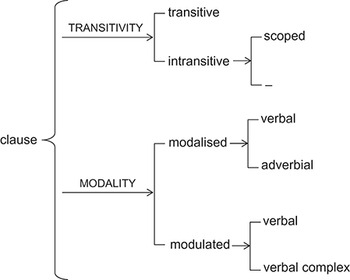
Figure 1.12 transitivity and modality systems in English
Next rank. As we saw in our discussion of modality above, systems can be realised in units of different kinds. In our examples modality was realised as a modal adverb in clauses (e.g. Lionel Messi certainly goals every match), as a verbal group in verbal group complexes (Lionel Messi is obliged to goal every match) and as a modal verb in verbal groups (Lionel Messi must goal every match). This reflects the fact that alongside clustering as metafunctions, our models of systems of choice will also tend to cluster with respect to the basic units they classify. The modality system in the network above is actually dependent on the mood feature indicative, since there is no modality in English imperative clauses. From the perspective of constituency, mood systems, including modality, can be seen to cluster at clause rank, as outlined with a little more detail in Figure 1.13 (elaborated in Chapter 4).

Figure 1.13 Dependency of modality on mood in English
But as we have seen, only one of the modality features included here is realised directly in clause structure – namely the feature adverbial, which triggers the insertion of a Modal Adjunct (e.g. perhaps Messi will goal). For the realisation of other modality features, we need to move down a rank and bring groups into the picture, verbal groups in particular. As we have seen, verbal group complex modulations involve two verbal groups, one finite verbal group followed by one non-finite one (e.g. finite is expected and non-finite to score in Messi is expected to score). The relevant systems are outlined in Figure 1.14. The loop in the network allows for complexing of groups (a recursive system). The left-facing brace establishes the verbal group complex environment in which modulation can be realised (read as if complex and verbal then optionally modulating).Footnote 14

Figure 1.14 Verbal group systems realising ‘periphrastic’ modulation in English
Other modality features are realised in English inside verbal groups, as modal verbs (e.g. Messi must play there). The relevant verbal group systems are outlined in Figure 1.15.

Figure 1.15 Verbal group systems realising modality through modal verbs in English
To take into account the realisation of these group rank systems, we have to move down a rank again and consider word classes (since the kind of verb we choose is crucial). A simplified word network is presented in Figure 1.16, including the relevant verb classes for verbal groups realising modality in English.Footnote 15
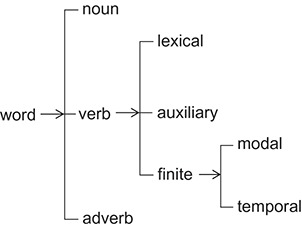
Figure 1.16 Word rank verb systems relevant to modality in English
In short, exploring modality means bringing a consideration of clauses, verbal groups and modal verbs into the picture; clauses, groups and words are all involved. In SFG these units are organised along a scale of constituency known as rank.Footnote 16 The scale is organised the way it is because of the way the choices involved obtain for units of different kinds. Seen from a syntagmatic perspective, the key units are clause, group,Footnote 17 word and morpheme – with a clause understood as realised through one or more groups, a group as realised through one or more words, and a word as realised through one or more morphemes.Footnote 18 This is illustrated below for a clause with a verbal group realisation of modality. In order not to over-complicate the presentation, we have only broken down the verbal group realising the Process into its constituent structure.

The details of this kind of analysis will be spelled out in later chapters. Our main point here is to suggest that the grammatical systems introduced above are organised by rank (i.e. clause systems, group systems, word systems and morpheme systems) and that their realisation in function structures gives the shape it does to the constituency hierarchy illustrated above for English. As indicated in Figure 1.14 with reference to the recursive system for group complexes, units at each rank may enter into complexes, as illustrated below.
| clauses complex | Serena Williams won but Venus Williams lost. |
| group complex | Serena Williams and Venus Williams both won. |
| word complex | Serena and Venus Williams both won. |
| morpheme complex | Serena was gracious in both pre- and post-match interviews. |
The final dimension we need to consider in terms of clustering of systems is stratification. We will continue to explore clustering with reference to modality. So far we have reviewed how modality can be realised verbally and adverbially across ranks in English. But from a discourse semantic perspective, there are other ways of expanding the play of voices implicated in an exchange. Two are added below. The first uses a mental process, I suppose, to open up the exchange; it involves two clauses, one projecting the other. The fourth uses a relational process, with probability encoded as an attribute (probable) of an embedded clause (he scored).
I suppose he scored.
He probably scored.
He would have scored.
It’s probable he scored.
In discourse semantics it is useful to bring these alternatives together, since they have comparable discourse functions. They all realise the appraisal sub-system engagement, which in simple terms allows speakers to make a move in an exchange without reference to other opinions (monogloss), or to acknowledge other voices (heterogloss). Heteroglossic moves can then either shut down other voices (via negation and concession for example) or allow them room (the contract/expand system in Figure 1.17). Modality is a key resource for opening up discourse by implicating other opinions. Saying Messi might have goaled, for example, acknowledges that there might be someone believing he didn’t, whereas Messi goaled does not.

Figure 1.17 Basic engagement systems
From the perspective of grammar, the first and fourth examples are quite different from the others. In these cases we haven’t modalised by simply adding a modal verb or modal adverb to an intransitive clause. Rather we’ve drawn on the English transitivity system, as we will expand it in Chapter 5, and in each case added another type of clause (a mental clause and a relational clause respectively). In SFL the first and fourth examples are treated as grammatical metaphors – because, as we will argue, they don’t directly realise discourse semantic choices; rather the grammar symbolises them.
I suppose he scored.
He probably scored.
He would have scored.
It’s probable he scored.
In the case of probability, symbolising rather that directly realising means finding appropriate transitivity resources to dress a statement or question up as probable. For our first example, a first person present tense mental clause of cognition is used to symbolise probability; in effect the grammar is saying, metaphorically speaking, that modalising is like thinking. A statement of this kind can be negotiated straightforwardly, using a modal adverb, as illustrated below; and because it is symbolising a modality, it will be tagged I suppose he scored, didn’t he? rather than I suppose he scored, don’t I?
I suppose he scored.
– Probably.
Alternatively, though this is less likely, it can be challenged – below by querying the thought process involved (so Do you? not Did he? below). In this case the mental process symbolising probability is taken literally, as if it was simply encoding what the speaker thought.
I suppose he scored.
– Do you?
The general point we would like to reinforce here is that discourse semantic systems can be realised across a range of lexicogrammatical resources. One of the pay-offs of conceptualising the relationship this way is that grammar can be used either to directly encode meaning (termed congruent realisation) or to symbolise it (termed metaphorical realisation). For some SFL grammarians (e.g. Reference MatthiessenHalliday and Matthiessen, 1999) recognition of this phenomenon is one of the key motivations for a model involving distinct systems of meaning on two levels of abstraction (their semantics and lexicogrammar).Footnote 19
Turning from discourse semantics to phonology, we also have to take into account that fact that prosodic phonology (i.e. rhythm and intonation) can contribute significantly to the meaning being negotiated. In casual conversation, for example, the fact that the clause I suppose is symbolising probability means that it is likely to be phonologically reduced, reflecting the diminished status of its ideational meaning. In the first example below, its articulation is reduced to a single non-salient syllable (written below as s’pose).
//^ s’pose he /scored//Footnote 20
The fast speech processes deployed here emphasise that the speaker is negotiating probability and is not, in fact, expecting his proposition to be challenged Do you? We can contrast this with a fully articulated version below and an alternative with two tone groups which follows. The first gives more informational prominence to the thinking clause; and the second offers it as negotiable in its own right, as an afterthought (undoing the grammatical metaphor of modality in the process).
//^ I su /ppose he /scored//
//^ he /scored//^ I su/ppose//
The ways in which the kind of language description we are promoting here draws on stratification to reason from above, around and below will be modelled in Chapters 2–6. In SFL the stratification hierarchy we are touching on here is usually modelled as co-tangential circles (Figure 1.18 below). The relationship between levels of abstraction is termed realisation. The increasing size of the circles reflects the fact that phonological systems realise lexicogrammatical systems, which in turn realise discourse semantic ones. So the choices in higher strata necessarily involve the choices in lower ones. The term metaredundancy is sometimes used to refer to this relationship among strata (after Reference LemkeLemke, 1995; cf. Reference Halliday and WebsterHalliday, 1992/2002). This is a way of theorising the relationship between patterns on one level and patterns on another – a pattern of phonemes, for example, realising morphemes, or a pattern of clauses realising an exchange. Or, to put this the other way around, discourse semantics is a pattern of lexicogrammatical patterns, which are in turn a pattern of phonological ones. In SFL, lexis is treated as more delicate grammar, as explained in chapter 6 of Reference Martin, Wang and ZhuMartin, Wang and Zhu (2013). For this reason the middle stratum is usually referred to as lexicogrammar.Footnote 21

Figure 1.18 Language strata realising register and genre systems
1.6 Outline of This Book
Following this introduction, this book comprises five main chapters followed by a brief culminative envoi. Each chapter is divided into three main sections, one each devoted to English, Spanish and Chinese; each chapter also dedicated to a specific dimension of grammatical description. A short outline of the pedagogic focus of each chapter is presented below.
Chapter 2 explores nominal group system and structure. In doing so, it concentrates on what in SFL is referred to as multivariate structure. Multivariate structures are structures involving a finite number of functions, each playing a distinct role. In this chapter we concentrate on developing multivariate structures for nominal groups in English, Spanish and Chinese.
Chapter 3 explores verbal group system and structure. In doing so for English and Spanish, it concentrates on what in SFL is referred to as univariate structure. Univariate structures are structures involving a single variable, which is repeated over and over again; they thus function as the realisation of recursive systems. The unit complexes introduced above (clause complexes, group complexes, word complexes and morpheme complexes) are structures of this kind. And some languages develop more delicate clause and group systems organised along these lines.
The recursive tense systems in English and Spanish which we describe in this chapter are good examples. Chinese verbal groups, on the other hand, do not involve recursive systems realised by iterating structures and so have to be approached from a multivariate perspective.
Chapter 4 explores mood systems and structures. It concentrates on paradigmatic relations – and the ways in which these can be motivated in the grammars of English, Spanish and Chinese. This chapter foregrounds questions about the nature of functional language typology, when confronted with the diverse structural realisations of mood in three different languages. It highlights the need to focus on system rather than structure, on higher ranks rather than lower ones and ultimately on discourse semantics rather than grammar by way of establishing comparable ground whenever languages are being contrasted and compared.
Chapter 5 explores transitivity systems and structures. It concentrates on the evidence used to motivate descriptions of paradigmatic relations. At stake here is the weight given to evidence of different kinds, including arguing from above, around and below. This chapter also foregrounds the cline of delicacy with respect to both system and structure, exploring what happens when general transitivity classes are explored in greater detail and issues that arise with respect to how much subclassification should be reflected in function structure labelling.
Chapter 6 explores theme and information systems and structures. It concentrates on the need to argue from discourse semantics as far as the interpretation of information flow is concerned. This chapter brings some phonological analysis into the picture, since information systems are realised through prosodic phonology (i.e. rhythm and intonation). This work draws on Halliday’s analysis of English intonation, as presented in Reference HallidayHalliday (1967c, Reference Halliday and Webster1970) and Reference Halliday and GreavesHalliday and Greaves (2008).
The final chapter rounds off the discussion, highlighting the distinctive nature of argumentation in the development of functional grammars informed by SFL and the importance of assembling data as a corpus of texts designed on the basis of a linguistic theory of register and genre.
In an ideal world, each one of these chapters would have had the strong discourse semantic orientation of Chapter 6. But this would have made the book very much longer than it is and might have backgrounded the pedagogic focus of the current chapters.
1.7 Notational Conventions
The notational conventions for this volume are basically those introduced in Reference Matthiessen and HallidayMatthiessen and Halliday (2009) and Reference Martin, Wang and ZhuMartin, Wang and Zhu (2013). These are consolidated as Appendix 1. Any additional conventions will be introduced where required. The morpheme-by-morpheme glossing of the Spanish examples is based on the Leipzig glossing rules. Further glossing is based on the dedicated SFL glossing conventions available at https://systemiclanguagemodelling.wordpress.com/.
At various points this book adopts the convention of referring to participant roles in very general terms as Participant 1, Participant 2 and Participant 3 (P1, P2 and P3 for short). For languages with case relations, this can be understood in terms of nominative, accusative and dative oppositions. For languages in general it reflects the differentiation of participant roles in terms of nuclearity, with P1s more closely associated with a Process than P2s, and P2s more closely associated than P3s. In SFL this is generally reflected in the delicacy of transitivity networks, with P1s realising more general options than P2s, and P3s more delicate ones. Across languages P1s are strongly associated with both modal responsibility and unmarked Theme, associations which we explore in detail in Chapters 4 and 6 respectively.


