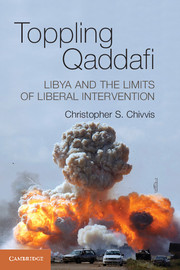
Book contents
- Frontmatter
- Dedication
- Contents
- List of Figures
- List of Table
- Foreword
- Preface
- Abbreviations
- 1 Libya and the Light Footprint
- 2 Precipitous Crisis
- 3 The Pivots of War
- 4 Crippling Qaddafi and Infighting over NATO
- 5 Stalemate
- 6 Grinding Away
- 7 Sudden Success
- 8 The Impact of the War and Its Implications
- Appendix A Operation Unified Protector Participating Nations
- Appendix B Operation Unified Protector Basing
- Appendix C Regime Defections
- Appendix D Contact Group
- Bibliography
- Index
Preface
Published online by Cambridge University Press: 05 June 2014

Book contents
- Frontmatter
- Dedication
- Contents
- List of Figures
- List of Table
- Foreword
- Preface
- Abbreviations
- 1 Libya and the Light Footprint
- 2 Precipitous Crisis
- 3 The Pivots of War
- 4 Crippling Qaddafi and Infighting over NATO
- 5 Stalemate
- 6 Grinding Away
- 7 Sudden Success
- 8 The Impact of the War and Its Implications
- Appendix A Operation Unified Protector Participating Nations
- Appendix B Operation Unified Protector Basing
- Appendix C Regime Defections
- Appendix D Contact Group
- Bibliography
- Index
Summary
When it began, I was among those skeptical about the 2011 intervention in Libya. To me, working in the Pentagon at the time, evidence of the many burdens the Iraq and Afghanistan wars had placed on our country was ever present. On the surface, another war hardly seemed wise. But further research, reflection, and many discussions with friends, colleagues, and those who were involved in the conduct of this intervention encouraged me to take a more positive view of what had been accomplished and why. This book does report some deficiencies in the conception and conduct of the war, but the picture presented is, on the whole, far more positive than I had envisioned at the outset.
The need to design cost-effective solutions to crises such as the one that occurred in Libya in March 2011 will be with us for many years. The study of what was and was not accomplished in Libya gives insight into both the limits and the potential for liberal intervention – the use of force to protect the basic liberal values of human rights, the rule of law, and constitutional government.
Information
- Type
- Chapter
- Information
- Toppling QaddafiLibya and the Limits of Liberal Intervention, pp. xv - xviPublisher: Cambridge University PressPrint publication year: 2013
Accessibility standard: Unknown
Why this information is here
This section outlines the accessibility features of this content - including support for screen readers, full keyboard navigation and high-contrast display options. This may not be relevant for you.Accessibility Information
Accessibility compliance for the PDF of this book is currently unknown
and may be updated in the future.