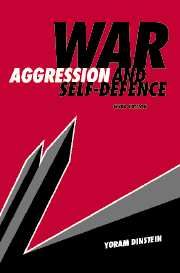
Book contents
- Frontmatter
- Contents
- Introduction to the Third Edition
- From the introduction to the First Edition
- Table of cases
- Table of treaties
- Table of Security Council resolutions
- Table of General Assembly resolutions
- List of abbreviations
- Part I The legal nature of war
- Part II The illegality of war
- Part III Exceptions to the prohibition of the use of inter-State force
- 7 The concept of self-defence
- 8 The modality of individual self-defence
- 9 Collective self-defence
- 10 Collective security
- Conclusion
- Index of persons
- Index of subjects
This chapter is part of a book that is no longer available to purchase from Cambridge Core
10 - Collective security

Book contents
- Frontmatter
- Contents
- Introduction to the Third Edition
- From the introduction to the First Edition
- Table of cases
- Table of treaties
- Table of Security Council resolutions
- Table of General Assembly resolutions
- List of abbreviations
- Part I The legal nature of war
- Part II The illegality of war
- Part III Exceptions to the prohibition of the use of inter-State force
- 7 The concept of self-defence
- 8 The modality of individual self-defence
- 9 Collective self-defence
- 10 Collective security
- Conclusion
- Index of persons
- Index of subjects
Summary
The meaning of collective security
Collective security postulates the institutionalization of the lawful use of force in the international community. What is required is a multilateral treaty, whereby contracting parties create an international agency vested with the power to employ force against aggressors (and perhaps other law-breakers). Such an instrument is basically ‘introverted’ in character (designed against a potential future aggressor from among the contracting parties), unlike a collective self-defence treaty (see supra, ch. 9, B) which is ‘extroverted’ (envisaging aggression from outside the system). Collective security shares with collective self-defence the fundamental premise that recourse to force against aggression can (and perhaps must) be made by those who are not the immediate and direct victims. But self-defence, either individual or collective, is exercised at the discretion of a single State or a group of States. Collective security operates on the strength of an authoritative decision made by an organ of the international community.
The system of collective security has its roots in the League of Nations. Article 10 of the Covenant empowered the League's Council to advise Member States on the means to be taken in case of aggression or threat of aggression. Article 11 declared that any war or threat of war, whether or not immediately affecting any Member, was a matter of concern to the whole League, which had to take action as required to safeguard peace among nations.
Information
- Type
- Chapter
- Information
- War, Aggression and Self-Defence , pp. 246 - 282Publisher: Cambridge University PressPrint publication year: 2001
Accessibility standard: Unknown
Why this information is here
This section outlines the accessibility features of this content - including support for screen readers, full keyboard navigation and high-contrast display options. This may not be relevant for you.Accessibility Information
Accessibility compliance for the PDF of this chapter is currently unknown
and may be updated in the future.