Book contents
- Frontmatter
- Contents
- Introduction to the Third Edition
- From the introduction to the First Edition
- Table of cases
- Table of treaties
- Table of Security Council resolutions
- Table of General Assembly resolutions
- List of abbreviations
- Part I The legal nature of war
- 1 What is war?
- 2 The course of war
- Part II The illegality of war
- Part III Exceptions to the prohibition of the use of inter-State force
- Conclusion
- Index of persons
- Index of subjects
This chapter is part of a book that is no longer available to purchase from Cambridge Core
1 - What is war?

Book contents
- Frontmatter
- Contents
- Introduction to the Third Edition
- From the introduction to the First Edition
- Table of cases
- Table of treaties
- Table of Security Council resolutions
- Table of General Assembly resolutions
- List of abbreviations
- Part I The legal nature of war
- 1 What is war?
- 2 The course of war
- Part II The illegality of war
- Part III Exceptions to the prohibition of the use of inter-State force
- Conclusion
- Index of persons
- Index of subjects
Summary
The definition of war
(a) The numerous meanings of war
The phrase ‘war’ lends itself to manifold uses. It is necessary, at the outset, to differentiate between ‘war’ as a figure of speech heightening the effect of an oral argument or a news story in the media, and ‘war’ as a legal term of art. In ordinary conversation, press reports or even literary publications, ‘war’ may appear to be a flexible expression suitable for an allusion to any serious strife, struggle or campaign. Thus, references are frequently made to ‘war against the traffic in narcotic drugs’, ‘class war’ or ‘war of nerves’. This is a matter of poetic licence. But in legal parlance, the term ‘war’ is invested with a special meaning.
In pursuing that meaning, a distinction must be drawn between what war signifies in the domestic law of this or that State and what it denotes in international law. War, especially a lengthy one, is likely to have a tremendous impact on the internal legal systems of the belligerents. A decision as to whether war has commenced at all, is going on or has ended, produces far-ranging repercussions in many branches of private law, exemplified by frustration of contracts or liability for insurance coverage. Similarly, multiple relevant issues arise in public law, such as constitutional ‘war powers’ (i.e. identification of the branch of Government juridically competent to steer the nation to war); the authority to requisition enemy property; tax exemptions allowed to those engaged in military service in wartime; and criminal prosecutions for violations of wartime regulations.
Information
- Type
- Chapter
- Information
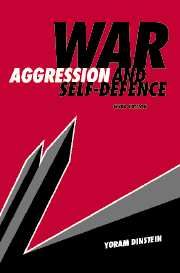
- War, Aggression and Self-Defence , pp. 3 - 28Publisher: Cambridge University PressPrint publication year: 2001
Accessibility standard: Unknown
Why this information is here
This section outlines the accessibility features of this content - including support for screen readers, full keyboard navigation and high-contrast display options. This may not be relevant for you.Accessibility Information
Accessibility compliance for the PDF of this book is currently unknown
and may be updated in the future.
- 1
- Cited by