


The global wave of democratization in the final decades of the twentieth century presented scholars with the challenge of conceptualizing a diverse array of post-authoritarian regimes. The national political regimes in Latin America, Africa, Asia, and the former communist world that emerged in the democratic third wave (Huntington Reference Huntington1991) exhibited important attributes of democracy. Yet these regimes differed profoundly both from each other and from the democratic regimes of advanced industrial countries. Indeed, scholars considered many not to be fully democratic.Footnote 1
This chapter argues that researchers responded to this challenge by pursuing two potentially contradictory goals. On the one hand, they attempted to increase analytic differentiation in order to capture the diverse regimes that had emerged. On the other hand, they sought to avoid the conceptual stretching that may occur when the concept of democracy is extended to cases for which, by relevant scholarly standards, it is not appropriate (Sartori Reference Sartori1970; Collier and Mahon Reference Collier and Mahon1993).Footnote 2 The result was a proliferation of alternative conceptual forms, including a surprising number of subtypes involving democracy with adjectives.Footnote 3 Examples from among the hundreds of subtypes that appeared in the scholarly literature were neopatrimonial, illiberal, delegative, managed, and low-intensity democracy.
The proliferation of subtypes occurred despite efforts by leading analysts to standardize usage based on procedural definitions of democracy, in the tradition of Joseph Schumpeter (Reference Schumpeter1947) and Robert A. Dahl (Reference Dahl1971). This standardization succeeded in important respects. Yet as democratization continued and attention focused on an increasingly diverse set of cases, scholars introduced even more subtypes and additional conceptual innovations. The resulting conceptual confusion served as a strong reminder that tools for understanding and clarifying concepts are crucial to the social science enterprise.
We seek to refine available tools for concept analysis, focusing on the concepts employed in studies of democracy at the level of national political regimes, with particular attention to work on Latin America. The goal is to examine the strategies of conceptual innovation that emerged and to explore trade-offs among them. Our perspective builds on the fundamental contributions of Sartori, at the same time that it is in part a sharp departure from his approach.
This chapter (1) introduces a framework for analyzing two forms of conceptual hierarchy that are central to these strategies – the kind hierarchy associated with classical subtypes of democracy, and the part–whole hierarchy associated with diminished subtypes of democracy. Next, we (2) address the root concept of democracy in this literature, that is, the basic conception of democracy that animated this research. We then go on to examine specific forms of conceptual innovation: (3) moving up and down a kind hierarchy, (4) moving down a part–whole hierarchy, (5) shifting the overarching concept, and (6) changing the definition of democracy itself, which involves making explicit features of democracy that might otherwise be taken for granted.
A central objective of the chapter is to encourage more careful definition and use of concepts. This is an important goal, given that the diverse conceptual forms examined here typically were central to the researchers’ main substantive arguments. These concepts served as data containers (Sartori Reference Sartori1970: 1039), grouping together cases that fit within the boundaries of a given concept. In order adequately to describe these newly formed regimes, these data containers had to be employed with care.
Improved description, in turn, was essential for assessing the causes and consequences of democracy – a central goal in this literature. Many studies treated democracy as an outcome to be explained, including major works of comparative-historical analysis and studies focused on the “social requisites” of different regime types.Footnote 4 Other analyses looked at the impact of democracy – and specific types of democracy – on economic growth, income distribution, economic liberalization and adjustment, and international conflict.Footnote 5 In these studies, the results of causal assessment could be strongly influenced by the definition of democracy employed.Footnote 6 We hope that the present discussion serves as a step toward greater consistency and clarity of meaning, which in turn will provide a more adequate basis for assessing causal relationships.
Hierarchies
Conceptual hierarchies have long played a key role in comparative research. Giovanni Sartori’s classic work reshaped thinking about comparison by formulating the idea of a ladder of generality (Sartori calls this the ladder of abstraction: see Glossary). This ladder or hierarchy – which posits a vertical array of concepts – was crucial in efforts to pursue the twofold goal of increasing analytic differentiation and avoiding conceptual stretching. The present analysis focuses centrally on this form of hierarchy, which will be referred to as a kind hierarchy. In addition, we will look at a parallel – yet quite different – form of hierarchy, the part–whole hierarchy.Footnote 7 This section briefly introduces this distinction, which is then extensively developed throughout this chapter.
Kind Hierarchies and Classical Subtypes
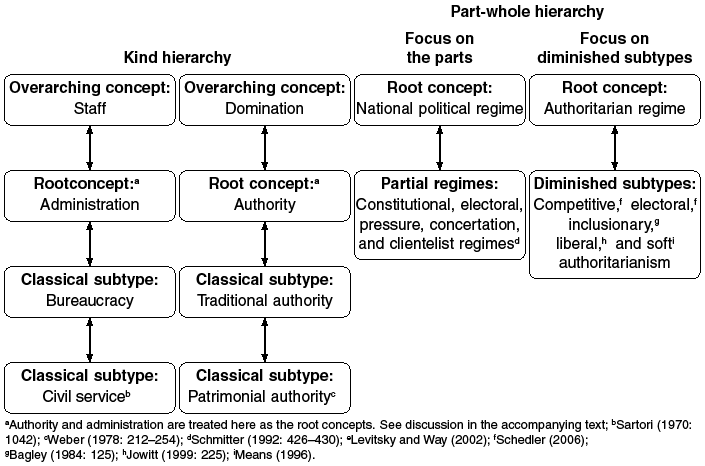
A kind hierarchy is a nested set of concepts in which the subordinate concepts or subtypes represent a qualitative variant of the superordinate concepts. These are called classical subtypes (Lakoff Reference Lakoff1987: passim; Taylor Reference Taylor2003: chap. 2). Each subordinate concept has the attributes of the superordinate concept, plus attributes that differentiate it. An example is Sartori’s (Reference Sartori1970: 1042) discussion of conceptual choices in the field of comparative administration, which in important respects draws on Weber. Taking as a point of departure the concept of administration, we may argue that bureaucracy is a kind of administration, and civil service is a kind of bureaucracy. Looking up the hierarchy, administration is in turn a specific kind of staff (Figure 2.1).Footnote 8 Collier and Mahon (Reference Collier and Mahon1993: 846) also suggest an example from Weber:Footnote 9 Taking the concept of authority as a point of departure, they observe that traditional authority is a kind of authority, and patrimonial authority is a kind of traditional authority. Again, looking up the hierarchy, authority is a specific type of domination (i.e., it is legitimate domination). Yet another example is found in the literature on corporatism: Corporatism and pluralism are seen as specific types in relation to an overall system of interest intermediation (Schmitter Reference Schmitter1977).
Kind hierarchy and part–whole hierarchy.
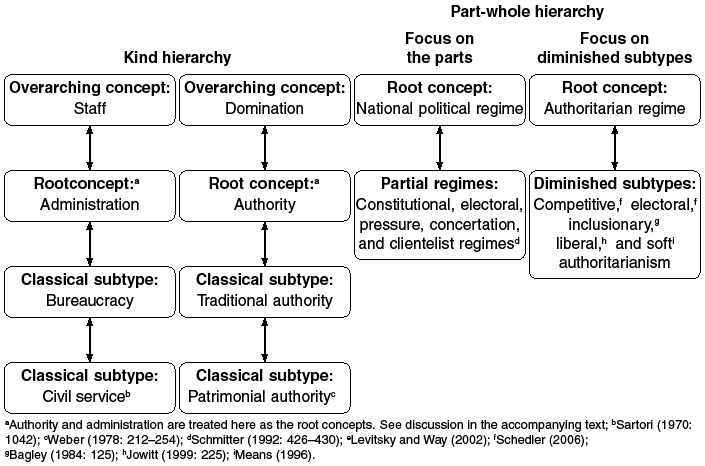
Figure 2.1 Long description
The diagram is divided into vertical columns, each containing a hierarchical structure. The left column is labeled “Kind hierarchy,” featuring two descending pathways. Pathway 1 follows the connections from top to bottom as an overarching concept: staff, root concept: administration, classical subtype: bureaucracy, and classical subtype: civil service. Pathway 2 follows the connections from top to bottom as an overarching concept: domination, root concept: authority, classical subtype: traditional authority, and classical subtype: patrimonial authority. The right column is titled “Part-whole hierarchy,” featuring two descending pathways. Pathway 1 is labeled “Focus on the parts” and follows the connections from top to bottom as root concept: national political regime and political regimes: constitutional, electoral, pressure, concertation, and clientelist regimes. Pathway 2 is labeled “Focus on diminished subtypes” and follows the connection from top to bottom as root concept: authoritarian regimes and diminished subtypes: competitive, electoral, inclusionary, liberal, and soft authoritarianism.
In discussing a kind hierarchy, it is helpful to distinguish the root concept, overarching concept, and subtypes. The root concept occupies the level in a conceptual hierarchy that is the central point of reference in a given study or line of analysis. Thus, in the literature cited earlier on corporatism, the root concept is corporatism. In relation to this root concept, the system of interest intermediation is the overarching concept, in that corporatism is a kind of in relation to this overarching idea. The subtype is subordinate to the root concept. Following this pattern of overarching concepts and subtypes, analysts can shift up or down the hierarchy as research moves forward.
Three points about kind hierarchies should be underscored here – points that converge with the standard understanding of Sartori’s framework.
(1) Well-bounded concepts. A key issue arises here concerning well-bounded concepts. Within a kind hierarchy, each classical subtype is deemed a full instance of the superordinate concept. Thus, a federal democracy is fully a democracy, and the subtype incorporates the overall definition of democracy being employed. Assuming that the concept of democracy is well-bounded – a position to which Sartori is strongly committed – then this well-boundedness will carry over to the subtype. As we will see, this stands in sharp contrast to the patterns that emerge with diminished subtypes.
(2) Inverse variation. The relationship among levels in the kind hierarchy is characterized by a pattern of inverse variation.Footnote 10 Further down the hierarchy, the concepts have more defining attributes – that is, greater intension; and they encompass fewer cases – that is, more limited extension. By contrast, further up the hierarchy, concepts have fewer defining attributes and encompass more instances – that is, more limited intension and greater extension.
(3) Trade-off. Correspondingly, we find a basic trade-off between avoiding conceptual stretching and achieving more fine-grained analytic differentiation. For instance, in Weber, designating a particular form of rule as domination would avoid the conceptual stretching that could arise from inappropriately calling it a system of authority (i.e., legitimate domination). At the same time, designating it as a system of domination provides less analytic differentiation than calling it a system of authority.
Part–Whole Hierarchies and Diminished Subtypes
Part–whole hierarchies build on the idea that we can meaningfully identify parts of many phenomena and entities. For example, in Schmitter’s (Reference Schmitter1992: 426 ff.) analysis of “partial regimes,” a national political regime has five parts: the constitutional, electoral, pressure, concertation, and clientelist regimes (Figure 2.1).
The idea of part–whole hierarchies is crucial in the present analysis because it is the basis for understanding what we call diminished subtypes. Here, the focus is on instances in which one attribute of the root concept is missing – yet other attributes are present. For example, in relation to democracy we find the diminished subtypes of illiberal, oligarchic, and electoral democracy. An illiberal democracy is understood as one in which civil liberties are evaluated as being inadequately protected, but other attributes of democracy are present. This is therefore a diminished subtype.
While the focus of this chapter is on the concept of democracy, these ideas have wide application. For example, we find diminished subtypes of authoritarianism, as with inclusionary or competitive authoritarianism.
Overall, we see important contrasts between kind versus part–whole hierarchies, which may be summarized by the criteria just enumerated in the discussion of classical subtypes.
(1) Key concepts may not be well-bounded. In contrast to the subtypes in a kind hierarchy, diminished subtypes do not represent full instances of the superordinate concept. Thus, with an illiberal democracy the element of civil liberties is eliminated or greatly weakened, thereby attenuating the boundary of the concept democracy. Given Sartori’s argument that democracy is a well-bounded concept, this is an important shift.
(2) Inverse variation does not hold. With kind hierarchies, one finds the pattern of inverse variation. Thus, moving to the subtype increases the number of defining attributes (intension) and decreases the number of cases encompassed by the type (extension) – and conversely. With a part–whole hierarchy, moving to the subtype decreases the number of defining attributes, and it may increase, decrease, or leave unchanged the number of cases, depending on the context of analysis.
(3) Trade-off eliminated. Correspondingly, and this is crucial, we no longer face the basic trade-off between achieving more fine-grained analytic differentiation and avoiding conceptual stretching. Diminished subtypes can yield fine-grained differentiation among cases. Yet they also sidestep conceptual stretching. As is clear with the analysis of democracy, the diminished subtypes avoid over-extending the concept of a democratic regime in that they specify that a given case is only a partial instance. This is a great advantage, in comparison with the classical subtypes on which Sartori focused.
Building on these fundamental contrasts, we now explore how these two forms of conceptual hierarchy were employed in research on the third wave of democracy. To do so, we first introduce the definition of democracy that was the point of departure for this literature.
Defining the Concept of Democracy
In his famous analysis of essentially contested concepts, W. B. Gallie argued that democracy is “the appraisive political concept par excellence.”Footnote 11 Thus, it involves a fundamental component of normative evaluation. Correspondingly, one finds recurring disputes over appropriate meaning and definition. However, the goal of Gallie’s analysis was not simply to underscore the importance of such disputes, but to show that recognition of the contested status of a given concept opens the possibility of understanding each meaning within its own framework.
The definition of democracy in the literature on the third wave was anchored in a procedural minimum definition, which focused on democratic procedures. It was minimal in that it deliberately focused on the smallest possible number of attributes that still were seen as producing a viable standard for democracy. Not surprisingly, there was some disagreement about which attributes were needed for the definition to be appropriate. For example, most (but not all) of these scholars differentiated what they viewed as the more specifically political features of the regime from characteristics of the society and economy. They argued that the latter were more appropriately analyzed as potential causes or consequences of democracy, rather than as features of democracy itself (Karl Reference Karl1990).
The procedural minimum definition most widely used in this literature presumed genuinely contested elections with full suffrage and the absence of massive fraud, combined with effective guarantees of civil liberties, including freedom of speech, assembly, and association.Footnote 12 However, some variants on this definition were also important. Certain scholars, for example, created an expanded procedural minimum definition by adding (in a sense making explicit) the criterion that elected governments must, to a reasonable degree, have effective power to govern vis-à-vis the military and other powerful, nonelected actors. As we will see later, this was a crucial issue in some countries.
Strategies of Conceptual Innovation
We turn now to specific strategies of innovation. These strategies employed the kind hierarchy and classical subtypes; the part–whole hierarchy and diminished subtypes; shifting the overarching concept within a kind hierarchy; and changing the definition of democracy to encompass features that were not stipulated in the prior definition, but were seen as critical to the wider understanding of the concept.
Working with Classical Subtypes in a Kind Hierarchy
As argued in the introduction, key analytic goals in the literature on the third wave were to achieve analytic differentiation among the diverse forms of democracy that emerged, while at the same time avoiding conceptual stretching in analyzing these countries.
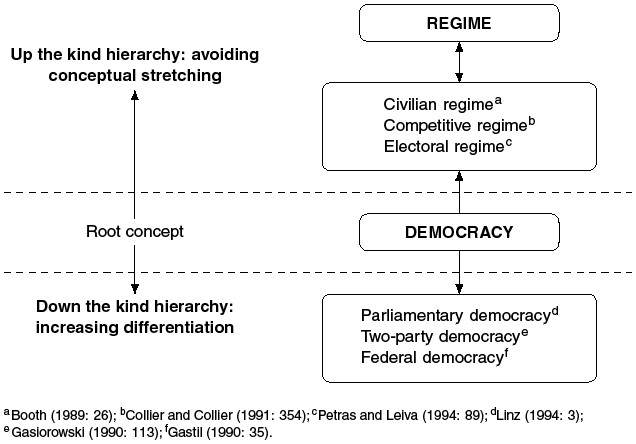
In the tradition of Sartori, greater analytic differentiation that captured these diverse forms of democracy could be achieved by moving down a kind hierarchy to classical subtypes that had more defining attributes and fit a narrower range of cases. Thus, each concept further down in the hierarchy encompassed all the defining attributes of the concept immediately above it, plus a further differentiating attribute. These subtypes provided more fine-grained distinctions that were often invaluable to the researcher. Earlier, we noted the example of federal democracy – that is, a democracy with the further differentiating attribute of having a federal system (Figure 2.2). Within Latin America, Argentina, Brazil, Mexico, and Venezuela had traditionally been understood to have federal systems.
The kind hierarchy: increasing differentiation versus avoiding conceptual stretching.
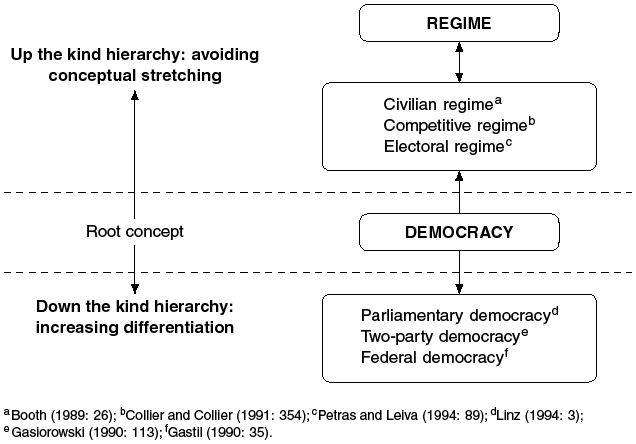
However, subtypes formed in this manner may leave analysts more vulnerable to conceptual stretching. These subtypes presume that the cases under discussion are full democracies, a condition that may not hold. One standard approach to avoiding this problem is to move up the kind hierarchy to concepts that have fewer defining attributes and correspondingly fit a broader range of cases. For example, if researchers had misgivings as to whether a particular case was really a democratic regime, they could move up the hierarchy and simply call it some other type of regime – for example, a civilian, competitive, or electoral regime (Figure 2.2).
An obvious trade-off arose here. Shifting to a concept as general as regime, even with the introduction of these subtypes, entailed a loss of analytic differentiation. The subtypes remained more general than the concept of democracy, encompassing not only democracies but also some nondemocracies. While with these subtypes scholars thus achieved some analytic differentiation in relation to regime, they did not specifically commit themselves to the claim that the cases under discussion were democracies. A similar pattern was followed when scholars used a related term for regime, such as civilian rule or competitive polity (Karl Reference Karl, Di Palma and Whitehead1986; Wilson Reference Wilson, Gills, Rocamora and Wilson1993).
To summarize, although climbing the hierarchy in this way helped to avoid conceptual stretching, it produced a sharp loss of analytic differentiation. These two strategies of moving down and up the kind hierarchy could advance one or the other of these goals, but not both at once.
Working with Diminished Subtypes in a Part–Whole Hierarchy
An alternative strategy of conceptual innovation, widely employed in this literature, was to use diminished subtypes within a part–whole hierarchy. This approach had the merit of simultaneously avoiding conceptual stretching and increasing analytic differentiation. Examples included limited suffrage democracy and tutelary democracy. Unlike classical subtypes in a kind hierarchy, diminished subtypes achieved both goals discussed here. First, because these subtypes served to designate partial democracies, analysts were less vulnerable to conceptual stretching in that they made a more modest claim about the extent of democratization. The second point concerned differentiation. The distinctive feature of diminished subtypes was that they generally identified specific attributes of democracy that were missing, thereby establishing the diminished character of the subtype. At the same time, they stipulated other attributes of democracy that were still present. Given this focus on specific combinations of attributes, these subtypes increased differentiation.
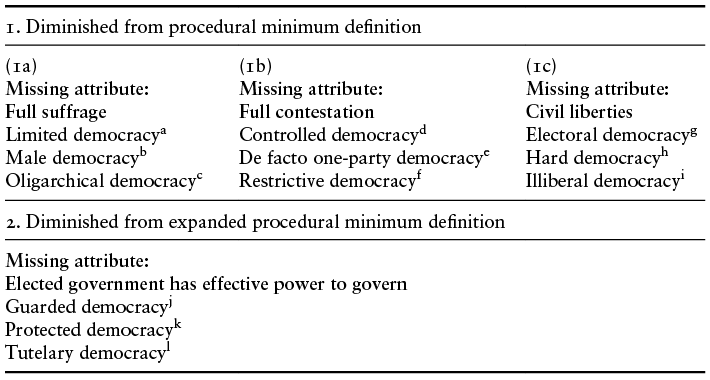
Table 2.1 presents examples of the numerous diminished subtypes that were generated in relation to the root concept of democracy. For the purpose of illustration, we focus on examples in which the author was reasonably careful in isolating a single missing attribute.
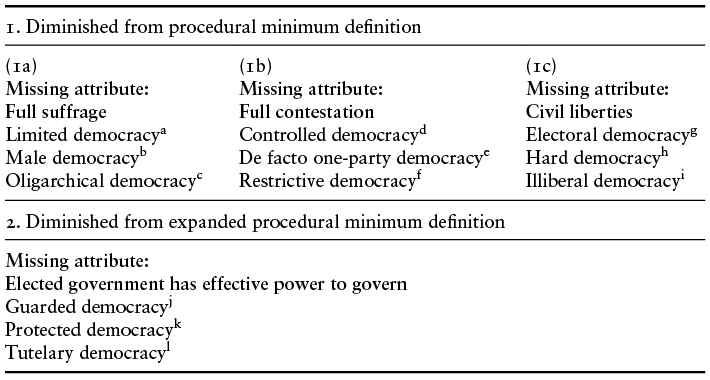
a Archer (Reference Archer, Mainwaring and Scully1995: 166); bSorensen (Reference Sorensen1993: 20); cHartlyn and Valenzuela (Reference Hartlyn, Valenzuela and Bethell1994: 99); dBagley (Reference Bagley and Wesson1984: 125); eLeftwich (Reference Leftwich1993: 613); fWaisman (Reference Waisman, Diamond, Linz and Lipset1989: 69); gHadenius (Reference Hadenius and Beetha1994: 69); hO’Donnell and Schmitter (Reference O’Donnell and Schmitter1986: 9); iEmmerson (Reference Emmerson1995); jTorres Rivas (Reference Torres Rivas1994: 27); kLoveman (Reference Loveman1994: 108–11); lPrzeworski (Reference Przeworski, Elster and Slagstad1988: 60–61).
The subtypes in the first group (1a) refer to cases where the missing attribute was full suffrage. Here, we find terms such as male or oligarchical democracy, which were used to distinguish contemporary cases from historical cases prior to the advent of universal suffrage. Where the attribute of full contestation was missing (1b), as when important parties were banned from electoral competition, we find terms such as controlled and restrictive democracy. Where civil liberties were incomplete (1c), scholars used terms such as electoral and illiberal democracy.
The subtypes in the final group (2) were those introduced by the scholars who created the expanded procedural minimum definition of democracy – which as noted earlier added the defining attribute that, to a reasonable degree, the elected government had effective power to govern. From that point of departure, these scholars introduced diminished subtypes in which this attribute was missing. Examples that referred to cases where the military was seen as having an inordinate degree of ongoing political power included protected democracy and tutelary democracy.
Diminished subtypes, to reiterate, were a useful means to avoid conceptual stretching in cases that were less than fully democratic. They also provided new analytic differentiation. Various scholars pointed to the need to move beyond a dichotomous conceptualization of authoritarianism and democracy, and they recognized the hybrid or mixed character of many post-authoritarian regimes.Footnote 13 Diminished subtypes could help bring into focus the diverse features of these hybrid regimes. For scholars, including Sartori, who thought that democracy should be treated as a well-bounded concept, this approach could be seen as giving up too much. Yet it does indeed appear to be a realistic way of grappling with the diverse panorama of cases in the third wave.
Shifting the Overarching Concept: Indirectly Changing the Definition
A further strategy involved a different approach to modifying kind hierarchies. Here, scholars shifted the overarching concept, in relation to which democracy was seen as a specific type. This shift in turn modified the meaning of the root concept, that is, of democracy. In this sense, it produced an innovation parallel to that of changing the definition of democracy, discussed in the next section. Yet it did so indirectly, via modifying the overarching concept.
Scholars in this literature most commonly understood democracy in relation to the overarching concept regime, and the procedural criteria for democracy discussed earlier were features of the regime. Yet some analysts came to view democracy as a root concept in relation to other overarching concepts, such as democratic government or democratic state. Hence, when a given country was labeled democratic, the meaning was modified to align with the alternative overarching concept. In this sense, two of the strategies overlap – that is, shifting the overarching concept and changing the definition.
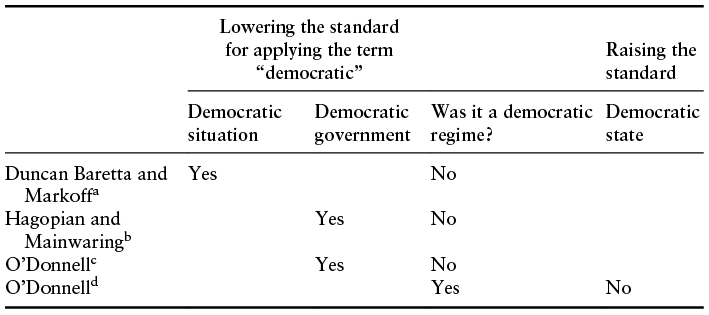
Scholars used the strategy of shifting the overarching concept to create a standard that could be either less or more demanding for classifying cases as democratic. These alternatives are illustrated by research on Brazil (Table 2.2). Some scholars found that in the immediate post-1985 period, Brazilian politics was so poorly institutionalized that it appeared inappropriate to use the overarching label “regime,” yet they felt it was unreasonable to insist that Brazil was not democratic. They thereby lowered the standard for labeling it a democracy by referring to a “democratic situation.”Footnote 14 Other scholars, out of a similar concern with the implications of regime, used the terms “democratic government” or “democratic moment.”Footnote 15 The idea of a democratic government, for example, suggested that, although a particular government had been elected democratically,Footnote 16 the sustainability of democratic procedures remained in doubt.
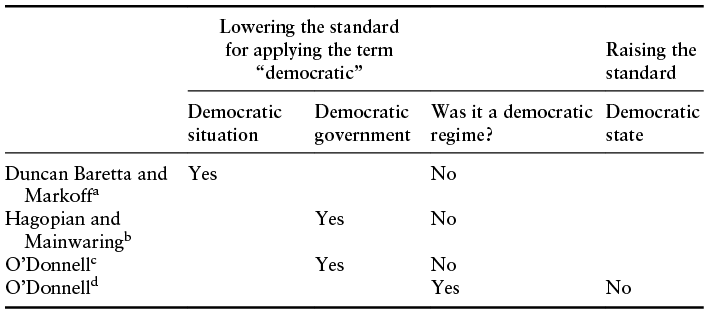
a Duncan Baretta and Markoff (Reference Duncan Baretta, Markoff, Malloy and Seligson1987: 62); bHagopian and Mainwaring (Reference Hagopian and Mainwaring1987: 485); cO’Donnell (1988: 281); dO’Donnell (Reference O’Donnell1993: 1360).
Subsequently, Brazil’s presidential election of 1989 led some scholars – previously skeptical about Brazilian democracy – to accept the idea that Brazil had a democratic regime. In this context, O’Donnell considered the regime to be democratic, and he went on to pose questions about the democratic character of the state in Brazil. He observed that, given widespread neofeudalized and sometimes sultanistic political relationships in some regions of the country, the national state did not protect basic rights of citizenship within the framework of law (Reference O’Donnell1993: 1359 and passim). This failure might not directly influence the functioning of the regime, in the sense of affecting the elections and associated civil liberties that were core features of the procedural understanding of a democratic regime. However, O’Donnell argued that this failure of the legal and bureaucratic institutions of the state was a crucial feature of politics in Brazil, as well as in several other Latin American countries. Although he recognized that Brazil had a democratic regime, he raised the standard by excluding it from the set of countries he considered to have democratic states.
To summarize, shifting the overarching concept within the kind hierarchy served to introduce finer differentiation. When this strategy lowered the standard for declaring a given case a democracy, it also helped avoid stretching the concept. When the strategy raised the standard, it was typically acknowledged that the cases of concern were in fact democratic regimes. Additional analytic differentiation was achieved by pointing to respects in which the countries might, nonetheless, be considered nondemocratic.
From democracy to authoritarianism. Modifying the overarching concept could also involve a shift from democracy to authoritarianism, and it could likewise involve diminished subtypes. For example, Bruce Bagley rejected the numerous diminished subtypes of democracy that had been applied to the National Front period in Colombia (1958–74). These included restricted, controlled, limited, oligarchical, elitist, and elitist-pluralist democracy. Bagley instead characterized Colombia as a diminished subtype of authoritarianism: inclusionary authoritarian regime (Bagley Reference Bagley and Wesson1984: 125–27). A parallel use of a diminished subtype was Levitsky and Way’s (Reference Levitsky and Way2002: 52–58) characterization of Russia under Yeltsin and Peru under Fujimori. These were treated not as partial democracies, but instead as competitive authoritarianism regimes.
Changing the Definition
A final strategy consisted of changing the definition of democracy. Here analysts adjusted the formal definition by adding one or more defining attributes that they argued were contained in the wider, intuitive understanding of democracy. This distinction between the operational definition and the larger understanding of the concept was parallel to the contrast between the systematized concept and the background concept discussed by Adcock and Collier (Reference Adcock and Collier2001).Footnote 17 This approach thereby modified the root concept in relation to which both the kind hierarchies and the part–whole hierarchies were structured. As noted earlier, this approach overlapped with the strategy of shifting the overarching concept. The difference was that here it was done not indirectly, but rather through directly revising the definition of democracy.
Thus, as the concept of democracy was extended to new settings, researchers sometimes encountered cases that (1) were classified as democracies on the basis of a commonly accepted scholarly definition; yet (2) were not seen as fully democratic in light of the larger shared understanding of the concept. This mismatch between the case and the broader understanding sometimes led analysts to make explicit one or more criteria that were implicitly understood as part of the overall meaning of democracy, but were not included in the prior definition. The result was a new definition intended to change how these cases were classified. This new definition enhanced analytic differentiation by fine-tuning the cut-point between democracy and nondemocracy. Simultaneously, it avoided conceptual stretching by not including cases that did not fit the new conception of democracy.
An important example of changing the definition was the emergence of the idea of an expanded procedural minimum (see Table 2.1). In several Central American countries, as well as some South American cases, owing to the ongoing power of the military and/or other elites, elected governments faced strong constraints on their power to govern. For example, in Chile one legacy of authoritarian rule was the persistence of reserved domains of military power over which elected governments had little or no authority (Valenzuela Reference Valenzuela, Mainwaring, O’Donnell and Valenzuela1992: 70).
Given these constraints, and often in reaction to claims that these countries were democratic because they had held free elections, some scholars modified the procedural minimum definition by explicitly specifying an additional criterion: The elected government must to a reasonable degree have effective power to rule. With this revised definition, countries such as Chile were excluded by some scholars from the set of cases classified as democracies, even though they had held relatively free elections.Footnote 18 These scholars thereby included an attribute that was taken for granted in studies of advanced industrial democracies, yet was absent in these cases. This revised definition was widely accepted, though some disagreement continued about the classification of specific cases.Footnote 19
As noted, changing the definition had the merit of both introducing finer differentiation and avoiding conceptual stretching, yet it modified the definitional point of departure for all the other strategies, thereby unsettling the semantic field.Footnote 20 By contrast, the introduction of a new subtype did not pose this problem. For literatures in which conceptual confusion was a recurring challenge, the analytic gains had to be weighed against this cost.
A related concern is the problem of definitional gerrymandering,Footnote 21 in the sense that scholars might introduce a new definition as an ad hoc means of dealing with an anomalous case. Analysts therefore needed to proceed with caution – at the same time recognizing that this was a valuable strategy.
Concluding Observations
We have discussed strategies of conceptual innovation employed by scholars as they addressed a twofold challenge in characterizing the diverse regimes that emerged in the third wave of democracy: increasing analytic differentiation, while simultaneously avoiding conceptual stretching. Our goal has been to examine the structure of these alternative strategies and to evaluate their strengths and weaknesses. We have seen that the strategies included working with both kind hierarchies and part–whole hierarchies. Even when analysts proceeded intuitively, rather than self-consciously, they tended to operate within these hierarchical structures. However, in the interest of conceptual and analytic clarity, it was far more desirable for scholars to proceed self-consciously, with full awareness of trade-offs among the strategies.
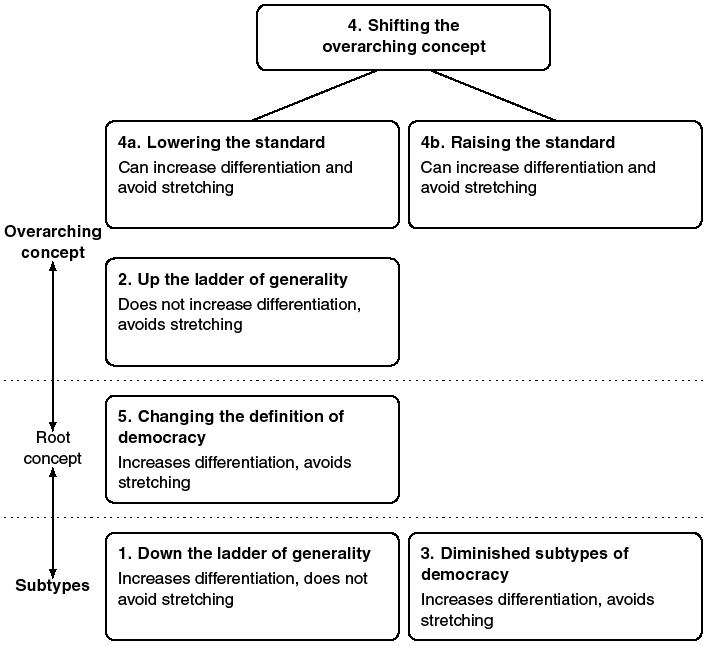
The strategies are summarized in Figure 2.3. Conceptual innovation occurred at three levels: the root concept of democracy itself, the subtypes, and the overarching concept. We observed that the strategies of (1) moving down the ladder of generality to classical subtypes of democracy and (2) moving up the ladder to classical subtypes of regime could serve either to increase differentiation or to avoid conceptual stretching, but could not do both simultaneously. By contrast, these two goals could be achieved simultaneously by (3) creating diminished subtypes within the framework of a part–whole hierarchy. Shifting the overarching concept, as a means of both lowering and raising the standard (4a and 4b), was successfully used both to increase differentiation and avoid stretching.
Evaluating the strategies: differentiation and avoiding stretching.
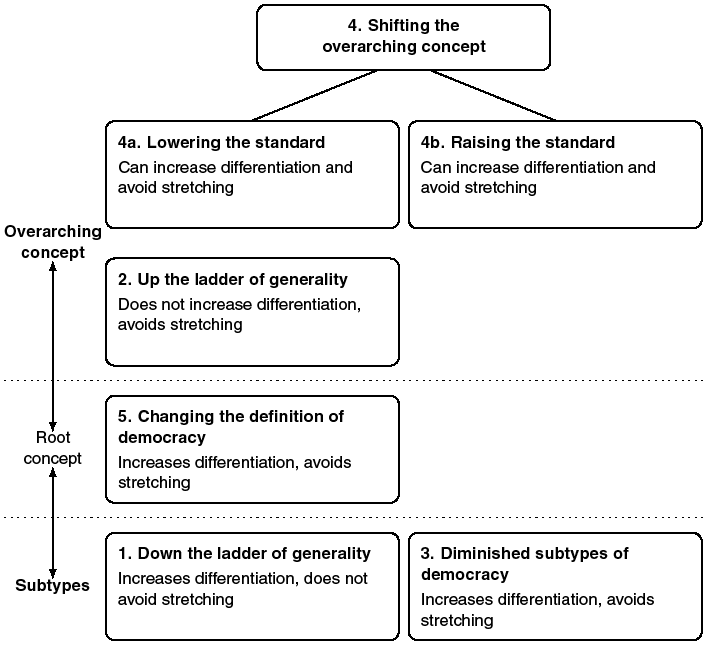
Figure 2.3 Long description
The figure presents a flowchart titled Evaluating the strategies: differentiation and avoiding stretching. At the top is a box labeled “4. Shifting the overarching concept”, which branches into two boxes: “4a. Lowering the standard” and “4b. Raising the standard.” Both boxes note that these strategies can increase differentiation and avoid stretching. On the left side, a vertical axis labels three conceptual levels: Overarching concept at the top, Root concept in the middle, and Subtypes at the bottom. Under “Lowering the standard,” three strategies are shown across these levels. At the overarching concept level is “2. Up the ladder of generality,” which does not increase differentiation but avoids stretching. At the root concept level is “5. Changing the definition of democracy,” which increases differentiation and avoids stretching. At the subtype level is “1. Down the ladder of generality,” which increases differentiation but does not avoid stretching. Under “Raising the standard,” the subtype-level strategy shown is “3. Diminished subtypes of democracy,” which increases differentiation and avoids stretching.
The final strategy – that is, (5) changing the definition of democracy by adding defining attributes – had the merit of contributing both to avoiding stretching (vis-à-vis a larger understanding of democracy) and to achieving finer differentiation. However, it was a more drastic approach in that it shifted the meaning of other concepts in the hierarchy.
We have also underscored further issues that arose with particular strategies. Diminished subtypes were useful for characterizing hybrid regimes, but raised the issue of whether these regimes should be treated as subtypes of democracy, rather than subtypes of authoritarianism or some other overarching concept. Shifting the overarching concept with the goal of raising the standard was not relevant to the problem of conceptual stretching. However, it allowed scholars to introduce new analytic issues without abandoning a procedural definition of democracy. Finally, the strategy of changing the definition was subject to the perennial problem of scholarly disputes over the meaning of democracy, as well as to the need to impose limits on definitional gerrymandering.
The diverse strategies summarized in Figure 2.3 also point to a broader problem. This literature on the third wave of democracy faced a major dilemma in the proliferation of literally hundreds of subtypes, many meaning approximately the same thing. The consequence could too readily be scholarly confusion, indeed, the kind of conceptual confusion against which Sartori (Reference Sartori and Sartori1984) warned long ago.
Hence, we propose another major objective of concept usage – one that introduces a further trade-off vis-à-vis the two goals of achieving analytic differentiation and avoiding conceptual stretching. Scholars should aim for parsimony and avoid excessive proliferation of new terms and concepts. Coordinating scholarly inquiry around carefully developed concepts will facilitate constructive dialogue and theory-building. The publication of review essays that clarify key concepts can play a crucial role. In the absence of such efforts, the advantages that derive from the kind of conceptual innovations that characterized this literature may be overridden by the resulting conceptual confusion.
A Brief Glossary of Terms
- Conceptual stretching
In the literature discussed here, extending the concept of democracy to cases which are seen (at least by some analysts) as not being democratic.
- Conceptual travelling
In the literature discussed here, extending the concept of democracy to new cases.
- Diminished subtype
A subtype in a part–whole hierarchy, in which the subtype lacks an attribute that is part of the root concept. For example, illiberal democracy is a diminished subtype of democracy, in that it lacks adequate protection of civil liberties.
- Extension
The set of cases encompassed by a concept.
- Intension
The defining attributes associated with a concept.
- Kind hierarchy
A conceptual hierarchy in which each subtype has all the attributes of the overarching concept, plus an additional attribute. It is a “kind of” in relation to the overarching concept. Thus, parliamentary democracy is a kind of democracy – that is, a democracy that has, in addition, a parliamentary system.
- Ladder of generality
The sequence of steps in a kind hierarchy. Sartori’s original term was ladder of abstraction, but it can be hard to pin down what it means for a concept to be abstract. Ladder of generality is more self-explanatory.
- Overarching concept
A broader concept in a conceptual hierarchy, in relation to which a subordinate concept is understood. For example, in many studies the overarching concept vis-à-vis democracy is regime.
- Part–whole hierarchy
A conceptual hierarchy in which each subtype lacks one of the attributes of the overarching concept. It is a “part of” in relation to that concept. Thus, an illiberal democracy is only partly democratic, in that it has limited civil liberties. It is a diminished subtype.
- Root concept
The point of entry in a given analysis. In a study of democracy, the root concept is democracy. Goertz (Reference Goertz2020: 27) suggests a parallel term: the “basic level.”
- Subtype
A type that is subordinate to or included in another type.

 Open access