


In this chapter, I illustrate the importance of ongoing engagement with conceptual analysis when conducting research. I focus on clientelism, a phenomenon in which politicians provide material benefits to citizens in direct exchange for political support. One of the thorniest issues in clientelism is conceptualization, with scholarly disagreement about questions such as what it is exactly, what different forms exist, and how it differs from other phenomena. At the outset, it should be emphasized that excellent studies by numerous others have advanced the conceptualization of clientelism;Footnote 1 such research is not examined here. Instead, I explore how my own published work on clientelism involves several conceptual typologies, which each consider different aspects of the concept. As discussed later, these typologies clarify four key points that address challenges that faced the clientelism literature: (1) campaign handouts can be used for both persuasion and mobilization; (2) campaign handouts can also shape the composition of the electorate; (3) a key distinction exists between electoral and relational clientelism; and (4) some scholarly usage of the term “vote buying” involves conceptual stretching.
Clientelism for Mobilization
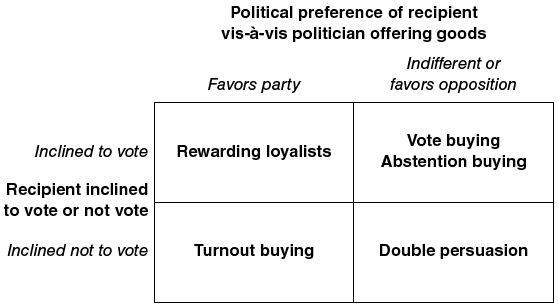
A first key challenge that faced the clientelism literature was its predominant focus on vote buying, which led studies to overlook the use of rewards for mobilization. Distinguishing whether rewards are used to influence vote choices or induce electoral participation is crucial not only for conceptual clarity but also to avoid analytic mistakes. Numerous prominent quantitative and formal studies of clientelism focus exclusively on vote buying,Footnote 2 unlike more recent research that investigates various distinct strategies. In Nichter (Reference Nichter2008), I emphasize that vote buying should not be confused with other forms of electoral clientelism, and examine how rewards can be distributed to mobilize rather than persuade citizens. To refine the concept, the article develops a conceptual typology of clientelist strategies during elections shown in Figure 8.1. As discussed in David Collier, Jody LaPorte, and Jason Seawright’s 2012 article, “Putting Typologies to Work: Concept Formation, Measurement, and Analytic Rigor,”Footnote 3 this typology has two dimensions: The row variable is whether the reward recipient is inclined to vote, and the column variable is whether the recipient favors the party offering the reward.
Strategies of clientelism during elections.

Figure 8.1 Long description
A two-by-two grid has an x-axis labeled “Political preference of recipient vis-à-vis politician offering goods”: the left column is “Favors party,” and the right column is “Indifferent or favors opposition.” The y-axis indicates the recipient’s inclination to vote: the top is “Inclined to vote,” and the bottom is “Inclined not to vote.” Within the four quadrants are labeled: top left “Rewarding loyalists,” top right “Vote buying/Abstention buying,” bottom left “Turnout buying,” and bottom right “Double persuasion.”
The clientelist strategies in each cell of Figure 8.1 target different types of individuals and induce distinct actions. The understudied strategy of turnout buying rewards unmobilized supporters for showing up at the polls. By contrast, vote buying rewards opposing (or indifferent) voters for switching their vote choices. Another clientelist strategy, abstention buying, rewards opposing (or indifferent) individuals for not voting.Footnote 4 Double persuasion distributes clientelist benefits to influence vote choices and induce electoral participation. Finally, rewarding loyalists delivers clientelist benefits to supporters who would turn out anyway. In addition to providing this typology, I conduct formal and quantitative analyses of turnout buying in Nichter (Reference Nichter2008). The article argues that Argentine survey data are more consistent with turnout buying than vote buying, though it explains that both strategies coexist.
The conceptual innovation in Figure 8.1, which increases analytic differentiation of clientelism, revealed an important avenue for further research. By refining the concept of clientelism and elaborating underlying dimensions, the typology laid the foundation for research on how the phenomenon might entail portfolios of distinct strategies. How and why might clientelist parties combine the strategies in Figure 8.1? To explore this question, I collaborated with Jordan Gans-Morse and Sebastian Mazzuca to operationalize the typology’s two dimensions – as political preferences and voting costs – and develop a formal model to analyze how parties adapt their portfolios of vote buying, turnout buying, abstention buying, and double persuasion to contextual factors (Gans-Morse, Mazzuca, and Nichter Reference Gans‐Morse, Mazzuca and Nichter2014). In addition to deriving formal predictions, we provide a graphical depiction of how many citizens are expected to be targeted with each clientelist strategy, as well as the effects of institutional factors. These axes correspond to the two dimensions of the typology discussed above. Among other findings, the article shows why introducing compulsory voting is expected to increase vote buying, and why enhanced ballot secrecy is expected to increase turnout buying and abstention buying. The typology, in other words, does quite a bit of work: It not only helps us disambiguate important concepts in the “semantic field” (Sartori Reference Sartori and Sartori1984), but it also helps to generate and structure causal predictions.
Clientelism for Shaping the Electorate
A second important challenge facing the clientelism literature was its nearly universal focus on how rewards shape the actions of the existing electorate. This depiction of the phenomenon was incomplete because it failed to capture how clientelism can also be used to shape the electorate. Indeed, my observations during empirical research suggested that the typology in Figure 8.1 required further conceptual analysis. As I conducted eighteen months of fieldwork and two surveys on clientelism in Brazil, I recognized another subtype of clientelism during elections that received scant attention in the academic literature – voter buying. Under this strategy, a politician distributes rewards to voters in other districts in exchange for transferring their electoral registration – and their vote – to the politician’s district. My collaborative work uncovered compelling qualitative evidence of this strategy, as well as survey evidence that voter buying was a common form of electoral clientelism in Northeast Brazil.Footnote 5 Voter buying does not correspond to any of the cells in Figure 8.1 because – as is common in the clientelism literature – the typology assumes that clientelist parties deliver rewards to the existing electorate (i.e., voters in a politician’s own district).
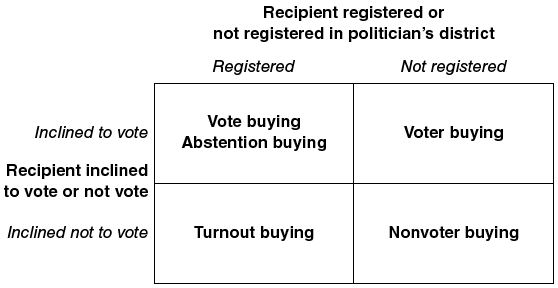
F. Daniel Hidalgo and I conducted further conceptual analysis to unpack this overlooked subtype (Hidalgo and Nichter Reference Hidalgo and Nichter2014). We contend that campaign handouts influence not only the electorate’s actions but also its composition. In order to clarify this point, we develop the conceptual typology in Figure 8.2, which introduces an important new dimension. Observe that the overarching concept (clientelist strategies during elections) and the row variable (whether the recipient is inclined to vote) are identical to Figure 8.1. However, the column variable is different: whether the recipient is registered in the politician’s district. The most common strategies discussed earlier continue to be shown in this revised typology.Footnote 6 More important, the new column variable exposes important variation in the overarching concept, thereby untangling voter buying from other forms of clientelism during elections.Footnote 7 Building on this conceptual analysis, we employ a regression discontinuity design and find that voter buying has significant effects on mayoral reelection as well as on voter registration in some Brazilian municipalities.
Strategies of clientelism during elections (with voter buying).
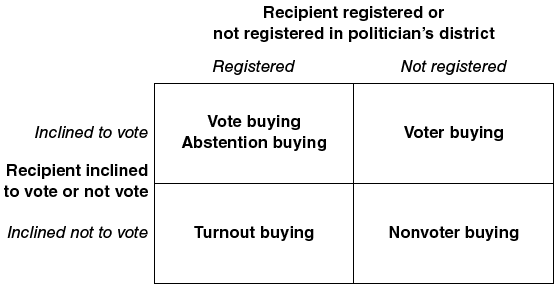
Figure 8.2 Long description
The two-by two grid x-axis categorizes voters’ registration status: “Registered” on the left and “Not registered” on the right. The y-axis distinguishes between “Inclined to vote” at the top and “Inclined not to vote” at the bottom. Within the four quadrants are labeled” top-left: “Vote buying” and “Abstention buying,” top-right: “Voter buying,” bottom-left: “Turnout buying” and bottom-right: “Nonvoter buying”
Electoral versus Relational Clientelism
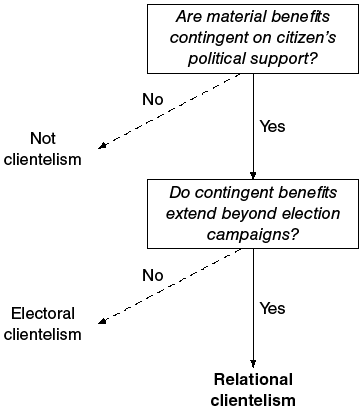
A third key challenge facing the literature was that it largely focused on clientelism during electoral campaigns. Unlike traditional work on the topic, many formal and quantitative studies ignore how clientelism often involves ongoing relationships between politicians and citizens. As with voter buying, my fieldwork made it clear that many contingent exchanges extend beyond elections, thereby suggesting yet another aspect of clientelism requiring further conceptual refinement. My 2018 book develops the conceptual typology in Figure 8.3 to sharpen the distinction between electoral clientelism and what I termed “relational clientelism” (Nichter Reference Nichter2018). The upper box describes the key defining attribute of the overarching concept of clientelism: Material benefits are provided contingent on a citizen’s political support. That is, recipients promise that they will provide (or have provided) political support in exchange for goods or services. If such contingency is not present, then the provision of benefits involves not clientelism but instead another modality of distribution (such as programmatic politics or constituency service) that one might view as politics as usual. The lower box presents a second defining attribute, which differentiates between electoral and relational clientelism. This attribute pertains to the timing of benefits – more specifically, whether contingent benefits extend beyond election campaigns. Whereas benefits are provided exclusively during campaigns with electoral clientelism, they extend beyond campaigns with relational clientelism.
Strategies of clientelism (electoral versus relational clientelism).
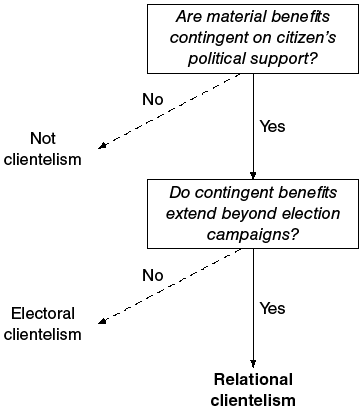
Figure 8.3 Long description
A flowchart begins with the question, “ Are material benefits contingent on citizen’s political support?”. If “No,” the outcome is “Not clientelism.” If “Yes,” it poses the question, “ Do contingent benefits extend beyond election campaigns?”. A “No” leads to “Electoral clientelism,” while a “Yes” leads to “Relational clientelism”.
The conceptual typology in Figure 8.3 proved to be foundational for quantitative and qualitative research in my 2018 book. One key reason is that by disaggregating clientelism according to the timing of benefits, the typology draws attention to the fact that the subtypes entail distinct credibility problems. With both forms of clientelism, politicians assess if a voter’s promises to provide political support are trustworthy. But unlike electoral clientelism, relational clientelism involves a dual credibility problem. Because relational clientelism involves promises of benefits beyond campaigns (i.e., after voting), citizens also assess the trustworthiness of politicians’ promises. By contrast, electoral clientelism provides all benefits during campaigns before voting, so citizens do not face the threat of opportunistic defection. Building on this conceptual insight – which emerged in the development of the typology in Figure 8.3 – I explore how and why citizens often help to alleviate this dual credibility problem, and thus play a crucial yet underappreciated role in sustaining relational clientelism. Many citizens across the world face inadequate social safety nets and are vulnerable to adverse shocks, and are thereby motivated to fortify long-term clientelist relationships as a risk-coping mechanism. Evidence suggests that citizens often use two key mechanisms to help sustain relational clientelism: they declare support to signal their own credibility, and they request benefits to screen politician credibility.
The typology in Figure 8.3 also suggests a fruitful direction for improving measurement and explanatory efforts in the field of clientelism. As with my prior work discussed earlier, the contemporary literature focuses predominantly on strategies of electoral clientelism, such as vote buying, turnout buying, abstention buying and voter buying. Yet it is possible that much of what researchers interpret to be electoral clientelism is actually relational clientelism. Researchers often measure electoral clientelism by asking survey respondents whether they received a handout during a given campaign period. But observe that in Figure 8.3 the second attribute about the timing of benefits does not imply that relational clientelism suspends benefits during electoral campaigns. As such, simply identifying the provision of a campaign handout is insufficient to determine whether the exchange constitutes electoral or relational clientelism. Instead, researchers must determine whether the provision of contingent benefits to the citizen also extends beyond campaigns. This issue is important not only for measurement but also for evaluating explanatory claims: If studies overlook the distinction between electoral and relational clientelism, serious analytical mistakes can arise. The broader point is that refining the concept of clientelism can offer both measurement and explanatory contributions.
“Vote Buying” and Conceptual Stretching
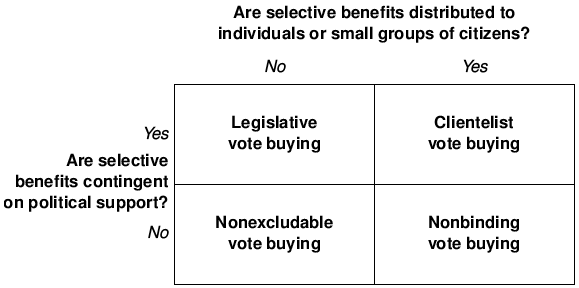
A fourth key challenge is that many studies use the term “vote buying” when referring to a broad range of phenomena, many of which do not involve clientelism at all. This practice contributes to substantial conceptual ambiguity with regard to scholarly usage of the term “vote buying.” My 2014 article (Nichter Reference Nichter2014) presents the typology in Figure 8.4 and, as discussed later, argues that some scholarly usage involves conceptual stretching (Sartori Reference Sartori1970). The conceptual typology has two dimensions referring to how researchers use the term “vote buying”: The row variable is whether selective benefits are contingent on political support, and the column variable is whether selective benefits are delivered to individual or small groups of citizens.
Common usage of “vote buying” in academic studies.
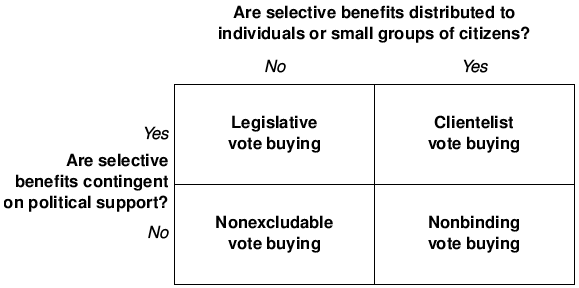
Figure 8.4 Long description
The x-axis of the 2x2 grid graph has the question “Are selective benefits distributed to individuals or small groups of citizens?”, having “No” on the left and “Yes” on the right. The y-axis presents the question “ “Are selective benefits contingent on political support?” with “Yes” at the top and “No” at the bottom”. The boxes in the graph contain “Legislative vote buying” on the top left, “Clientelist vote buying” on the top right, “Non-excludable vote buying” on the bottom left, and “Non-binding vote buying” on the bottom right.
As shown in the cells, academic usage of “vote buying” can be categorized into four subtypes: clientelist, legislative, nonexcludable, and nonbinding. Clientelist vote buying refers to the phenomenon described earlier (see discussion of Figure 8.1). A second common subtype is legislative vote buying, which similarly involves contingent benefits but provides benefits to legislators instead of citizens. Many studies investigate how vote buyers such as interest groups or politicians provide selective benefits to legislators who agree to vote for a specific bill. Such studies typically deem the exchanges to be quid pro quo: Legislators agree to support a bill in exchange for including specific benefits before voting. A third common subtype is nonexcludable vote buying, which provides local public goods to political districts in an effort to generate political support. Unlike the first two subtypes, these studies typically do not describe citizens or elites as providing political support in contingent exchange for benefits. Local public goods are nonexcludable within districts; all residents can access them even if they refuse political support. Thus, vote buying with local public goods does not involve contingency. A fourth subtype is nonbinding vote buying, which delivers benefits to individual or small groups of citizens without conditioning receipt on promises of political support. Such studies typically depict politicians as providing benefits – with or without partisan bias – in order to foster goodwill that can heighten future electoral support. While both clientelist and nonbinding vote buying target individual or small groups of citizens, only the former subtype involves quid pro quo exchanges of benefits for political support.
Building on this typology, I contend in Nichter (Reference Nichter2014) that some scholarly usage of the term “vote buying” is inappropriate. Because contingent exchange is a fundamental component of any “root definition” of vote buying, the bottom two subtypes in Figure 8.4 – nonexcludable and nonbinding vote buying – involve conceptual stretching.Footnote 8 As discussed earlier, nonexcludable vote buying lacks contingency because residents in recipient districts cannot be prevented from accessing local public goods, and nonbinding vote buying lacks contingency because it does not require recipients to promise political support in exchange for benefits. Ideally, researchers should not use the term “vote buying” when referring to either of these phenomena. Alternatively, they should be explicitly identified as “diminished subtypes” (Collier Reference Collier and Smith1995; Collier and Levitsky Reference Collier and Levitsky1997), in which the adjectives “nonexcludable” and “nonbinding” convey that an attribute of the root concept (i.e., contingency) is missing.
Discussion
Stepping back, this discussion of clientelism demonstrates that continued engagement with conceptual analysis can yield important insights and analytic leverage. Taken together, the typologies presented herein refine the overarching concept of clientelism by revealing underlying dimensions, explicating subtypes, and reducing conceptual ambiguity. Among other insights, they heighten analytical differentiation by revealing how distinct strategies of electoral clientelism can be used to persuade, mobilize, and even shape the electorate. Also of fundamental importance, the typologies distinguish between electoral clientelism (in which benefits are limited to campaigns) and relational clientelism (in which benefits extend beyond campaigns). Moreover, refined conceptualization identifies how researchers can avoid potential conceptual stretching when using the term “vote buying.” These typologies not only improve conceptual clarity but also prove to be foundational for further formal and empirical research on the topic.
Introduction
Since the dissolution of communist party systems across Eurasia from 1989 to 1991, scholars have sought to better understand communism’s political aftermath and the variation in political outcomes across the region. Dominant questions include: What are communism’s legacies? Are post-communist systems conceptually distinct from other formerly authoritarian systems? What explains the substantial divergence in contemporary political outcomes among entities that shared broad structural similarities only forty years ago? Is “post-communism” a helpful concept, or is it a relic of a colonized scholarly agenda?
Typologies can be a valuable tool to provide analytical leverage on these questions. David Collier, Jody LaPorte, and Jason Seawright (Reference Collier, LaPorte and Seawright2012) argue that typologies can be put to work to form concepts, refine measurement, explore dimensionality, and organize explanatory claims, tasks that are all necessary to advance scholarship on the most pressing questions about the former communist world.Footnote 1
Since the 1990s, scholars have attempted to classify formerly communist states into categories or “types” that characterize the political and economic institutions that have developed after the end of communist-party rule (Linz, Stepan, and Gunther Reference Linz, Stepan, Gunther, Gunther, Diamandouros and Puhle1995; Møller and Skaaning Reference Møller and Skaaning2010; Zimmerman Reference Zimmerman2014; Hale Reference Hale2015; Way and Casey Reference Way and Casey2018; Kornai Reference Kornai and Magyar2019). Regardless of the classification scheme employed, there is broad consensus among scholars of post-communist transformation about the existence of a variety of systems across Eurasia and the inadequacy of earlier typologies of political regimes to adequately describe them. Scholars investigating the region have offered new insights into underlying dimensions and overlooked assumptions about dynamic political processes. These contributions have advanced the study of democratization and regime change, shifting discussion about regime categorization and dimensionality away from attributes of democracy and toward a more robust consideration of differences among nondemocratic forms of political organization.
Nevertheless, this scholarship also exposes several missed opportunities for putting typologies to work more effectively. While scholars critique existing concepts, analyses rarely advance a complete typology comprised of mutually exclusive categories or “types” arrived at by evaluating dimensions upon which phenomena can differ in substantively meaningful ways. An absence of specification about the underlying dimensions and their potential points of intersection hinders scholars’ ability to identify points of agreement and discord among competing explanations and limits their ability to apply descriptive typologies as causal variables. Scholars of formerly communist cases frequently engage in typological thinking – the intellectual work of engaging in the building blocks of typologies without specifying the dimensions of variation that lead to distinct categorical types.
By examining several examples of typologies of communist and post-communist systems, I aim to highlight their contributions to the study of political regimes while also identifying missed opportunities where closer attention to typology building may yield greater insights for comparative politics.
Building and Identifying Typologies
Before delving into specific post-communist typologies, clarification of a few terms is necessary. There is a key distinction between descriptive and explanatory typologies. Descriptive typologies (also called conceptual typologies) seek to map out a concept’s dimensions, which correspond to the rows and columns in the typology, while explanatory typologies treat rows and columns as variables and cells as the hypothesized or confirmed outcomes of a causal process. With an explanatory typology, the author can potentially identify the cases that correspond to each cell. With this approach, the explanatory typology in effect is also empirical cross-tabulation.
Creating descriptive and explanatory typologies involves several “building blocks”: explicating the overarching concept,Footnote 2 disaggregating it into two or more dimensions that comprise the row and column variables, and cross-tabulating the dimensions in a matrix through which distinct “types” appear in the cells.
While these steps may appear straightforward, failure to carefully follow them can lead to missed opportunities for improving conceptualization and measurement. Descriptive typologies that fail to disaggregate the dimensions upon which the overarching concept’s types are based limit other scholars’ ability to apply the relevant concept as a variable in an explanatory framework. In almost all instances, selective engagement with typology building blocks coincides with inductive theory building that draws on a broad range of qualitative evidence. As part of their theory building, some scholars emphasize distinct types of an overarching concept without fully elaborating the dimensions that give rise to the distinctions. In other instances, scholars engage in the work of concept formation and categorization while simultaneously offering a rich, qualitative, empirical account but then do not take the final step of abstracting away from the empirical work to specify dimensions and categories that could be applied by scholars surveying other phenomena.
A close look at the literature reveals a common thread of selectively engaging with a typology’s building blocks, or what I will call “typological thinking.” Typological thinking – or the intellectual work of defining overarching concepts, distinguishing their boundaries, identifying underlying dimensions and the range of possible variation within them – is necessary for building typologies. However, it is possible to engage in this intellectual process without creating a complete typology or even acknowledging that these efforts at conceptualization, measurement, and categorization comprise a typology.
Typological thinking abounds in the conceptual, theoretical, and empirical work centered on the formerly communist countries of central and southern Europe and Eurasia. While some scholars call their classification schemes typologies, others who engage in typological thinking do not elaborate an explicit, complete typology. Among the variety of typologies that describe or explain post-communist phenomena, regime typologies are the most numerous, covering a range of goals and scopes. Some typologies have focused on explicating variation in communist systems (Kitschelt et al. Reference Kitschelt, Mansfeldova, Markowski and Toka1999; Breslauer Reference Breslauer2021). Others theorize underlying dimensions (and their possible empirical ranges) and identify an array of specific types of political regime (Linz and Stepan Reference Linz and Stepan1996; Møller and Skaaning Reference Møller and Skaaning2010; Zimmerman Reference Zimmerman2014). Overall, typological analysis that classifies political and economic systems regularly engages discussion about shifting the root conceptFootnote 3 to move away from a democracy-centric understanding of the dimensions of political regime (Hale Reference Hale2015).
Despite these valuable contributions, the overall utility of existing classificatory schemes for addressing the most pressing questions about post-communism has been limited. While both specified and unacknowledged typologies of post-communist outcomes offer a valuable appraisal of omitted variables in analytical frames commonly applied in comparative politics, they have seldom moved fully from critique to construction of new alternatives. Explanatory typologies that explicate a process for post-communist regime variation are rare, even though typologies of political regimes remain among the most common classificatory schemes in the post-communist literature.
In the early 1990s, several central European states had laid the pathway toward developing democracies and robust market economies, while political and economic reforms appeared stalled or nonexistent in the south and east. More than thirty years later, the diversity of outcomes remains. There is no scholarly consensus, however, about how to best conceptualize this variation and the number of distinct types that exist. Likewise, agreement over the causes of this variation remains elusive. Many empirical outcomes, from the Czech Republic’s early success at democratization to Turkmenistan’s absence of meaningful reform, had multiple plausible explanations.
While existing classificatory schemes are of limited utility in gaining traction on these questions, carefully constructed typologies could be used more effectively. Typologies can sharpen concepts, map out rival explanations, promote parsimony to elucidate complex causal sequences, and represent differences in kind. The potential opportunity of typologies to offer analytical leverage is most apparent in the debate about regime type and the causal sequences that led to such dramatic variation across the region.
In the following sections, I will highlight several existing classificatory schemes to both shed light on their contributions and identify opportunities to strengthen typology-building to maximize analytical leverage. The schemes selected for analysis are influential, well-regarded pieces of scholarship. Individually, each has made an important contribution to understanding post-communist outcomes. They are also illustrative of the broader trends present in post-communist typologies and typological thinking. The prominence of these schemes is precisely why I have selected them for critique, with the goal of demonstrating how existing concepts and theoretical approaches can be sharpened for broader impact.
Typologizing Communist Systems
The first set of typologies focuses on the communist systems themselves. After the dissolution of these systems, many scholars and analysts assumed that communist inheritances would have a uniform effect on post-communist transformation. Yet several scholars have challenged this assumption. Curiously, however, descriptive typologies of communist systems are not common. The most influential is Kitschelt et al.’s (Reference Kitschelt, Mansfeldova, Markowski and Toka1999) typology, which describes three types of communism that were present at the end of communist rule: bureaucratic-authoritarian communism, national-accommodative communism, and patrimonial communism. The authors arrived at this typology by looking at both the political and economic antecedents of communist rule and modes of communist rule. After describing these types and categorizing cases accordingly, the authors incorporate the type of communist rule as an explanatory variable responsible for post-communist regime trajectories, quality of representation, and strength of political institutions.
The significance of this typology is evident from the frequency with which it has been cited and applied in further work. In one prominent example, when establishing his concept of “patronalism,”Footnote 4 Henry E. Hale (Reference Hale2015: 60) uses information from Kitschelt et al.’s analysis to classify country cases into ordinal categories of “most patronalistic,” “moderately patronalistic,” and “least patronalistic.” Hale argues that levels of patronalism are central to understanding the descriptive contrasts among post-communist systems and their capacity for achieving certain political and economic outcomes. We thus have three categories with an ordinal ranking, and the typological thinking incorporated into Hale’s conceptualization of patronalism has shed light on the significance of informal arrangements that frequently penetrate and subvert formal institutions (Hale Reference Hale and Magyar2019).
Few analysts have attempted a comprehensive typology of communist systems. Kitschelt et al.’s typology offers a useful representation of communist systems in the years immediately prior to their dissolution. George W. Breslauer (Reference Breslauer2021) offers a classification scheme of six “patterns” of communism that emerged in the six decades following Stalin’s death, ultimately converging into three durable types: Stalinism maintained, bureaucratic Leninism, and market Leninism. Breslauer is clear that these three types are not the only models of communism that existed but rather the three that have proved most durable, as well as relevant for communism outside Europe. Breslauer links these patterns of communism to several other outcomes of interest, including the resilience of the five remaining communist states in the contemporary world.
The communist types identified by both Kitschelt et al. and Breslauer are conceptually rich and detailed. They are “ideal types” in the Weberian tradition of concept formation and, as such, offer scholars the opportunity to consider longitudinal variation in types within the same communist country case over time. Both scholarly works suggest that variation in these communist system types is causally significant for some outcomes of interest. While both Kitschelt et al. and Breslauer distill many characteristics of communist rule into more parsimonious categories, questions about the root concept remain. Kitschelt et al.’s conceptualization of communism appears thinner, focused more narrowly on the party’s relationship with the public and bureaucracy, while Breslauer’s conceptualization is broader, encompassing elites’ commitments to Marxist or national revolutionary ideals as well as their methods of economic and political management. Closer attention to the boundaries of the root concept of “communism” and its underlying dimensions would facilitate the application of typologies of former communist systems to other explanatory models. For example, these typologies might play an important role in measuring the impact of communist legacies on post-communist regime outcomes.
To provide an illustrative example of how typology building could be sharpened to strengthen analytical leverage in understanding post-communist outcomes, I have taken descriptions of characteristics from both Kitschelt et al.’s and Breslauer’s communist system types and restructured them into more parsimonious typologies. Table 9.1 is a conceptual typology elaborating the main dimensions for modes of communist rule as described by Kitschelt et al. Table 9.2 is an explanatory typology that demonstrates how pre-communist antecedents determined which communist system came into being. This modification for representing the original typology emphasizes the key dimensions upon which the types are drawn, offering a more parsimonious explication of a complex explanatory sequence for how specific communist systems emerged and operated.
| Method to induce popular compliance | Formal bureaucratization | |
|---|---|---|
| High/intermediate with low corruption | Low with high corruption | |
| Primarily repression | Bureaucratic authoritarian communism (Czech Republic, German Democratic Republic) | Patrimonial communism (Albania, Armenia, Azerbaijan, Belarus, Bulgaria, Georgia, Kazakhstan, Kyrgyzstan, Macedonia, Moldova, Romania, Russia, Tajikistan, Turkmenistan, Ukraine, Uzbekistan) |
| Primarily cooptation | National-accommodative communism (Croatia, Hungary, Slovenia) | |
Note: Derived from information presented by Kitschelt et al. (Reference Kitschelt, Mansfeldova, Markowski and Toka1999: 35–41). Kitschelt et al. identify Poland as a mixed case between the bureaucratic authoritarian and national-accommodative types and Slovakia, Latvia, Lithuania, Estonia, and Serbia as a mix of the national-accommodative and patrimonial types.
| Antecedent political regime | Antecedent political economy | |
|---|---|---|
| Industrial capitalist | Predominantly agricultural | |
| Competitive/pluralist | Bureaucratic authoritarian communism | National-accommodative communism |
| Absolutist/authoritarian | Patrimonial communism | |
Note: Derived from information presented by Kitschelt et al. (Reference Kitschelt, Mansfeldova, Markowski and Toka1999: 35–41).
In both Tables 9.1 and 9.2, I simplified Kitschelt et al.’s original articulation of the underlying dimensions that give rise to specific communist types to arrive at a two-dimensional typology. By collapsing several dimensions or values that the authors treat separately, this modification sacrifices detail. Yet, in return, it focuses attention on the primary dimensions where variation is most relevant: formal bureaucratization and the methods used by the state to induce popular compliance for Table 9.1 and antecedent political and economic systems in Table 9.2.
I have created a conceptual typology (Table 9.3) that summarizes Breslauer’s analysis. In contrast to Kitschelt et al., Breslauer does not display his types and the dimensions upon which they are based in tabular form. In reading through the empirical details across durable types, however, two primary dimensions emerge as significant sources of variation. One dimension is a communist system’s form of economic management. One standard mode is central planning, while the other is some form of (narrow or broad) marketization. The other dimension involves how political elites sought to manage political relations with society. Along this dimension, the primary variation concerns the use of coercion versus other forms of nonviolent incentives.
| Political management | Economic management | |
|---|---|---|
| Central planning | Marketization | |
| Primarily coercion/violence | Stalinism maintained (Mao’s China, Cambodia, Vietnam, Albania post-1953, North Korea) | |
| Primarily rationalization/cooptation | Bureaucratic Leninism (Brezhnev’s USSR, most East European cases 1957–85, Castro’s Cuba since 1970s) | Market Leninism (Yugoslavia and Hungary 1960s–80s; Deng’s China; Vietnam, and Laos since 1980s–90s) |
Note: Derived from information presented by Breslauer (Reference Breslauer2021: chap. 2). The countries in bold type are contemporary cases of the types as of 2021.
The intersection of these two dimensions yields the three durable modes of communist rule Breslauer identifies. No cases of systems that rely primarily on coercive political tactics attempted marketization. There remains meaningful scope for empirical variation within the categories summarized in each of these two dimensions, yet they offer a parsimonious portrayal of the primary features behind Breslauer’s three durable types.
In comparing Tables 9.1 and 9.3, one can notice similarities and differences in underlying dimensions, categories, and classification across the two descriptive typologies. Exploring these more deeply is beyond the scope of this chapter, but the exercise reveals the value of sharpening typology building for greater analytical leverage.
Post-Communist Systems of the 1990s
Discussions of post-communist outcomes and related classification schemes from the 1990s were heavily influenced by the literature on democratization in southern Europe and Latin America in the 1970s and 1980s. Consequently, scholarship of this era frequently adopted a lens of elite-led democratic transitions after the dissolution of communism. The inadequacy of this framework to account for the full range of post-communist transformation experiences broke open the study of regime change, compelling closer attention to how structures shape and constrain individual choices among both political elites and citizens (Frye Reference Frye2018; Way and Casey Reference Way and Casey2018).
An early and significant contribution to this corrective was advanced by Juan Linz and Alfred Stepan (Reference Linz and Stepan1996), who updated and expanded Linz’s classic 1975 typology of authoritarian regimes. Linz’s original typology aimed to distinguish between authoritarian and totalitarian regimes, developing these types based on variation along four underlying dimensions: degree of pluralism, ideology, mobilization, and political rule. The updated typology contained five “ideal types” of regime: democracy, authoritarianism, totalitarianism, post-totalitarianism, and sultanism. The underlying dimensions of pluralism, ideology, and mobilization remain, while political rule is replaced with the dimension of leadership. By bringing the nondemocratic regimes into direct dialogue with the features of democracy, Linz and Stepan shifted focus on regime transformation away from a teleological centering on democracy in favor of dimensions emphasizing other forms of linkage between political elites and citizens and the role of broader pluralism in public life. This approach reveals commonalities that can exist between democracies and some nondemocratic systems, such as the presence of social and economic pluralism, while also demonstrating how the dimensions vary across nondemocratic contexts. The typology offers a useful template for thinking about regime mobilization and citizen participation as existing on opposite poles on the same underlying dimension, as well as for considering the distinction between an intellectual commitment to the ideals of democracy versus the role of a guiding ideology that is used to justify political rule.
While the expanded typology offers useful analytical features, it also reveals missed opportunities to rebuild the classic typology. The root concept of Linz’s original typology was authoritarian regimes, while the expanded typology describes political regimes in general. However, the underlying dimensions in the expanded typology appear to be slightly adjusted to accommodate a comparison with democracy rather than being fully revaluated. As a result, the theoretical range of scores on these dimensions is unclear. For example, the “mobilization” dimension in the original typology comprised a more limited range as it did not include the possibility of citizen participation, while the expanded typology includes full citizen participation as one pole on this dimension, which would perhaps be more accurately labeled as “public engagement.”
Additionally, the introduction of a “post-totalitarian” type inspires new questions. Are post-totalitarian systems temporary and transitory? Is post-totalitarianism a diminished subtype of totalitarianism? If so, what is the root concept? In sum, while Linz and Stepan aimed to shift the root concept of the original Linz typology, they did so more in name than in practice, resulting in lack of clarity of the boundaries of the underlying dimensions.
Post-Communist Systems in the Twenty-first Century
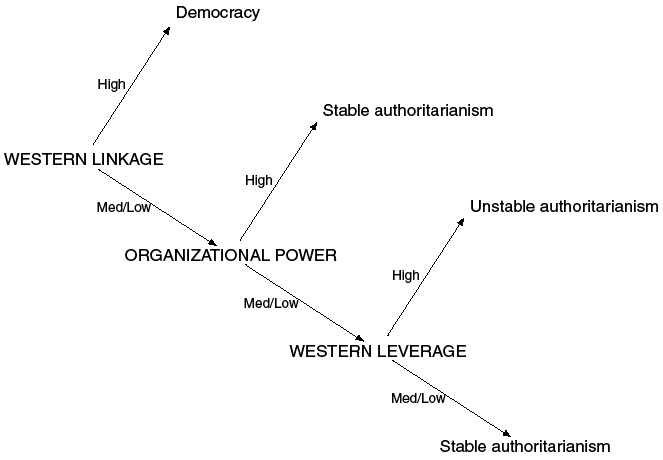
In the 2000s, post-communist regime classifications evolved to acknowledge the fuzzy boundaries that appeared to exist between democracies and authoritarian regimes. Levitsky and Way’s (Reference Levitsky and Ahmad Way2010) concept of competitive authoritarianism further advanced typological thinking about post-communist regimes by extending Dahl’s (Reference Dahl2008) concept of polyarchy to make explicit the assumption of a reasonably level playing field between incumbents and opposition. While the authors do not cast their work as a typology, their theory about the rise of competitive authoritarian regimes in the early twenty-first century – nearly one-third of which were concentrated in post-communist states – can be viewed as an explanatory typology. Their explanatory argument is based on three variables: Western linkage, organizational power, and Western leverage. The combination of scores on these variables lead to the three regime outcomes of democracy, stable authoritarianism, and unstable authoritarianism.
They presented their argument as a form of arrow diagram that summarizes the three components of their explanatory claims (Figure 9.1; i.e., their original diagram). This diagram has two disadvantages. It could be mistakenly read as a kind of path diagram often used in quantitative research. Relatedly, it appears to suggest a temporal sequence, which is misleading. In Table 9.4, I have used standard ideas about diagramming typologies to create a depiction of their argument that allows scores on multiple dimensions and cases to be depicted together. It is more readable, for example, in that one can quickly identify the cells that correspond to successful and unsuccessful prediction of a democratic outcome.
Levitsky and Way’s regime outcomes.
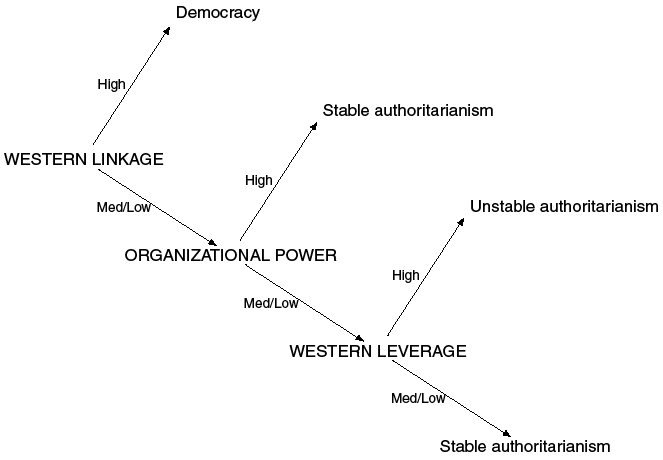
Figure 9.1 Long description
A flowchart begins with “Western linkage” that if “high” goes to “democracy” and if “med/low” goes to “organizational power. “Organizational power” if” high” leads to “ stable authoritarianism,” and if “med/low” goes “Western leverage.” “Western leverage” if “high leads to “ unstable authoritarianism,” and if “med/low” results in “stable authoritarianism.”
| Organizational power | Western leverage | |||
|---|---|---|---|---|
| Low/medium | High | |||
| Western linkage | ||||
| Low/medium | High | Low/medium | High | |
| Low/medium | Stable authoritarianism (Russia) | Democracy (no cases) | Unstable authoritarianism (Georgia, Moldova) | Democracy (Macedonia, Romania) |
| High | Stable authoritarianism (no cases) | Democracy (no cases) | Stable authoritarianism (Armenia) | Democracy (Croatia, Serbia, Slovakia) |
Note: Derived from information presented by Levitsky and Way (Reference Levitsky and Ahmad Way2010: 70–72, 341–42). Levitsky and Way note that their theory does not correctly predict the outcomes for Albania, Belarus, and Ukraine. Albania is a case where high linkage does not result in democracy; in Belarus authoritarianism is unstable when predicted to be stable; and in Ukraine, democracy results in place of unstable authoritarianism.
Levitsky and Way&presents an overview of’s argument is a compelling explanation for variation in post-communist political regimes, correctly predicting the outcome for all but three of the post-communist cases included in the sample at the time of publication. Their explanatory framework views competitive authoritarianism as an unstable or transitionary regime that will ultimately move onto a path toward democracy or some other form of authoritarianism. However, the resilience of competitive authoritarian or other forms of hybrid regimes in the post-communist region over the past decade challenges this perspective.
Other scholars have attempted to incorporate hybridity into their typologies by rethinking the underlying dimensions that make up a regime. Jørgen Møller and Svend-Erik Skaaning’s (Reference Møller and Skaaning2010) typology clarifies the property space between autocracy and democracy by examining three dimensions commonly related to democracy: free elections, freedom rights, and rule of law. Each dimension is given three possible ordinal scores of “no defects,” “moderate defects,” and “severe defects,” resulting in six distinct types: liberal democracy, polyarchy, electoral democracy, minimalist democracy, autocracy, and illiberal autocracy. William Zimmerman (Reference Zimmerman2014) examines the status of core democratic institutions and elections, status of the opposition, level of electoral uncertainty, size of the electorate, and regime goals in distinguishing between four regime types: democratic, competitive authoritarian, full authoritarian, and mobilizational.
Like the missed opportunities identified in the Linz and Stepan typology, classification schemes involving hybridity suffer from unclear articulation of the root concept and specification of the underlying dimensions that determine it. Consequently, scholars are frequently talking past each other, and few attempts to flesh out hybrid concepts (other than Levitsky and Way’s) have caught on.
Conclusion
Typologies can be put to work in two fundamental ways. The first is to use them to introduce conceptual and theoretical innovations, sometimes drawing together multiple lines of investigation or analytic traditions. The second is to map political transformations and empirical change. Typologies have been applied in both ways to categorize and explain post-communist outcomes. Both specified typologies and classificatory schemes that result from typological thinking have broken open the study of regime change to shift away from a focus on democratic transition and consolidation to consider a broader range of outcomes. Differences in both formal institutions and the informal practices that operate them have received greater scrutiny.
Nevertheless, missed opportunities to carefully consider the boundaries of concepts and their underlying dimensions have limited the analytical value of typologies for conceptualizing the relationship among rival hypotheses and formulating parsimonious explanations of post-communist political change. Closer attention to specifying the building blocks of a typology would strengthen the potential contributions of typologies for explicating the causal force of communist-era practices on post-communist outcomes. Specifically, much remains to be done on developing the root concept of “regime.” Unlike Weber’s definition of the “state,” comparativists lack the same clarity of vision regarding “regime.” While commonly understood as the rules and procedures that determine access and distribution of power, even this basic articulation begs many questions about underlying dimensions and their theoretical and empirical ranges. While categorization of communist systems and post-communist typologies may not have offered the most comprehensive and satisfying answers to the question of what comprises a regime, their missteps can help establish a clear path forward from critique to construction.

 Open access