To save content items to your account,
please confirm that you agree to abide by our usage policies.
If this is the first time you use this feature, you will be asked to authorise Cambridge Core to connect with your account.
Find out more about saving content to .
To save content items to your Kindle, first ensure no-reply@cambridge.org
is added to your Approved Personal Document E-mail List under your Personal Document Settings
on the Manage Your Content and Devices page of your Amazon account. Then enter the ‘name’ part
of your Kindle email address below.
Find out more about saving to your Kindle.
Note you can select to save to either the @free.kindle.com or @kindle.com variations.
‘@free.kindle.com’ emails are free but can only be saved to your device when it is connected to wi-fi.
‘@kindle.com’ emails can be delivered even when you are not connected to wi-fi, but note that service fees apply.
Large walling projects are among the most visible features in the archaeological record. However, enclosure walls remain relatively under-theorized relative to other monumental buildings. In an attempt to move beyond simple explanations that analyse walls solely as defensive features or symbols, I link monumental walls to notions of sovereign power and action-oriented theories of value(s). Using examples from Pharaonic Egypt, I argue that monumental enclosure walls were attempts to define and realize particular social totalities, whether these were a temple complex, a royal tomb or an urban centre. If all efforts at border-making are also an exercise in power, walls have the potential to illuminate some of the goals and values of those ordering their construction. By analysing changes and continuities related to which structures required the protection of a monumental enclosure wall over time, it is possible to shed light on the fluid priorities of the most important political actors in Pharaonic society. Yet the very presence of a wall implies potential dissent and alternative practices—otherwise a wall's construction would not have been necessary.
Southern Peru is home to one of the richest sites with rock art in South America—Toro Muerto. A unique aspect of the iconography of the petroglyphs of the site is the figures of dancing humans, the so-called danzantes, which are additionally frequently associated with geometric motifs, mostly variants of zigzag lines. Drawing upon intriguing data recorded during Reichel-Dolmatoff's research in Colombia related to the meaning of analogous motifs in Tukano art, as well as broader exploration of the sonic sphere in South American cultures and the thesis that Amazonian animism was a more archaic ontology over a broader area of South America, this paper suggests that the geometric patterns at Toro Muerto, with which the figures of danzantes are juxtaposed, may have been representations of songs. An extension of this hypothesis is the suggestion that some of the more complex compositions consisting of danzantes and linear geometric motifs were graphic metaphors of transfer to the other world.
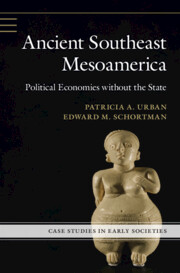
Ancient Southeast Mesoamerica explores the distinctive development and political history of the region from its earliest inhabitants up to the Spanish conquest. It was composed of a matrix of social networks rather than divided by distinct cultures and domains. Making use of the area's rich archaeological data, Edward Schortman and Patricia Urban provide a social network analysis of southeast Mesoamerica. They demonstrate how inhabitants from different locales were organized within such networks, and how they mobilized the assets that they needed to define and achieve their own goals. The also provide evidence for the actions of other groups, who sought to promote their importance at local and regional scales, and often opposed those efforts. Schortman and Urban's study demonstrates the fresh insights gained from study of socio-political structures via a social network perspective. It also challenges models that privilege the influence of powerful leaders in shaping those structures.
This Element describes and synthesizes archaeological knowledge of humankind's first cities for the purpose of strengthening a comparative understanding of urbanism across space and time. Case studies are drawn from ancient Mesopotamia, Europe, Asia, Africa, and the Americas. They cover over 9000 years of city building. Cases exemplify the 'deep history' of urbanism in the classic heartlands of civilization, as well as lesser-known urban phenomena in other areas and time periods. The Element discusses the relevance of this knowledge to a number of contemporary urban challenges around food security, service provision, housing, ethnic co-existence, governance, and sustainability. This study seeks to enrich scholarly debates about the urban condition, and inspire new ideas for urban policy, planning, and placemaking in the twenty first century.
The aim of the article is to reframe speculation from being seen as synonymous with unacademic conjecture, or as a means for questioning consensus and established narratives, to becoming a productive practical engagement with the archaeological and responding to its intrinsic uncertainties. In the first part of the article, we offer a review of speculation in the history of archaeological reasoning. In the second part, we proceed to discussing ways of embracing the speculative mandate, referring back to our engagements with the art/archaeology project Ineligible and reflections on how to work with the unknowns and uncertainties of archaeology. In the third and last part, we conclude by making the case for fertilizing the archaeological potential nested in the empirical encounter, creating more inceptions than conclusions, fostering ambiguities, contradictions and new spaces of experiential inquiry. This leads us to suggest that—when working with the archaeological—speculation should be seen not only as a privilege, but also as an obligation, due to the inherent and inescapable uncertainties of the discipline. In other words, archaeology has been given a mandate for speculation through its material engagements.
Rebutting previous claims, the paper employs comparative stylistic analysis and palaeoenvironmental data to argue that Angara style rock art originated in the Mongolian Altai during the Upper Palaeolithic (13,000–10,300 bp) where it evolved in situ. Around 8200–7300 bp, drought forced the hunter-gatherers who created Angara style rock art to migrate to the Upper Yenisey and the Selenga and Angara basins. When drought impacted that area c. 7500–7000 bp, Kotoi (Ket) culture descendants sought refuge in the resource-rich Minusinsk Basin. On the Middle Yenisey River, Angara style rock art served as a mnemonic device that encoded the syncretism of proto Ket and Evenki cosmologies and beliefs resulting from their social alliance.
This chapter continues through the early eleventh century our account of the political histories related in Chapter 8. In contrast to events chronicled for the Copán-centered network at this time, what we see in other parts of Honduras and El Salvador is the emergence of large capitals that dominated their respective domains. These processes are most evident in Honduras’s Lower Ulúa, Lower Cacaulapa, and Comayagua valleys where the regional capitals of Cerro Palenque, El Coyote, Tenampua, and Las Vegas were established. Whereas these developments had Indigenous roots, Pipiles, Nahua-speaking immigrants from Mexico, now founded Cihuatán, a large town located in El Salvador’s Cerrón Grande basin. How power relations within the realms governed from these capitals were structured varied considerably. Similarly, the roles of things, whether locally fashioned (such as copper at El Coyote) or imported (such as Plumbate and Fine Orange ceramics and Pachuca obsidian), in these political processes also differed.
This chapter traces the consequences of Copán’s dynastic collapse for the realms that had been colonies or allies of the lowland Maya capital. All of these domains underwent demographic declines and political fragmentation. The nature of the changes, however, differed depending in part on what relations an area’s inhabitants had enjoyed with Copán’s agents. A crucial event in this process was the secession of Quirigua from the colonial network in CE 738. This dramatic development precipitated changes in governance at Copán even as it offered novel opportunities for former allies to advance claims to power that had not been available to them when Copán’s rulers enjoyed greater regional predominance. Ultimately, however, processes of political centralization and hierarchy building were curtailed among all participants in this network by CE 1000.
This interval witnessed drastic changes in political formations throughout Southeast Mesoamerica. These shifts generally took the form of political decentralization as what had been regional capitals were largely abandoned and replaced by the more muted expressions of political preeminence that took shape in smaller, dispersed political centers. A major exception to this trend is found at the site of Copán. The arrival here of interlopers from the Maya lowlands, led by K’inich Yax K’uk’ Mo’, transformed this settlement into the capital of a realm ruled according to principles previously foreign to the Southeast but which were well established among lowland Maya domains to the west. Much of the chapter is devoted to exploring how this singular event was possibly implicated in changes occurring elsewhere in Southeast Mesoamerica at this time. Copán’s rulers, outside their realm, did not determine the course of any area’s local history. Their mode of rule that combined political centralization with marked expressions of hierarchy, however, offered a model that their Southeastern neighbors could and did adapt to their own purposes.
In this chapter, we consider how power was centralized within multiple Southeastern societies and the ways such pretensions were challenged. These contests were waged as people employed a diverse array of things secured from various sources to accomplish their distinct aims. Efforts to concentrate power and build hierarchies generally involved the creation of plazas, surrounded by monumental platforms, that served as venues for communal gatherings. The rituals and feasts held within these locales helped instill in the participants a sense of belonging to a group that encompassed and transcended earlier loyalties to individual households. Such events also promoted the preeminence of those who hosted them, planned the raising of these impressive arenas, and lived in the buildings bordering them. Resistance to these political projects relied on the majority’s efforts to remain economically self-sufficient, thus stymieing the emergence of hierarchies in most parts of the Southeast. The resulting political formations varied in their degrees of power concentration and the creation of invidious distinctions based on the shifting outcomes of these power competitions.
This summary chapter focuses on the tensions that characterized the political histories of Southeast Mesoamerica. At the heart of these contradictions are the majority’s strategies to protect their autonomy in the face of those who sought to centralize power and build hierarchy by promoting the rank and file’s dependence on them for essential goods, symbols, and practices. Schemes to concentrate power by reconfiguring extant social nets and the movement of resources through them were met by countermeasures of the intended victims, who redirected needed assets to their projects by working within social networks of their own making. Oscillations between centralizing and decentralizing tendencies occurring at multiple scales resulted from these contests. Shifts in the availability of resources among competitors presented opportunities for the formation of new political arrangements comprised of novel social webs enacted through unprecedented practices. Thus, as diverse agents sought their often contradictory aims, assets derived from multiple origins came to constitute the lives of people of all ranks living across wide swaths of Southeast Mesoamerica.
The Naco and Middle Chamelecón’s political histories continued to diverge from patterns seen elsewhere in the Southeast during the ninth through tenth centuries. Political fragmentation in the Naco valley was accompanied by the proliferation of craft specialization. Specialized manufacture, though still pursued at La Sierra, was no longer restricted to the capital. Just about every known rural homestead was engaged in one or more forms of manufacture, exchanges of surpluses constituting a matrix of social networks that bound all valley residents together in relations that were more heterarchical than hierarchical. Differences in the scales and intensities of production did contribute to variations in the material well-being of producers; those who made more of a greater variety of goods accumulated more valuables than those who made less. Community-wide specialization in pottery production continued at Las Canoas even as signs of centralized power vanished there. Las Canoas’ potters exchanged their output with the Naco valley’s residents, though they were seemingly disadvantaged in those dealings. This vital system of production and exchange ended by CE 1000.
We review here the scant evidence pertaining to the early arrival of people in Southeast Mesoamerica and what is presently known about the timing and nature of the first efforts to domesticate plants in the area. Most of the chapter summarizes the different forms that sociopolitical complexity took in the Southeast during 1600–400 BCE. It was during this period that the first monumental platforms were raised in the area, suggesting the emergence of leaders who could plan these projects and command the labor to complete them. While such constructions speak to a modicum of political centralization, they did not necessarily signify the existence of hierarchies. People in different areas thus used similar things, such as large buildings, to craft different, locally specific power relations. Such variety sets the stage for the different political histories that will take shape in the coming centuries.
This chapter considers processes of political centralization, hierarchy building, and social differentiation that were initiated and sustained by agents who, from CE 600–800, operated in realms that were not in direct contact with representatives of the Copán state. In general, the creation of sociopolitical complexity in each case involved the selective acquisition and use of goods and ideas from various sources, including but not limited to the Maya lowlands, in strategies designed to advance the interests of a few elites over those of their immediate subordinates. The latter, in turn, transformed their domestic arrangements as they sought to maintain as much autonomy as they could in the face of these threats. The resulting changes often involved increased involvement in craft production and possibly market exchanges as those facing onerous elite demands for tribute sought novel means to counter them. The outcome was a dynamic set of political relations that operated at multiple spatial scales and which were animated by people of all ranks who mobilized diverse resources secured through overlapping social networks from various sources to exercise power in all its forms.