To save content items to your account,
please confirm that you agree to abide by our usage policies.
If this is the first time you use this feature, you will be asked to authorise Cambridge Core to connect with your account.
Find out more about saving content to .
To save content items to your Kindle, first ensure no-reply@cambridge.org
is added to your Approved Personal Document E-mail List under your Personal Document Settings
on the Manage Your Content and Devices page of your Amazon account. Then enter the ‘name’ part
of your Kindle email address below.
Find out more about saving to your Kindle.
Note you can select to save to either the @free.kindle.com or @kindle.com variations.
‘@free.kindle.com’ emails are free but can only be saved to your device when it is connected to wi-fi.
‘@kindle.com’ emails can be delivered even when you are not connected to wi-fi, but note that service fees apply.
The Wire is an example of the way that new technologies and methods of dissemination have made realism possible on television. Where broadcast TV required episodes that could be watched independently and that were structured by the need for commercial interruptions, pay networks such as HBO and the more recent streaming services allow for long-form narratives that develop over many weeks and stretch on for years. The Wire has been widely recognized for its realism, which, however, is usually equated with what is seen as the program’s accuracy. I show how it makes use of conventions of realism inherited from nineteenth century fiction, which are enabled by its structure as a long-form program. The Wire makes use of genres not typically associated with realism, including crime fiction (the police procedural), TV’s police melodramas, and the ancient genre of tragedy as a plot form in Hayden White’s sense. The series incorporates this variety of genres in the service of a vision of ordinary life that continually surprises the viewers. The Wire thus demonstrates the power of new forms of television to represent social complexity to a degree not found in media other than print.
The critique of realism dominant in the 1970s and 1980s should be understood in the context of the longer history of anti-realism that accompanied the rise of literary modernism. Misconceptions about realism deriving from three sources within the larger frame of discourse of French theory: the modernist rejection of realism as an outmoded form; general claims about language, representation, and knowledge, making it harder to see the validity of the realist project; explicit attacks on realism, which need to be read as an argument with Lukács and the version of Marxism he represented. It is my hypothesis that the conception of realism as an epistemological problem is rooted these three tendencies, and once those positions are no longer assumed, then it can be shown that realism entails no special epistemological pleading and does not offer or require any particular philosophy of knowledge. Questions regarding realism’s truth should (and, if fact usually do) turn on what is represented, rather than on the claim that it has been represented truthfully. Realism should be understood as a set of conventions that emerge in nineteenth- century fiction and which have been recognized by critics since at least the second half of the twentieth century.
realism continues to be misunderstood under the influence of 1970s literary and film theory and its continuing import underrecognized in literary and cultural histories. My approach to realism is formalist in the sense that Brian McHale’s Postmodern Fiction is formalist: it is a “descriptive poetics.” My argument is motivated primarily by what I regard as serious persistent errors in academic discourses.These errors are in large measure the result of arguments within the Left. My goal in this book is not to restore realism to the place Georg Lukács once assigned it as the only politically correct kind of literature, but rather to show the continued vitality of realism in late-20th century American culture
In The U.S. Presidency, E. Thomas Sullivan and Richard W. Painter examine the evolving state of presidential power in the United States, specifically facilitating discussion and debate concerning the power, responsibility, and accountability of U.S. Presidents. How is power acquired? How is it used or misused? How are the President's powers checked and how are they held accountable to and by the people? Rather than promote a single theory of presidential power, Sullivan and Painter answer these questions with a wide range of arguments for and against power in a broad number of circumstances and Supreme Court holdings. Grounded in the intersection of law, politics, and history, this book engages readers across disciplines, helping them understand the remarkable transformation of the United States presidency. Objective and timely, The U.S. Presidency makes a case for a democratic model of self-government centered on accountability and the rule of law.
In the United States stakeholders make rules for the allocation of deceased-donor transplant organs. More than 110,000 Americans are currently awaiting transplants and more than 1,200 die annually before they get transplants; more than 1,700 leave the waiting list annually because they've become too sick to receive transplants. Contributing to better organ transplantation policy is thus socially valuable with life and death consequences. In Negotiating Values, David Weimer deals with this important policy issue. He considers how well stakeholder rulemaking, an example of constructed collaboration, taps relevant expertise and he exploits the unusual opportunity it provides to study the implementation of a substantial planned organizational change. He also explores the implications of “street level” responses for the operation of systemwide allocation rules. Most broadly, Weimer contributes to our understanding of complex multigoal decisionmaking by explicating the interplay between values and evidence in responding to a demand for substantial policy change.
This paper explores the lesser-known World War I memorials across the United States, hidden in cemeteries and behind closed doors, which were built by and for immigrant communities during the interwar years. These memorials tell a story of the cataclysmic loss World War I brought to a generation of new Americans. Proclaiming some aspects of their history and concealing other aspects, immigrant communities brought a nuanced response to World War I, a war that destroyed four empires, empires from which many of them had only recently come. They strove to honor both their homelands and their new lives in the United States. But by being concealed far from the larger American public, these memorials also revealed a distrust in popular interpretations of the war and what it had meant, interpretations which excluded immigrants from the national narrative and revealed a shaky grasp on international affairs when they did attempt to include foreign nationals. These memorials represent a cautious but determined effort by immigrant communities to claim a place in the United States.
For decades, the Democratic Party has commanded the overwhelming support of racial and ethnic minority voters in the United States. While a majority of Black, Latino, and Asian American voters continue to vote for the Democrats, recent elections and polls have suggested that Republicans are making inroads. The 2024 Democratic electorate was whiter than it had been in 2012, even though the US has become more racially diverse in that same period. There has been much speculation in the media over Donald Trump’s apparent appeal to some racial and ethnic minority voters, but not enough attention has been given to differences between and within racial and ethnic minority groups. This article emphasizes key differences. African Americans have remained more loyal to the Democratic Party than Latino and Asian American electorates. The article then examines class and ideological differences within racial and ethnic groups. It finds that while working-class and conservative Latinos and Asian Americans have joined the Republican fold, the same cannot be said to the same extent for working-class or conservative African Americans. Intergenerational partisan socialization is identified as a key difference.
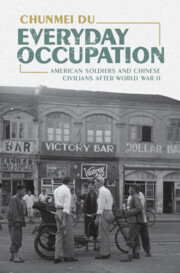
'In this rich history of everyday encounters between US soldiers and Chinese civilians, Chunmei Du explores their entangled relations from the end of World War II to the founding of the People's Republic of China. Drawing upon official, popular and personal accounts from both countries, Du examines the sensorial, material, and symbolic exchanges that took place between GIs and ordinary Chinese people-stall vendors, pedestrians, rickshaw pullers, 'Jeep girls,' and suspected thieves. Through the conceptual lens of the everyday, this book reveals how interactions such as traffic accidents, sexual relations, theft, and black-market dealings, impacted larger political dynamics during this pivotal era. Du shows how mundane struggles made imperialism and sovereignty tangible, fueling anti-American sentiment. Meanwhile, these encounters fostered informal diplomacy, shaping identities and forging new bonds that left a lasting imprint on both countries. This title is also available as Open Access on Cambridge Core.'
This article examines the evolution of a political order built on its citizens’ ambitious self-government and achievement and how the fit body became key to this order. In the first part, the article traces the origins of our current understanding of fitness back to the writings of John Locke and the invention of human agency and an ambitious pursuit of achievement as political paradigms. The second part moves on to the nineteenth century and shows how the body moved to the center of ambitious attention and how working on one’s body indicated a desire and responsibility for achievement. In the United States in particular, improving one’s physical ability meant living up to the demands of good citizenship. The article argues that fitness is a liberal political practice, and at the same time it means voluntary submission to the normative ideal of achievement and successful subjecthood.
Ralph Waldo Emerson developed a metaphysics of process, an epistemology of moods, and an 'existentialist' ethics of self-improvement, drawing on sources including Neoplatonism, Kantianism, Hinduism, and the skepticism of Montaigne. In this book, Russell B. Goodman demonstrates how Emerson's essays embody oppositions – one and many, fixed and flowing, nominalism and realism – and argues, in tracing Emerson's main positions, that we miss the living nature of his philosophy unless we take account of the motions and patterns of his essays and the ways in which instability, spontaneity, and inconsistency are dramatized within them. Goodman presents Emerson as a philosopher in conversation with Plato, Kant, Nietzsche, William James, Wittgenstein, and Cavell. He finds a variety of skepticisms in Emerson's work – about friendship, language, freedom, and the world's existence – but also an acknowledgement of skepticism as a 'wise' form of life.
With the Depression, the rise of fascism, and ongoing, even more dire civil rights struggles, patriarchal power seemed more than ever a race-work imperative. “Bad girls” offered diversions while Black female civil rights leaders garnered acclaim, but the New Negro hero who led the race forward, was, in the Pittsburgh Courier’s pages, more emphatically and presumptively male.
Musk announced Tesla’s decision to go direct to consumers after looking at the history of the legacy car companies with their increasingly onerous dealer networks and the failure of recent EV startups such as Fisker that had tried to sell through dealers. Chapter 2 examines Tesla’s direct sales decision both in Tesla’s own words and with supporting evidence on why selling EVs through franchised dealers is an unworkable business strategy, as demonstrated by the fact that almost every other EV startup has chosen a direct sales approach as well.
As a new US President took office in 2021, US–Russian relations veered between cooperation and confrontation. In February, Washington and Moscow agreed to extend the New Strategic Arms Reduction Treaty (which had been signed in 2010) for another five years. But in March, Joseph R. Biden called Vladimir Putin “a killer,” souring relations between Russia and the United States and leading to a reduction in the number of staff members in both diplomatic missions. Just a month later, however, Biden proposed holding a bilateral summit, which finally took place in Geneva on June 16, 2021. This event planted the seeds of hope for an improvement in bilateral relations – albeit more among Russian observers than among their American counterparts. Biden’s critics in the United States in fact saw this meeting as “appeasing” Putin, whom many American politicians, experts, and journalists had by that time represented as the epitome of evil.