To save content items to your account,
please confirm that you agree to abide by our usage policies.
If this is the first time you use this feature, you will be asked to authorise Cambridge Core to connect with your account.
Find out more about saving content to .
To save content items to your Kindle, first ensure no-reply@cambridge.org
is added to your Approved Personal Document E-mail List under your Personal Document Settings
on the Manage Your Content and Devices page of your Amazon account. Then enter the ‘name’ part
of your Kindle email address below.
Find out more about saving to your Kindle.
Note you can select to save to either the @free.kindle.com or @kindle.com variations.
‘@free.kindle.com’ emails are free but can only be saved to your device when it is connected to wi-fi.
‘@kindle.com’ emails can be delivered even when you are not connected to wi-fi, but note that service fees apply.
Who Nominates? is an accessible and non-partisan examination of the presidential nomination process, untangling the byzantine web of legal rules that govern modern nomination procedures in both major political parties. Beginning with the Constitutional Convention of 1787, noted constitutional law scholar Norman R. Williams traces the evolution of party rules and state laws regarding which individuals are entrusted with the power to choose the parties' presidential nominees. Only in the 1970s were ordinary voters fully included in the process, and even today, the rules governing nominations exclude or devalue a large number of voters. Williams' analysis provides context for modern debates about the role and influence of party elites, such as the Democrats' “superdelegates,” and examines how the rules governing the process today contribute to the increasingly divisive ideological polarization of presidential contests.
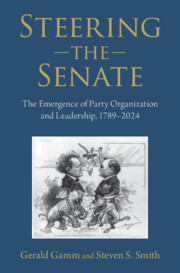
The Senate majority and minority leaders stand at the pinnacle of American national government – as important to Congress as the speaker of the House. However, the invention of Senate floor leadership has, until now, been entirely unknown. Providing a sweeping account of the emergence of party organization and leadership in the US Senate, Steering the Senate is the first-ever study to examine the development of the Senate's main governing institutions. It argues that three forces – party competition, intraparty factionalism, and entrepreneurship – have driven innovation in the Senate. The book details how the position of floor leader was invented in 1890 and then strengthened through the twentieth and twenty-first centuries. Drawing on the full history of the Senate, this book immediately becomes the authoritative source for understanding the institutional development of the Senate – uncovering the origins of the Senate party caucuses, steering committees, and floor leadership.
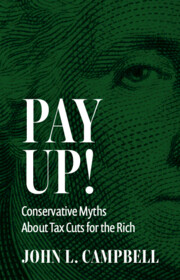
Since the Reagan era, conservatives in the United States have championed cutting taxes, especially for wealthy individuals and corporations, as the best way to achieve economic prosperity. In his new book, Pay Up!, John L. Campbell shows that while these claims are highly influential, they are also wrong. Using historical and cross-national evidence, the book challenges and refutes every justification conservatives have made for tax cuts – that American taxes are too high; they hurt the economy; they facilitate government waste; they constitute an unfair downward redistribution of income; and they threaten individual freedom – and conversely shows that countries can actually benefit from higher taxes, especially when tax increases fall most heavily on those most able to pay them. Through clear prose and a well-reasoned argument, Campbell's book provides an accessible, engaging, and much-needed perspective on the role of taxes in American society.
August Wilson was born in 1945 in the Hill District of Pittsburgh, Pennsylvania. The community where he spent the early part of his life notably served as the geographic location for nine of the ten plays in his American Century Cycle. This chapter provides historical background and cultural context for the Hill District and spotlights the ways Wilson dramatizes the specificity of the community in his plays.
Within August Wilson’s century-long odyssey, the survival of the past is symbolized through its most significant character, Aunt Ester Tyler. The mistress of 1839 Wylie Avenue, Aunt Ester represents the ingenuity and will of the African spirit to survive the horrors and the degradation of the conditions of slavery and dehumanization. This chapter teases out some of these elements of memory, illuminating how the American Century Cycle structurally signifies Passover themes, while arguing that Wilson dramaturgically deploys such cues as a strategy towards a cultural rehearsal of remembering.
August Wilson’s plays show his ability to draw upon and transcend the turbulent years he spent at his now-famous Hill District address at 1827 Bedford Avenue. With the benefit of time and distance, Wilson wrote a series of compelling dramas that speak not just to the tensions within a single Black family but also to conditions faced by the Black masses still impacted by the trauma of slavery and the effects of cultural fragmentation. We thus see in Wilson’s series of symbolic and sometimes clearly allegorical characters evidence of an overarching narrative about the counterbalances between forces that set Black families asunder and the resilience that reunites and bonds them together. This chapter explores the ways Wilson’s plays demand that we regard “family” in both literal and figurative terms through an analysis of the Black family portraits on display in them.
This chapter convenes seven notable directors – Denise Chapman, TammyRa’ Jackson, Ron O.J. Parson, Mark Clayton Southers, Timothy Douglas, Seret Scott, and Bartlett Sher – who have collectively directed nearly eighty productions of Wilson’s works. The conversation features these artists reflecting on their directing approach, Wilson’s grounding in American theatre, and the challenges of exploring the worlds Wilson creates.
August Wilson once suggested that African Americans leaving the US South during the Great Migration was one of the worst things that happened to the community. Because the Great Migration and the chronicle of African and African American migrants’ histories/herstories are intertwined discussions, this chapter suggests that the American Century Cycle enables Wilson to design a culturally specific study of the affects and effects of the migration on the characters and geographic spaces he plots. It considers how Wilson uses the plays in the cycle to demonstrate his point while also providing hope that, even within the urban North, the realities of the South and transformation of Southern mores will not be forgotten or ignored.
The October 1990 issue of Spin Magazine featured an essay by Wilson, “I Want a Black Director,” in which he described the challenges he encountered while attempting to sell the film rights for Fences in Hollywood. Wilson noted that studio executives were especially hostile to his request to have a Black director helm the project, dismissing it as a sign of the playwright’s naiveté. For Wilson, the disregard he experienced only served to reinforce his view that his work should be directed by artists who, as he put it, shared the sensibilities of Black Americans. This chapter explores the importance of Wilson’s declaration in the essay, contemplating how it proved an important clarion call for the entertainment industry to reevaluate its racist beliefs and hiring practices.
August Wilson’s 1996 “The Ground on Which I Stand” speech was not without its detractors. Perhaps most striking to some about the speech was its lack of acknowledgment of the existence of the theatrical “Chitlin Circuit,” which has been producing performances by, about, for, and near Black people and communities since the early decades of the twentieth century. This chapter contemplates the relationship between Wilson and the “Chitlin Circuit,” highlighting resonances and divergences between their aims and ambitions.
This chapter explores the complex representations of the Black middle class in August Wilson’s American Century Cycle, with particular attention given to Radio Golf. After providing contextual material on the Black middle class in culture and literature, it examines the importance of Harmond Wilks, the real estate developer and aspiring politician at the center of the play who eventually rejects conventional notions of Black aspiration and uplift for African values of community, family, and cultural origins. The chapter demonstrates how Wilks’s trajectory from being a son of privilege to becoming a community rebel highlights Wilson’s evolving views about the potential of the Black elite and the need for their participation to change the world for Black Americans.