To save content items to your account,
please confirm that you agree to abide by our usage policies.
If this is the first time you use this feature, you will be asked to authorise Cambridge Core to connect with your account.
Find out more about saving content to .
To save content items to your Kindle, first ensure no-reply@cambridge.org
is added to your Approved Personal Document E-mail List under your Personal Document Settings
on the Manage Your Content and Devices page of your Amazon account. Then enter the ‘name’ part
of your Kindle email address below.
Find out more about saving to your Kindle.
Note you can select to save to either the @free.kindle.com or @kindle.com variations.
‘@free.kindle.com’ emails are free but can only be saved to your device when it is connected to wi-fi.
‘@kindle.com’ emails can be delivered even when you are not connected to wi-fi, but note that service fees apply.
The ideology of monolingualism can prove enduringly resistant to change, regardless of what new practices might be introduced. Australia adopted official national policies on multiculturalism in the 1970s, and yet in a study of that country's language potential, Clyne (2005) stresses the disparity between what he calls Australia's ‘monolingual mindset’ at policy and institutional level and the on-the-ground multilingual reality of Australia's communities. The same is true of Japan, which is at a much earlier stage in the process: leaving aside the notable exception of the promotion of English, other policies and practices remain largely predicated on the ideological assumption that Japan is a monolingual nation, although there are signs that this is beginning to change. The following discussion will examine the linguistic needs of immigrants and their relationship to existing ideologies and policies.
When prominent Japanese journalist and political commentator Funabashi Yōichi wrote in a 2001 essay entitled ‘Japan's Moment of Truth’ that ‘new lines of debate are forming around the politics of Japanese identity’, he summarised astutely the issues surrounding Japan's current demographics. ‘This debate’, he continued, ‘takes the form of a clash between two visions of Japan's future: a more open, multilingual and multiracial Japan versus a homogenous, monolingual and mono-ethnic one.’ As we saw in Chapter 1, immigration, for so long a reluctant response to the demands of an ageing population and a low birth rate, is now a fact of life in Japan and is increasingly being recognised as such in both official and private sector discourse across the country. A report on Japan's future goals published in the year 2000 spoke encouragingly of immigration's potential to contribute to Japan's wellbeing and even suggested that Japan begin work on an ‘imin seisaku’ (migration policy) (Nijūisseiki Nihon no Kōsō Kondankai 2000). The use of the word ‘imin’ (migrant) here, Morris-Suzuki (2002: 169) points out, is significant because the more commonly used terminology of ‘shutsunyūkoku kanri seisaku’ (policy controlling entry and exit from Japan) refers more to border control than to any real acknowledgment of the existence and needs of migrants as people.
In the best of all possible worlds, the formulation and implementation of language policy would respond quickly to change in on-the-ground circumstances once sufficient time had elapsed to establish the permanence of that change. In modern bureaucracies, however, this is only infrequently the case. If we consider language policy in its formalised, overt incarnation, i.e., as ‘the formulation and proclamation of an explicit plan or policy, usually but not necessarily written in a formal document, about language use’ (Spolsky, 2004: 11), then examination of past policy formulation in Japan – relating, for example, to standardisation, script reform and the revival of the Ainu language – makes it clear that the process is usually slow and often tortuous. The presence of deep-rooted language ideologies means that change is something to be carefully scrutinised for agendas both overt and hidden that have the potential to upset the status quo. On a practical level, the implementation phases of new policies must be carefully planned and costed. Change at the national level of language policy often involves many years of discussion and consultation on issues that affect the nation as a whole.
We have seen in earlier chapters of this book that growing multilingualism in local communities, the negative effect of the overwhelming national promotion of the study of English on the teaching of other languages and the changes to ways of writing Japanese enabled by electronic text production all raise questions about the way language is currently managed in Japan, i.e., about language policies. The preceding chapter discussed the only one of these to have been addressed at national level so far. In this chapter, I will examine to what extent the will to move in the direction of change can be discerned at national level in response to the other issues. As will become clear, a discursive shift is under way in relation to the old ideology that the Japanese language is the exclusive property of the Japanese people.
The broad social reach of language policy's implementation makes it a key player in framing the manner in which language is handled in a particular society. It acts as an important device for the legitimisation of particular uses of language which coincide with social expectations, i.e., it encapsulates and articulates the national thinking on language (language ideology) and cannot stand outside the culture and the times in which it is created. Therefore, it is imperative that language policy evolves to reflect contemporary social realities and does not remain fossilised, reflecting circumstances now past. Both increased immigration and technology-related language change have made their presence felt in Japan for thirty years now; they are in no sense temporary aberrations. It is clear that they have important consequences for society at large and that language policy must therefore be extended to address them. As we have seen, at national level only one of these issues has resulted in action, namely the revision of the kanji policy to reflect the influence of information technology on reading and writing.
I would argue that the provision of JSL learning opportunities at national level and the expansion of opportunities to learn languages other than English are the most important language policy matters facing Japan today, far more significant than the forthcoming establishment of English as a curriculum subject in elementary schools, because of their deep and enduring import for future social cohesion. What has emerged in this book from the discussion of community language needs and practices and responses to them by government and other groups is a picture of rich, diversely textured language management activities (language policies) being adopted in a multiplicity of areas by bodies ranging from groups of concerned individuals to the highest levels of the national government, with many local government levels in between. What is at issue now is the direction in which Japan will next move. At what stage will the government decide that a critical mass of long-term foreign residents sufficient to justify national intervention into language provision has been reached?
This book examines two important issues in language policy in Japan today: first, and most prominently, increasing migration-induced multilingualism which has ramifications both for providing Japanese-language learning opportunities for migrants and for the use and teaching of languages other than Japanese and English; and second, the influence of electronic technologies such as computers and cell phones on the way in which Japanese is written. These two developments, of course, have occurred in many other countries beside Japan. What makes the Japanese case particularly interesting is that Japan does not yet consider itself to be a country of immigration and hence has only recently shown signs of an awareness of the importance of providing both language teaching and multilingual services for non-Japanese workers, so that what policy development does exist in this area is ad hoc and fragmented rather than centrally planned and coordinated at national level. It also has in place a set of longstanding policies pertaining to the officially sanctioned use of the writing system, policies which were arrived at after a great deal of division and debate, that shape the way in which Japanese and non-Japanese children alike learn to read and write in Japanese schools. In both these cases, official and individual views are strongly informed by language ideologies of various kinds.
Any study of a society's language policy must take into account the ideological context within which language functions because language ideologies always mediate and sometimes directly shape the formulation of such policy. To speak of language policy in Japan in isolation from national ideas about language would be to see only a part of the whole picture. Language ideology plays an important role in discussions of issues pertinent to this study, such as the provision of multilingual services for migrants, the current ‘tabunka kyōsei’ (multicultural coexistence) policy discourse influencing local communities, the teaching of foreign languages other than English and the prominence of non-standard orthographic conventions online. The most strongly entrenched and overarching ideology is a lingering belief that Japan is monolingual.
It is no accident that the most clearly marked policy development in recent years, apart from the announcement of the Action Plan to Cultivate Japanese with English Abilities, relates to kanji. For one thing, the kanji policy is relatively easy to change, because it already exists as a policy document; while arguments surrounding the recent increase in content were many and varied, they centred on which characters should be added or deleted rather than on whether the policy itself should be changed to accommodate an increase. For another, kanji are the venerated icons of Japan's writing system: reinforcing their position is in line with the language ideology surrounding characters discussed in Chapter 1. We have seen that despite the availability of an alternative means of writing in the form of the kana, literacy in Japan is judged by the ability to use kanji correctly; use of kana where kanji would be the norm is not encouraged, despite its frequent occurrence. This means that ‘kanji heavily contribute to the lengthening of acquisition of literacy, which is often a lifelong process’ (Akamatsu 2006: 486). It takes until the end of the nine years of compulsory education to teach the full List of Characters for General Use. Over the two decades between 1975 and 1995, the teaching of writing was the most researched and discussed aspect of national language education in Japan (Namba 1995: 64), a situation which has continued since then. ‘Under the conditions of a writing system that makes use of Chinese characters’, Coulmas (1994: 312) comments, ‘literacy is a graded notion. This is true, of course, also of alphabetic literacy, but with Chinese characters this gradation is more obviously encoded in the writing system.’ Everyone who has completed compulsory education is expected to know and to use a certain level of kanji, whether or not this is actually the case in practice. Little wonder, then, that discussion of literacy standards, by which is frequently meant kanji proficiency standards, features so frequently in both the academic and popular literature.
This book examines two language issues in Japan today which have arisen from significant developments in the social environment over the last three decades and have pointed to a need for a change in language policy. One is the increase in the number of migrants needing opportunities to learn Japanese as a second language (JSL), the other is the influence of electronic technologies on the way Japanese is written. Immigration-induced demographic changes confront long-cherished notions of national monolingualism, and technological advances in electronic text production have led to textual practices with ramifications for script use and for literacy in general. My central concern is to show whether and how language policy authorities in Japan are moving to accommodate these social and cultural changes. Both the integration of immigrants and new practices affecting literacy are important to the social fabric; it is essential, therefore, that expectations about language in these areas are clear and that policy addresses the realities of the present rather than harking back to an earlier social context.
In one of these two areas, a national policy already exists; in the other, it does not. In one of these areas, the national policy has been revised to acknowledge change; in the other, no national-level policy has yet been developed. In the area of kanji policy, deeply rooted in Japanese language ideology and important to ethnic mainstream Japanese citizens as it is, the widespread uptake of electronic text production has been viewed as necessitating a revision of the List of Characters for General Use, which has just been expanded to acknowledge that larger numbers of kanji are now routinely used than was the case when writing by hand alone. In the second, more contentious area, that of providing JSL instruction for migrants to Japan at a national rather than local level, no policy currently exists, in large part because such a move goes against deep-seated national language ideologies of monoethnicity and monolingualism. It is only very recently that the national government – in contrast to local governments, which have been active in this area for years – has begun to make sporadic provision for language training in certain clearly defined areas relating to employment.
This book examines the relationship between foreign companies and government within the Indonesian oil industry. It is concerned in particular to identify those factors which determine the balance between central regulation and untrammelled company activity, in order to evaluate the choices which the government has to make in the creation of its policies. Given the extent of foreign investment in the mineral extractive industries of many of the less-developed countries, such policies are of major importance. From his study of the operation of Indonesian oil contracts, Dr Khong concludes that the formal terms of an agreement may well give a misleading impression of the actual allocation of the benefits from petroleum extraction. The common perception that a basic shift in favour of host governments has occurred is shown to be largely misplaced, whatever relative advances they may have achieved.
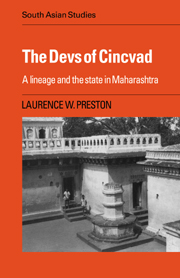
This innovative study of the power of lineage in India across two centuries examines some of the traditional social structures which transcended so successfully the political upheavals of British rule. Under the Maratha Kingdom, the Devs occupied a privileged position in the ritual, social and economic hierarchies of the state from the 1620s onwards, their continuing influence stemming principally from obtaining grants of rent-free land around Pune and successfully maintaining this inheritance from generation to generation. With the British conquest of Maharashtra in 1818, the close relations between state and privileged subject were slowly broken and by the 1850s, the British sought to settle the Devs' landed rights. Basing their inquiries on preconquest vernacular documents, they became entwined in disputes over the tenure of the Devs' lands and the mode of inheritance within the lineage that reveal a telling ignorance of the customary relations between the Indian State and its privileged subjects.
This book challenges the conventional view of Japanese society as monocultural and homogenous. Unique for its historical breadth and interdisciplinary orientation, Multicultural Japan ranges from prehistory to the present, arguing that cultural diversity has always existed in Japan. A timely and provocative discussion of identity politics regarding the question of 'Japaneseness', the book traces the origins of the Japanese, examining Japan's indigenous people and the politics of archaeology, using the latter to link Japan's ancient history with contemporary debates on identity. Also examined are Japan's historical connections with Europe and East and Southeast Asia, ideology, family, culture and past and present.
Women under the Bo Tree examines the tradition of female world-renunciation in Buddhist Sri Lanka. The study is textual, historical and anthropological, and links ancient tradition with contemporary practice. Tessa Bartholomeusz utilizes data based on her field experiences in many contemporary cloisters of Sri Lanka, and on original archival research. She explores the history of the re-emergence of Buddhist female renouncers in the late nineteenth century after a hiatus of several hundred years; the reasons why women renounce; the variety of expressions of female world-renunciation; and, above all, attitudes about women and monasticism that have either prohibited women from renouncing or have encouraged them to do so. One of the most striking discoveries of the study is that the fortunes of Buddhist female renouncers is tied to the fortunes of Buddhism in Sri Lanka more generally, and to perceived notions of Sri Lanka as the caretaker of Buddhism.
Interest in Shi'a Islam has increased greatly in recent years, although Shi'ism in the Indian subcontinent has remained largely underexplored. Focusing on the influential Shi'a minority of Lucknow and the United Provinces, a region that was largely under Shi'a rule until 1856, this book traces the history of Indian Shi'ism through the colonial period toward independence in 1947. Drawing on a range of new sources, including religious writing, polemical literature and clerical biography, it assesses seminal developments including the growth of Shi'a religious activism, madrasa education, missionary activity, ritual innovation and the politicization of the Shi'a community. As a consequence of these significant religious and social transformations, a Shi'a sectarian identity developed that existed in separation from rather than in interaction with its Sunni counterparts. In this way the painful birth of modern sectarianism was initiated, the consequences of which are very much alive in South Asia today.
James Mill's three volume History of British India was published from 1817 to 1818 and became an immediate success. A friend of Jeremy Bentham and a follower of utilitarianism, Mill focuses more on historical processes than human interest. He uses extensive sources rather than first-hand experience to create, as his preface claims, an 'objective' yet 'critical' history, often making harsh judgements of the country and its people within the context of a wider theoretical framework. He also criticises the British involvement in India and the process of conquest, colonization, and administration, the intention being to encourage the reader to a greater understanding of historical processes, ideas, and institutions with a view to encouraging thorough reform. Volume 2 covers the period from the establishment of the Honourable East India Company in 1708 to East India Company Act of 1773, and from this to Pitt's India Act of 1784.
Raised in a politically-active household, Emily Eden's childhood prepared her well for her role as companion to her brother, the Governor-General of India. Outwardly all that a middle-class spinster should be, Eden never permitted diplomacy to dilute her letters home. Published in 1866, the letters provoked sympathy among women who had similarly endured dusty bonnets to accompany fathers and husbands to distant outposts of the British Empire. As one reviewer noted, this book is 'addressed primarily to a public consisting of wives, sisters, or daughters of possible Governors-General, and is sure therefore of general popularity'. There is still plenty to amuse modern audiences. Volume 2 conveys the growing anxiety surrounding the Anglo-Afghan war, stirring and sympathetic accounts of poverty, and the author's eagerness to return to her much-loved Kensington. Eden's descriptive passages and personal reflections are all narrated with her signature sensitivity and wit.
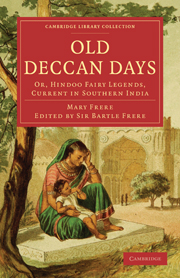
First published in 1868, this volume contains a collection of twenty-four traditional stories from the southern Indian state of Maharashtra. Mary Eliza Isabella Frere (1845–1911) travelled to India in 1863 to stay with her father, Sir Bartle Frere, the Governor of Bombay. She became fascinated with Indian culture and transcribed these stories from her ayah (nanny and chaperone) Anna Liberata da Souza who had been told them by her grandmother. Expressive and detailed, these stories formed part of southern India's traditional oral culture, at risk of being lost. This volume includes an introduction by Sir Bartle Frere exploring the cultural background to the stories and a chapter by Anna Liberata da Souza describing her life and childhood. This volume was extremely popular, being reprinted in four editions by 1889 and encouraging the study of comparative mythology while revealing new information concerning Indian traditional culture.
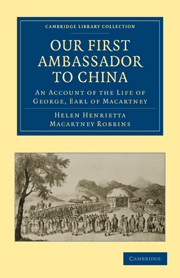
An Account of the Life of George, Earl of Macartney, with Extracts from His Letters, and the Narrative of His Experiences in China, as Told by Himself, 1737–1806
George Macartney (1737–1806) was a British statesman, diplomat and administrator who held a succession of important appointments. In 1764 he was sent as envoy extraordinary to Russia, but described the Russian nobility as 'vain, petulant, inconsequent, indiscreet, and changeable'. After several years as Chief Secretary for Ireland (1767–1772) and a governorship in the West Indies, he served as Governor of Madras in the early 1780s, a difficult role surrounded by controversy and intrigue. In 1792–1794 he travelled to China on behalf of the government and the East India Company on a mission to negotiate a trade agreement, but was unsuccessful. He ended his career as Governor of the Cape Colony. This 1908 biography, which includes extracts from previously unpublished letters by Macartney and other newly-researched archival material, complements the two-volume 1807 account of Macartney's life by Sir John Barrow, also reissued in this series.
The publications of the Hakluyt Society (founded in 1846) made available edited (and sometimes translated) early accounts of exploration. The first series, which ran from 1847 to 1899, consists of 100 books containing published or previously unpublished works by authors from Christopher Columbus to Sir Francis Drake, and covering voyages to the New World, to China and Japan, to Russia and to Africa and India. François Leguat (1637–1735) was a French Huguenot who became the leader of a group of seven Huguenot refugees forced to colonise the island of Rodriguez in 1693, after the French claimed their intended destination, the Ile de Réunion. He remained on the island for two years, before escaping via the neighbouring island of Mauritius; after imprisonment in Jakarta, he returned to Europe in 1698. Volume 1 describes his journey to Rodriguez and provides descriptions of the island's now extinct flightless birds and giant turtles.