To save content items to your account,
please confirm that you agree to abide by our usage policies.
If this is the first time you use this feature, you will be asked to authorise Cambridge Core to connect with your account.
Find out more about saving content to .
To save content items to your Kindle, first ensure no-reply@cambridge.org
is added to your Approved Personal Document E-mail List under your Personal Document Settings
on the Manage Your Content and Devices page of your Amazon account. Then enter the ‘name’ part
of your Kindle email address below.
Find out more about saving to your Kindle.
Note you can select to save to either the @free.kindle.com or @kindle.com variations.
‘@free.kindle.com’ emails are free but can only be saved to your device when it is connected to wi-fi.
‘@kindle.com’ emails can be delivered even when you are not connected to wi-fi, but note that service fees apply.
Sir William Henry Sleeman (1788–1856) was a British soldier and administrator in India. While serving as Resident at the court of the King of Oude in Lucknow he travelled around the kingdom and made reports to the Governor-General regarding its proposed annexation by the East India Company. His letters and diaries reveal him as a capable and just administrator, who was at pains to weigh all the evidence for and against annexation, and who believed that reform of the existing administration would be possible. Sleeman described the kingdom of Oude as suffering from maladministration, lawlessness and corruption, but he stressed that illegal annexation would lead to resentment and rebellion. This book, containing Sleeman's account of his journey and a selection of private correspondence, was originally published in Lucknow in 1852; this reissue reproduces the 1858 London edition. Volume 1 covers the first six weeks of Sleeman's tour.
Sir William Henry Sleeman (1788–1856) was a British soldier and administrator in India. While serving as Resident at the court of the King of Oude in Lucknow he travelled around the kingdom and made reports to the Governor-General regarding its proposed annexation by the East India Company. His letters and diaries reveal him as a capable and just administrator, who was at pains to weigh all the evidence for and against annexation, and who believed that reform of the existing administration would be possible. Sleeman described the kingdom of Oude as suffering from maladministration, lawlessness and corruption, but stressed that illegal annexation would lead to resentment and rebellion. This book, containing Sleeman's account of his journey and a selection of private correspondence, was originally published in Lucknow in 1852; this reissue reproduces the 1858 London edition. Volume 2 discusses the social and economic condition of the kingdom.
Sir John Malcolm (1769–1833) was a soldier and diplomat in British India and Persia. He returned to India on the eve of the British conquest of Malwa, a region of central India previously little known to Europeans, in 1818. Malcolm studied the region's geology, its agriculture and the history of its ruling families in the eighteenth and nineteenth centuries. His reports were first published in Calcutta in 1821, and were revised and expanded for publication in two volumes in London in 1823. Based on interviews with native inhabitants and oral testimonies, Malcolm's work was the leading authority on Malwa until the 1930s. Despite more recent scholarship on the region, Malcolm's work remains valuable for its first-hand account of nineteenth-century Malwa's politics, culture and society. Volume 1 contains overviews of Malwa's geology, agriculture and the government of the leading families.
Mountstuart Elphinstone (1779–1859) was appointed through family influence to the East India Company, and arrived in India in 1796. He learnt Persian, and developed an interest in Indian literature and politics. After postings in Afghanistan and Poona he became Governor in 1819 of the recently acquired territory that became known as the Bombay Presidency. His biographer also had connections to India. Thomas Edward Colebrooke (1813–1890) was the son of British administrator and Sanskrit scholar Henry Thomas Colebrooke (1765–1837), and although he lived in England and served as an M. P., Colebrooke remained interested in colonial affairs. He had written about Elphinstone's life in 1861 for the Journal of the Royal Asiatic Society and subsequently expanded his work into these two volumes, published in 1884. Volume 1 examines Elphinstone's childhood, education and early career, covering the period up to 1817.
This 'sketch' by John Malcolm (1769–1833), covers a relatively small period – from the introduction of the India Bill in 1784 to the book's publication in 1811. The bill marked the beginning of increased government control over the East India Company, and Malcolm had arrived in India the year before it was passed and had an in-depth understanding of the dynamics of British influence and ambitions in India. In over five hundred pages, he examines governance in India, covering the administrations of Lord Cornwallis, Sir John Shore and Marquis Wellesley, all of whom he served under in increasingly important roles. Malcolm went on to write other books about India and Persia, where he also spent several years, and in 1827 became Governor of Bombay. His Sketch of India gives an insider's perspective on a crucial period in the consolidation of British authority in large areas of the subcontinent.
Richard, Marquess Wellesley (1760–1842) became one of the most controversial politicians of his generation during his time as Governor-General of Bengal (1798–1805). Although this period saw him achieve territorial gains and military victories in India - including the defeat of Tipu Sultan, the ruler of Mysore - the financial cost was considered too high. The East India Company Court of Directors in London disagreed with many of the changes he made, and Wellesley was forced to return to England. This five volume collection of papers, edited by the political activist and historian Robert Montgomery Martin (1800–1868), was published in 1836–1837 and documents Wellesley's period of office in India. Volume 2 spans the period from 1799 to 1802, including the settlement of Mysore, the treaty of Hyderabad and the encroaching threat from French troops. Wellesley also mentions his intention to establish a college to train civil servants.
Sir John Malcolm (1769–1833) was a diplomat and administrator in India. He arrived there in 1783 as a cadet in the East India Company, was quickly promoted, and soon moved into political and diplomatic roles where his linguistic skills proved extremely useful. In 1799 he was dispatched to Persia by Lord Wellesley, and concluded two important treaties. He returned to India in 1801 and towards the end of his career became the governor of Bengal (1827–1830). He wrote several books on India and Persia, including this two-volume history, published in 1826, which documents the period Malcolm himself had spent in India. In Volume 2, Malcolm considers the changing nature of Britain's control in India, and in later chapters reflects on the type of governance that developed, examining the roles of governor-general and the issue of crime and justice, as well as observing the British community more widely.
Sir John Malcolm (1769–1833) was a diplomat and administrator in India. He arrived there in 1783 as a cadet in the East India Company, was quickly promoted, and soon moved into political and diplomatic roles where his linguistic skills proved extremely useful. In 1799 he was dispatched to Persia by Lord Wellesley, and concluded two important treaties. He returned to India in 1801 and towards the end of his career became the governor of Bengal (1827–1830). He wrote several books on India and Persia, including this two-volume history, published in 1826, which documents the period Malcolm himself had spent in India. Volume 1 incorporates content from Malcolm's earlier Sketch of Political India (1811). It covers the administrations of Lord Cornwallis, Sir John Shore, Marquess Wellesley, Lord Minto and the Marquess of Hastings, which marked a period of extensive British expansion into Indian territory.
Mountstuart Elphinstone (1779–1859) was a colonial official who spent his career in India, eventually becoming governor of Bombay in 1819. Before that he was resident in Poona (Pune) during the final days of the Maratha empire. He was fluent in Persian and took an interest in the culture of the region. This report, however, published in 1821, is a political work. The report describes the western Indian territory that the British had acquired by 1818, and Elphinstone provides a geographical overview of the area and the people who lived there. He then gives a brief sketch of Maratha history before moving on to the crux of the work: how to administer the territory, with the question of how to raise more revenue being of especial importance. This report provides a first-hand example of the inner workings of the British Empire in India.
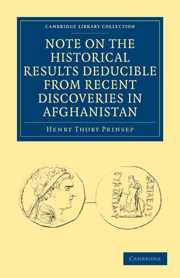
Henry T. Prinsep (1792–1878) was the son of a prominent East India Company servant, and like his father, Prinsep also spent much of his life in the East. He left Britain for Calcutta in 1809, at the age of seventeen, and stayed in India, working in a variety of roles, until his retirement in 1843. His brother James also lived in India and was a prominent scholar. Upon the latter's death in 1840, Prinsep found himself in possession of his brother's coin collection and a notebook, which became the basis of this work, published in 1844. Prinsep explains that the coins – which have inscriptions in both Greek and unknown languages – are valuable evidence of Alexander the Great's famous expedition to the east in the fourth century BCE. Prinsep also includes extensive illustrations of the coins, offering a fascinating view of an important archaeological discovery.
Between 1827 and 1841, Samuel Sneade Brown (1809–1875), a colonial administrator, was stationed in India. Published in 1878, this is a selection of the letters he sent home to his family during that period. Brown describes his correspondence as 'a journal of my heart, rather than a diary of my actions', and his letters are both poetic and humorous, telling a personal history of the British Empire. Brown reveals the high cost of colonial living, lamenting to his mother the fact that he could not afford to marry and support a family either in India or England. He communicates his strong bond of affection to his native country and to those he left behind. Making the connection between home and abroad, private and public, the domestic and the Empire, the letters present an insight into the economic changes and political challenges of the nineteenth century.
The first English version of Bernier's 1670 work since its initial translation from the French in 1672, Irving Brock's 1826 edition vastly improved his predecessor's work. François Bernier (1625?–1688) trained as a physician at Montpellier and left France for Syria in 1654, travelling to Egypt and finally to India ('Hindustan'), where he spent twelve years as the court physician to the Great Mogul Aurangzeb. Celebrated and influential, his Travels shaped European opinions and knowledge of India. Volume 2 details religious practices, the Great Mogul's journey to Kashmir, and many other topics, concluding with an appendix of north Indian history and a chronology of its rulers. Including Brock's interventions to relate the narrative to imperial Britain, this work will be of interest to scholars of post-colonialism, of early modern travel and of Asian and European encounters.
The first English version of Bernier's 1670 work since its initial translation from the French in 1672, Irving Brock's 1826 edition vastly improved his predecessor's work. François Bernier (1625?–1688) trained as a physician at Montpellier and left France for Syria in 1654, travelling to Egypt and finally to India ('Hindustan'), where he spent twelve years as the court physician to the Great Mogul Aurangzeb. Celebrated and influential, his Travels shaped European opinions and knowledge of India. Brock provides a biography in his preface to Volume 1, where he also outlines the volumes' contents. Volume 1 narrates civil war, describes the government and finances of the court, and the army, and closes with detailed descriptions of Delhi and Agra. Including Brock's many interventions to relate the narrative to imperial Britain, this work will be of interest to scholars of post-colonialism, of early modern travel and of Asian and European encounters.
This anonymous work was published at the end of the First Anglo-Maratha war (1775–1782) to provide an English audience with a better understanding of the recent conflict. The author (who may have been a Major John Scott, and is likely to have been connected to the East India Company) is at times quite critical of the Company and some of the decisions which were made in relation to the conduct of the war. He suggests that India-based employees were not always giving the whole picture to the directors in England. He argues that war could have been avoided (blaming Warren Hastings, the governor-general of Bengal, for its outbreak),and that Britain had done badly out of negotiations for peace. The book is an early source of information about the Indian states which were soon to become incorporated into British India, and on Anglo-Indian relations.
This six-volume History of the Indian Mutiny was first produced in 1890 by Colonel George Malleson (1825–1898), who combined Sir John Kaye's History of the Sepoy War in India with his own later work. Kaye (1814–1876) was a prolific writer of biography and history who started the Calcutta Review in 1844. His use of first-hand evidence, collected from personal and professional contacts, supports (perhaps predictably) his assertion that the rebellion is a story of British 'national character', and the narrative is illustrated with biographical and personal anecdotes. Malleson's contributions however are derived from his controversial 'Red Pamphlet' (1857) and other writings, in which he is unafraid to criticise or praise British troops and administration as the occasion demands. Volume 5 narrates the ending of the Mutiny, concluding, as Kaye had initially proposed, that the events of the period illustrate British strength of character and fortitude.
T. T. Roberts, an East India Company lieutenant attached to a native regiment, published this glossary in 1800 to assist those newly arrived in India. Roberts was one of the first to produce such a guide to Indian terms which had entered into common use among the English in India, rather than materials to help Europeans to learn Indian languages properly, as the East India Company's Fort William College in Calcutta, founded in the same year, intended. English did not become the dominant language of administration until the 1830s, and even then many Indian and Persian words continued to be widely used. Arranged alphabetically, Roberts' glossary contains over one thousand entries, from personal names and titles to terms relating to food, drink, trade, law and religion. It is a valuable source of information on colonial Indian history, geography and society, with explanations of names, places, and the status of different castes.
Emma Roberts' 1835 work, compiled from articles she published in the Asiatic Journal, was well received in India and England. Roberts lived in India from 1828 with her sister and her brother-in-law, who served in the 61st Bengal infantry. In 1830 she moved to Calcutta, where she edited and wrote for the Oriental Observer and contributed to periodicals and annuals. Returning to London in 1832, she threw herself into the literary world, publishing in several different fields. This book reveals her sympathetic attitude to the Indian people and her genuine interest in providing a thorough and honest report of their culture. Volume 1 begins with a description of Calcutta. It reflects the diversity of Roberts' interests, covering topics from marriages to murders, domestic arrangements to military operations, religion to shopping, and architecture to dancing. For more information on this author, see http://orlando.cambridge.org/public/svPeople?person_id=robeem
William Gill (1843–1883) was an explorer and commissioned officer in the Royal Engineers. After inheriting a fortune from a distant relative in 1871, Gill decided to remain in the Army and use his inheritance to finance explorations of remote countries, satisfying his love of travel and gathering intelligence for the British government. He was awarded a gold medal by the Royal Geographical Society in 1879 for his scientific observations on his expeditions. This two volume work, first published in 1880, is Gill's account of his expedition from Chengdu, China through Sichuan, along the eastern edge of Tibet via Litang, to Bhamo in Burma, a region little explored by westerners before him. Gill describes in vivid detail the cultures, societies and settlements of the region, and their political and economic systems. Volume 2 recounts his travels across the plateau to the upper reaches of the Irrawaddy, partly retracing Marco Polo's route.
Journalist and traveller Andrew Wilson (1831–1881) was born in India to colonial missionaries. Educated in Europe, he later edited the China Mail in Hong Kong, and the Bombay Times. This, his best known work, was published in 1868, and recounts the suppression of the Taiping uprising in 1863–1864 by Colonel Charles G. ('Chinese') Gordon, leading a small multinational force. The Taiping rebellion against the Qing dynasty lasted from 1850 to 1864, and it is estimated that some 20 million people died as a result. Wilson was given access to Gordon's journals to write the book. Wilson was very pro-Chinese, and was quite critical of British colonial policy towards China. Despite this bias, the work contains much fascinating information on nineteenth-century China, and sheds light on the early career of one of Britain's greatest Victorian military heroes.
This collection of papers, reports and letters, published in 1842, documents the official investigation into the export of South Asians effectively as slave labour to Mauritius and British Guiana in 1837, four years after the abolition of slavery in all British colonies. The investigation revealed how the anti-slavery laws were evaded by the issue of nominal contracts for labourers, by which much of their wages were withheld to pay for their passage, and how enticement, trickery and sometimes kidnap were used in recruiting them. It highlights appalling conditions on overloaded ships, inadequate living conditions and a brutal working environment. Only rarely were workers released at the end of their 'contract'. The reports and correspondence show the struggle of Parliament and the Anti-Slavery Society to ascertain facts often distorted by corrupt officials, particularly on Mauritius. Readers will find chilling parallels to the human trafficking that still persists today.