Refine search
Actions for selected content:
125539 results in Asian Studies
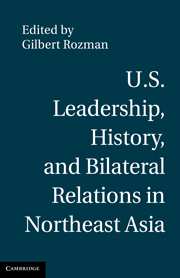
U.S. Leadership, History, and Bilateral Relations in Northeast Asia
-
- Published online:
- 01 March 2011
- Print publication:
- 21 October 2010
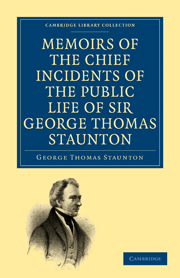
Memoirs of the Chief Incidents of the Public Life of Sir George Thomas Staunton, Bart., Hon. D.C.L. of Oxford
- One of the King's Commissioners to the Court of Pekin, and Afterwards for Some Time Member of Parliament for South Hampshire
-
- Published online:
- 01 March 2011
- Print publication:
- 10 June 2010
- First published in:
- 1856
Muslim Identity, Local Networks, and Transnational Islam in Thailand's Southern Border Provinces
-
- Journal:
- Modern Asian Studies / Volume 45 / Issue 6 / November 2011
- Published online by Cambridge University Press:
- 01 March 2011, pp. 1383-1421
-
- Article
- Export citation
CQY volume 205 Cover and Front matter
-
- Journal:
- The China Quarterly / Volume 205 / March 2011
- Published online by Cambridge University Press:
- 01 April 2011, pp. f1-f5
- Print publication:
- March 2011
-
- Article
-
- You have access
- Export citation
Steinnudeln. Ländliche Erinnerungen und staatliche Vergangenheitsbewältigung der “Großen Sprung”- Hungersnot in der chinesischen Provinz Henan (Stone Noodles: Rural and Official Memories of the Great Leap Famine in the Chinese Province Henan). Felix Wemheuer. Vienna: Peter Lang, 2007. xii + 294 pp. £31.30ISBN 978-3-631-56279-6
-
- Journal:
- The China Quarterly / Volume 205 / March 2011
- Published online by Cambridge University Press:
- 01 April 2011, pp. 194-195
- Print publication:
- March 2011
-
- Article
- Export citation
Patriotism, Nationalism and China's US Policy: Structures and Consequences of Chinese National Identity
-
- Journal:
- The China Quarterly / Volume 205 / March 2011
- Published online by Cambridge University Press:
- 01 April 2011, pp. 1-17
- Print publication:
- March 2011
-
- Article
- Export citation
Preparing the People for Mass Clemency: The 1956 Japanese War Crimes Trials in Shenyang and Taiyuan
-
- Journal:
- The China Quarterly / Volume 205 / March 2011
- Published online by Cambridge University Press:
- 01 April 2011, pp. 152-172
- Print publication:
- March 2011
-
- Article
- Export citation
Contributors
-
- Journal:
- The China Quarterly / Volume 205 / March 2011
- Published online by Cambridge University Press:
- 01 April 2011, pp. 250-252
- Print publication:
- March 2011
-
- Article
- Export citation
Chinese Male Homosexualities: Memba, Tongzhi and Golden Boy. Travis S. K. Kong. New York and London: Routledge, 2010. xxiv + 296 pp. £85.00ISBN 978-0-415-45189-5
-
- Journal:
- The China Quarterly / Volume 205 / March 2011
- Published online by Cambridge University Press:
- 01 April 2011, pp. 184-186
- Print publication:
- March 2011
-
- Article
- Export citation
Innovation and Preservation: Remaking China's National Leadership Training System*
-
- Journal:
- The China Quarterly / Volume 205 / March 2011
- Published online by Cambridge University Press:
- 01 April 2011, pp. 18-39
- Print publication:
- March 2011
-
- Article
- Export citation
Growing Pains: Tensions and Opportunity in China's Transformation. Edited by Jean C. Oi, Scott Rozelle and Xueguang Zhou. Stanford, CA: Walter H. Shorenstein Asia-Pacific Research Center, 2010. xxv + 366 pages, $28.95ISBN 978-193136818-6
-
- Journal:
- The China Quarterly / Volume 205 / March 2011
- Published online by Cambridge University Press:
- 01 April 2011, pp. 176-177
- Print publication:
- March 2011
-
- Article
- Export citation
Planning in Taiwan: Spatial Planning in the Twenty-First Century. Edited by Roger Bristow. London and New York: Routledge, 2010. xvi + 303pp, £85.00; $140.00ISBN 978-0-415-55173-1
-
- Journal:
- The China Quarterly / Volume 205 / March 2011
- Published online by Cambridge University Press:
- 01 April 2011, pp. 192-194
- Print publication:
- March 2011
-
- Article
- Export citation
Chinese Family Business and the Equal Inheritance System: Unravelling the Myth. Victor Zheng. London: Routledge, 2010. xiv + 205 pp. £80.00ISBN 978-0-415-55638-5
-
- Journal:
- The China Quarterly / Volume 205 / March 2011
- Published online by Cambridge University Press:
- 01 April 2011, pp. 179-180
- Print publication:
- March 2011
-
- Article
- Export citation
The Local Environmental State in China: A Study of County-Level Cities in Suzhou*
-
- Journal:
- The China Quarterly / Volume 205 / March 2011
- Published online by Cambridge University Press:
- 01 April 2011, pp. 115-132
- Print publication:
- March 2011
-
- Article
- Export citation
Challenging the Economic Reform Paradigm: Policy and Politics in the Early 1980s' Collapse of the Rural Co-operative Medical System
-
- Journal:
- The China Quarterly / Volume 205 / March 2011
- Published online by Cambridge University Press:
- 01 April 2011, pp. 80-95
- Print publication:
- March 2011
-
- Article
- Export citation
The Rey Chow Reader. Rey Chow (edited by Paul Bowman). New York: Columbia University Press, 2010. xxiii + 289 pp. £19.00ISBN 978-0-231-14995-2
-
- Journal:
- The China Quarterly / Volume 205 / March 2011
- Published online by Cambridge University Press:
- 01 April 2011, pp. 189-191
- Print publication:
- March 2011
-
- Article
- Export citation
CQY volume 205 Cover and Back matter
-
- Journal:
- The China Quarterly / Volume 205 / March 2011
- Published online by Cambridge University Press:
- 01 April 2011, pp. b1-b10
- Print publication:
- March 2011
-
- Article
-
- You have access
- Export citation
Quarterly Chronicle and Documentation: (October–December 2010)
-
- Journal:
- The China Quarterly / Volume 205 / March 2011
- Published online by Cambridge University Press:
- 01 April 2011, pp. 200-249
- Print publication:
- March 2011
-
- Article
- Export citation
State Control, Female Prostitution and HIV Prevention in China
-
- Journal:
- The China Quarterly / Volume 205 / March 2011
- Published online by Cambridge University Press:
- 01 April 2011, pp. 96-114
- Print publication:
- March 2011
-
- Article
- Export citation
Drink Water, but Remember the Source: Moral Discourse in a Chinese Village. Ellen Oxfeld. Berkeley and Los Angeles: University of California Press, 2010. xix + 292 pp.$24.95; £16.95ISBN 978-0-520-26095-5
-
- Journal:
- The China Quarterly / Volume 205 / March 2011
- Published online by Cambridge University Press:
- 01 April 2011, pp. 181-182
- Print publication:
- March 2011
-
- Article
- Export citation
