To save content items to your account,
please confirm that you agree to abide by our usage policies.
If this is the first time you use this feature, you will be asked to authorise Cambridge Core to connect with your account.
Find out more about saving content to .
To save content items to your Kindle, first ensure no-reply@cambridge.org
is added to your Approved Personal Document E-mail List under your Personal Document Settings
on the Manage Your Content and Devices page of your Amazon account. Then enter the ‘name’ part
of your Kindle email address below.
Find out more about saving to your Kindle.
Note you can select to save to either the @free.kindle.com or @kindle.com variations.
‘@free.kindle.com’ emails are free but can only be saved to your device when it is connected to wi-fi.
‘@kindle.com’ emails can be delivered even when you are not connected to wi-fi, but note that service fees apply.
Chapter 4 focuses on unguarded POW labor distribution and the farms and rural industries associated with the camps. Across the Pacific theater civilians and POWs, as well as alienated citizens (in North America), supplemented wartime industry through their nominally waged employment in manufacturing and agricultural industries. The chapter looks at the penal economy, the labor regimen and the ways in which the labor of Italian POWs became integrated into a larger network of wartime labor circulation throughout Australia, with insights into the exceptional productivity of camps at Marrinup, Hay and Loveday. Key differences between internee and POW labor employment are contextualized in the wartime mobilization of workers across Australia.
The Introduction outlines the book’s scope as exploring the taxonomy of concentration-camp types that emerged, temporarily, in the three geographical areas of focus: Australia, the USA and Singapore, and in related conflicts around the Pacific Basin. It highlights key theoretical approaches: genealogy, archipelagic consciousness and border-thinking as the book’s intellectual framework investigating how the global conflict shaped and transformed settler-colonial forms of sovereignty as revealed in the wartime prisons and prison camps’ designs and materiality. The Introduction argues that although architectural histories have previously neglected the Pacific War architectures of confinement, the discipline offers a unique lens into wartime histories.
Chapter 5 shifts to the island colony of Singapore, where Australia’s Eighth AMF Division defended the island alongside British and local forces and volunteers in the weeks before its capitulation, suffering greatly as Japanese captives. The chapter describes the dispersal of camps at the fall of Singapore, following the fate of Australian and other Allied soldiers across an emergent camp geography. Its main aim is envisioning the entirety of the island as converted to an encampment through the distribution of Allied camps, including the dispersal of work camps in requisitioned domestic and institutional facilities, exploring how wartime defense and capitulation provided structures for contemporary citizenship.
Chapter 11 takes us to the edges of the Pacific archipelago for a closer look at the camps for Japanese Surrendered Personnel and the War Crimes Trials Compounds in the Australian-administered island territories of New Guinea. The chapter traces their changing accommodation in underground tunnels, timber barracks and Quonset huts. The War Criminals Prison at Manus Island precedes the later location there of the infamous offshore detention center, one of many such facilities later created for incarcerating unauthorized asylum seeker arrivals to Australia. The chapter makes the case for a genealogical approach to physical sites of incarceration as important for understanding the continuous historical entanglements of sovereignty and spatial forms of violence.
Chapter 1 lays out the reasoning behind the book and its investigative schema, drawing links with interpretations of incarceration familiar to the discipline. The chapter’s central argument is that the Pacific War’s imperial border contestations were inscribed in those national populations who were alienated or disenfranchised by new hostilities, and that camps treated as border facilities became places for testing cultural boundaries, advancing programs of assimilation but also of prisoner defiance, dissidence and cultural recovery. Case studies are viewed comparatively in order to gain an understanding of the differing physical makeup of each camp environment in the various national sites explored.
Chapter 3 discusses how the captive population of Germans, Italians and Japanese, their patriotism sharpened by group incarceration, railed against confinement in Australian and New Zealand’s camps. Using “escape” as its central theme, the chapter examines breakout attempts at camps in Murchison, Cowra and Featherston, offering insights into enforcement of 1929 Geneva Convention regulations for POW treatment. The chapter introduces the dodecagon-shaped POW camp as a unique design tested in Australia for the accommodation of racially different combatants and a continuation of a longer history of convictism. New Zealand’s wartime camps repurpose and adapt facilities associated with quarantine.
Chapter 6 discusses the two most notorious institutions in wartime Singapore, the Changi and Outram Road prisons, with key focus on civilian internment at Changi. It describes the colonial origins of penal institutions and the erection of Changi Prison as the first modern (reinforced-concrete) penal complex. The prison’s inversion to intern colonial residents, as an act of forced removal and dispossession of once-privileged colonial civilians, is discussed in terms of “subalternization,” a recurring theme in subsequent chapters. The chapter focuses specifically on the experiences of incarcerated colonial women, children and elders, as different to those of imprisoned service personnel. It concludes with their relocation to Sime Road Camp.
Chapter 2 introduces the eighteen major camps created in Australia to intern “enemy aliens,” as well as overseas internees/refugees and POWs, as an expanding military-camp typology, an extension of the punitive-space typologies that had historically filtered entry into the continent. Unlike in other case studies, the proximity of POW and internee populations to both theaters of conflict forced Australia to devise evermore complex schemes that would segregate nationals of belligerent countries, as well as the political factions within them. The centerpiece of this chapter is the Waranga Basin’s Tatura group of seven camps – the key camp cluster in Victoria.
Chapter 9 examines the historical arc of sovereignty and national belonging through the physical sites created for redress and reconciliation at Manzanar. Like other traumatized populations, the move to redress the injustices of incarceration occurred at a temporal distance after the event, initiated in the USA mainly at the insistence of Sansei, the college-aged children of incarcerees, demanding to know what had happened in “camps.” This Nisei leadership of the postwar redress movement included many extraordinary “unquiet” women, at a time when the patriarchal structure of Japanese American communities prevailed. Sue Kunitomi Embrey’s legacy as thirty-year Chair of the Manzanar Committee is the creation of the National Park Service’s Manzanar National Historic Site.
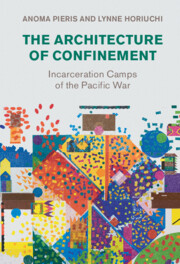
In this global and comparative study of Pacific War incarceration environments we explore the arc of the Pacific Basin as an archipelagic network of militarized penal sites. Grounded in spatial, physical and material analyses focused on experiences of civilian internees, minority citizens, and enemy prisoners of war, the book offers an architectural and urban understanding of the unfolding history and aftermath of World War II in the Pacific. Examples are drawn from Australia, New Zealand, Singapore, Japan, and North America. The Architecture of Confinement highlights the contrasting physical facilities, urban formations and material character of various camps and the ways in which these uncover different interpretations of wartime sovereignty. The exclusion and material deprivation of selective populations within these camp environments extends the practices by which land, labor and capital are expropriated in settler-colonial societies; practices critical to identity formation and endemic to their legacies of liberal democracy.
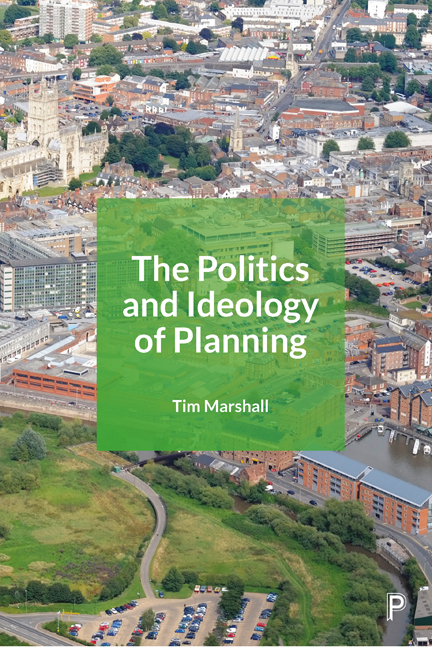
Marshall examines the ideological structuring of current planning models and the interplay of political interests. He analyses attempts at planning reform by recent governments to show how we can generate more effective political engagements for common gain.
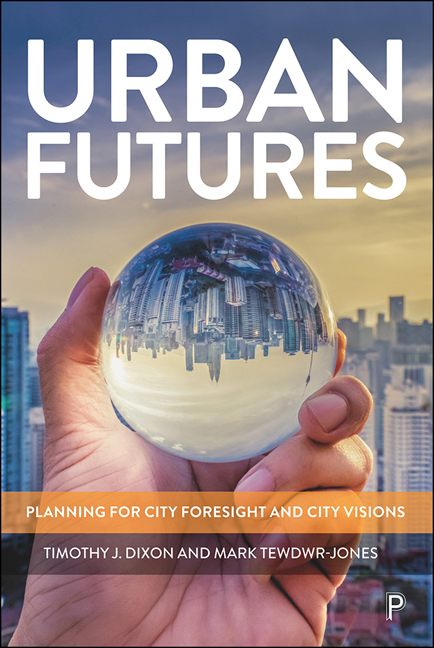
City visions represent shared, and often desirable, expectations about our urban futures. This book explores the history and evolution of city visions, placing them in the wider context of art, culture, science, foresight and urban theory.