To save content items to your account,
please confirm that you agree to abide by our usage policies.
If this is the first time you use this feature, you will be asked to authorise Cambridge Core to connect with your account.
Find out more about saving content to .
To save content items to your Kindle, first ensure no-reply@cambridge.org
is added to your Approved Personal Document E-mail List under your Personal Document Settings
on the Manage Your Content and Devices page of your Amazon account. Then enter the ‘name’ part
of your Kindle email address below.
Find out more about saving to your Kindle.
Note you can select to save to either the @free.kindle.com or @kindle.com variations.
‘@free.kindle.com’ emails are free but can only be saved to your device when it is connected to wi-fi.
‘@kindle.com’ emails can be delivered even when you are not connected to wi-fi, but note that service fees apply.
The City of Adelaide Development Control Act 1976 and the City of Adelaide Plan 1976–81 came into force on 1 March 1977. The agreement between the ACC and the State for the governance of the City under the Act contained a number of elements. The ACC would manage the City as a series of four Districts (Core, Inner Frame, Outer frame and Residential) containing 23 Precincts, as Figure 30 shows. These were as recommended by George Clarke and USC in the City of Adelaide Planning Study 1974. For each Precinct there was a ‘Desired Future Character Statement’, which was an innovative qualitative statutory control. From 1977 until 1982 there were a number of key individuals from the State and the ACC who where influential in the planning of the City, as Table 3 shows.
The ACC and the State were committed to a process of review and the adoption of a new City Plan on a five-yearly cycle with an integration of strategic and statutory approaches. This would provide certainty for the community during the first three years of the operation of the City Plan. But after a review in years four and five, with public involvement, a new City Plan would be adopted.
Permitted Development (PD) is the set of laws that determine what can be built in the UK without needing planning permission. These laws, which have existed since 1947, typically cover smallscale developments that have a minor impact on their surroundings. In 2008 the laws covering household developments were radically revised in an effort to free up planning departments to focus on larger applications. But the rewritten laws, while inherently more ‘liberal’ than their predecessors, are also confusing, impractical, and obscured by legalese.
Since 2009, we have produced a series of projects with a number of collaborators that explore PD. These projects all involve engaging with the laws in order to make public their potential for development. We see this work as a form of spatial practice.
This article presents an edited selection of spreads from our 2009 book-pamphlet SUB-PLAN: A Guide to Permitted Development, which was produced with the graphic design studio Europa and a group of students at the Architectural Association Summer School.
The Rescue man was not only working on the incident, he became a part of it […] he was the vaguely apprehended shape which suddenly appeared from the surrounding chaos as a human being […].
This paper explores a very particular form of building activity: demolition work. My aim is to show that the peculiarities of demolition work challenge how construction history contends with certain ontological and epistemological problematics. In the first instance, I am concerned with how the historical activity of demolition produces subjects which are held in distinct social relationships and material processes. In the second instance, I am concerned with how knowledge is produced in those relationships and processes, and further how knowledge of those relationships and processes might be made historically available. These questions are developed through an examination of archival material related to the clearance of the South Bank in the late 1940s in preparation for the Festival of Britain Exhibition and the Royal Festival Hall. The archived contracts are shown to have a specific status and effect for such an enquiry.
This issue of arq contains a selection of papers first presented at an event titled Further Reading Required held at the Bartlett School of Architecture, UCL, in 2011. Here, the conference organisers reflect on the distinctive strand of architectural research – comprising historical and theoretical readings of technical construction literature – which it sought to consolidate.
In a 2009 interview, architect Peter St John of Caruso St John Architects defined a good architect as one who makes few compromises, highlighting precise instructions as imperative in achieving this. An architectural project, St John stated, 'is far more likely to work well if you put an enormous effort into defining what you want, to achieve quality’. At Caruso St John Architects' 2006 entrance addition to the Victoria and Albert Museum of Childhood in Bethnal Green, London [1], the precise specification of mortar and mastic joints throughout a cut-stone facade was employed to define expectations of quality in the constructed facade. These specifications, written in accordance with the recommendations of professional practice, set out stringent expectations of dimensional perfection. When dimensional variations during design development and construction threatened to disrupt these expectations, the precise definition of quality shifted, becoming less defined by dimensional perfection and more reliant upon the ‘architectural intentions’ underpinning the project. In referencing conceptual, ideological, historical and technological intentions which were difficult definitively to express, this critical phrase – ‘architectural intentions’ – is examined here in terms of its ambiguity in the context of the written specification [2].
Ambiguity in the written specification is emphatically rejected by regulatory and advisory bodies in the architectural profession, which frequently advise that the written specification must provide, above all else, certainty. In The Architects' Journal in 1989, author Francis Hall went as far as describing the properly drafted specification as the ‘one certain opportunity’ for an architect to set down a ‘definitive and enforceable expression of standard and quality’. ‘Properly drafted’ is typically translated as a prosaic language, specifically devoid of poetic content. The ability of the unambiguous written specification to convey adequately the poetic content of architectural intentions has, however, been under critique since its inception.
The Further Reading Required event – subtitled Building Specifications, Contracts and Technical Literature – was focused on the role and status of the non-pictorial documents that establish the relations and responsibilities of those involved in building, and that describe the materials and processes to be used in construction. A one-day symposium, held on 17 February at the Bartlett School of Architecture, UCL, organised by Tilo Amhoff, Nick Beech and Katie Lloyd Thomas, it sought to examine the various regulatory documents and processes in relation to which architecture is historically constituted; to interpret how they distribute competencies and negotiate the various agencies and interests involved in building; and to explore the particular kinds of productivity that they make available or alternatively foreclose.
In this article I set out some of the distinct ways materials and components are described in architectural specifications. In many cases, as we might expect, materials are simply named, albeit in a great variety of ways from brand name to botanical species. In others, materials are specified via a reference to something else – to be built ‘like is the timbers of the Rente of Robert’, or to match a sample of stock bricks ‘marked No 1 to be seen with the Architect at No 1 Westminster Chambers’. We find many examples of what Bertrand Gille has called the ‘recipe’ – details about the ingredients and processes of making up a material or fixing it in site (Gille locates one in Vitruvius). And recently, and ever more pervasively, materials are prescribed in terms of their performance – how they are to behave in the finished building, whether acoustically or structurally or thermally and so on, with no mention at all of how the result is to be achieved. Indeed, the point may be precisely to avoid naming a particular material so that the responsibility for a compliant selection no longer rests with the architect. These descriptions, with their language of properties and materials science, could not be more different from the instructive prose-like sentences of the process-based specification. With one describing how to make up a given material, and the other how it is to behave, we might also suggest that they depend on very different, even incompatible, conceptualisations of the material – as artefact on the one hand and as actor on the other.
Differences between types of clause are recognised in contemporary technical literature and guides to specification practice, although the distinctions considered significant vary greatly. The typologies set out here, however, are drawn from my own survey of documents from the eighteenth century to the present day. In some cases, such as the performance clause, the type I identify maps directly onto a widely used industry category but in others, such as the process-based clause not so much in use today, it may only share some similarities with existing technical definitions.
To show every minute portion of a building by drawing is next to impossible, and would be more laborious than useful, and therefore description in writing is resorted to, by which much labour is saved, and the intentions of the architect more readily conveyed to the mind of the operative.
This paper investigates the changes in architectural practice following the introduction of contracting in gross for the execution of building work in early nineteenth-century England. This particular new form referred to two different agreements, either contracting for a whole undertaking by a single builder who agreed to erect the whole of an edifice at a predetermined price and time, or contracting for the work of a specific trade only.
The changes in contracting the building work are understood as changes in building practice, whose material product would be the building. In a similar manner the building contracts are considered as the material products of the architectural practice, including not only the working drawings, but also the legal obligations and building specifications. This paper investigates the contract documents that were to be produced in the architectural office in order to build on site as evidence for a response of architectural practice to the changes in building practice. It traces this process in the adaptation of the writings of the legal documents to contracting in gross by comparing the specifications of John Soane's building contract for Tendring Hall of 1784 with the instructions and model specifications of the early nineteenth-century handbooks and practical guides.
British Standard 8213-1: 2004 provides design recommendations for windows, door-height windows and rooflights, based upon a detailed assessment of the risk of accident encountered in their use and cleaning. Conservation Area guidance in Edinburgh's New Town sees windows instead as part of the special character of the place. The contradictions between BS 8213-1 and Edinburgh City Council's Conservation Area Guidelines are considered here as a creative opportunity for design.
This paper looks at the evolution of the structure of construction contract documentation over time, from ancient Greece through to the near future, in terms of the degree to which the contract documentation is integrated. Documentation might comprise anything from a single ‘integrated’ text to a range of ‘dis-integrated’ documents, fashioned by different players in the procurement process and not offering an easily appreciable integrated whole. The paper ends with the hope that new digital methods of information production will lead to better integrated and more easily readable ‘wholes’ in the new forms offered by building information modelling (BIM), which in turn will facilitate collaborative working.
The paper shows that contract documentation has evolved through four stages of integration: Integrated: up to the end of the medieval period construction contract documentation was essentially fully integrated – everything that was required was stated in the one written document, which typically covered contract conditions, building layouts, assembly descriptions, quantities of components and requirements for quality.
The standard construction contract in the UK, such as JCT 2005, is designed to balance time, quality and cost. Typically, the contract documents consist of a bespoke design described by a full package of drawings and a specification describing quality, techniques and materials. These enable a contractor to offer a fixed price for the work and establish a programme and the aim is to provide a level of financial security that leaves little to error or to contingent forces. That, at least, is the theory. In practice, there are few contracts that run as smoothly as the theory suggests, which accounts for the myriad case law in this area.
In preparing the contract documents, an architect conventionally begins their work by acting as agent for the client. Once appointed, s/he develops the brief with the client and/or users, designs the building and guides the scheme through the regulatory system, describing it in sufficient detail to allow a contractor to arrive at an accurate cost. After this, the ways in which a building can be procured can vary considerably. This article focuses on what happens under a Design and Build (D&B) contract.
The common lawyer's understanding of land still hovers between a purely material conception of the physical stuff of land and a more cerebral image of land as comprising a co-ordinated set of abstract entitlements. This underlying tension between the physical and the conceptual has imparted a multi-dimensional complexity to the term […]. Kevin Gray and Susan Gray
What is a building? To begin to extrapolate our reasons for posing this question, consider the context of ‘Further Reading’, and the supplementary documents this supposes. To those whose profession is dedicated to the design of buildings, and whose professional life is, all too often, beleaguered by impediments threatening the actualisation, the construction, of their design, supplementary documents are not simply footnotes to design but evidence of struggles over design control. Within this trajectory, law is, most frequently, figured as yet another problematic. But consider a rather different trope – one which uses aspects of legal thinking, or rather thinking through law, to re-engage with the idea of ‘a building’ and of ‘design’. Supplementary documents, in this sense, become a ‘supplement’ which we could characterise as an ‘excess’. Documents which before might have been marginalised now become reconstituted as artefacts, evidencing other accounts of the processes of architecture. Legal artefacts related to design and building, which evidence a series of techniques and strategies for diagramming rights and responsibilities, may be deployed to open new perspectives on the question of ‘What is a building?’
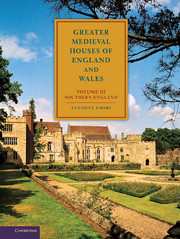
This is the third volume of Anthony Emery's magisterial survey, Greater Medieval Houses of England and Wales, 1300–1500, first published in 2006. Across the three volumes Emery has examined afresh and re-assessed over 750 houses, the first comprehensive review of the subject for 150 years. Covered are the full range of leading homes, from royal and episcopal palaces to manor houses, as well as community buildings such as academic colleges, monastic granges and secular colleges of canons. This volume surveys Southern England and is divided into three regions, each of which includes a separate historical and architectural introduction as well as thematic essays prompted by key buildings. The text is complemented throughout by a wide range of plans and diagrams and a wealth of photographs showing the present condition of almost every house discussed. This is an essential source for anyone interested in the history, architecture and culture of medieval England and Wales.
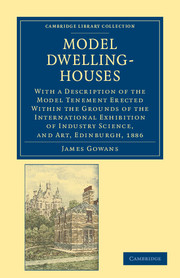
This detailed guide to the model tenement building displayed at Edinburgh's International Exhibition of Industry Science and Art in 1886 was first published in that year. A prominent figure in Scottish architecture and engineering, Sir James Gowans (1821–90) designed and built railways, roads, and stone houses during his long career, including a model village in West Lothian named Gowanbank. His intention in designing tenement buildings was to produce a standardised model that would make homes more affordable. This short book considers the tenement designs, including the situation of staircases, drainage, materials, and the mode of construction. Gowans' book also features chapters on the Prince Albert Victor Sundial, built to commemorate the opening of the exhibition by the prince, the Memorial Mason's pillars erected in Edinburgh, and the Electric Tramway. Gowans was made Lord Dean of Guild of the city of Edinburgh in 1885.
The hammams (or Islamic bath-houses), commonly known as ‘Turkish baths’, are one of the key urban facilities in Islamic cities. They evolved from the Roman and Byzantine public baths, as these were assimilated when the Umayyad dynasty conquered Byzantine territories in the Middle East between AD 661 and 750. Early hammams were built in the eighth century by the Umayyad rulers who established their capital in Damascus. The most famous ones are Qusayr Amra, in today's north-eastern desert of Jordan and Khirbat al Mafjar. The period following the rise of Islam witnessed a rapid development in the architecture of baths and the change from Roman to Islamic bathing habits. Public Roman baths consisted of very large establishments, the thermae, which comprised not only bathing facilities but also recreational ones such as libraries, gymnasiums, exercise grounds and gardens, tanning rooms, ball courts and concert halls. The balnea were the smaller privately or publicly owned Roman baths, located in greater number within the city.