Refine search
Actions for selected content:
7915 results in Architecture
Mapping deep space-time
-
- Journal:
- arq: Architectural Research Quarterly / Volume 15 / Issue 4 / December 2011
- Published online by Cambridge University Press:
- 09 March 2012, pp. 302-303
- Print publication:
- December 2011
-
- Article
-
- You have access
- Export citation
ARQ volume 15 issue 4 Cover and Back matter
-
- Journal:
- arq: Architectural Research Quarterly / Volume 15 / Issue 4 / December 2011
- Published online by Cambridge University Press:
- 09 March 2012, pp. b1-b2
- Print publication:
- December 2011
-
- Article
-
- You have access
- Export citation
Living in the field: ethnographic experience of place
-
- Journal:
- arq: Architectural Research Quarterly / Volume 15 / Issue 4 / December 2011
- Published online by Cambridge University Press:
- 09 March 2012, pp. 341-346
- Print publication:
- December 2011
-
- Article
- Export citation
Form, matter and David Chipperfield
-
- Journal:
- arq: Architectural Research Quarterly / Volume 15 / Issue 4 / December 2011
- Published online by Cambridge University Press:
- 09 March 2012, pp. 380-382
- Print publication:
- December 2011
-
- Article
- Export citation
The Architecture of Light: Recent Approaches to Designing with Natural Light By Mary Ann Steane Routledge, Oxford, 2011246pp., Many mono illus. ISBN: 978-0-415-39479-6 (hb), 978-0-415-39479-9 (pb) Price £95.00 (hb), £29.99 (pb)
-
- Journal:
- arq: Architectural Research Quarterly / Volume 15 / Issue 4 / December 2011
- Published online by Cambridge University Press:
- 09 March 2012, pp. 377-379
- Print publication:
- December 2011
-
- Article
- Export citation
Contents
-
- Journal:
- arq: Architectural Research Quarterly / Volume 15 / Issue 4 / December 2011
- Published online by Cambridge University Press:
- 09 March 2012, pp. 297-298
- Print publication:
- December 2011
-
- Article
- Export citation
An architect's Tagwerk: notes on Otto Steidle's work between the urban and the rural
-
- Journal:
- arq: Architectural Research Quarterly / Volume 15 / Issue 4 / December 2011
- Published online by Cambridge University Press:
- 09 March 2012, pp. 327-340
- Print publication:
- December 2011
-
- Article
- Export citation
The field and the table: Rosalind Krauss's ‘expanded field’ and the Anarchitecture group
-
- Journal:
- arq: Architectural Research Quarterly / Volume 15 / Issue 4 / December 2011
- Published online by Cambridge University Press:
- 09 March 2012, pp. 347-358
- Print publication:
- December 2011
-
- Article
- Export citation
Coastal conditions
-
- Journal:
- arq: Architectural Research Quarterly / Volume 15 / Issue 4 / December 2011
- Published online by Cambridge University Press:
- 09 March 2012, pp. 312-326
- Print publication:
- December 2011
-
- Article
- Export citation
Modern church architect as ritual anthropologist: architecture and liturgy at Clifton Cathedral
-
- Journal:
- arq: Architectural Research Quarterly / Volume 15 / Issue 4 / December 2011
- Published online by Cambridge University Press:
- 09 March 2012, pp. 359-372
- Print publication:
- December 2011
-
- Article
- Export citation
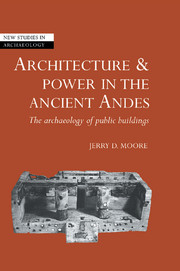
Architecture and Power in the Ancient Andes
- The Archaeology of Public Buildings
-
- Published online:
- 26 October 2011
- Print publication:
- 22 August 1996
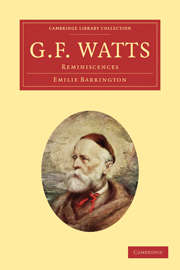
G. F. Watts
- Reminiscences
-
- Published online:
- 07 October 2011
- Print publication:
- 09 December 2010
- First published in:
- 1905
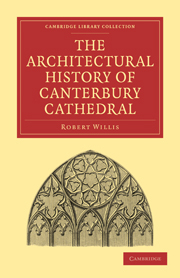
The Architectural History of Canterbury Cathedral
-
- Published online:
- 07 September 2011
- Print publication:
- 02 December 2010
- First published in:
- 1845
Contents
-
- Journal:
- arq: Architectural Research Quarterly / Volume 15 / Issue 3 / September 2011
- Published online by Cambridge University Press:
- 07 November 2011, p. 201
- Print publication:
- September 2011
-
- Article
- Export citation
Architecture and intellectual property
-
- Journal:
- arq: Architectural Research Quarterly / Volume 15 / Issue 3 / September 2011
- Published online by Cambridge University Press:
- 07 November 2011, pp. 294-296
- Print publication:
- September 2011
-
- Article
- Export citation
ARQ volume 15 issue 3 Cover and Front matter
-
- Journal:
- arq: Architectural Research Quarterly / Volume 15 / Issue 3 / September 2011
- Published online by Cambridge University Press:
- 07 November 2011, pp. f1-f2
- Print publication:
- September 2011
-
- Article
-
- You have access
- Export citation
Books received
-
- Journal:
- arq: Architectural Research Quarterly / Volume 15 / Issue 3 / September 2011
- Published online by Cambridge University Press:
- 07 November 2011, pp. 289-290
- Print publication:
- September 2011
-
- Article
- Export citation
Assemblage theory, gardens and the legacy of the early Garden City movement
-
- Journal:
- arq: Architectural Research Quarterly / Volume 15 / Issue 3 / September 2011
- Published online by Cambridge University Press:
- 07 November 2011, pp. 271-278
- Print publication:
- September 2011
-
- Article
- Export citation
What's science got to do with it?
-
- Journal:
- arq: Architectural Research Quarterly / Volume 15 / Issue 3 / September 2011
- Published online by Cambridge University Press:
- 07 November 2011, pp. 205-206
- Print publication:
- September 2011
-
- Article
-
- You have access
- Export citation
Truthing gap: imagining a relational geography of the uninhabitable1
-
- Journal:
- arq: Architectural Research Quarterly / Volume 15 / Issue 3 / September 2011
- Published online by Cambridge University Press:
- 07 November 2011, pp. 216-230
- Print publication:
- September 2011
-
- Article
- Export citation
