To save content items to your account,
please confirm that you agree to abide by our usage policies.
If this is the first time you use this feature, you will be asked to authorise Cambridge Core to connect with your account.
Find out more about saving content to .
To save content items to your Kindle, first ensure no-reply@cambridge.org
is added to your Approved Personal Document E-mail List under your Personal Document Settings
on the Manage Your Content and Devices page of your Amazon account. Then enter the ‘name’ part
of your Kindle email address below.
Find out more about saving to your Kindle.
Note you can select to save to either the @free.kindle.com or @kindle.com variations.
‘@free.kindle.com’ emails are free but can only be saved to your device when it is connected to wi-fi.
‘@kindle.com’ emails can be delivered even when you are not connected to wi-fi, but note that service fees apply.
This part explores how early television dealt with representations of antiquity and the significant differences in the structural framework between the commercial broadcasting system in the US and the dominance of public broadcasting in the UK and elsewhere in Europe. It also argues that, while specific shows dealing with antiquity were rare, many other shows, especially science fiction, contained episodes set in the ancient world. The two case studies that feature in this part, ITV’s The Caesars and RAI’s Odissea/The Odyssey (both 1968), offer examples of two very different approaches to TV antiquity as well as diversity of aesthetic styles. In addition to the case studies, the introduction to this part also discusses the BBC’s remarkable six-part series The Spread of the Eagle (1963), and a number of other shows featuring ancient world episodes.
Previous studies of Greek oracles have largely studied their social and political connections. In contrast, this pioneering volume explores the experience of visiting the oracle of Zeus at Dodona in NW Greece, focusing on the role of the senses and embodied cognition. Building on the unique corpus of oracular question tablets found at the site, it investigates how this experience made new ways of knowing and new forms of knowledge available. Combining traditional treatments of evidence with more recent theoretical approaches, including from psychology, narratology and environmental humanities, the chapters explore the role of nature, sound, touch, and stories in the experience of consultation. By evoking the details of this experience, they help the reader understand more deeply what it was like for ancient men and women to visit the oracle and ask the god for help. This title is also available as open access on Cambridge Core.
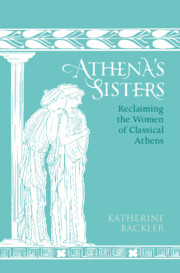
Athena's Sisters transforms our understanding of Classical Athenian culture and society by approaching its institutions—kinship, slavery, the economy, social organisation—from women's perspectives. It argues that texts on dedications and tombstones set up by women were frequently authored by those women. This significant body of women's writing offers direct insights into their experiences, values, and emotions. With men often absent, women redefined the boundaries of the family in dialogue with patriarchal legal frameworks. Beyond male social and political structures, women defined their identities and relationships through their own institutions. By focusing on women's engagement with other women, rather than their relationships to men, this timely and necessary book reveals the richness and dynamism of women's lives and their remarkable capacity to shape Athenian society and history.
In the Roman Republic, elite women were legally permitted to control substantial assets – and many demonstrably were in direct control of their wealth. They were also the mothers, wives and daughters of the politicians who built Rome's empire and, in a time of high mortality, could find themselves running households that did not contain adult men. This volume explores the political and social consequences of elite female wealth. It combines case studies of individual women, such as Licinia, wife of C. Gracchus, Mucia Tertia, Fulvia and Octavia Minor, with broader surveys of the institutional frameworks and social conventions that constrained and enabled women's wealth and its consequences. The book contributes to the recent upsurge of interest in re-evaluating the role of women in Republican Rome and will be invaluable for scholars and students alike.
Sidonius Apollinaris' fifth-century Letters are a highpoint of Latin literature. They are also a unique document from the end of the Western Roman Empire on the brink of the Middle Ages. They have a direct appeal to modern readers for the struggle between tradition and innovation, dominant and immigrant culture, and shifting balances of power. This book is the first selection from Sidonius' correspondence that goes beyond the anecdotal to reveal its depth and coherence. It applies insights brought to light by research on Sidonius in the last half-century, as well as by functional grammar, text linguistics and narratology. Based on an updated Latin text and attentive to intertextuality throughout, it introduces a number of interpretative innovations. With an Introduction and detailed Commentary providing help down to the level of individual words, it caters for the needs of students and instructors, while also offering much to scholars.
The ancient neighborhood of the Subura in Rome was held together by the shape of its terrain and the urban thoroughfares that connected the city's center and periphery. In this study, Margaret Andrews traces the Subura's urban development from the Iron Age through the Early Middle Ages. Using both written and material evidence, she argues that the valley was imbued with a social ideology that focused on the virtuous woman. This ideology was reconstituted and refocused over the centuries by Rome's most powerful leaders – senators, emperors, and bishops – and the Subura's residents themselves. The neighborhood's physical fabric was transformed in each period, as monumental and mundane structures were recombined in ways that blended past and present. Andrews demonstrates how the Subura serves as a compelling case study of urban evolution. She shows how socially constructed concepts are inscribed into urban environments and how the social processes through which these concepts were embedded evolved over time.
In this chapter, we will examine the Old Testament’s role in religious communities as an authoritative revelation from God – the concept of “scripture” common to the three monotheistic religions: Judaism, Christianity, and Islam. These texts hardly began as the books that now comprise the Bible; rather, what we will discover is a lengthy, complex development of authoritative texts from oral to written to canon.
This chapter will take us inside the ancient world of the Old Testament’s formation. Words, considered powerful, were painstakingly preserved through centuries in the hands of anonymous authors and editors, scribes and scholars. Texts were collected into books and went through a process of use and standardization by the ancient Israelites, beginning as early as the tenth century bceand lasting through the Babylonian exile and beyond – emerging finally in the canonical form we know today as the Old Testament.
In the books of Joshua and Judges, God’s gift of land to Israel takes center stage. The first book recounts Israel’s conquest and division of the land under the leadership of Moses’ successor, Joshua. Judges highlights governance in the land by a succession of twelve leaders. Connected by a recurring cycle – Israel’s disobedience to Yahweh, foreign oppression, repentance, and deliverance – the Judges stories narrate the end of one era in Israel’s history and serve as introduction to the next.
Alongside these Primary History accounts, we will consider archaeological evidence for a significant population increase in Canaan during Iron Age I and look at three theories that attempt to explain the appearance of new populations in the region at that time. In addition to observing the nature of religion during Israel’s early history in the land, we will address the difficult subject of the land today. Jewish, Christian, and Muslim readers all have varying responses. Joshua and Judges should not and need not be used in the debate, but they remind us how very ancient is the issue of land.
The first eleven chapters of Genesis – and of the Old Testament – constitute the Primeval History. This carefully arranged collection of traditions detail God’s good creation of the cosmos, the nature of humanity in the created order of the universe, and God’s relationship with humans. In this chapter, we will explore various genres such as cosmogony, theogony, myth, and history, all of which will help to demonstrate ways in which Israel’s Primeval History resembled the traditions of its ancient neighbors and ways in which Israel’s form and content were unique.
Importantly, Genesis 1–11 prepare the reader for the rest of the Bible. They also function as an explanation for Israelite readers of why things are the way they are. Furthermore, they introduce themes that will be important throughout the remainder of the Old Testament: the concept of creation, the unchallenged sovereignty of God, the central importance of humanity, and the first mention of covenant.
The three major sections of Genesis 12–50 focus on the ancestral narratives of Abraham, Jacob, and Joseph. We know little of the historical details, although archaeological data suggests a plausible context for these stories in the Middle Bronze Age. We will see that the narratives themselves hint at even earlier traditions, suggestive of oral traditions preserved and woven into the texts. In these narratives we will also encounter the social structure of kinship-based tribal societies. The “father’s house” and the larger clan formed the subunits of the geographically based organization of the tribe.
This portion of Genesis narrates Yahweh’s provision of hope for the divine–human relationship so tragically marred by human rebellion (Genesis 1–11). Moreover, God chooses an individual, Abraham, to partner in a covenant. This covenant, shaped by God’s promises of land, descendants, and worldwide blessing, is the lasting hallmark of Israelite religion. Abraham’s descendants include not only those named in the Old Testament but those in the three monotheistic religions for which Abraham is acknowledged as the “father of faith.”
We will now focus our attention on the final book of the Pentateuch, Deuteronomy. We will discover that, even as the book recounts what has come before for the sake of Israel poised to enter the promised land, it does so in a new setting, in an innovative literary format, and with distinctive emphases that speak to generations present and yet to come.
Deuteronomy consists of four collections of speeches given by Moses, set off by literary superscriptions. Scholars have determined that the book is organized in the form of an ancient international treaty. Following a historical prologue, the speeches reiterate and affirm Torah instruction, institute a covenant renewal that links blessings with covenant fidelity, and detail provisions for Israel after Moses’ death (recounted in the final chapter of the book). Deuteronomy is distinctive in the Pentateuch for its focus on the centralization of Israel’s religious cult at the place where Yahweh will cause his name to dwell, the great statement of faith known as the Shema (Deuteronomy 6:4), and the first explicit statements of monotheism in the Old Testament.
All historiography or history writing is done with a purpose, and the purpose of Israel as expressed in the Old Testament was clearly religious and theological. The Israelites sought to record their relationship with God in the past – to relate their unique understanding of God, his universe, and his relationship to Israel. Additionally significant is the fact that Israel was among the first nations in the ancient world to write history.
This chapter will take us into the library of ancient Israel to get a better look at how the books of the Old Testament narrate history and how these books have been organized. Specifically, we will investigate the sources that appear to have been interwoven to create the so-called Primary History. These sources are characterized by their distinctive ways of referring to God and by their themes and literary techniques. We will observe that the Old Testament presents the Primary History in such a way as to provide a framework for understanding the historical contexts of all the rest of the Old Testament books.
Ancient Israel existed in real time and space. In time, we will recall that ancient Israel was preceded by thousands of years of world history, including, for example, the first writing of the Sumerians (third millennium bce), the Babylonian Empire, and the renowned history of ancient Egypt. In space, Israel was part of Syria–Palestine. Together with Egypt and Mesopotamia, Israel constituted a vast swath of arable land known as the “Fertile Crescent.” Syria–Palestine was thus a vital land bridge between three continents and, likewise, highly vulnerable to surrounding power struggles. The latter meant frequent invasions and domination by a succession of world empires.
The primary purpose of Israel’s story contained in the pages of the Old Testament is to explore its relationship with God. Yahweh initiated an intimate relationship with a man named Abraham, which was defined by a covenant and by promises of descendants and land. The ensuing history covers an era that left its own mark on world history, in no small part due to Israel’s legacy. The age between 800 and 200 bce(the Axial Age) witnessed the appearance of ethical religion and rational philosophy in human civilization. Israel gave the world the Old Testament and the concept of monotheism emerging in its pages.
A survey of the evidence for textile production and trade shows extensive market activities, supported by state enforcement of agreements. The most intrusive form of state intervention was the imposition of a monthly quota to be delivered by weavers, accounting for up to half of their production volume. This may have represented the transformation of an existing quota arrangement attested in New Kingdom Egypt. However, the cash-based Ptolemaic system, in which weavers were compensated and could substitute cash payments for their deliveries, had a different dynamic. The stable demand offered by the quotas offset some of the risk of production for the market by the weavers. This arrangement made the state into an oversized market player, but the textiles it collected were not sold through retail concessions but put to practical use or exported. In addition, weavers and other occupations were subject to taxation in cash, the state levied customs and sales taxes, and it derived revenues from flax cultivation and sheep husbandry, likewise without exercising exclusive control and using private contractors. Attempts at local monopolies were rather undertaken by professional associations.