To save content items to your account,
please confirm that you agree to abide by our usage policies.
If this is the first time you use this feature, you will be asked to authorise Cambridge Core to connect with your account.
Find out more about saving content to .
To save content items to your Kindle, first ensure no-reply@cambridge.org
is added to your Approved Personal Document E-mail List under your Personal Document Settings
on the Manage Your Content and Devices page of your Amazon account. Then enter the ‘name’ part
of your Kindle email address below.
Find out more about saving to your Kindle.
Note you can select to save to either the @free.kindle.com or @kindle.com variations.
‘@free.kindle.com’ emails are free but can only be saved to your device when it is connected to wi-fi.
‘@kindle.com’ emails can be delivered even when you are not connected to wi-fi, but note that service fees apply.
The Lives and Opinions of Eminent Philosophers by Diogenes Laertius (third century AD) are transmitted (entirely, partially, or in the form of excerpts) by a hundred or so manuscripts. The oldest witnesses of this tradition are three continuous manuscripts (B, P and F), datable between the end of the eleventh century and the thirteenth century, and three collections of excerpts, two (Φ/Φh) copied in a Vatican MS of the twelfth century (and in its descendants) and the third in a MS in Vienna (Vi) written and dated 28 July 925. All other manuscripts date from the fourteenth to the sixteenth centuries, though some manuscripts with excerpts are as late as the eighteenth.
P Paris, Bibliothèque nationale de France, gr. 1759. 11th/12th cent. Oriental paper. 210×150 mm. ff. I + 251 (ff. 174r end, 174v–176r blanks). Written at Constantinople by two contemporary anonymous hands (A: 1r–95r; B: 95v–251v). There is evidence of six correctors (P2–7), the most important of whom is indicated with the siglum P4. In f. Ar, a later hand (15th–16th cent.) copied an epitaph on Emperor Basil II the Bulgar–slayer ‘Bulgaroktonos’ (958–1025), followed by two further epitaphs, one on Julian the Apostate and one on a certain Bessarion. In f.
‘Si possem, haec […] volumina retinerem et retractarem potius quam ederem.’ As I prepared to publish the results of nearly two decades of research dedicated to the history of the text and to the editing of the Lives and Opinions of Eminent Philosophers by Diogenes Laertius, more than once this phrase came to mind. But, like Siegfried Sudhaus, I did not give in to the temptation: ‘sed multa me commovent, ut quae habeam tandem edam. nam […] infiniti laboris aliquis tandem finis faciendus videbatur, et complurium contentione et iudicio philologorum plus effici quam unius opera expertus scio’ (Philodemi Volumina Rhetorica ed. S. Sudhaus, Leipzig 1892, v).
No edition of an ancient text can be considered definitive. My hope is to have taken a step forward in the understanding of the text of Diogenes' Lives, and to have laid down foundations on which others will build.
This project would never have been realized if I had not had the enviable privilege of belonging to a team of the French ‘Centre National de la Recherche Scientifique’ (CNRS), the ‘Centre Jean Pépin (UPR 76)’. Being free of didactic and administrative commitments, and hence enjoying complete otium, I have been able to dedicate myself full time to the study of Diogenes Laertius.
Many other cultural institutions have come forward with useful and concrete o.ers of help.
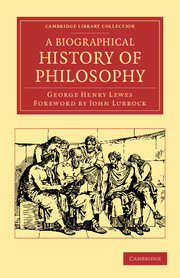
The philosopher and critic George Henry Lewes (1817–78) published this work in two volumes in 1845–6. This is a reissue of an 1892 printing, which brought the volumes into one book. Lewes wrote widely on literature, science and philosophy, and was also the long-term intimate companion of George Eliot. This book is a narrative history, rather than an encyclopedia, of key philosophers. It is, therefore, a partial and personal study instead of an exhaustive textbook. The first volume concentrates solely on Greek philosophy, beginning with the Pre-Socratics and ending with the Neo-Platonists. The second volume jumps to Francis Bacon, concentrating on British, German and French philosophy, and addressing, among others, Spinoza, Locke, Hume and Kant, and ending with Auguste Comte. Containing both historical anecdotes and pithy analyses of ideas, this book reflects the expertise and intellectual sympathies of a Victorian polymath.
The German philosopher and philologist Friedrich Ast (1778–1841) published this monumental lexicon in three volumes (1835–8). A professor of classical literature at the University of Landshut and member of the Bavarian Academy of Sciences, Ast wrote widely on the history of philosophy. He edited a complete edition of Plato with Latin translation, identifying spurious interpolations and false attributions, using this as a basis for his Lexicon. The work is arranged alphabetically, Volume 2 (1836) covering Theta to Omicron. The entries give citations both from Plato and from later works that extensively quote Plato. Though the Lexicon met with criticism for omissions of particles, prepositions and proper names, and the lack of systematic arrangement, it had a high reputation throughout the nineteenth century. It remains a milestone in Plato scholarship and is an indispensable resource for readers interested in the history of philology and methods in textual criticism.
The German philosopher and philologist Friedrich Ast (1778–1841) published this monumental lexicon in three volumes (1835–8). A professor of classical literature at the University of Landshut and member of the Bavarian Academy of Sciences, Ast wrote widely on the history of philosophy. He edited a complete edition of Plato with Latin translation, identifying spurious interpolations and false attributions, using this as a basis for his Lexicon. The work is arranged alphabetically, Volume 1 (1835) covering Alpha to Epsilon. The entries give citations both from Plato and from later works that extensively quote Plato. Though the Lexicon met with criticism for omissions of particles, prepositions and proper names, and the lack of systematic arrangement, it had a high reputation throughout the nineteenth century. It remains a milestone of Plato scholarship and is an indispensable resource for readers interested in the history of philology and methods in textual criticism.
This edition presents a radically improved text of Diogenes Laertius' Lives of Eminent Philosophers. The text is accompanied by a full critical apparatus on three levels. A lengthy introduction lists all the manuscripts of the Lives and discusses its transmission in late antiquity, the Middle Ages and the Renaissance. There is also an index of personal names, a bibliography and notes covering several features of the text and its interpretation. Professor Dorandi has used the Nachlaß of Peter Von der Mühll, for the first time in its entirety, to verify and consolidate material that he had previously gathered. This is by far the most detailed and elaborate edition which Diogenes' Lives - a unique work which has had a profound influence on European literature and philosophy - has ever received.
The German philosopher and philologist Friedrich Ast (1778–1841) published this monumental lexicon in three volumes (1835–8). A professor of classical literature at the University of Landshut and member of the Bavarian Academy of Sciences, Ast wrote widely on the history of philosophy. He edited a complete edition of Plato with Latin translation, identifying spurious interpolations and false attributions, using this as a basis for his Lexicon. The work is arranged alphabetically, Volume 3 (1838) covering Pi to Omega. The entries give citations both from Plato and from later works that extensively quote Plato. Though the Lexicon met with criticism for omissions of particles, prepositions and proper names, and the lack of systematic arrangement, it had a high reputation throughout the nineteenth century. It remains a milestone in Plato scholarship and is an indispensable resource for readers interested in the history of philology and methods in textual criticism.