To save content items to your account,
please confirm that you agree to abide by our usage policies.
If this is the first time you use this feature, you will be asked to authorise Cambridge Core to connect with your account.
Find out more about saving content to .
To save content items to your Kindle, first ensure no-reply@cambridge.org
is added to your Approved Personal Document E-mail List under your Personal Document Settings
on the Manage Your Content and Devices page of your Amazon account. Then enter the ‘name’ part
of your Kindle email address below.
Find out more about saving to your Kindle.
Note you can select to save to either the @free.kindle.com or @kindle.com variations.
‘@free.kindle.com’ emails are free but can only be saved to your device when it is connected to wi-fi.
‘@kindle.com’ emails can be delivered even when you are not connected to wi-fi, but note that service fees apply.
Cicero's On the Commonwealth and On the Laws were his first and most substantial attempt to adapt Greek theories of political life to the circumstances of the Roman Republic. They represent Cicero's vision of an ideal society, and remain his most important works of political philosophy. On the Commonwealth survives only in part, and On the Laws was never completed. The present volume offers a scholarly reconstruction of the fragments of On the Commonwealth and a masterly translation of both dialogues, prepared by James E. G. Zetzel, Professor of Classics at Columbia University. The texts are supported by a concise introduction, notes, synopsis, biographical notes and bibliography, all designed to assist students in politics, philosophy, ancient history, law and classics.
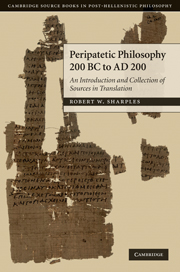
This book provides a collection of sources, many of them fragmentary and previously scattered and hard to access, for the development of Peripatetic philosophy in the later Hellenistic period and the early Roman Empire. It also supplies the background against which the first commentator on Aristotle from whom extensive material survives, Alexander of Aphrodisias (fl. c. AD 200), developed his interpretations which continue to be influential even today. Many of the passages are here translated into English for the first time, including the whole of the summary of Peripatetic ethics attributed to 'Arius Didymus'.
This comprehensive sourcebook makes available in the original Latin and Greek the principal extant texts required for the study of the Stoic, Epicurean and sceptical schools of philosophy. The material is organised by schools, and within each school topics are treated thematically. The volume presents the same texts (with some additional passages) as are translated in The Hellenistic Philosophers, Volume 1. The authors provide their own critical apparatus, and also supply detailed notes on the more difficult texts. This volume is equipped with a large annotated bibliography.
This edition of early Greek writings on social and political issues includes works by more than thirty authors. There is a particular emphasis on the sophists, with the inclusion of all of their significant surviving texts, and the works of Alcidamas, Antisthenes and the 'Old Oligarch' are also represented. In addition there are excerpts from early poets such as Homer, Hesiod and Solon, the three great tragedians Aeschylus, Sophocles and Euripides, the historians Herodotus and Thucydides, medical writers and presocratic philosophers. Besides political theory, areas represented include early anthropology, sociology, ethics and rhetoric, and the wide range of issues discussed includes human nature, the origin of human society, the origin of law, the nature of justice, the forms of good government, the distribution of wealth, and the distribution of power among genders and social classes.
Sextus Empiricus' Against the Logicians is by far the most detailed surviving examination by any ancient Greek sceptic of the areas of epistemology and logic. It critically examines the pretensions of non-sceptical philosophers to have discovered methods for determining the truth, either through direct observation or by inference from the observed to the unobserved. It is therefore a fine example of the Pyrrhonist sceptical method at work. It also provides a mine of information about the ideas of other Greek thinkers, ideas that are in many cases poorly preserved in other sources. This volume presents Against the Logicians in a new and accurate translation, together with a detailed introduction that sets the work in its philosophical context.
This 2001 translation makes one of the most important texts in ancient philosophy available to modern readers. Cicero is increasingly being appreciated as an intelligent and well-educated amateur philosopher, and in this work he presents the major ethical theories of his time in a way designed to get the reader philosophically engaged in the important debates. Raphael Woolf's translation does justice to Cicero's argumentative vigour as well as to the philosophical ideas involved, while Julia Annas's introduction and notes provide a clear and accessible explanation of the philosophical context of the work. This edition will appeal to all readers interested in this central text in ancient philosophy and the history of ethics.
This anthology of philosophical texts by Greek and Roman authors brings together works from the late fifth century BC to the sixth century AD that comment on major aesthetic issues such as the perception of beauty and harmony in music and the visual arts, structure and style in literature, and aesthetic judgement. It includes important texts by Plato and Aristotle on the status and the role of the arts in society and in education, and Longinus' reflections on the sublime in literature, in addition to less well-known writings by Philodemus, Cicero, Seneca, Plotinus, Augustine and Proclus. Most of the texts have been newly translated for this volume, and some are available in English for the first time. A detailed introduction traces the development of classical aesthetics from its roots in Platonism and Aristotelianism to its ultimate form in late Antiquity.
This is the first title in the Key Themes in Ancient Philosophy series, which provides concise books, written by major scholars and accessible to non-specialists, on important themes in ancient philosophy which remain of philosophical interest today. In this book, Professor Gerson explores ancient accounts of the nature of knowledge and belief from the Presocratics up to the Platonists of late antiquity. He argues that ancient philosophers generally held a naturalistic view of knowledge as well as of belief. Hence, knowledge was not viewed as a stipulated or semantically determined type of belief but was rather a real or objectively determinable achievement. In fact, its attainment was identical with the highest possible cognitive achievement, namely wisdom. It was this naturalistic view of knowledge at which the ancient Skeptics took aim. The book concludes by comparing the ancient naturalistic epistemology with some contemporary versions.
Aristotle's Ethics develops a complex theory of the qualities which make for a good human being and for several decades there has been intense discussion about whether Aristotle's theory of voluntariness, outlined in the Ethics, actually delineates what modern thinkers would recognize as a theory of moral responsibility. Javier Echeñique presents a novel account of Aristotle's discussion of voluntariness in the Ethics, arguing - against the interpretation by Arthur Adkins and that inspired by Peter Strawson - that he developed an original and compelling theory of moral responsibility and that this theory has contributed in important ways to our understanding of coercion, ignorance and violence. His study will be valuable for a wide range of readers interested in Aristotle and in ancient ethics more broadly.
This fourth Companion to Ancient Thought is devoted to ancient ethics. The chapters range over the ethical theories of all the major philosophers and schools from the earliest times to the work of the Hellenistic philosophers. There is a substantial introduction which considers the question of what is distinctive about ancient ethics, and an extensive bibliography. This collection provides a sophisticated and accessible introduction to the moral theories of the ancient world.
This book examines Aristotle's metaphysics and his account of nature, stressing the ways in which his desire to explain observed natural processes shaped his philosophical thought. It departs radically from a tradition of interpretation, in which Aristotle is understood to have approached problems with a set of abstract principles in hand, principles derived from critical reflection on the views of his predecessors. A central example of the book interprets Aristotle's essentialism as deriving from an examination of the kinds of unity that various sorts of things have: elemental motion, alteration, transformation and the growth of organisms. An important conclusion of this argument is that an essence may, under certain circumstances, lack some of its essential attributes. This is a major re-evaluation of Aristotle's metaphysics that will interest philosophers, classicists and historians of science.
Plato's Symposium, written in the early part of the 4th century BC, is set at a drinking party (symposium) attended by some of the leading intellectuals of the day, including Aristophanes, the comic dramatist, Socrates, Plato's mentor, and Alcibiades, the brilliant but (eventually) treacherous politician. Each guest gives a speech in praise of the benefits of desire and its role in the good and happy human life. At the core of the work stands Socrates' praise of philosophical desire, and an argument for the superiority of the philosophical life as the best route to happiness. This edition provides an accessible and engaging new translation by M. C. Howatson, and a substantial introduction, by Frisbee C. C. Sheffield, which guides the reader through the various parts of the dialogue and reflects on its central arguments. A chronology and detailed notes on the participants help to set this enduring work in context.