To save content items to your account,
please confirm that you agree to abide by our usage policies.
If this is the first time you use this feature, you will be asked to authorise Cambridge Core to connect with your account.
Find out more about saving content to .
To save content items to your Kindle, first ensure no-reply@cambridge.org
is added to your Approved Personal Document E-mail List under your Personal Document Settings
on the Manage Your Content and Devices page of your Amazon account. Then enter the ‘name’ part
of your Kindle email address below.
Find out more about saving to your Kindle.
Note you can select to save to either the @free.kindle.com or @kindle.com variations.
‘@free.kindle.com’ emails are free but can only be saved to your device when it is connected to wi-fi.
‘@kindle.com’ emails can be delivered even when you are not connected to wi-fi, but note that service fees apply.
The influential historiographer of philosophy Eduard Zeller, in his monumental Die Philosophie der Griechen, criticized the ‘philosophical sterility’ and ‘intellectual torpor’ of the Epicurean school, which, he claimed, remained more than any of its rivals confined throughout its history to the utterances of its founder. In his abridged Grundriß der Geschichte der griechischen Philosophie, Zeller went so far as to assert that none of Epicurus' successors ‘made any attempt worth mentioning’ to the development of the school's doctrines. A survey of much more recent histories of Hellenistic philosophy confirms that these stereotypes, which find antecedents already in antiquity, have proven persistent. As a consequence, studies of Epicurean philosophy remain disproportionately studies of Epicurus' philosophy. The present collection represents an attempt to help correct this imbalance and the misperceptions that sustain it. The essays contained herein explore various aspects of the interplay between tradition and innovation within Epicureanism.
That interplay begins with Epicurus himself, who was both heir to a rich philosophical tradition and the founder of a new philosophical school. The opening essay by Michael Erler, ‘Autodidact and student: on the relationship of authority and autonomy in Epicurus and the Epicurean tradition’, explores how Epicurus balanced these two contrasting roles. Critics both ancient and modern have viewed Epicurus' repeated, emphatic declarations of his own independence and originality as transparent attempts to mask the extent of his indebtedness to various predecessors.
In this chapter, I defend (once again) the view that the Epicurean gods are real, in the sense that they exist as atomic compounds and possess the properties that pertain to the concept, or prolêpsis, that people have of them. The contrary view – that the Epicurean gods have no objective existence, and that the notion of them is a consequence of ‘psychological processes…within the human soul’, was proposed in the nineteenth century and revived in the twentieth by Jean Bollack; more recently, it has received support from Long and Sedley and Dirk Obbink, and, most forcefully, in the chapter by David Sedley in this volume. The physical existence of the gods has been reasserted, in turn, by Jaap Mansfeld, Gabriele Giannantoni, Maria Carolina Santoro and Michael Wigodsky.
Given that Epicurus, in the Letter to Menoeceus (123–4), flatly declares that ‘there are gods’ (θεοὶ μὲν γὰρ εἰσίν), and that this dictum is echoed by all subsequent Epicureans who have pronounced on the matter, I venture to say that no one would ever have proposed that they were mere ‘psychological processes’ or ‘thought-constructs’, had it not been for two difficulties that appear to beset the Epicurean theory. Both are evident in the same passage from Epicurus' Letter to Menoeceus.
When it comes to political involvement, some of our most important sources on early Epicureanism frame the question in terms regularly employed by their Stoic rivals: ‘Will the sage engage in politics?’ Epicurus and Chrysippus apparently both discussed this question in works sharing the title On Modes of Life (Περὶ βίων). Of Epicurus' treatment we have a two-word summary: οὐδὲ πολιτεύσεται (‘and the sage will not participate in politics’). But if the question were really as simple as its traditional wording makes it seem, this answer would appear to create complications for some, especially for converts in oligarchic aristocracies. What was someone like Cassius, the tyrannicide, to do once he came to be a late-life convert to Epicureanism? On the face of it, if Epicureanism has really taken hold, he would lay down his political influence, withdraw from the larger society and live the rest of his life unnoticed with his Epicurean friends. Otherwise, if he clings to his political career and influence, and even risks his life for them, as Cassius did, we would suspect that he is just dabbling in Epicureanism. As for Epicurean philosophers, we might expect the more rigorous ones to help princes and courtiers find ways to descend from their positions of authority and influence, as Epicurus did with his friend Idomeneus, a politician from Lampsacus.
Attempts to dispel fear of death by claiming that life continues on in some fashion post mortem are commonplace. Such was not, however, the approach adopted by the ancient Epicureans. On the contrary, Epicurus is frequently credited with originating the argument that death is not to be feared, precisely because it is the end of existence. That no person survives his own death is a proposition to which the Epicureans are unquestionably committed. It is also true that Epicurus and his followers consistently represent fear of death as one of the greatest impediments to human flourishing. Nevertheless, Epicurean attitudes toward death and its associated fears turn out to be considerably more nuanced than generally recognized.
To speak of the fear of death already risks obscuring the protean nature of the phenomenon in question. People in fact fear a diversity of things related to death for equally diverse reasons. The Epicureans are sometimes accused of failing to appreciate, or at least to have addressed, this actual multiplicity of death-related fears. Such accusations are unwarranted, as several recent commentators have convincingly demonstrated. Epicurean sources in fact contain arguments directed at many distinct fears of death. What has yet to be fully appreciated is the degree to which Epicureanism is able to countenance at least certain of these fears.
From its beginnings, philosophy's language, concepts and imaginative growth have been heavily influenced by poetry and poets. Drawing on the work of a wide range of thinkers throughout the history of Western philosophy, Raymond Barfield explores the pervasiveness of poetry's impact on philosophy and, conversely, how philosophy has sometimes resisted or denied poetry's influence. Although some thinkers, like Giambatista Vico and Nietzsche, praised the wisdom of poets, and saw poetry and philosophy as mutually beneficial pursuits, others resented, diminished or eliminated the importance of poetry in philosophy. Beginning with the famous passage in Plato's Republic in which Socrates exiles the poets from the city, this book traces the history of the ancient quarrel between philosophy and poetry through the works of thinkers in the Western tradition ranging from Plato to the work of the contemporary thinker Mikhail Bakhtin.
Aristotle's definition of time as 'a number of motion with respect to the before and after' has been branded as patently circular by commentators ranging from Simplicius to W. D. Ross. In this book Tony Roark presents an interpretation of the definition that renders it not only non-circular, but also worthy of serious philosophical scrutiny. He shows how Aristotle developed an account of the nature of time that is inspired by Plato while also thoroughly bound up with Aristotle's sophisticated analyses of motion and perception. When Aristotle's view is properly understood, Roark argues, it is immune to devastating objections against the possibility of temporal passage articulated by McTaggart and other 20th-century philosophers. Roark's novel and fascinating interpretation of Aristotle's temporal theory will appeal to those interested in Aristotle, ancient philosophy and the philosophy of time.
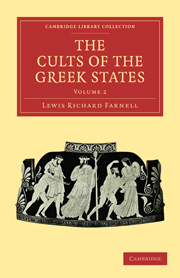
Lewis Richard Farnell's five-volume The Cults of the Greek States, first published between 1896 and 1909, disentangles classical Greek mythology and religion, since the latter had often been overlooked by nineteenth-century English scholars. Farnell describes the cults of the most significant Greek gods in order to establish their zones of influence, and outlines the personality, monuments, and ideal types associated with each deity. He also resolutely avoids the question of divine origins and focuses instead on the culture surrounding each cult, a position which initially drew some criticism, but which allowed him more space to analyse the religious practices themselves. Written to facilitate a comparative approach to Greek gods, his work is still regularly cited today for its impressive collection of data about the worship of the most popular deities. Volume 5 focuses on the cults of Hermes, Dionysos, Hestia, Hephaistos, Ares and several minor figures.
Lewis Richard Farnell's five-volume The Cults of the Greek States, first published between 1896 and 1909, disentangles classical Greek mythology and religion, since the latter had often been overlooked by nineteenth-century English scholars. Farnell describes the cults of the most significant Greek gods in order to establish their zones of influence, and outlines the personality, monuments, and ideal types associated with each deity. He also resolutely avoids the question of divine origins and focuses instead on the culture surrounding each cult, a position which initially drew some criticism, but which allowed him more space to analyse the religious practices themselves. Written to facilitate a comparative approach to Greek gods, his work is still regularly cited today for its impressive collection of data about the worship of the most popular deities. Volume 3 focuses on the cults of Ge, Demeter, Hades, and Rhea.
Lewis Richard Farnell's five-volume The Cults of the Greek States, first published between 1896 and 1909, disentangles classical Greek mythology and religion, since the latter had often been overlooked by nineteenth-century English scholars. Farnell describes the cults of the most significant Greek gods in order to establish their zones of influence, and outlines the personality, monuments, and ideal types associated with each deity. He also resolutely avoids the question of divine origins and focuses instead on the culture surrounding each cult, a position which initially drew some criticism, but which allowed him more space to analyse the religious practices themselves. Written to facilitate a comparative approach to Greek gods, his work is still regularly cited today for its impressive collection of data about the worship of the most popular deities. Volume 2 focuses on the cults of Artemis, Adrasteia, Hekate, Eileithyia, and Aphrodite.
In Plato's Apology, Socrates says he spent his life examining and questioning people on how best to live, while avowing that he himself knows nothing important. Elsewhere, however, for example in Plato's Republic, Plato's Socrates presents radical and grandiose theses. In this book Sandra Peterson offers a hypothesis which explains the puzzle of Socrates' two contrasting manners. She argues that the apparently confident doctrinal Socrates is in fact conducting the first step of an examination: by eliciting his interlocutors' reactions, his apparently doctrinal lectures reveal what his interlocutors believe is the best way to live. She tests her hypothesis by close reading of passages in the Theaetetus, Republic and Phaedo. Her provocative conclusion, that there is a single Socrates whose conception and practice of philosophy remain the same throughout the dialogues, will be of interest to a wide range of readers in ancient philosophy and classics.
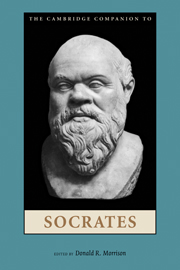
The Cambridge Companion to Socrates is a collection of essays providing a comprehensive guide to Socrates, the most famous Greek philosopher. Because Socrates himself wrote nothing, our evidence comes from the writings of his friends (above all Plato), his enemies, and later writers. Socrates is thus a literary figure as well as a historical person. Both aspects of Socrates' legacy are covered in this volume. Socrates' character is full of paradox, and so are his philosophical views. These paradoxes have led to deep differences in scholars' interpretations of Socrates and his thought. Mirroring this wide range of thought about Socrates, this volume's contributors are unusually diverse in their background and perspective. The essays in this volume were authored by classical philologists, philosophers and historians from Germany, Francophone Canada, Britain and the United States, and they represent a range of interpretive and philosophical traditions.
A DATUM: THE TWO DIFFERENT MODES OF SPEAKING OF PLATO'S SOCRATES
The Socrates of Plato's Apology, on trial for his life, announces an intention to his jurors:
While I breathe and am able, I will not stop philosophizing (philosophôn)…saying the sorts of things I usually do.
(29d)
His example of what he usually says is this:
Best of men – being an Athenian, from the city the greatest and most reputed for wisdom and strength – are you not ashamed that you are concerned about having as much money as possible, and reputation and honor, while you are not concerned for (epimelê(i)) nor do you think about thoughtfulness and truth and how your soul will be the best it can be?
(29d–e)
He also says:
My total concern is to be practicing nothing unjust or impious.
(32d)
We can then infer that concern for “how your soul will be…best” is for Socrates concern about how to live justly and piously. So Socrates' usual address involves issuing a challenge about the rightness of your way of living.
Socrates further reports that his challenge can lead to examination and that the examination can lead to reproach under certain conditions:
And if one of you disputes this and says he is concerned, I won't directly let him off or go away, but I will question him and examine (exetasô) and test (elegxô) and if he does not seem to me to possess virtue, but says he does, I will reproach him that things that are worth the most he makes least of, but the more trivial things he makes more of. […]
Consideration of Socrates' behavior in putatively doctrinal dialogues confirms so far my hypothesis that within the dialogues of Plato Socrates stays the same examining figure of the Apology. I do not say that my hypothesis is conclusively established. I think it at least as likely as the alternative hypothesis that Socrates speaks doctrine of a developing Plato.
The hypothesis that the Socrates of Plato's dialogues is deeply the same explains, for the dialogues I have considered, what Socrates is doing – he is engaging in the activity in which, as he says in the Apology, he spent his life. In the Apology he calls it his philosophizing; he says it comprises asking whether people care for the condition of their souls, and examining or testing them to find out if they do if they say that they do. He discerns their care or lack of it by observing their reaction to being shown not to know what they think they know. He reproaches if they seem untroubled. And all of that, he says, is persuading people to care about the way they live.
In the Theaetetus digression, the Republic, and the Phaedo we saw only a certain stage of the process of examination – the stage of the interlocutor's revealing himself by his reaction to Socrates' apparent teaching. Disclosing to his interlocutors what they are inclined to believe is the first step of the process of examination that he is always encouraging.
A famous passage in the Theaetetus presents a challenge for my thesis that the Socrates of any of Plato's dialogues is profoundly the same as the Socrates of the Apology. Socrates, the main speaker of the passage (172–177), labels it a “digression” (parerga: “by-work”) at 177b8. Not only does the Socrates of the digression seem different from the Socrates of the Apology, he also seems different from the Socrates of the rest of the Theaetetus. In the surrounding dialogue Socrates deploys argument, analysis, and critical reflection of the greatest interest as he considers the theme question: “What is knowledge?” The digression has no argument, analysis, or critical reflection. It has both dismayed and fascinated readers. Gilbert Ryle calls it “the philosophically quite pointless digression.” On the other hand, Myles Burnyeat credits the passage with “impassioned otherworldliness.” He says:
Plato puts the full power of his rhetoric into an extreme expression of his own vision of the human condition.
However, Burnyeat also recognizes the two faces of the passage. He says that today's readers
are…likely to find [it] alien and repellent, even as we are gripped (despite ourselves) by the sweep and force of the rhetoric.
I will admit immediately that I do not at all have the experience that Burnyeat describes of being gripped despite myself by the sweep and force of its rhetoric.
This chapter will pursue Ryle's insight that the passage is philosophically pointless.