To save content items to your account,
please confirm that you agree to abide by our usage policies.
If this is the first time you use this feature, you will be asked to authorise Cambridge Core to connect with your account.
Find out more about saving content to .
To save content items to your Kindle, first ensure no-reply@cambridge.org
is added to your Approved Personal Document E-mail List under your Personal Document Settings
on the Manage Your Content and Devices page of your Amazon account. Then enter the ‘name’ part
of your Kindle email address below.
Find out more about saving to your Kindle.
Note you can select to save to either the @free.kindle.com or @kindle.com variations.
‘@free.kindle.com’ emails are free but can only be saved to your device when it is connected to wi-fi.
‘@kindle.com’ emails can be delivered even when you are not connected to wi-fi, but note that service fees apply.
Chapter 9 assesses Seneca’s claim in the Letters on Ethics to provide moral benefits to his future readers. Although he may not have read Plato’s Phaedrus, Seneca is certainly aware of the arguments Socrates makes there concerning the efficacy of writing. In his own work, Seneca sometimes seems to echo Plato’s points that writing cannot improve the character of the reader because it lacks the immediacy, the adaptability, and the interactive possibilities of spoken discourse. At the same time, however, he comments both explicitly and implicitly on the means by which a written work can indeed take on some of those characteristics when it is presented in the novel format adopted for the Letters on Ethics. Invoking the commonplace that letters have the potential to make the absent present, he develops a variety of strategies for creating a lively sense of authorial presence, for training the reader in methods of application, and for engaging the reader in a quasi-dialogic interaction with the text. Further, he explores the emotional dimension of the reader’s experience in ways that are surprising for an author of his Stoic commitments.
Chapter 7 treats the consolatory letter to Marullus, which is provided as an enclosure in Epistulae morales 99. The latest of Seneca’s consolations, this work takes an unusually rigorous Stoic line. Although the deceased was a young child, Marullus is told not to grieve at all: Even the death of an adult friend would not truly be an evil, and the correct response to it is to rejoice in the goodness of the relationship that is now concluded. As elsewhere, however, Seneca concedes that an emotion-like reaction that does not depend on a belief that the loss is an evil is both natural and blameless. That pre-emotional reaction may include tears, as also may the eupathic joy of the Stoic sage. This last claim is paralleled in Philo of Alexandria, with interesting implications for the phenomenology of the Stoic eupatheiai. At the end of his letter, Seneca considers and rejects a consolatory tactic suggested by the Epicurean Metrodorus.
The first chapter considers Seneca’s views on the life of studious leisure (otium) in relation to the therapeutic purpose that he claims for all his philosophical writings. In his essay On Leisure, Seneca explores several standard defenses of the contemplative life (Aristotle’s βίος θεωρητικός), indicating clearly that such theoretical pursuits as astronomy and metaphysics are worthwhile pursuits in their own right. Yet there are tensions in his position, for he also suggests that the expenditure of time that philosophy requires is justified primarily by the moral benefits it conveys to oneself and, through the medium of writing, to future generations. In the Letters on Ethics, the latter claim is put forward as the very reason for the book’s existence, a generic imperative to which the entire content should refer. Consequently, those purely theoretical investigations that (nonetheless) appear in the Letters are present on sufferance and must be excused by a series of deliberately transparent rhetorical devices.
The chapter reviews the essentials of Seneca’s positions in moral psychology as compared to those of earlier Stoics whose works he might have studied. On the material nature of the mind (or soul); on the mechanisms of thought, belief, and action; and on the nature and management of the emotions, Seneca’s views are consonant with those of his Stoic predecessors; however, his knowledge of the system is not necessarily complete, and his emphases are sometimes different. Thus, he shows some awareness of earlier discussions of phantasia (impressions) but does not explore the topic deeply; on the other hand, he gives assent and impulse the same kind of significance in ethics as Chrysippus had. Contrary to some earlier studies, this chapter does not find Seneca to be innovative as concerns volition (voluntas) or the will. Likewise, his analysis of the emotions and of involuntary emotional response finds parallel in earlier texts. For the good emotions (eupatheiai) of the Stoic sage, he seems to know only that part of the analysis that concerns joy, to which he assigns an important role in his own ethics.
Seneca’s discussions of prose style frequently apply language of masculinity or effeminacy not only to authors but also to their works. For him, the laxness that he finds in Maecenas’s writing is a direct reflection of character flaws that he as a cisgender Roman male attributes to defective masculinity. The figure of Maecenas thus emblematizes the proverb that style mirrors conduct (talis oratio qualis vita). But there is also a philosophical underpinning to Seneca’s position. Stoic ethics attaches great importance to integrity and coherence in one’s thought, and thought, as internal speech, is closely allied to what he calls the ingenium; that is, the linguistic ability of an individual that is manifested in speech and writing. Prose style is thus understood as a reflex of character: The “manly” style is a highly structured, hypotactic style that traces connections between all elements of the thought.
In the early treatise On Anger, Seneca struggles to reconcile what he thinks is required of a therapeutic treatise with the view of emotions to which he is philosophically committed. In book 1 and the first part of book 2, he states the Stoic position with great clarity: that anger, like any emotion, consists essentially in a judgment by the rational mind; that the moment this voluntary judgment has been made, anger becomes unmanageable; that involuntary corporeal responses (pre-emotions) that occur prior to that assent are not themselves anger. Even the contested passage in De ira 2.4 can be read consistently with Stoic orthodoxy if one recognizes that the “third movement” described there is a further response that goes on beyond anger, namely the impulses of post-rational feritas as described in 2.5. Seneca’s recommendations for the management of anger in the remainder of the book mainly accord with this theoretical framework, in that they concentrate on the period before assent. At one point in book 3, however, he does offer a stratagem for managing anger in full swing, in tension with his own theoretical position.
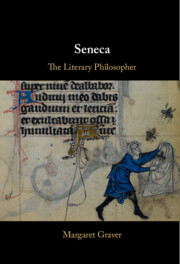
Seneca stands apart from other philosophers of Greece and Rome not only for his interest in practical ethics, but also for the beauty and liveliness of his writing. These twelve in-depth essays take up a series of interrelated topics in his works, from his relation to Stoicism, Epicureanism, and other schools of thought; to the psychology of emotion and action and the management of anger and grief; to letter-writing, gift-giving, friendship, and kindness; to Seneca's innovative use of genre, style, and humor. Recalling Socrates's critique of philosophical writing in Plato's Phaedrus, this volume gives particular attention to Seneca's ideas about the techniques of reading, writing, and study that make philosophy beneficial to the individual and to society. Clear explanations and careful translations make the volume accessible to a wide range of readers.