To save content items to your account,
please confirm that you agree to abide by our usage policies.
If this is the first time you use this feature, you will be asked to authorise Cambridge Core to connect with your account.
Find out more about saving content to .
To save content items to your Kindle, first ensure no-reply@cambridge.org
is added to your Approved Personal Document E-mail List under your Personal Document Settings
on the Manage Your Content and Devices page of your Amazon account. Then enter the ‘name’ part
of your Kindle email address below.
Find out more about saving to your Kindle.
Note you can select to save to either the @free.kindle.com or @kindle.com variations.
‘@free.kindle.com’ emails are free but can only be saved to your device when it is connected to wi-fi.
‘@kindle.com’ emails can be delivered even when you are not connected to wi-fi, but note that service fees apply.
This chapter argues that, just as the opening of the dialogue repeatedly alluded forward to the theories Socrates goes on to develop, Socrates’ death scene repeatedly refers back to these theories. It does so by showing Socrates living in accordance with the views he has defended over the course of the dialogue about the soul, courage, temperance, how to act toward the gods, and the correct way to interpret them. Scholarship on the death scene, especially in the last thirty years, has been dominated by Socrates’ famous last words: “Crito, we owe a cock to Asclepius. All of you must pay what is owed and not be careless” (118a7–8). Given its obscurity and the temptation to project our own desired message back onto these words, it is especially important to place them within their context in the death scene and the dialogue as a whole. My procedure is first to set up constraints within which an interpretation should operate, and then suggest a series of interrelated possibilities that fit within these constraints. Doing so provides the opportunity to review some of the dialogue’s major ideas.
This book examines the role and influence of Greek philosophy in the final days of the Roman republic. It focuses primarily (although not exclusively) on the works and views Cicero, premier politician and Roman philosopher of the day, and Lucretius, foremost among the representatives and supporters of Epicureanism at the time.
Though Cicero offers his most explicit, detailed critiques of Epicureanism in De Finibus and De Natura Deorum, his anti-Epicureanism consistently works itself into a wide swath of his theoretical writings over the last 13 years of his life. Therein Cicero consistently uses a rhetorical strategy whereby he avoids naming the Epicureans outright. Instead he employs a series of shorthand descriptions to attack the Epicureans for what he understands to be their basic tenets. In employing this tactic Cicero both slights the Epicureans by leaving them unnamed and reduces their philosophy to a set of behaviors that he thinks best encapsulate their beliefs. They fail by believing the soul to be mortal, by prioritizing an animal-like desire for pleasure over ratio and oratio, and by using quasi-commercial calculations to make ethical decisions. In each of these ways they fail most of all in Cicero’s eyes by representing a threat to the social fabric of the republic.
The Phaedo portrays Socrates in a long discussion with members of his inner circle, which leads the dialogue to portray a very different sort of conversation from those found in most of Plato’s other dialogues. The chapter begins by considering why Plato makes Phaedo the narrator of such a significant event: the death of Socrates. The chapter also discusses Socrates’ main interlocutors, Simmias and Cebes. I argue that both are skilled, both make mistakes, and both need to be cautious lest they fall into misology. They are sympathetic to a variety of Pythagorean and Orphic ideas, but are by no means committed followers of Philolaus, a Pythagorean. The end of the chapter turns to the portrayal of Socrates, arguing that Socrates seeks not to be treated as an authority and that the Phaedo presents Socrates’ questions and views as naturally emerging from those in the Socratic dialogues.
Catullus’ collection contains several clear echoes of the work of two contemporary Epicurean poets, Lucretius and Philodemus. Indeed, several of the neoteric poet’s central themes (the attractions of otium and disengagement from public life; patronage by members of the high elite and its pitfalls; dissatisfaction with the mos maiorum) bring him potentially into close alignment with Epicurean ideals. In this chapter, however, I argue that, on closer consideration, Catullus’ intertextual engagement with his two contemporaries points rather to a self-consciously antagonistic stance towards Epicurean ethics. Catullus’ attack on ‘Socration’ in Poem 47, combined with parodic echoes of Philodemus’ epigrams in Poems 13 and 43, bears comparison with Cicero’s deployment of anti-Epicurean clichés in the In Pisonem; similarly, Philodemean and Lucretian echoes underline a striking divergence both from Epicurean ideals of friendship and from the rejection of romantic love explicit in Lucretius and arguably implicit in Philodemus’ Xanthippe cycle.
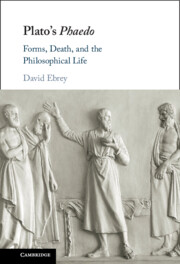
Plato's Phaedo is a literary gem that develops many of his most famous ideas. David Ebrey's careful reinterpretation argues that the many debates about the dialogue cannot be resolved so long as we consider its passages in relative isolation from one another, separated from their intellectual background. His book shows how Plato responds to his literary, religious, scientific, and philosophical context, and argues that we can only understand the dialogue's central ideas and arguments in light of its overall structure. This approach yields new interpretations of the dialogue's key ideas, including the nature and existence of 'Platonic' forms, the existence of the soul after death, the method of hypothesis, and the contemplative ethical ideal. Moreover, this comprehensive approach shows how the characters play an integral role in the Phaedo's development and how its literary structure complements Socrates' views while making its own distinctive contribution to the dialogue's drama and ideas.
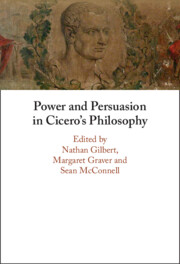
Extensively trained as a philosopher, Cicero was also a working politician with a keen awareness of the distance between pure intellectual endeavor and effective strategies of persuasion. This volume explores a series of interrelated problems in his works, from the use of emotion, self-correction, and even fiction in intellectual inquiry, to the motives of political agents and the morality of political arguments, to the means of justifying the use of force in international relations. It features close readings of works from all periods of Cicero's philosophical career, from the threshold of Rome's civil war to the year following the assassination of Julius Caesar. For a richer body of evidence, the volume also makes use of material from Cicero's personal letters and political speeches. Power and Persuasion in Cicero's Philosophy will be essential reading not only in Roman philosophy but also for the political and rhetorical culture of the Roman Republic.
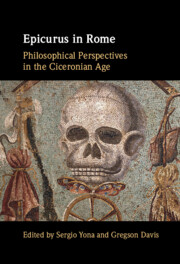
The role of Greek thought in the final days of the Roman republic is a topic that has garnered much attention in recent years. This volume of essays, commissioned specially from a distinguished international group of scholars, explores the role and influence of Greek philosophy, specifically Epicureanism, in the late republic. It focuses primarily (although not exclusively) on the works and views of Cicero, premier politician and Roman philosopher of the day, and Lucretius, foremost among the representatives and supporters of Epicureanism at the time. Throughout the volume, the impact of such disparate reception on the part of these leading authors is explored in a way that illuminates the popularity as well as the controversy attached to the followers of Epicurus in Italy, ranging from ethical and political concerns to the understanding of scientific and celestial phenomena. This title is also available as Open Access on Cambridge Core.
The purpose of this chapter is to offer a sketch of the relation between rhetoric and dialectic as Cicero sees it, and to identify a problem internal to his account. Cicero argues at length in the Tusculan Disputations in favor of the idea that the good and wise person does not experience any form of emotional disturbance. That being so, how can one who signs up to the idea that emotional disturbance is ideally to be eliminated then in good conscience recommend a practice – namely, rhetoric – one of whose principal objectives is to arouse the emotions? There looks to be a clash here between the objective of the philosopher and that of the orator. I explore Cicero’s resources for tackling this tension, and suggest how his conception of the relation between rhetoric and dialectic may thereby illuminate some distinctive aspects of his philosophical approach.
In a striking passage from the last book of his Tusculan Disputations, Cicero claims to live from day to day (nos in diem vivimus; 5.33). He always opts for what he deems probable, and this, he argues, also constitutes his freedom. This remarkable statement, which is obviously rooted in Cicero’s Academic philosophy, is far from unproblematic. This contribution aims at a better understanding of Cicero’s claim, through an analysis of his argumentative strategies in Tusculan Disputations. More precisely, attention is given to Cicero’s use of (1) the argument from common sense, (2) the argument from dignitas and decorum, (3) illustrative examples, and (4) to his approach in introducing the philosophical topics of the conversation. Finally, I deal with the complicated question as to whether Cicero’s sophisticated attitude of in diem vivere can be reconciled with the therapeutic goal of Tusculan Disputations.
The De re publica contains a sophisticated strain of reflection on the place of the honor motive in a good life, and in particular in the good life of public service. Cicero finds a way for a conscientious public servant to be interested in receiving honor while still directing his actions at the public good and that only. Further, he finds a use for merited honor and merited shame in the moral education of citizens and political leaders. The chapter argues that Cicero’s account of how honor motivates a person, both ordinarily and in the normative case, is fundamentally more similar to the views on honor put forward by the Hellenistic Stoics than it is to the tripartite model of psyche used by Plato in his Republic. As so often in De re publica, what we have is Platonism filtered through and modified by subsequent Stoic thought. But Cicero’s own experience in politics has also given stimulus to his reflections; and conversely, the philosophical position on honor that he develops in his writing becomes part of his self-representation as a public figure.
This chapter examines Cicero’s Pro Marcello of 46 bce, a speech of thanksgiving to Julius Caesar for pardoning his civil-war for M. Claudius Marcellus. I argue that Cicero cleverly uses philosophical arguments to, as it were, entrap Caesar into working towards the restoration of the Republic. Philosophical wisdom is a leitmotif of the speech, and Caesar in particular is called sapiens or associated with sapientia nine times. The basic argument that underlies Pro Marcello, without ever being made explicit, is the following syllogism: The wise man will act virtuously. Caesar is a wise man. Therefore, Caesar will act virtuously. In defining what acting virtuously would mean for his addressee, Cicero argues vigorously against Caesar’s own statement that he had already ‘lived enough for either nature or glory’ (satis diu uel naturae uixi uel gloriae, 25), painting the dictator as an Epicurean whose wrong ideas about both virtue and glory the orator seeks to combat.