To save content items to your account,
please confirm that you agree to abide by our usage policies.
If this is the first time you use this feature, you will be asked to authorise Cambridge Core to connect with your account.
Find out more about saving content to .
To save content items to your Kindle, first ensure no-reply@cambridge.org
is added to your Approved Personal Document E-mail List under your Personal Document Settings
on the Manage Your Content and Devices page of your Amazon account. Then enter the ‘name’ part
of your Kindle email address below.
Find out more about saving to your Kindle.
Note you can select to save to either the @free.kindle.com or @kindle.com variations.
‘@free.kindle.com’ emails are free but can only be saved to your device when it is connected to wi-fi.
‘@kindle.com’ emails can be delivered even when you are not connected to wi-fi, but note that service fees apply.
Chapter Summary. The second book of the Posterior Analytics is a sustained investigation of different modes of inquiry aimed at achieving scientific knowledge. So understood, it has far more unity than is typically claimed for it, and its last chapter is a fitting conclusion. But it does not present, let alone defend, substantive norms to guide distinct scientific inquiries. Those norms are domain-specific and as such are presented and defended in the introductions to Aristotle’s scientific treatises themselves. What, then, is accomplished by APo. ii? In this chapter, I introduce and defend the idea that APo. ii provides an erotetic framework for any inquiry, provided only that its goal is epistêmê, demonstrative knowledge. As such, it can be thought of as providing metalevel norms, for example, about how different inquiries ought to be staged, or about how inquiries aimed at formulating definitions are related to those aimed at achieving causal demonstrations.
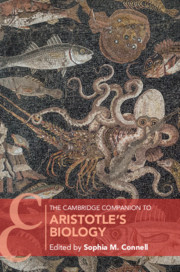
Aristotle's voluminous writings on animals have often been marginalised in the history of philosophy. Providing the first full-length comprehensive account of Aristotle's biology, its background, content and influence, this Companion situates his study of living nature within his broader philosophy and theology and differentiates it from other medical and philosophical theories. An overview of empiricism in Aristotle's Historia Animalium is followed by an account of the general methodology recommended in the Parts of Animals. An account of the importance of Aristotle's teleological perspective and the fundamental metaphysics of biological entities provides a basis for understanding living capacities, such as nutrition, reproduction, perception and self-motion, in his philosophy. The importance of Aristotle's zoology to both his ethics and political philosophy is highlighted. The volume explores in detail the changing interpretations and influences of Aristotle's biological works from antiquity to modern philosophy of science. It is essential for both students and scholars.
A pioneering work in the history of philosophy, the ancient text of the Lives presents engaging portraits of nearly a hundred Greek philosophers. It blends biography with bibliography and surveys of leading theories, peppered with punchy anecdotes, pithy maxims, and even snatches of poetry, much of it by the philosophers themselves. The work presents a systematic genealogy of Greek philosophy from its origins in the sixth century BCE to its flowering in Plato's Academy and the Hellenistic schools. In this fully up-to-date and accessible translation, based on the most accurate texts and the latest advances in scholarship, Stephen White provides a valuable resource for students and scholars of ancient philosophy. Highlights include extended treatment of the 'Seven Sages' (Book 1), Socrates and his Socratic followers (Book 2), Plato (Book 3), Aristotle and his school (Book 5), Diogenes the Cynic (Book 6), Stoicism (Book 7), Pythagoreans (Book 8), Pyrrhonian skepticism (Book 9), and Epicureanism (Book 10).
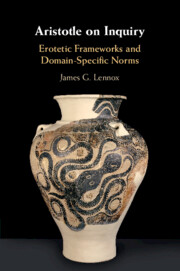
Aristotle is a rarity in the history of philosophy and science - he is a towering figure in the history of both disciplines. Moreover, he devoted a great deal of philosophical attention to the nature of scientific knowledge. How then do his philosophical reflections on scientific knowledge impact his actual scientific inquiries? In this book James Lennox sets out to answer this question. He argues that Aristotle has a richly normative view of scientific inquiry, and that those norms are of two kinds: a general, question-guided framework applicable to all scientific inquiries, and domain-specific norms reflecting differences in the target of inquiry and in the means of observation available to researchers. To see these norms of inquiry in action, the second half of this book examines Aristotle's investigations of animals, the soul, material compounds, the motions of heavenly bodies, and respiration.
In ancient Greece, philosophers developed new and dazzling ideas about divinity. These thinkers drew on a deep well of poetry, myth, and religious practices even as they set out to construct new theological ideas. Ancient Greek religion had a wondrous heterogeneity – rituals and cult practices varied dramatically in different geographical regions. Greek religion was far more open to diverse theological ideas than monotheistic religions. In contrast to the sacred scriptures of the monotheists, Greek religion relied on a vast array of myths handed down from one generation to another through poetry and song. These myths surrounded and sustained religious rituals and festivals. In Greek culture, there was no separation of religion and state – to live in a political community meant that one participated in religious rituals and festivals.1 Indeed, Greek city-states organized almost all public religious events.
In the Phaedrus, Plato composes another dialogue on love and beauty. Once again, he foregrounds metaphysical desire and shows how it lifts the soul to the Form of Beauty. He also represents the philosopher seeing an epiphany of divine Beauty. However, Plato offers a different conception of the soul in this text than he did in the Symposium: the soul is immortal, tripartite, and self-moving (245c–e). As the only “self-moving” entity in the cosmos, the soul initiates the motion in bodies. In addition, all souls have eros for the Forms, including the gods (who are divine souls). Because the gods themselves possess eros, I will refer to philosophic eros as “divine desire.” Finally, in the Phaedrus, the divine souls of the gods govern the physical cosmos and play an important role in human life.
In his description of the sanctuary for Demeter at Mount Pron (2.35–49), Pausanias details a strange sacrificial ritual of the people of Hermionê. In the procession to the temple, men brought sacrificial cows to the open doors of the temple and then released them so that they could rush inside. When the cows had entered the temple, the people outside rapidly shut the doors of the temple. Then four old women inside the temple killed each cow in order. As Pausanias states: “A few statues of the women who have served Demeter as priestesses stand at the temple; when you go inside, you see seats where the old women wait for the cows to be driven in one by one, and also images, not all that old, of Athena and Demeter. But that which they worship more than everything else, I myself did not see (ἐγὼ μὲν οὐκ εἶδον), nor has any other man, be it a stranger or a person from Hermionê. Only the old women know what sort of thing this is (μόναι δὲ ὁποῖόν τί ἐστιν αἱ γρᾶες ἴστωσαν).” As an outsider, Pausanias could not see or know what the women experienced. As readers of Plato, we are in a similar position as Pausanias: we stand outside the door (as it were) of his theological thinking. Like Pausanias, we can see the philosopher’s upward “procession” to the realm of the Forms, and we can understand Plato’s accounts of the activities and disciplines that the philosopher engages in. We can also view, following Plato’s imagistic accounts, the philosophic soul contemplating the Forms. But we ultimately bump into closed doors. We cannot understand the philosopher’s sacred way of seeing and knowing unless we contemplate the Forms ourselves.
But how can you look at something and set your own ego aside? Whose eyes are doing the looking? As a rule, you think of the ego as one who is peering out of your own eyes as if leaning on a window sill, looking at the world stretching out before him in all its immensity. So, then: a window looks out on the world. The world is out there; and in here, what do we have? The world still – what else could there be? With a little effort of concentration, Mr. Palomar manages to shift the world from in front of him and set it on the sill, looking out. Now, beyond the windows, what do we have? The world is also there, and for the occasion has been split into a looking world and a world looked at. And what about him, also known as “I,” namely Mr. Palomar? Is he not a piece of the world that is looking at another piece of the world? Or else, given that there is world that side of the window and world this side, perhaps the “I,” the ego, is simply the window through which the world looks at the world. To look at itself the world needs the eyes (and the eyeglasses) of Mr. Palomar.
As his biological time ticks away, Socrates describes the everlasting life of his soul. His friends keep their eyes on the clock: Cebes reminds everyone to speak up now while Socrates is still alive (107a), and Crito urges Socrates to delay drinking the poison, since “the sun is on the mountains and has not yet set” (116e). But Socrates looks beyond the present to the future life of his soul. He presents four arguments for the immortality of the soul. In one argument, he says that the soul acquired knowledge of the Forms before it entered a body. As he claims: “souls existed previously … apart from bodies, before they took on human form, and they had intelligence” (76c).1 By pointing to a period of existence before incarnation, Socrates locates the soul outside of biological and historical time.
In Plato’s Symposium, a group of intellectuals and artists give speeches in praise of the god Eros. The speakers engage in a playful competition with one another, showing off their wit, cultivation, and eloquence. Each articulates a different conception of Eros and his role in the human, divine, and cosmic realms. In Socrates’ speech, philosophic desire takes center stage. Socrates focuses on two key desires: the desire for immortality and the metaphysical desire for the Forms. Both aim at something beyond the human, but they differ in key ways. I will examine both of these desires and show how they work together in the life of the philosopher.
In its most basic sense, the desire for immortality is a desire for an everlasting self. The Greeks understood immortality in terms of living like the gods.
The ancient Greeks conceived of the gods as having knowledge of the past and the future. Humans, mere “creatures of a day,” had finite and limited minds. Some early Greek philosophers, however, claimed to have gained the wisdom of the gods, having received this in a divine revelation or by aligning their thoughts with the divine mind. Indeed, thinkers such as Xenophanes, Parmenides, Heraclitus, Empedocles, and Diogenes of Apollonia presented rich and varied ideas about god and the human grasp of the divine.1 Plato follows in this tradition by granting the human soul the divine capacity to apprehend the divine realm of the Forms.
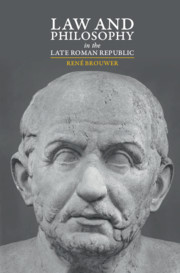
The middle of the second until the middle of the first century BCE is one of the most creative periods in the history of human thought, and an important part of this was the interaction between Roman jurists and Hellenistic philosophers. In this highly original book, René Brouwer shows how jurists transformed the study of law into a science with the help of philosophical methods and concepts, such as division, rules and persons, and also how philosophers came to share the jurists' preoccupations with cases and private property. The relevance of this cross-fertilization for present-day law and philosophy cannot be overestimated: in law, its legacy includes the academic study of law and the Western models of dispute resolution, while in philosophy, the method of casuistry and the concept of just property.
In ancient Greece, philosophers developed new and dazzling ideas about divinity, drawing on the deep well of poetry, myth, and religious practices even as they set out to construct new theological ideas. Andrea Nightingale argues that Plato shared in this culture and appropriates specific Greek religious discourses and practices to present his metaphysical philosophy. In particular, he uses the Greek conception of divine epiphany - a god appearing to humans - to claim that the Forms manifest their divinity epiphanically to the philosopher, with the result that the human soul becomes divine by contemplating these Forms and the cosmos. Nightingale also offers a detailed discussion of the Eleusinian Mysteries and the Orphic Mysteries and shows how these mystery religions influenced Plato's thinking. This book offers a robust challenge to the idea that Plato is a secular thinker.