To save content items to your account,
please confirm that you agree to abide by our usage policies.
If this is the first time you use this feature, you will be asked to authorise Cambridge Core to connect with your account.
Find out more about saving content to .
To save content items to your Kindle, first ensure no-reply@cambridge.org
is added to your Approved Personal Document E-mail List under your Personal Document Settings
on the Manage Your Content and Devices page of your Amazon account. Then enter the ‘name’ part
of your Kindle email address below.
Find out more about saving to your Kindle.
Note you can select to save to either the @free.kindle.com or @kindle.com variations.
‘@free.kindle.com’ emails are free but can only be saved to your device when it is connected to wi-fi.
‘@kindle.com’ emails can be delivered even when you are not connected to wi-fi, but note that service fees apply.
Although the unattested language of Proto-Indo-European has been studied for over 200 years, the greater part of this literature has focused on its phonology and morphology, with comparatively little known of its syntax. This book aims to redress the balance by reconstructing the syntax of relative clauses. It examines evidence from a wide range of archaic Indo-European languages, analysing them through the lens of generative linguistic theory. It also explains the methodological challenges of syntactic reconstruction and how they may be tackled. Ram-Prasad also alights on a wide range of points of comparative interest, including pronominal morphology, discourse movement and Wackernagel's Law. This book will appeal to classicists interested in understanding the Latin and Greek languages in their Indo-European context, as well as to trained comparative philologists and historical linguists with particular interests in syntax and reconstruction.
This book, which draws on Lisa Bendall's lectures over three decades, provides an engaging and accessible survey of everything students need to know to read and understand texts in Linear B. As John Chadwick noted, the Linear B scholar must be 'not just an epigraphist, not just a linguist, not just an economic historian and archaeologist; ideally he or she…must be all these things simultaneously'. Volume 1 introduces the student to the writing system and the language, especially the phonology and morphology. It also explains the formal aspects of the documents and gives guidance on the tools available to the student and scholar. Volume 2 will provide a guide to using the documents to understand the Mycenaean world.
Reading Biblical Greek is aimed at students who are studying New Testament Greek for the first time, or refreshing what they once learned. Designed to supplement and reinforce The Elements of New Testament Greek, by Jeremy Duff, each chapter of this textbook provides lengthy, plot-driven texts that will be accessible as students study each chapter of The Elements. Each text is accompanied by detailed questions, which test comprehension of content from recent lessons and review challenging topics from previous chapters. The graded nature of the texts, together with the copious notes and comprehension questions, makes this an ideal resource for learning, reviewing or re-entering Greek. The focus of this resource is on reading with understanding, and the exercises highlight how Greek texts convey meaning. Finally, this book moves on from first-year Greek, with sections that cover the most important advanced topics thoroughly.
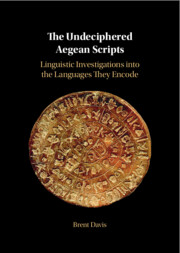
The decipherment of Linear B, an early form of Greek used by the Myceneans, by Michael Ventris and John Chadwick has long been celebrated. But five other scripts from the Bronze-Age Aegean remain undeciphered. In this book, Brent Davis provides a thorough introduction to these scripts and uses statistical techniques drawn from linguistics to provide insights into the languages lying behind them. He deals most extensively with the script of the Minoan civilization on Crete (“Linear A”), whose decipherment remains one of the Holy Grails of archaeology. He discusses linguistic topics in clear language and explains linguistic terms in a comprehensive glossary. The book also includes all data on which the various analyses of the scripts are based. It will therefore be of great interest and use not just to experts in the undeciphered Aegean scripts, but to novices and aficionados of decipherment as well.
Naming new discoveries is central to science, and for centuries, Latin dominated this process. The resulting terminology still shapes modern science, yet the influences behind its creation have remained largely unexplored. This is the first comprehensive exploration of how modern scientific terminology took shape during the early modern period. Far from being the product of individual scientists or institutions, the development of this terminology emerged over several centuries, involving a remarkably diverse range of contributors. In particular, the process was often influenced by factors unrelated to science itself – such as the appeal of certain linguistic forms or even sheer coincidence – revealing the unexpected and sometimes arbitrary forces behind the creation of technical terms.
The Corpus of Latin Texts on Papyrus (CLTP) is a comprehensive, up-to-date, and unique reference tool in six volumes, gathering nearly 1,500 Latin texts on papyrus. Editions are provided with both a palaeographic and a critical apparatus, English translations, and detailed introductions. The texts in CLTP cover a wide chronological range and many different types and genres. They include both literary and documentary texts, dating from the first century BC to the Middle Ages. They provide new knowledge about the circulation of Latin, offering unique insights into textual transmission and indeed into Latin literature itself, but also into topics such as ancient education and multilingualism, economics, society, culture, and multiculturalism in the ancient Mediterranean world. The result is a lasting and crucial reference work for all those interested in the history of Latin and of the Roman world.