To save content items to your account,
please confirm that you agree to abide by our usage policies.
If this is the first time you use this feature, you will be asked to authorise Cambridge Core to connect with your account.
Find out more about saving content to .
To save content items to your Kindle, first ensure no-reply@cambridge.org
is added to your Approved Personal Document E-mail List under your Personal Document Settings
on the Manage Your Content and Devices page of your Amazon account. Then enter the ‘name’ part
of your Kindle email address below.
Find out more about saving to your Kindle.
Note you can select to save to either the @free.kindle.com or @kindle.com variations.
‘@free.kindle.com’ emails are free but can only be saved to your device when it is connected to wi-fi.
‘@kindle.com’ emails can be delivered even when you are not connected to wi-fi, but note that service fees apply.
This book, which draws on Lisa Bendall's lectures over three decades, provides an engaging and accessible survey of everything students need to know to read and understand texts in Linear B. As John Chadwick noted, the Linear B scholar must be 'not just an epigraphist, not just a linguist, not just an economic historian and archaeologist; ideally he or she…must be all these things simultaneously'. Volume 1 introduces the student to the writing system and the language, especially the phonology and morphology. It also explains the formal aspects of the documents and gives guidance on the tools available to the student and scholar. Volume 2 will provide a guide to using the documents to understand the Mycenaean world.
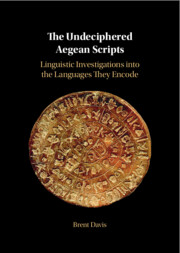
The decipherment of Linear B, an early form of Greek used by the Myceneans, by Michael Ventris and John Chadwick has long been celebrated. But five other scripts from the Bronze-Age Aegean remain undeciphered. In this book, Brent Davis provides a thorough introduction to these scripts and uses statistical techniques drawn from linguistics to provide insights into the languages lying behind them. He deals most extensively with the script of the Minoan civilization on Crete (“Linear A”), whose decipherment remains one of the Holy Grails of archaeology. He discusses linguistic topics in clear language and explains linguistic terms in a comprehensive glossary. The book also includes all data on which the various analyses of the scripts are based. It will therefore be of great interest and use not just to experts in the undeciphered Aegean scripts, but to novices and aficionados of decipherment as well.
Although the unattested language of Proto-Indo-European has been studied for over 200 years, the greater part of this literature has focused on its phonology and morphology, with comparatively little known of its syntax. This book aims to redress the balance by reconstructing the syntax of relative clauses. It examines evidence from a wide range of archaic Indo-European languages, analysing them through the lens of generative linguistic theory. It also explains the methodological challenges of syntactic reconstruction and how they may be tackled. Ram-Prasad also alights on a wide range of points of comparative interest, including pronominal morphology, discourse movement and Wackernagel's Law. This book will appeal to classicists interested in understanding the Latin and Greek languages in their Indo-European context, as well as to trained comparative philologists and historical linguists with particular interests in syntax and reconstruction.
Reading Biblical Greek is aimed at students who are studying New Testament Greek for the first time, or refreshing what they once learned. Designed to supplement and reinforce The Elements of New Testament Greek, by Jeremy Duff, each chapter of this textbook provides lengthy, plot-driven texts that will be accessible as students study each chapter of The Elements. Each text is accompanied by detailed questions, which test comprehension of content from recent lessons and review challenging topics from previous chapters. The graded nature of the texts, together with the copious notes and comprehension questions, makes this an ideal resource for learning, reviewing or re-entering Greek. The focus of this resource is on reading with understanding, and the exercises highlight how Greek texts convey meaning. Finally, this book moves on from first-year Greek, with sections that cover the most important advanced topics thoroughly.
Chapter 3 discusses the designations for the classes of objects (i.e. animals, plants – including flora and fauna – and minerals), as well as for the respective disciplines. In the early modern period, historia naturalis/natural history was the name applied to the study of natural objects, later to be known as biology and geology/mineralogy. The names for these and other subdisciplines emerged in the early modern period but at different stages and sometimes with divergent intentions and meanings.
Giving names to new things and concepts is an important part of the scientific process, as it establishes something as an object of study. Names can also reveal the conceptions and the intentions behind them. These conceptions can be very different compared to our modern views on the objects in question.
Chapter 5 turns its attention to the so-called New World, focusing on the flora and fauna of the Americas. The chapter begins with an overview of the relevant texts and examines the practical and conceptual challenges faced by European naturalists – particularly the difficulty of reconciling unfamiliar species with biblical accounts of creation and the flood. It then analyses the naming of American plants and animals in Latin texts, highlighting characteristic processes of lexical acculturation. Four case studies delve into specific challenges in depth: the sloth, which was assigned multiple names across European languages; the penguin, mistakenly identified as a European species; a mythical creature called Su, for which Conrad Gessner sought a more classical name; and ficus indicus, a term applied to at least three entirely different plants.
Chapter 1 begins with an overview of Neo-Latin as a scientific language. By the mid-fifteenth century, Latin had been the Western European lingua franca of science and learning for more than a millennium. However, the stylistic preferences of humanist authors, who tried to imitate classical texts, especially their vocabulary, presented a challenge in many areas, but above all in the sciences, where a new-found wealth of knowledge required an equal number of new names. Important debates on how far nonclassical words were to be tolerated and the hierarchy of res and verba are also analysed in this chapter.
Chapter 4 focuses on naturalia from Europe. The naming of natural objects from the so-called Old World presented early modern natural scientists with major challenges. While European scholars at the beginning of the sixteenth century were primarily concerned with the identification of minerals, plants, and animals mentioned in ancient texts, knowledge soon increased dramatically through systematic observation of nature, requiring new forms of description, cataloguing, systematisation, and naming. The chapter charts this development with a focus on naming and highlights specific processes through three case studies: the controversy between Fuchs and Mattioli over the identification of ancient plant names, the incorporation of German mining terminology into Latin scholarly discourse, and the role of misunderstanding and chance in the formation of technical terms.
Chapter 2 presents the relevant linguistic terminology, provides an overview of different forms of names, and addresses the question of which languages the names were based on. Two principal kinds of neologism can be distinguished: form and sense. The former denotes the coinage of new words and the latter the process of giving existing words a new meaning. In practice, they were not as distinct as they appeared, since most new words were coined from well-known roots and according to long-established rules. Although the texts that form the corpus of the monograph were predominantly written in Latin, many names were also taken from Greek, some from Arabic and Hebrew, and others from vernacular languages. The last part of Chapter 2 discusses processes of naming using four examples: Technica, Musa, the names of the moons of Jupiter, and Atlas. The case studies have been arranged according to their ever-increasing contingency, beginning with a term that had been chosen on purpose and ending with a term that was never meant to assume its present connotation.
Chapter 6 explores what is arguably the most peculiar ‘world’ – that revealed by the microscope. The technical challenges and the fleeting nature of microscopic observations hindered the systematic study and naming of this hidden realm, leading to the use of rather vague or metaphorical terms, often diminutives. The first two case studies consolidate and extend findings gained in other contexts. The naming of the microscope itself illustrates that terms for technical innovations could be subject to processes similar to those of natural objects. Meanwhile, spermatozoa were long conceptualised and named as a type of animal. It was not until the nineteenth century that their true nature as a type of cell became widely accepted, yet the terminology persists, continuing to imply an animal-like nature. The third case examines how an assumed analogy between plant seeds and animal embryos led Malpighi to an erroneous description of plant seeds.