To save content items to your account,
please confirm that you agree to abide by our usage policies.
If this is the first time you use this feature, you will be asked to authorise Cambridge Core to connect with your account.
Find out more about saving content to .
To save content items to your Kindle, first ensure no-reply@cambridge.org
is added to your Approved Personal Document E-mail List under your Personal Document Settings
on the Manage Your Content and Devices page of your Amazon account. Then enter the ‘name’ part
of your Kindle email address below.
Find out more about saving to your Kindle.
Note you can select to save to either the @free.kindle.com or @kindle.com variations.
‘@free.kindle.com’ emails are free but can only be saved to your device when it is connected to wi-fi.
‘@kindle.com’ emails can be delivered even when you are not connected to wi-fi, but note that service fees apply.
Plutarch the philosopher is present in all his texts. His allegiance is not in doubt: he is a follower of Plato, who is open-minded to other schools, as far as their views are reconcilable with Plato’s. He is above all committed to the dialogical spirit pervading Plato’s works. In several more technical treatises, he develops the core of his philosophical views. These have to do with the composition of the world-soul and its image, the human soul. From there, Plutarch develops his views on moral psychology: it is the task of reason, the divine presence in us, to control the irrational passions. This idea forms the basis of various texts in which the therapy of the soul and the development of character are the central goals. Plutarch’s concept of philosophy and his doctrinal stance are quite different from what we find in later Platonism. Later doxographical reports on Plutarch are not always reliable.
Our modern age has modified somewhat the definition of “family” as a way of thinking about relationships between men and women, parents and children, and brothers and sisters. Plutarch did not imagine these relationships in terms of sexuality and gender. Rather, affection, love, marriage, and the family were the key concepts in his study of “private life.” He also lived, however, during an era of change. This change had consequences for the idea of marriage, justifying a more in-depth analysis of Plutarch’s view of the subject. In order to distinguish between contemporary attitudes and original ideas in his works, we will clarify the notion of “private life,” the philosophical tradition, and contemporary idea(s) of the family before reintegrating familial relations into Plutarch’s view of human nature and code of ethics.
Plutarch is well known as a generally even-tempered expositor of the great tapestry of Greek history, literature, and philosophy, and a benign counselor on questions of ethical conduct and social mores, but there is another side to him, that of the accomplished polemicist, primarily in the area of philosophy, but also concerning his predecessors in the craft of history, and on occasion the poets as well. In all of Plutarch’s polemics, we can discern common threads. While historians (especially Herodotus) and poets are criticized primarily for their flawed socioethical views, the Stoics, Epicureans, and even Plutarch’s predecessors in the Platonic tradition have the inconsistencies in their positions relentlessly skewered, and the most absurd consequences of their misguided arguments teased out. This essay surveys a selection of Plutarch’s critiques of previous historians, then casts a brief glance at his censure of the poets, before turning to an examination of his polemics against rival philosophical schools, and lastly rival views within the Platonist tradition.
This chapter assesses the cultural and broader symbolic significance of the symposium in Plutarch’s biographical and philosophical works. It begins by situating Plutarch’s references to the symposium in their cultural context, by examining the symposium/convivium as a key social institution in the Roman imperial period. Next, the chapter discusses the symbolic dimension of conviviality in Plutarch’s oeuvre, through characteristic examples from the Lives and Moralia. It underlines that, for Plutarch, the symposium serves as a tool for evaluating moral character, as well as for conducting cross-cultural comparison. In addition, Plutarch’s interest in philosophical dietetics turns consumption patterns and behaviour at symposia into an important point of focus and concern. The last two sections look closely at Plutarch’s two surviving sympotic works, the Banquet of the Seven Sages and Table Talk. It discusses their genre and literary techniques, their relationship to the philosophical tradition of sympotic writing initiated by Plato and Xenophon, and the central role they both assign to philosophical enquiry.
A central concern of Plutarch’s works is what constitutes a good and honorable life, and they commonly claim to “improve” the character and behaviour of their elite readers, especially in politics and leadership. This chapter assesses this educational approach across the whole corpus, paying particular attention to works of literary criticism, works of practical morality, political texts, and the Parallel Lives. It highlights, among other themes, the importance both of comparison (syncrisis) and of examples (paradeigmata) drawn from history, literature, or everyday life to stimulate reflection. Though profoundly influenced by Plato, Plutarch is particularly concerned with the practical application of philosophical principles to real-life situations, whether faced by the statesmen of the past or by his own readers. Indeed, rather than preaching simplistic lessons, many of Plutarch’s texts bring out how complex moral judgments can be in practice and invite readers to think deeply about morality, literature, and politics.
This chapter explores Plutarch’s presentation of greatness as it equates with leadership ability and outcomes. He expressly values civic participation and leadership that aims to secure and promote the welfare of the community. Subsequent to the presentation of some basic information concerning his theories of education, especially ethical education, attention is then focused on the innate components of greatness and the appropriate means to develop this inborn talent in training individuals to wield power in an effective and responsible fashion. A comparative analysis is then undertaken to set forth the similarities and differences between the psychological/behavioral makeup of Plutarch’s ideal leader and recent influential work in leadership theory by Daniel Goleman, James MacGregor Burns, and Bernard M. Bass. The significant degree of correspondence elucidated leads to a discussion of the literary techniques Plutarch employs to place in sharper relief the salient aspects of great leadership (and its opposite), including his developed use of synkrisis and the Socratic paradigm, as well as the representation of performative acts of leadership.
Plutarch’s various comments about wealth are usually recognizable as springing from the same personality, but the emphasis is different in different contexts. This chapter explores this variety within the Lives, and in particular the characteristic connection with moral decadence and decay. Two pairs are explored as test-cases, Agis–Cleomenes–Gracchi and Agesilaus–Pompey. Rome, with signs of luxury and decadence everywhere, might be expected to be particularly in focus, but talk of decadence is most frequent in the Spartan Lives. Is this an indirect way of passing comment on Rome without causing offense That may also explain his frequent reluctance to talk as openly about Roman corruption and bribery as one might expect, especially in connection with a Life’s central figure. He may also be sidestepping too great an emphasis on Roman luxury as this had traditionally been associated with the Greek East.
The classical past, for Plutarch, offered a huge reservoir of history, art, and traditions, from which he drew examples of virtue for inspiration and encouragement. He expected that his readers should do the same. But he also insisted that the examples that we draw from that reservoir must be carefully strained and tested, using investigative acumen and skeptical discussion and evaluation, to remove the inevitable debris, the inescapable outcome of human ambition, competition, greed, and desire. Internecine war and personal rivalries polluted those great times even as they did his own day, and still do the present world. The best qualities of the classical past could be reacquired only by the constant exercise of prudent reason and controlled passion. Plutarch dared his readers to accept this challenge.
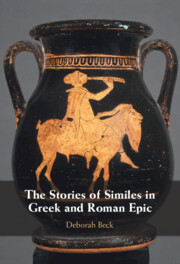
Just as the story of an epic poem is woven from characters and plot, so too the individual similes within an epic create a unique simile world. Like any other story, it is peopled by individual characters, happenings, and experiences, such as the shepherd and his flocks, a storm at sea, or predators hunting prey. The simile world that complements the epic mythological story is re-imagined afresh in relation to the themes of each epic poem. As Deborah Beck argues in this stimulating book, over time a simile world takes shape across many poems composed over many centuries. This evolving landscape resembles the epic story world of battles, voyages, and heroes that comes into being through relationships among different epic poems. Epic narrative is woven from a warp of the mythological story world and a weft of the simile world. They are partners in creating the fabric of epic poetry.
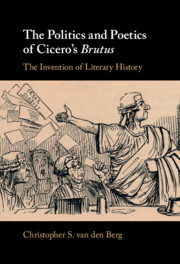
Cicero's Brutus (46 BCE), a tour-de-force of intellectual and political history, was written amidst political crisis: Caesar's defeat of the republican resistance at the battle of Thapsus. This magisterial example of the dialogue genre capaciously documents the intellectual vibrancy of the Roman Republic and its Greco-Roman traditions. This book studies the work from several distinct yet interrelated perspectives: Cicero's account of oratorical history, the confrontation with Caesar, and the exploration of what it means to write a history of an artistic practice. Close readings of this dialogue-including its apparent contradictions and tendentious fabrications-reveal a crucial and crucially productive moment in Greco-Roman thought. Cicero, this book argues, created the first nuanced, sophisticated, and ultimately 'modern' literary history, crafting both a compelling justification of Rome's oratorical traditions and also laying a foundation for literary historiography that abides to this day. This title is also available as Open Access on Cambridge Core.
This chapter deploys the modes of relating to the classical past established in the previous chapter to survey the contemporary resonances of the full range of declamation scenarios, paying particular attention to the realm of the imaginary. The interpersonal conflicts (murder, rape, disownment, etc.) of the genre are very close to the gossip about and probably some of the reality of many star declaimers' lives. Similarly, declamations on war tapped into a major Greek imperial discourse as well as the civil wars and foreign incursions about which most of our sources keep a diplomatic silence. Declamations on tyranny tapped into another common discourse and offered space for reflection on illegitimate power. The survey continues with civil strife and misconduct in public life and and moves on to consider honours, embassies, religion, migration, both collective and personal, and construction projects. In these areas, too, declamation speaks both to contemporary realities and to contemporary discourses.