To save content items to your account,
please confirm that you agree to abide by our usage policies.
If this is the first time you use this feature, you will be asked to authorise Cambridge Core to connect with your account.
Find out more about saving content to .
To save content items to your Kindle, first ensure no-reply@cambridge.org
is added to your Approved Personal Document E-mail List under your Personal Document Settings
on the Manage Your Content and Devices page of your Amazon account. Then enter the ‘name’ part
of your Kindle email address below.
Find out more about saving to your Kindle.
Note you can select to save to either the @free.kindle.com or @kindle.com variations.
‘@free.kindle.com’ emails are free but can only be saved to your device when it is connected to wi-fi.
‘@kindle.com’ emails can be delivered even when you are not connected to wi-fi, but note that service fees apply.
Starting from a sequence regarded as a walk through some set of values, we consider the associated loop-erased walk as a sequence of directed edges, with an edge from i to j if the loop-erased walk makes a step from i to j. We introduce a colouring of these edges by painting edges with a fixed colour as long as the walk does not loop back on itself, then switching to a new colour whenever a loop is erased, with each new colour distinct from all previous colours. The pattern of colours along the edges of the loop-erased walk then displays stretches of consecutive steps of the walk left untouched by the loop-erasure process. Assuming that the underlying sequence generating the loop-erased walk is a sequence of independent random variables, each uniform on [N] := {1, 2, . . ., N}, we condition the walk to start at N and stop the walk when it first reaches the subset [k], for some 1 ≤ k ≤ N − 1. We relate the distribution of the random length of this loop-erased walk to the distribution of the length of the first loop of the walk, via Cayley's enumerations of trees, and via Wilson's algorithm. For fixed N and k, and i = 1, 2, . . ., let Bi denote the events that the loop-erased walk from N to [k] has i + 1 or more edges, and the ith and (i + 1)th of these edges are coloured differently. We show that, given that the loop-erased random walk has j edges for some 1 ≤ j ≤ N − k, the events Bi for 1 ≤ i ≤ j − 1 are independent, with the probability of Bi equal to 1/(k + i + 1). This determines the distribution of the sequence of random lengths of differently coloured segments of the loop-erased walk, and yields asymptotic descriptions of these random lengths as N → ∞.
A set of integers is called a B2[g] set if every integer m has at most g representations of the form m = a + a′, with a ≤ a′ and a, a′ ∈ . We obtain a new lower bound for F(g, n), the largest cardinality of a B2[g] set in {1,. . .,n}. More precisely, we prove that infn→∞ where ϵg → 0 when g → ∞. We show a connection between this problem and another one discussed by Schinzel and Schmidt, which can be considered its continuous version.
We study the asymptotic distribution of the displacements in hashing with coalesced chains, for both late-insertion and early-insertion. Asymptotic formulas for means and variances follow. The method uses Poissonization and some stochastic calculus.
Gerards and Seymour (see [10], p. 115) conjectured that if a graph has no odd complete minor of order l, then it is (l − 1)-colourable. This is an analogue of the well-known conjecture of Hadwiger, and in fact, this would immediately imply Hadwiger's conjecture. The current best-known bound for the chromatic number of graphs with no odd complete minor of order l is by the recent result by Geelen, Gerards, Reed, Seymour and Vetta [8], and by Kawarabayashi [12] later, independently. But it seems very hard to improve this bound since this would also improve the current best-known bound for the chromatic number of graphs with no complete minor of order l.
Motivated by this problem, in this note we show that there exists an absolute constant f(k) such that any graph G with no odd complete minor of order k admits a vertex partition V1, . . ., V496k such that each component in the subgraph induced on Vi (i ≥ 1) has at most f(k) vertices. When f(k) = 1, this is a colouring of G. Hence this is a relaxation of colouring in a sense, and this is the first result in this direction for the odd Hadwiger's conjecture.
Our proof is based on a recent decomposition theorem due to Geelen, Gerards, Reed, Seymour and Vetta [8], together with a connectivity result that forces a huge complete bipartite minor in large graphs by Böhme, Kawarabayashi, Maharry and Mohar [3].
Sokal in 2001 proved that the complex zeros of the chromatic polynomial PG(q) of any graph G lie in the disc |q| < 7.963907Δ, where Δ is the maximum degree of G. This result answered a question posed by Brenti, Royle and Wagner in 1994 and hence proved a conjecture proposed by Biggs, Damerell and Sands in 1972. Borgs gave a short proof of Sokal's result. Fernández and Procacci recently improved Sokal's result to |q| < 6.91Δ. In this paper, we shall show that all real zeros of PG(q) are in the interval [0,5.664Δ). For the special case that Δ = 3, all real zeros of PG(q) are in the interval [0,4.765Δ).
A graph construction game is a Maker–Breaker game. Maker and Breaker take turns in choosing previously unoccupied edges of the complete graph KN. Maker's aim is to claim a copy of a given target graph G while Breaker's aim is to prevent Maker from doing so. In this paper we show that if G is a d-degenerate graph on n vertices and N > d1122d+9n, then Maker can claim a copy of G in at most d1122d+7n rounds. We also discuss a lower bound on the number of rounds Maker needs to win, and the gap between these bounds.
Let ai,bi, i = 0, 1, 2, . . . be drawn uniformly and independently from the unit interval, and let t be a fixed real number. Let a site (i, j) ∈ be open if ai + bj ≤ t, and closed otherwise. We obtain a simple, exact expression for the probability Θ(t) that there is an infinite path (oriented or not) of open sites, containing the origin. Θ(t) is continuous and has continuous first derivative except at the critical point (t=1), near which it has critical exponent (3 − )/2.
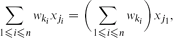
Let G denote a finite abelian group of order n and Davenport constant D, and put m = n + D − 1. Let x = (x1,. . .,xm) ∈ Gm. Gao's theorem states that there is a reordering (xj1, . . ., xjm) of x such that
Let w = (x1, . . ., wm) ∈ ℤm. As a corollary of the main result, we show that there are reorderings (xj1, . . ., xjm) of x and (wk1, . . ., wkm) of w, such thatwhere xj1 is the most repeated value in x. For w = (1, . . ., 1), this result reduces to Gao's theorem.
We consider Glauber dynamics on finite spin systems. The mixing time of Glauber dynamics can be bounded in terms of the influences of sites on each other. We consider three parameters bounding these influences: α, the total influence on a site, as studied by Dobrushin; α′, the total influence of a site, as studied by Dobrushin and Shlosman; and α″, the total influence of a site in any given context, which is related to the path-coupling method of Bubley and Dyer. It is known that if any of these parameters is less than 1 then random-update Glauber dynamics (in which a randomly chosen site is updated at each step) is rapidly mixing. It is also known that the Dobrushin condition α < 1 implies that systematic-scan Glauber dynamics (in which sites are updated in a deterministic order) is rapidly mixing. This paper studies two related issues, primarily in the context of systematic scan: (1) the relationship between the parameters α, α′ and α″, and (2) the relationship between proofs of rapid mixing using Dobrushin uniqueness (which typically use analysis techniques) and proofs of rapid mixing using path coupling. We use matrix balancing to show that the Dobrushin–Shlosman condition α′ < 1 implies rapid mixing of systematic scan. An interesting question is whether the rapid mixing results for scan can be extended to the α = 1 or α′ = 1 case. We give positive results for the rapid mixing of systematic scan for certain α = 1 cases. As an application, we show rapid mixing of systematic scan (for any scan order) for heat-bath Glauber dynamics for proper q-colourings of a degree-Δ graph G when q ≥ 2Δ.
In this paper we present a dual approximation scheme for the classconstrained shelf bin packing problem.In this problem, we are given bins of capacity 1, and n items ofQ different classes, each item e with class ce and sizese. The problem is to pack the items into bins, such thattwo items of different classes packed in a same bin must be indifferent shelves. Items in a same shelf are packed consecutively.Moreover, items in consecutive shelves must be separated by shelfdivisors of size d. In a shelf bin packing problem, we have toobtain a shelf packing such that the total size of items and shelfdivisors in any bin is at most 1. A dual approximation scheme must obtain a shelf packing of all items into N bins, such that, thetotal size of all items and shelf divisors packed in any bin is atmost 1 + ε for a given ε > 0 and N is the number of bins usedin an optimum shelf bin packing problem.Shelf divisors are used to avoid contact between items of differentclasses and can hold a set of items until a maximum given weight.We also present a dual approximation scheme for the class constrainedbin packing problem. In this problem, there is no use of shelfdivisors, but each bin uses at most C different classes.
We describe the main structural results on number rings, that is, integral domains for which the field of fractions is a number field. Whenever possible, we avoid the algorithmically undesirable hypothesis that the number ring in question is integrally closed.
The ring ℤ of ‘ordinary’ integers lies at the very root of number theory, and when studying its properties, the concept of divisibilityof integers naturally leads to basic notions as primality and congruences. By the ‘fundamental theorem of arithmetic’, ℤ admits unique prime factor decompositionof nonzero integers. Though one may be inclined to take this theorem for granted, its proof is not completely trivial: it usually employs the Euclidean algorithm to show that the prime numbers, which are defined as irreducibleelements having only ‘trivial’ divisors, are prime elementsthat only divide a product of integers if they divide one of the factors.
Let p be a prime number and n a positive integer, and let q = pn. Let 𝔽q be the field of q elements and denote by 𝔽*q the multiplicative subgroup of 𝔽*q. Assume t and u are elements in 𝔽*q with the property that u is in the subgroup generated by t. The discrete logarithm of u with respect to the base t, written logtu, is the least non-negative integer x such that tx= u.
In this paper we describe two methods to compute discrete logarithms, both of which derive from the number field sieve (NFS) factoring algorithm described in [Stevenhagen 2008] and [Lenstra and Lenstra 1993].
The analysis of many number theoretic algorithms turns on the role played by integers which have only small prime factors; such integers are known as “smooth numbers”. To be able to determine which algorithm is faster than which, it has turned out to be important to have accurate estimates for the number of smooth numbers in various sequences. In this chapter, we will first survey the important estimates for application to computational number theory questions, results as well as conjectures, before moving on to give sketches of the proofs of many of the most important results. After this, we will describe applications of smooth numbers to various problems in different areas of number theory. More complete surveys, with many more references, though with a different focus, were given by Norton [1971] and Hildebrand and Tenenbaum [1993a].
This article has two target audiences. For those primarily interested in computational number theory, I have tried to write this paper so that they can better understand the main tools used in analyzing algorithms. For those primarily interested in analytic problems, I have tried to give concise introductions to simplified versions of various key computational number theory algorithms, and to highlight applications and open counting questions. Besides the danger of never quite getting it right for either reader, I have had to confront the difficulty of the differences in notation between the two areas, and to work with some standard concepts in one area that might be puzzling to people in the other. Please consult the appendix for notation that is non-standard for one of the two fields.
This article is not meant to be a complete survey of all progress in this very active field. Thus I have not referred to many excellent works that are not entirely pertinent to my view of the subject, nor to several impressive works that have been superseded in the aspects in which I am interested.
We illustrate recent developments in computational number theory by studying their implications for solving the Pell equation. We shall see that, if the solutions to the Pell equation are properly represented, the traditional continued fraction method for solving the equation can be significantly accelerated. The most promising method depends on the use of smooth numbers. As with many algorithms depending on smooth numbers, its run time can presently only conjecturally be established; giving a rigorous analysis is one of the many open problems surrounding the Pell equation.
The English mathematician John Pell (1611–1685) has nothing to do with the equation. Euler (1707–1783) mistakenly attributed to Pell a solution method that had in fact been found by another English mathematician, William Brouncker (1620–1684), in response to a challenge by Fermat (1601–1665); but attempts to change the terminology introduced by Euler have always proved futile.
Class field theory furnishes an intrinsic description of the abelian extensions of a number field which is in many cases not of an immediate algorithmic nature. We outline the algorithms available for the explicit computation of such extensions.
Class field theory is a twentieth century theory describing the set of finite abelianextensions L of certain base fields K of arithmetic type. It provides a canonical description of the Galois groups Gal.(L/K) in terms of objects defined ‘inside K’, and gives rise to an explicit determination of the maximal abelian quotient GabK of the absolute Galois group GK of K. In the classical examples, K is either a global field, that is, a number field or a function field in one variable over a finite field, or a local fieldobtained by completing a global field at one of its primes. In this paper, which takes an algorithmic approach, we restrict to the fundamental case in which the base field K is a number field. By doing so, we avoid the complications arising for p-extensions in characteristic p > 0.
This is an introduction to some aspects of the arithmetic of elliptic curves, intended for readers with little or no background in number theory and algebraic geometry. In keeping with the rest of this volume, the presentation has an algorithmic slant. We also touch lightly on curves of higher genus. Readers desiring a more systematic development should consult one of the references for further reading suggested at the end.
Let k be a field. For instance, k could be the field ℚ of rational numbers, the fieldℝ of real numbers, the field ℂ of complex numbers, the field ℚp of p-adic numbers (see [Koblitz 1984] for an introduction), or the finite field 𝔽q of q elements (see Chapter I of [Serre 1973]). Let K be an algebraic closure of K. A (geometrically integral, affine) plane curve X over K is defined by an equation f(x, y).
This article gives a gentle introduction to factoring large integers via the quadratic sieve algorithm. The conjectured complexity is worked out in some detail.
When faced with a large number n to factor, what do you do first? You might say, “Look at the last digit,” with the idea of cheaply pulling out possible factors of 2 and 5. Sure, and more generally, you can test for divisibility cheaply by all of the very small primes. So it may as well be assumed that the number n has no small prime factors, say below log n. Since it is also cheap to test for probable primeness, say through the strong probable prime test, and then actually prove primality as in [Schoof 2008] in the case that you become convinced n is prime, it also may as well be assumed that the number n is composite.
Trial division is a factoring method (and in the extreme, a primality test) that involves sequentially trying n for divisibility by the consecutive primes. This method was invoked above for the removal of the small prime factors of n. The only thing stopping us from continuing beyond the somewhat arbitrary cut off of log n is the enormous time that would be spent if the smallest prime factor of n is fairly large. For example, if n were a modulus being used in the RSA cryptosystem, then as current protocols dictate, n would be the product of two primes of the same order of magnitude. In this case, factoring n by trial division would take roughly n1/2 steps. This already is an enormous calculation if n has thirty decimal digits, and for numbers only slightly longer, the calculation is not possible at this time by the human race and all of their computers.
We present a deterministic polynomial time algorithm for computing the zeta function of an arbitrary variety of fixed dimension over a finite field of small characteristic. One consequence of this result is an efficient method for computing the order of the group of rational points on the Jacobian of a smooth geometrically connected projective curve over a finite field of small characteristic.
The purpose of this paper is to give an elementary and self-contained proof that one may efficiently compute zeta functions of arbitrary varieties of fixed dimension over finite fields of suitably small characteristic. This is achieved via the p-adic methods developed by Dwork in his proof of the rationality of the zeta
function of a variety over a finite field [Dwork 1960; 1962]. Dwork’s theorem shows that it is in principle possible to compute the zeta function. Our main contribution is to show how Dwork’s trace formula, Bombieri’s degree bound [1978] and a semilinear reduction argument yield an efficient algorithm for doing so. That p-adic methods may be used to efficiently compute zeta functions for small characteristic was first suggested in [Wan 1999; 2008], where Wan gives a simpler algorithm for counting the number of solutions to an equation over a finite field modulo small powers of the characteristic.
We explain how weight-two modular forms on 0.N/ are related to modular symbols, and how to use this to explicitly compute spaces of modular forms.
The definition of the spaces of modular forms as functions on the upper half plane satisfying a certain equation is very abstract. The definition of the Hecke operators even more so. Nevertheless, one wishes to carry out explicit investigations involving these objects.
We are fortunate that we now have methods available that allow us to transform the vector space of cusp forms of given weight and level into a concrete object, which can be explicitly computed. We have the work of Atkin–Lehner, Birch, Swinnerton-Dyer, Manin, Mazur, Merel, and many others to thank for this (see, e.g., [Birch and Kuyk 1975; Cremona 1997; Mazur 1973; Merel 1994]). For example, we can use the Eichler–Selberg trace formula, as extended in [Hijikata 1974], to compute characteristic polynomials of Hecke operators. Then the method described in [Wada 1971] gives a basis for certain spaces of modular forms. Alternatively, we can compute ⊝-series using Brandt matrices and quaternion algebras as in [Kohel 2001; Pizer 1980], or we can use a closely related geometric method that involves the module of enhanced supersingular elliptic curves [Mestre 1986]. Another related method of Birch [1991] is very fast, but gives only a piece of the full space of modular forms. The power of the modular symbols approach was demonstrated by Cremona in his book [1997], where he systematically computes a large table of invariants of all elliptic curves of conductor up to 1000 (his online tables [Cremona undated] go well beyond 100,000).