To save content items to your account,
please confirm that you agree to abide by our usage policies.
If this is the first time you use this feature, you will be asked to authorise Cambridge Core to connect with your account.
Find out more about saving content to .
To save content items to your Kindle, first ensure no-reply@cambridge.org
is added to your Approved Personal Document E-mail List under your Personal Document Settings
on the Manage Your Content and Devices page of your Amazon account. Then enter the ‘name’ part
of your Kindle email address below.
Find out more about saving to your Kindle.
Note you can select to save to either the @free.kindle.com or @kindle.com variations.
‘@free.kindle.com’ emails are free but can only be saved to your device when it is connected to wi-fi.
‘@kindle.com’ emails can be delivered even when you are not connected to wi-fi, but note that service fees apply.
In this chapter, we aim to contribute to the ongoing discussions involving legal entities, big tech, and governments by introducing several key topics and questions related to data privacy, decision-making, and regulation. We explore the balance between mathematical logic and social justice, the challenge of eliminating persistent biases through programming, and the extent of control and accountability humans should maintain over generative systems. We also consider whether machines should be held to the same ethical standards as humans and contemplate the role of the free market in shaping societal outcomes.
The chapter concludes with an examination of how data is monetized through Ad markets, its role in perpetuating bias, and the need to define personal data. Through these discussions, we hope to provide a foundation for deeper exploration and understanding of the complex issues surrounding data privacy, decision-making, and regulation.
This chapter delves into the complexities and challenges of data science, emphasizing the potential pitfalls and ethical considerations inherent in decision-making based on data. It explores the intricate nature of data, which can be multifaceted, noisy, temporally and spatially disjointed, and often a result of the interplay among numerous interconnected components. This complexity poses significant difficulties in drawing causal inferences and making informed decisions.
A central theme of the chapter is the compromise of privacy that individuals may face in the quest for data-driven insights, which raises ethical concerns regarding the use of personal data. The discussion extends to the concept of algorithmic fairness, particularly in the context of racial bias, shedding light on the need for mitigating biases in data-driven decision-making processes.
Through a series of examples, the chapter illustrates the challenges and potential pitfalls associated with data science, underscoring the importance of robust methodologies and ethical considerations. It concludes with a thought-provoking examination of income inequality as a controversial example of data science in practice. The example highlights the nuanced interplay between data, decisions, and societal impacts.
This chapter asserts that the evolution of AI over the past seven decades has been closely intertwined with advancements in computational power. It identifies four key computing developments – mainframes, personal computers, wireless communication and the internet, and embedded systems – that have significantly influenced the field of data science and AI.
Starting from the early concepts of Turing machines, the chapter traces the parallel evolution of AI through milestones such as the invention of the perceptron, the development of machine learning techniques, and the current state of AI systems. It highlights key moments in AI history, from the first computer to play checkers to the algorithmic triumph of Deep Blue over a chess champion, as well as the recent achievements of AlphaGo.
By placing these advances in the context of broader computing history, the chapter argues that contemporary AI capabilities are the culmination of deliberate and iterative technological progress. It concludes by examining the profound impact of computing and AI on political institutions, citing examples such as the Arab Spring and the Cambridge Analytica scandal.
This chapter introduces Data, Systems, and Society (DSS), a new transdiscipline bridging statistics, information and decision systems, and social and institutional behavior. It emphasizes the value of transdisciplinarity over multidisciplinarity and interdisciplinarity and advocates for integrating DSS across domains where data and systems are pivotal (e.g., engineering, sciences, social sciences, and management). The chapter concludes by illustrating how DSS training has been instrumental in tackling different facets of the COVID-19 pandemic, including testing, vaccination strategies, and evaluating regional policies.
This chapter explores how students and faculty have applied their training in the DSS transdiscipline to address complex societal problems. Through examples from fields as diverse as climate change, social media, genomics, and anesthesia, it demonstrates the breadth of the transdiscipline’s power. Those examples illustrate how the DSS framework enables researchers to navigate and effectively address complex societal questions.
This brief chapter serves as a prelude to the book, initiating a dialogue on a societal challenge – specifically, transportation systems – and their intersection with data science and AI. It establishes a thematic framework for ensuing discussions.
This chapter explores the role of abstraction in addressing complex societal issues, challenging the perception that abstractions are merely approximations that separate physical systems from high-level computational systems. It emphasizes the importance of intentional and expert-driven abstraction in modeling and analyzing intricate systems. The chapter argues that deriving abstractions is a creative process lacking a systematic methodology.
Drawing examples from information theory and equilibrium theory, the chapter illustrates how abstractions have shaped discoveries over time. It emphasizes the close relationship between abstractions and objectives, noting the presence of multiple abstractions within a single domain.
The chapter concludes with an example demonstrating how abstractions can offer valuable insights into questions surrounding collective intelligence and crowd-sourcing.
This chapter explores the establishment of the Institute of Data, Systems, and Society (IDSS) at MIT, which was founded on the principles of the DSS transdiscipline. It provides a historical overview of the various components of DSS at MIT and describes how the new institute built upon this foundation. The chapter delves into the creation of a robust statistics effort within IDSS, emphasizes the importance of strong connections with the social sciences and humanities, and discusses the need to embed the institute across various domains. It also examines the rationale behind the creation of new academic programs designed to prepare students proficient in this transdiscipline while simultaneously focusing on specific domains. In addition, the chapter outlines the breadth of academic programs offered by IDSS, including considerations for online educational programs.
The chapter offers a thorough description of the unique administrative architecture of IDSS and how it was designed to support the transdiscipline’s growth and development. It addresses MIT’s approach to hiring and promoting faculty within IDSS and highlights the professional challenges faced by junior faculty members.
The chapter concludes with an overview of the launch of the Initiative on Combating Systemic Racism within IDSS, highlighting why the institute is well-suited to nurture such initiatives within MIT.
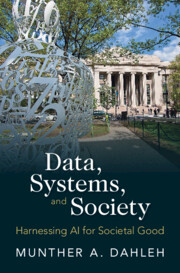
Harnessing the power of data and AI methods to tackle complex societal challenges requires transdisciplinary collaborations across academia, industry, and government. In this compelling book, Munther A. Dahleh, founder of the MIT Institute for Data, Systems, and Society (IDSS), offers a blueprint for researchers, professionals, and institutions to create approaches to problems of high societal value using innovative, holistic, data-driven methods. Drawing on his experience at IDSS and knowledge of similar initiatives elsewhere, Dahleh describes in clear, non-technical language how statistics, data science, information and decision systems, and social and institutional behavior intersect across multiple domains. He illustrates key concepts with real-life examples from optimizing transportation to making healthcare decisions during pandemics to understanding the media's impact on elections and revolutions. Dahleh also incorporates crucial concepts such as robustness, causality, privacy, and ethics and shares key lessons learned about transdisciplinary communication and about unintended consequences of AI and algorithmic systems.
Published in collaboration with The British Universities Industrial Relations Association (BUIRA), this book critically reviews the future of Industrial Relations (IR) in a changing work landscape and traces its historical evolution. Essential for academics, students and trade unions, it explores IR's significant changes over the past decade and its ongoing influence on our lives.
It is impossible to view the news at present without hearing talk of crisis: the economy, the climate, the pandemic. This book asks how these larger societal issues lead to a crisis with work, making it ever more precarious, unequal and intense. Experts diagnose the nature of the problem and offer a programme for transcending above the crises.
Offering theoretical frameworks from experts as well as practical examples to support women transitioning through menopause in the workplace, this is a go-to reference for academics and policy makers working in the field.
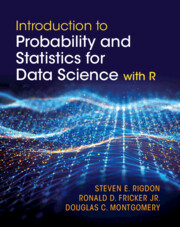
Introduction to Probability and Statistics for Data Science provides a solid course in the fundamental concepts, methods and theory of statistics for students in statistics, data science, biostatistics, engineering, and physical science programs. It teaches students to understand, use, and build on modern statistical techniques for complex problems. The authors develop the methods from both an intuitive and mathematical angle, illustrating with simple examples how and why the methods work. More complicated examples, many of which incorporate data and code in R, show how the method is used in practice. Through this guidance, students get the big picture about how statistics works and can be applied. This text covers more modern topics such as regression trees, large scale hypothesis testing, bootstrapping, MCMC, time series, and fewer theoretical topics like the Cramer-Rao lower bound and the Rao-Blackwell theorem. It features more than 250 high-quality figures, 180 of which involve actual data. Data and R are code available on our website so that students can reproduce the examples and do hands-on exercises.
This chapter explores the crucial alternative to traditional data processing methods, focusing on in-memory data processing. It discusses storing large volumes of data in DRAM for efficient and rapid data access, while using disk and SSD storage mainly for backup and archival purposes. The chapter sheds light on the benefits and significance of this approach, emphasizing its role in enabling efficient computing tasks. It also examines the implications of this shift for disk utilization, highlighting the transition towards using disk and SSD storage as secondary mediums, rather than primary data sources.