To save content items to your account,
please confirm that you agree to abide by our usage policies.
If this is the first time you use this feature, you will be asked to authorise Cambridge Core to connect with your account.
Find out more about saving content to .
To save content items to your Kindle, first ensure no-reply@cambridge.org
is added to your Approved Personal Document E-mail List under your Personal Document Settings
on the Manage Your Content and Devices page of your Amazon account. Then enter the ‘name’ part
of your Kindle email address below.
Find out more about saving to your Kindle.
Note you can select to save to either the @free.kindle.com or @kindle.com variations.
‘@free.kindle.com’ emails are free but can only be saved to your device when it is connected to wi-fi.
‘@kindle.com’ emails can be delivered even when you are not connected to wi-fi, but note that service fees apply.
Purpose This book is an introduction to some of the basic concepts of topology, especially of non-Hausdorff topology. I will of course explain what it means (Definition 4.1.12). The important point is that traditional topology textbooks assume the Hausdorff separation condition from the very start, and contain very little information on non-Hausdorff spaces. But the latter are important already in algebraic geometry, and crucial in fields such as domain theory.
Conversely, domain theory (Abramsky and Jung, 1994; Gierz et al., 2003), which arose from logic and computer science, started as an outgrowth of theories of order. Progress in this domain rapidly required a lot of material on (non-Hausdorff) topologies.
After about 40 years of domain theory, one is forced to recognize that topology and domain theory have been beneficial to each other. I've already mentioned what domain theory owes to topology. Conversely, in several respects, domain theory, in a broad sense, is topology done right.
This book is an introduction to both fields, dealt with as one. This seems to fill a gap in the literature, while bringing them forth in a refreshing perspective.
Secondary purpose This book is self-contained. My main interest, though, as an author, was to produce a unique reference for the kind of results in topology and domain theory that I needed in research I started in 2004, on semantic models of mixed non-deterministic and probabilistic choice.
In Chapter 4, we mentioned a connection between topology and order, centered around the notion of specialization quasi-ordering. The connection between topology and order goes much beyond this. For any topological space X, O(X) is a poset, of a rather special kind, and we start by examining when a poset L is of this form for some space X. The posets that have this property are the spatial lattices, and Stone duality is a canonical way of retrieving the space X of points from the lattice L alone; see Section 8.1. Conversely, the spaces X of points obtained from spatial lattices are exactly the sober topological spaces, and any space can be completed to a sober space. This is explored in Section 8.2. The sober spaces have wonderful properties, and the single most important result about sober spaces is the Hofmann–Mislove Theorem, which we establish and whose consequences we state in Section 8.3. This is the starting point of a theory of correspondences between certain spaces and certain lattices: sober spaces and spatial lattices, but also sober locally compact spaces and continuous distributive complete lattices, or continuous dcpos with their Scott topology and completely distributive lattices notably. We then look at limits and colimits in Top, and how they are preserved or not by the sobrification functor in Section 8.4.
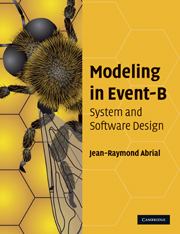
A practical text suitable for an introductory or advanced course in formal methods, this book presents a mathematical approach to modelling and designing systems using an extension of the B formal method: Event-B. Based on the idea of refinement, the author's systematic approach allows the user to construct models gradually and to facilitate a systematic reasoning method by means of proofs. Readers will learn how to build models of programs and, more generally, discrete systems, but this is all done with practice in mind. The numerous examples provided arise from various sources of computer system developments, including sequential programs, concurrent programs and electronic circuits. The book also contains a large number of exercises and projects ranging in difficulty. Each of the examples included in the book has been proved using the Rodin Platform tool set, which is available free for download at www.event-b.org.
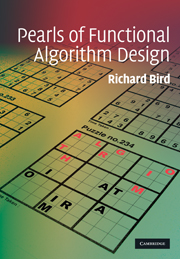
Richard Bird takes a radical approach to algorithm design, namely, design by calculation. These 30 short chapters each deal with a particular programming problem drawn from sources as diverse as games and puzzles, intriguing combinatorial tasks, and more familiar areas such as data compression and string matching. Each pearl starts with the statement of the problem expressed using the functional programming language Haskell, a powerful yet succinct language for capturing algorithmic ideas clearly and simply. The novel aspect of the book is that each solution is calculated from an initial formulation of the problem in Haskell by appealing to the laws of functional programming. Pearls of Functional Algorithm Design will appeal to the aspiring functional programmer, students and teachers interested in the principles of algorithm design, and anyone seeking to master the techniques of reasoning about programs in an equational style.
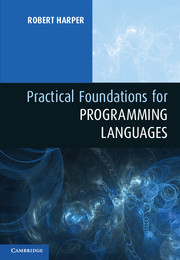
Types are the central organizing principle of the theory of programming languages. In this innovative book, Professor Robert Harper offers a fresh perspective on the fundamentals of these languages through the use of type theory. Whereas most textbooks on the subject emphasize taxonomy, Harper instead emphasizes genetics, examining the building blocks from which all programming languages are constructed. Language features are manifestations of type structure. The syntax of a language is governed by the constructs that define its types, and its semantics is determined by the interactions among those constructs. The soundness of a language design – the absence of ill-defined programs – follows naturally. Professor Harper's presentation is simultaneously rigorous and intuitive, relying on elementary mathematics. The framework he outlines scales easily to a rich variety of language concepts and is directly applicable to their implementation. The result is a lucid introduction to programming theory that is both accessible and practical.
The inductive and the coinductive types are two important forms of recursive type. Inductive types correspond to least, or initial, solutions of certain type isomorphism equations, and coinductive types correspond to their greatest, or final, solutions. Intuitively, the elements of an inductive type are those that may be obtained by a finite composition of its introductory forms. Consequently, if we specify the behavior of a function on each of the introductory forms of an inductive type, then its behavior is determined for all values of that type. Such a function is called a recursor, or catamorphism. Dually, the elements of a coinductive type are those that behave properly in response to a finite composition of its elimination forms. Consequently, if we specify the behavior of an element on each elimination form, then we have fully specified that element as a value of that type. Such an element is called an generator, or anamorphism.
Motivating Examples
The most important example of an inductive type is the type of natural numbers as formalized in Chapter 9. The type nat is defined to be the least type containing z and closed under s(−). The minimality condition is witnessed by the existence of the recursor, iter e {z ⇒ e0 ∣ s(x) ⇒ e1}, which transforms a natural number into a value of type τ, given its value for zero, and a transformation from its value on a number to its value on the successor of that number.
The dynamics of a language is a description of how programs are to be executed. The most important way to define the dynamics of a language is by the method of structural dynamics, which defines a transition system that inductively specifies the step-by-step process of executing a program. Another method for presenting dynamics, called contextual dynamics, is a variation of structural dynamics in which the transition rules are specified in a slightly different manner. An equational dynamics presents the dynamics of a language equationally by a collection of rules for deducing when one program is definitionally equal to another.
Transition Systems
A transition system is specified by the following four forms of judgment:
s state, asserting that s is a state of the transition system,
s final, where s state, asserting that s is a final state,
s initial, where s state, asserting that s is an initial state,
s ↦ s′, where s state and s′ state, asserting that state s may transition to state s′.
In practice we always arrange things so that no transition is possible from a final state: If s final, then there is no s′ state such that s ↦ s′. A state from which no transition is possible is sometimes said to be stuck. Whereas all final states are, by convention, stuck, there may be stuck states in a transition system that are not final.
Many programs can be seen as instances of a general pattern applied to a particular situation. Very often the pattern is determined by the types of the data involved. For example, in Chapter 9 the pattern of computing by recursion over a natural number is isolated as the defining characteristic of the type of natural numbers. This concept will itself emerge as an instance of the concept of type-generic, or just generic, programming.
Suppose that we have a function f of type ρ → ρ′ that transforms values of type ρ into values of type ρ′. For example, f might be the doubling function on natural numbers. We wish to extend f to a transformation from type [ρ/t]τ to type [ρ′/t]τ by applying f to various spots in the input where a value of type τ occurs to obtain a value of type ρ′, leaving the rest of the data structure alone. For example, τ might be bool × ρ, in which case f could be extended to a function of type bool × ρ → bool × ρ′ that sends the pairs ⟨a, b⟩ to the pair ⟨a, f(b)⟩.
This example glosses over a significant problem of ambiguity of the extension. Given a function f of type ρ → ρ′, it is not obvious in general how to extend it to a function mapping [ρ/t]τ to [ρ′/t]τ.
Parallel computation seeks to reduce the running times of programs by allowing many computations to be carried out simultaneously. For example, if we wish to add two numbers, each given by a complex computation, we may consider evaluating the addends simultaneously, then computing their sum. The ability to exploit parallelism is limited by the dependencies among parts of a program. Obviously, if one computation depends on the result of another, then we have no choice but to execute them sequentially so that we may propagate the result of the first to the second. Consequently, the fewer dependencies among subcomputations, the greater the opportunities for parallelism. This argues for functional models of computation, because the possibility of mutation of shared assignables imposes sequentialization constraints on imperative code.
In this chapter we discuss nested parallelism in which we nest parallel computations within one another in a hierarchical manner. Nested parallelism is sometimes called fork-join parallelism to emphasize the hierarchical structure arising from forking two (or more) parallel computations, then joining these computations to combine their results before proceeding. We consider two forms of dynamics for nested parallelism. The first is a structural dynamics in which a single transition on a compound expression may involve multiple transitions on its constituent expressions. The second is a cost dynamics (introduced in Chapter 7) that focuses attention on the sequential and parallel complexity (also known as the work and depth) of a parallel program by associating a series-parallel graph with each computation.
An interface is a contract that specifies the rights of a client and the responsibilities of an implementor. Being a specification of behavior, an interface is a type. In principle any type may serve as an interface, but in practice it is usual to structure code into modules consisting of separable and reusable components. An interface specifies the behavior of a module expected by a client and imposed on the implementor. It is the fulcrum on which is balanced the tension between separability and integration. As a rule, a module should have a well-defined behavior that can be understood separately, but it is equally important that it be easy to combine modules to form an integrated whole.
A fundamental question is, what is the type of a module? That is, what form should an interface take? One long-standing idea is for an interface to be a labeled tuple of functions and procedures with specified types. The types of the fields of the tuple are traditionally called function headers, because they summarize the call and return types of each function. Using interfaces of this form is called procedural abstraction, because it limits the dependencies between modules to a specified set of procedures. We may think of the fields of the tuple as being the instruction set of an abstract machine. The client makes use of these instructions in its code, and the implementor agrees to provide their implementations.
We saw in Chapter 17 that an untyped language may be viewed as a unityped language in which the so-called untyped terms are terms of a distinguished recursive type. In the case of the untyped λ-calculus this recursive type has a particularly simple form, expressing that every term is isomorphic to a function. Consequently, no run-time errors can occur that are due to the misuse of a value—the only elimination form is application, and its first argument can only be a function. This property breaks down once more than one class of value is permitted into the language. For example, if we add natural numbers as a primitive concept to the untyped λ-calculus (rather than defining them via Church encodings), then it is possible to incur a run-time error arising from attempting to apply a number to an argument or to add a function to a number. One school of thought in language design is to turn this vice into a virtue by embracing a model of computation that has multiple classes of value of a single type. Such languages are said to be dynamically typed, in purported opposition to statically typed languages. But the supposed opposition is illusory: Just as the so-called untyped λ-calculus turns out to be unityped, so dynamic languages turn out to be but restricted forms of static language. This remark is so important it bears repeating: Every dynamic language is inherently a static language in which we confine ourselves to a (needlessly) restricted type discipline to ensure safety.