To save content items to your account,
please confirm that you agree to abide by our usage policies.
If this is the first time you use this feature, you will be asked to authorise Cambridge Core to connect with your account.
Find out more about saving content to .
To save content items to your Kindle, first ensure no-reply@cambridge.org
is added to your Approved Personal Document E-mail List under your Personal Document Settings
on the Manage Your Content and Devices page of your Amazon account. Then enter the ‘name’ part
of your Kindle email address below.
Find out more about saving to your Kindle.
Note you can select to save to either the @free.kindle.com or @kindle.com variations.
‘@free.kindle.com’ emails are free but can only be saved to your device when it is connected to wi-fi.
‘@kindle.com’ emails can be delivered even when you are not connected to wi-fi, but note that service fees apply.
The aerodynamics of airplanes designed before and during World War II springs from linear potential theory (discussed in Chapter 3) together with empirical data and lessons learned from previous airplane designs. Jet engines and rocket propulsion enabled vehicles to fly much faster. This uncovered high-speed aerodynamic phenomena that must be understood for the successful design of airplanes capable of trans- and supersonic flight and of space vehicles. This chapter presents the numerical methods employed in computational fluid dynamics (CFD) to treat shock waves. A complete recipe for inviscid nozzle flow is given, with accompanying tutorial software. Mature tools are now standard in the form of industrial-strength CFD codes. A perusal of the user manual for any one of them shows many options and functions. A basic understanding of the theory is needed for the user to set up the code properly for the intended case. While not focusing on constructing such a CFD code, this chapter lays the foundations for training the reader to become an "informed user" of these codes by learning CFD "due diligence." It spells out CFD fundamentals such as constructing the numerical flux, artificial dissipation, approximate Riemann, high-resolution schemes. explicit and implicit time integration, and convergence to steady state.
The design task facing us is to shape the wing to realize aerodynamic characteristics well suited to the mission. Doing this requires a prediction method of either L1, L2, or L3 genus that maps the given geometry to its pressure field and ultimately to its performance. An early multidisciplinary design and optimization activity is the cycle 1 parametric design of the clean wing, A parametric design study evaluates the aircraft baseline configuration and it has the ability to arbitrarily vary those parameters that influence its shape and hence its performance. It determines the sensitivity of the vehicle effectiveness against some of the established requirements. The parametric effects of, for example, varying the wing planform are assessed, leading toward optimization of the layout by some measure of effectiveness. L0 and L1 tools are enhanced with surrogate models to speed up the aerodynamic evaluations. The vortex lattice method is presented as a mainstay tool in the clean-wing design process and is illustrated using a number of examples. The discussion of the design task continues for high-speed flight missions, indicating where the fidelity must be increased to L2 and L3 tools.
Having constructed the initial wing shape as a stack of airfoils, the 2D flow around an airfoil can tell us much about the 3D flow around a finite wing. In particular, exploring first in 2D the mapping from shape to flow to performance and its inverse tells us much about the roles that thickness and camber play in attaining sought-after performance. A rapid, special-purpose tool for airfoil analysis greatly aids the aerodynamic designer if results can be run in seconds on a laptop computer. This chapter describes one such tool, MSES, a surrogate model to the Reynolds-averaged Navier–Stokes (RANS) methodology, which very rapidly solves the steady Euler equations coupled to the integral boundary-layer equations. As a rule, a RANS code is too slow for routine design work and has not yet shown any accuracy advantages over the much faster zonal approaches. However, it is more robust with respect to Mach number and flow separation and can compute the entire shock stall phenomenon, as we saw in the steady-flow example in Chapter 6. Examples are given showing MSES applied to airfoil designs in both direct and inverse modes. MSES together with RANS completes the computational fluid dynamics tool kit needed for the applications in the remaining chapters.
Applying the computational fluid dynamics tool kit to the analysis and design of airfoil aerodynamics, this chapter explores the details of the shape-to-performance mapping under a variety of flight conditions, from low subsonic to transonic and supersonic speeds. The mappings change with the intended design goal, be it more laminar flow, higher maximum lift coefficient, or increased drag divergence speed. Through computations one sees correlations between these performance measures and shape factors such as thickness and camber distributions. One also sees clear historical progress in design methods. The earliest NACA airfoils during the 1920s were designed mainly in a cut-and-try approach. Aided by a theoretical method for predicting airfoil aerodynamics, the designs in the 1930s–1950s improved performance significantly. During the 1970s, NASA then resumed work combining a computational inverse procedure with supportive wind-tunnel measurements that produced the new technology family of NASA airfoils. This chapter investigates and compares some of them. It continues with a high-lift example analyzing the three-element slat-airfoil-flap test case L1T2 and comparing the predicted increases in lift with that measured in experiments for these high-lift devices. The final example – airfoil design by mathematical single-point optimization – reshapes the RAE2822 airfoil to minimize the wave drag at cruise conditions.
The prime focus of aerodynamic design is the shaping and layout of the aircraft's lifting surfaces. Introducing the subject matter of the book, this chapter also conveys some appreciation for, and fundamental insight into, how and why wings evolve into the configurations we see flying. Typical of the development process is that the new aircraft evolves in a succession of design cycles. This chapter describes three early design cycles. As Theodore von Karman implies, creativity lies at the heart of any engineering activity. Belonging to the cognitive aspects of the human brain, creativity is not in the realm of technology, but we indicate how and where it enters into the design process and encourage students to "think outside the box." The fundamental aerodynamic quantities of lift and drag are key to performance. Sizing the wing surface to the design mission is a crucial step in determining the baseline configuration, which then develops further in cycles 2 and 3. The chapter introduces the tools, tasks, and workflows of the three design cycles, explains how computational fluid dynamics and optimization procedures are involved, and maps out where in the coming chapters each of these is treated in depth.
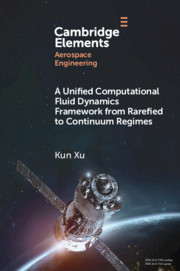
This Element presents a unified computational fluid dynamics framework from rarefied to continuum regimes. The framework is based on the direct modelling of flow physics in a discretized space. The mesh size and time step are used as modelling scales in the construction of discretized governing equations. With the variation-of-cell Knudsen number, continuous modelling equations in different regimes have been obtained, and the Boltzmann and Navier-Stokes equations become two limiting equations in the kinetic and hydrodynamic scales. The unified algorithms include the discrete velocity method (DVM)–based unified gas-kinetic scheme (UGKS), the particlebased unified gas-kinetic particle method (UGKP), and the wave and particle–based unified gas-kinetic wave-particle method (UGKWP). The UGKWP is a multi-scale method with the particle for non-equilibrium transport and wave for equilibrium evolution. The particle dynamics in the rarefied regime and the hydrodynamic flow solver in the continuum regime have been unified according to the cell's Knudsen number.
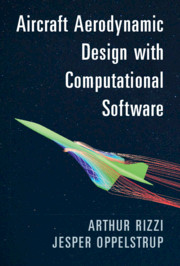
This modern text presents aerodynamic design of aircraft with realistic applications, using CFD software and guidance on its use. Tutorials, exercises, and mini-projects provided involve design of real aircraft, ranging from straight to swept to slender wings, from low speed to supersonic. Supported by online resources and supplements, this toolkit covers topics such as shape optimization to minimize drag and collaborative designing. Prepares seniors and first-year graduate students for design and analysis tasks in aerospace companies. In addition, it is a valuable resource for practicing engineers, aircraft designers, and entrepreneurial consultants.
The design of the diffuser system immediately downstream of the impeller is considered. The diffuser transforms the kinetic energy at its inlet into a rise in the static pressure. Centrifugal compressors are usually fitted with either a vaned or a vaneless diffuser leading to a collector. The diffuser meridional channel comprises an annular channel extending radially outwards from the impeller outlet, usually of the same width as the impeller. The simplest diffuser system is a radial vaneless annular channel where the radial velocity component is reduced by the increase in the area of the channel with radius (conservation of mass) and the circumferential velocity component is reduced by the increase in radius in the diffuser (conservation of angular momentum). In a vaned diffuser, of which several types are considered, there is a small vaneless region upstream of the diffuser vanes. The vanes themselves form flow channels designed to decelerate the flow more than is possible in a vaneless diffuser by turning the flow in a more radial direction. The different zones of pressure recovery in vaned diffusers are examined and compared with the equivalent planar diffuser.
The laws of gas dynamics, that is, the fluid dynamics of compressible flows, that are relevant to understand compressible flow in channels of variable area and in turbocompressor blade rows are introduced. The theory of one-dimensional compressible flow in variable area ducts is developed. The mass-flow function or corrected flow per unit area is introduced. The variation of the pressure in a nozzle at different back pressures is described. The one-dimensional approach is used to describe the nature of choking, expansion waves and shock waves. Special emphasis is given on the nature of the transonic flow and shock structure at inlet to a radial compressor inducer and how this is affected by the blade shape and the operating conditions. The gas dynamics of flows of real gases are considered.
Fluid dynamic principles that are fundamental to understanding the motion of fluids in radial compressors are highlighted. These include the continuity and the momentum equations in various forms. These equations are then used to delineate the effect of the fluid motion on pressure gradients on the flow. The simple radial equilibrium equation for a circumferentially averaged flow is introduced. Special features of the flow in radial compressors due to the radial motion are considered, such as the effects of the Coriolis and centrifugal forces. The relative eddy, which gives rise to the slip factor of a radial impeller, is explained. A short overview of boundary layer flows of relevance to radial compressors is provided. The flow in radial compressor impellers is strongly affected by secondary flows and tip clearance flows, and an outline is provided of the current understanding of the physics related to these. The phenomenon of jet-wake flow in compressors is described.
A study of the Euler equation on the basis of one-dimensional velocity triangles provides insights into energy transfer in compressors, emphasising the importance of the centrifugal effect in the impeller, the diffusion of the flow and the degree of reaction. An introduction to thermodynamics is given leading to the steady flow energy equation (SFEE), which is the first law of thermodynamics applied to a fixed region with steady flow passing through it. The SFEE is used to account for the changes in fluid properties along the flow path and shows that the bookkeeping of the energy transfer needs to be carried out using the total enthalpy or the rothalpy. The study of compressors needs to consider the efficiency of processes concerned. The Gibbs equation, a form of the second law of thermodynamics, provides a rigorous way to do this through the thermodynamic state variable known as entropy. In the context of energy transfer, the entropy production characterises the lost work in the machine due to dissipation losses. Isentropic and polytropic compression processes are explained. The important concept of the aerodynamic work and the value of a polytropic analysis are considered.
The key aspects of the physics of unstable flows in compressors are described. Operating at part-load can cause serious instabilities in the compressor flow, even leading to damage to the compressor. Different types of unsteady flow can be categorised as surge, rotating stall and hysteresis, and these depend on both the compressor and the process to which it delivers the flow. The key parameter in the system dynamics that is used to measure the likelihood of rotating stall or surge is a stability parameter known as the Greitzer B parameter. The onset of instability can happen in two different ways, known as modes and spikes. The consequence of instability on the operating range is described, and field experience shows that the operating range reduces with higher tip-speed Mach numbers and larger work coefficients. The system requirements can be categorised in terms of the pressure versus volume characteristics of the process. Methods to extend the stable operating range of compressors by control with variable speed, variable geometry, passive recirculation systems and other regulation devices are described.
Aspects of impeller design are explained taking into account the constraints from mechanical and aerodynamic considerations. A one-dimensional steady flow analysis is used to obtain a general understanding of the effects of the impeller design parameters on the geometry. This analysis provides some clear design guidelines for values of specific nondimensional flow parameters for optimum performance. The effects of the impeller blade inlet design on the inlet relative Mach number are considered together with that of the throat on flow capacity. The effect of the outlet velocity triangle on the work input and degree of reaction is explored. The considerations that lead to the choice of backsweep at the impeller outlet are explained. The steps required to adapt an impeller designed for one task to fulfil other requirements by means of trimming or flow cuts are explained. Guidance on the selection of mixed flow impellers is given. Some important differences are explained between the velocity triangles in radial flow compressor impellers and those in the rotors of centrifugal pumps, axial compressors and radial turbines.
The systematic definition of efficiency introduces isentropic, polytropic and isothermal efficiencies. The isentropic efficiency compares the actual work transfer to that which would take place in an ideal isentropic adiabatic process (with no losses and no heat transfer). Unfortunately, this does not represent the real thermodynamic process of a compressor very well. For example, a two-stage turbocharger using two stages each with a pressure ratio of 2 and an isentropic efficiency of 80%, has a pressure ratio of 4, but an isentropic efficiency of 78.1%. The polytropic efficiency overcomes this issue, and the two-stage compressor has the same polytropic efficiency as its individual stages. The kinetic energy present at the inlet and outlet of a stage can be identified by the difference between total and static states. The value of the kinetic energy in these planes is taken into account by comparing the total-to-total or total-to-static efficiencies. Care is needed as a radial compressor impeller may have a total-to-total polytropic impeller efficiency of over 90% but a static-to-static isentropic efficiency of well below 60%.